
 Search

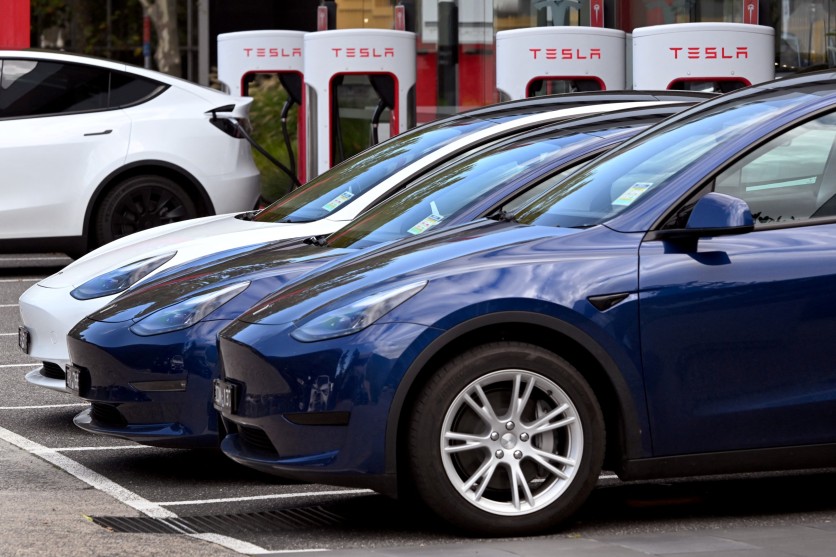
Electric vehicles (EV) line up outside a Tesla dealership in Melbourne on April 19, 2023. WILLIAM WEST/AFP via Getty Images
Battery electric vehicles outsold petrol and diesel cars in Australia for the first time on record in August 2026 — and the milestone came almost entirely on the back of vehicles manufactured in China. Official VFACTS data released Wednesday by the Federal Chamber of Automotive Industries (FCAI) showed 27,089 fully electric vehicles delivered in August, representing 24.9 percent of the entire new car market and topping both petrol (25,824 vehicles) and diesel (23,608 vehicles) in a single month for the first time in Australian history.
The figures mark Australia's most decisive automotive shift in decades. When plug-in hybrids (10.5 percent of the market) and conventional hybrids (18.5 percent) are added alongside battery electrics, electrified vehicles of all kinds accounted for 53.9 percent of August sales — making combustion-only cars the minority in a major auto market for the first time. Across all reporting sources, total market volume reached 108,760 vehicles for the month.
What Moved Markets: The Iran Oil Shock
Australia began 2026 with battery electric vehicles accounting for 8.4 percent of new car sales — a solid but unremarkable figure. What followed was one of the fastest market rotations any major economy has recorded.
In late February, conflict involving Iran sent global oil prices surging, and petrol prices on Australia's east coast climbed to around AUD $2.40 per litre (approximately $1.73 USD per litre, or about $6.54 per US gallon), a jump of roughly 15 to 20 percent in weeks. Consumer calculations changed quickly. Monthly battery EV sales went from 7,316 in January to 32,583 units in June — a 146.9 percent increase in six months. August's 27,089 deliveries represent nearly 3.7 times January's total, achieved in eight months.
The Australian government responded with a temporary fuel excise reduction of 32 cents per litre (approximately $0.23 USD per litre), which began winding back on July 1, 2026, and ended completely on August 2. The relief did not slow EV adoption; it had already become structural.
Monthly BEV sales in Australia, 2026:
| Month | BEV Sales | Market Share |
|---|---|---|
January | 7,316 | 8.4% |
February | 11,067 | 12.2% |
March | 15,839 | 15.1% |
April | 15,459 | 16.4% |
May | 21,303 | 21.3% |
June | 32,583 | 23.5% |
July | 23,510 | 22.7% |
August | 27,089 | 24.9% |
Source: FCAI/VFACTS and Electric Vehicle Council
"Structural Shift": What Industry Leaders Now Say
For months the FCAI's chief executive, Tony Weber, cautioned that the EV surge might not be permanent. That position shifted as the data accumulated.
"The sustained level of BEV sales, together with changing brand preferences, shows how quickly consumer choice and competition are reshaping Australia's new-vehicle market," FCAI's Weber said Wednesday. He added that the results reinforce the need for charging infrastructure that "keeps pace" with the market, particularly in rural and regional areas and for households without home-charging access.
The Electric Vehicle Council's chief executive, Julie Delvecchio, called the August figures evidence of a "structural shift" in which environmental and economic factors are "coming together, changing what Australians buy and how they spend."
That reading is backed by a large-scale consumer survey. The NRMA — Australia's largest member organization — published results in August from a survey of 42,472 members, describing it as the largest membership survey it had ever conducted. The survey found that EV owners were now less worried about charging availability than petrol car owners were about fuel costs. NRMA spokesperson Peter Khoury was direct: "In a year of oil shock, 2026 will be seen as a tipping point," Khoury told the NRMA. The NRMA's own total-cost-of-ownership analysis found that EVs are "almost at parity" with petrol equivalents across a full ownership lifecycle — removing one of the last major objections to switching.
Forward-looking consumer indicators point the same direction. A nationwide survey by automotive service company mycar found 46 percent of Australian vehicle owners planned to choose a hybrid or fully electric vehicle for their next purchase, up from 36 percent in 2025. Commonwealth Bank reported a 161 percent surge in new EV finance applications since the start of March. Used-EV sales at auction house Pickles grew 60 percent in March compared with February — a sign the secondary market that broadens EV access is developing alongside new-car sales.
Is Australia Ready to Ask Who Is Building These Cars?
The milestone deserves celebration on its own terms. But a significant dimension of the August story received almost no attention in the day's coverage: every one of Australia's eight best-selling electric vehicles in August was manufactured in China.
Tesla's Model Y and Model 3 are widely understood as American-designed vehicles. Less widely discussed is where they are physically built: Giga Shanghai, Tesla's primary factory for right-hand-drive markets. The other six top-sellers — the BYD Sealion 7, Geely EX5, Zeekr 7X, Jaecoo J5, Geely EX2, and BYD Atto 2 — are products of Chinese brands building in China. In the VFACTS data, five Chinese brands — BYD, GWM, MG, Geely, and Chery — combined for 26,610 sales, or 26.4 percent of the entire VFACTS market. Chinese-sourced vehicles across all fuel types reached 43,882 deliveries, or 40.3 percent of Australia's total new car market in August — a new record, up 88.9 percent over the same month last year.
Australia has no domestic automotive industry to protect, and as a result it has imposed no tariffs on Chinese EVs. The United States has imposed a 100 percent tariff on Chinese EVs, partly on data-security grounds, and the European Union has applied tariffs of up to 35 percent. Australia's open market makes it far and away the most accessible tariff-free market for Chinese automotive exports being displaced from Western economies. Chinese car exports surged 65 percent in the first half of 2026, with 5.1 million vehicles sold globally — and Australia is a primary destination.
Why Chinese EVs Are Cheaper: Battery Supply Chains and State-Backed Scale
The economic reason Chinese EVs can underprice Western competitors in Australia comes down to two structural factors.
First, vertical integration. Chinese manufacturers — particularly BYD, which manufactures its own battery cells — control their supply chain from raw materials to finished vehicle. Companies like BYD and CATL now dominate global battery production. When a Western automaker builds an EV, it typically pays a margin to a battery supplier; when BYD builds one, that margin stays in-house.
Second, state-directed scale and aggressive export pricing. Domestic legislative changes in China compressed profit margins — a vehicle selling for 200,000 yuan (approximately AUD $42,000, or about $30,200 USD) may generate a profit of only 3,000 yuan (approximately AUD $633, or about $455 USD). Chinese brands must export to sustain volume. Australia, with no tariff wall, received the benefit of that pressure in the form of the BYD Atto 1 at AUD $23,990 (approximately $17,248 USD) — the cheapest new EV in the country and a price point Western manufacturers have not matched.
The Lowy Institute noted in published analysis that four in five EVs sold in Australia are now manufactured in China, including models marketed as Swedish (Volvo's EVs are built with Chinese manufacturing partnerships), Japanese (Mazda's EV models), and Korean (certain Hyundai and Kia models for Australia). The record-breaking EV uptake and the record-level dependency on Chinese manufacturing are the same story.
How Does Australia's Charging Network Hold Up?
The question that shapes whether Australia's EV shift proves durable is infrastructure. The country's urban charging network has grown, but the coverage picture is starkly uneven.
Australia has approximately 1,250 public charging sites with nearly 3,800 charge ports nationwide — roughly 45 EVs for every public charger, compared to 14 EVs per charger in the European Union. By population, about 88 percent of Australians live within 5 kilometers (3.1 miles) of a public charger. The picture looks far worse by geography: more than two-thirds of Australian towns have no charger within 5 kilometers (3.1 miles). Between Melbourne and Darwin — a route spanning thousands of kilometers — there are stretches of highway hundreds of kilometers long without a single fast charger.
Nearly 30 percent of EV drivers have experienced a lack of long-distance charging infrastructure, and 25 percent have encountered a shortage of chargers in rural areas, according to a June 2026 survey of Australian motorists by charging equipment manufacturer Kempower. Apartment dwellers and renters face an additional structural barrier: most apartment buildings were not designed to carry the electrical load required by EV charging, and upgrading building infrastructure can cost more than the vehicles themselves.
The federal government committed AUD $40 million (approximately $28.7 million USD) in the 2026 federal budget to accelerate regional and kerbside EV charging infrastructure over four years, alongside AUD $15.4 million (approximately $11.1 million USD) to support dealership and repairer adaptation. Hussein Dia, a professor of transport technology and sustainability at Swinburne University of Technology, has written that the challenge ahead is not merely installing more chargers but placing them "where they'll make the biggest difference to confidence and coverage" in the towns that currently lack any.
Tesla Leads, but Chinese Brands Are Closing the Distance
The Tesla Model Y retained its position as Australia's best-selling vehicle of any type in August, with 6,414 deliveries — its second-best monthly result on record, behind only the June 2026 peak. That figure demonstrates Tesla's enduring pull in Australia's premium EV segment. What follows it on the chart tells a different structural story.
Best-selling BEVs in August 2026 (July figures in parentheses):
| Model | August Sales | July Sales |
|---|---|---|
Tesla Model Y | 6,414 | 4,644 |
BYD Sealion 7 | 2,213 | 2,548 |
Geely EX5 | 1,947 | 2,034 |
Zeekr 7X | 1,747 | 1,892 |
Jaecoo J5 | 1,672 | 1,654 |
Geely EX2 | 1,279 | 474 |
Tesla Model 3 | 1,271 | 134 |
BYD Atto 2 | 1,122 | 1,214 |
Source: FCAI/VFACTS and Electric Vehicle Council
The Geely EX2 — priced below AUD $40,000 (approximately $28,748 USD) — surged from 474 units in July to 1,279 in August, a 170 percent month-on-month jump that points to affordability as an increasingly active driver of volume in the segment. BYD as a brand accumulated 8,231 total deliveries in August, positioning it second overall among all Australian automotive brands.
The Geely EX5 posted a year-over-year surge of more than 385 percent. Volvo, one of the few non-Chinese Western brands benefiting from the electrification wave, now sells 65 percent of its Australian volume as fully electric vehicles — a striking turnaround for a brand that was still predominantly combustion-based only a few years ago.
Are Australian EVs Still a New-Car Story?
One important gap in the August data: the milestone belongs almost entirely to new-car buyers. EVs account for roughly 2 percent of all vehicles currently on Australian roads — a figure that will take years of continued strong new-car sales to move significantly. Fleet and commercial vehicles, where adoption consistently lags personal car markets, remain a largely unconverted segment.
A separate August survey by Allianz Australia, covering 1,096 motorists surveyed between July 13-17 by research firm Pureprofile, found that 47 percent of non-EV Australians said they were not yet ready to switch from a combustion vehicle — signaling that mass-market conversion still has substantial distance to travel even as monthly sales numbers make headlines. The NRMA's finding that 17 percent of members expressed no interest in EVs at all suggests a floor of resistance that sales trends alone may not move.
What Has to Keep Pace
Tony Weber's observation that charging infrastructure must "keep pace" with the market is the most understated sentence in the FCAI's August release. Per Swinburne's Hussein Dia, the critical test is not how many chargers exist near cities but whether the network extends into the regional towns that represent a large share of Australia's geography and a disproportionate share of its long-haul driving needs.
The August numbers show one thing clearly: for the first time, more Australians drove home from a dealership in a new electric car than in a new petrol or diesel one. Whether that becomes the norm — rather than a milestone month powered by an oil shock and a flood of tariff-free Chinese vehicles into an unprotected market — depends on answers that aren't visible in the VFACTS data alone.
Frequently Asked Questions
Which electric vehicles are the most popular in Australia and where are they made?
The Tesla Model Y led all models in August 2026 with 6,414 deliveries, followed by the BYD Sealion 7 (2,213), Geely EX5 (1,947), and Zeekr 7X (1,747). Every one of Australia's eight best-selling EVs in August was manufactured in China — including the Tesla models, which are built at Giga Shanghai for right-hand-drive markets. Tesla, BYD, Geely, Zeekr, and Chery's Jaecoo brand together account for the bulk of Australia's battery electric vehicle sales.
Is Australia's EV surge permanent or a temporary response to high fuel prices?
The evidence increasingly supports a structural shift rather than a temporary spike, though the question remains contested. The FCAI's own chief executive described the change as a "permanent structural shift" after months of hedging. The NRMA's 42,472-member survey found that range anxiety and purchase-price concerns — the traditional barriers — are fading. Total-cost-of-ownership parity with equivalent petrol vehicles appears to have arrived. At the same time, 47 percent of non-EV Australians said in a July 2026 survey that they weren't yet ready to switch, and EVs still represent only about 2 percent of all vehicles on Australian roads, meaning the transition has barely begun in the broader fleet.
Why are Chinese EVs so much cheaper than Western alternatives in Australia?
Two structural factors explain the price gap. First, Chinese manufacturers like BYD control their own battery production — eliminating the margin that Western automakers pay to external battery suppliers. Second, China's domestic EV market has become intensely competitive, compressing profit margins to the point where export markets are essential for volume. Australia has no domestic auto industry to protect and imposes no tariffs on Chinese EVs, unlike the United States (100 percent tariff) and European Union (up to 35 percent). That combination — scale-driven Chinese pricing and a tariff-free Australian market — makes Australia one of the most accessible destinations for Chinese automotive exports globally.
Where can Australians charge their EVs, and is the network good enough?
Urban areas are reasonably served: about 88 percent of Australians by population live within 5 kilometers (3.1 miles) of a public charger. The regional picture is far less developed — more than two-thirds of Australian towns lack a charger within 5 kilometers. About 30 percent of EV drivers report having experienced a shortage of long-distance charging infrastructure. The federal government committed AUD $40 million (approximately $28.7 million USD) in the 2026 budget for regional and kerbside charging expansion over four years. Apartment and rental housing access to home charging remains an unresolved structural gap. The FCAI, the government, and EV advocacy groups all cite infrastructure as the critical factor in whether August's milestone becomes a sustained trend.

-
 C114 Communication Network
 -
 Communication Home
