
 Search

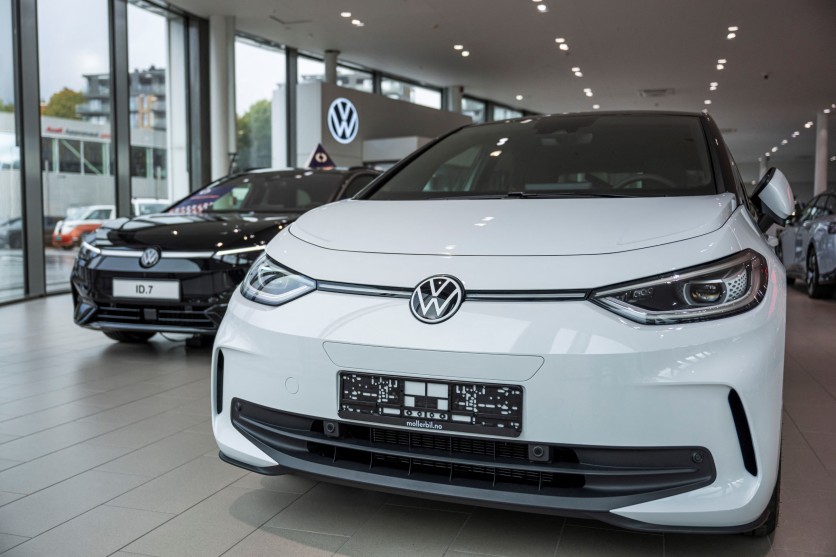
A model of the Volkswagen ID.3 fully electric vehicle is displayed at a Moller Bil Volkswagen car dealership outside the Norwegian capital of Oslo. JONATHAN NACKSTRAND/AFP via Getty Images
August 2026 delivered a cascade of electric vehicle records across Europe — and the most significant detail is not the numbers themselves, but what they reveal about where adoption now stands. Norway's share of new passenger cars that were battery electric climbed to record 98.7 percent EV share last month, the highest ever recorded by any significant automotive market anywhere in the world. That figure was not produced by an escalating subsidy regime: Norway's VAT exemption for electric vehicles was Norway EV VAT threshold 2026 (approximately $32,100 USD) at the start of this year, making EVs comparatively less subsidized than they were in 2025. The 98.7% share happened anyway. Europe's electric vehicle transition, at least in its leading markets, has crossed from policy-driven to self-sustaining.
Belgium, Denmark, and Spain all set national records in August. France and Germany maintained their accelerating trajectories from an already-record first half of the year. The center of gravity of European EV adoption, long anchored in Scandinavia's premium-market buyers, is moving south and west — into markets historically characterized by price sensitivity and combustion-engine loyalty.
Norway: What 98.7% Actually Means
According to data published by Norway's Road Traffic Information Council (OFV) and reported by electrive.com on September 1, 2026, OFV August 2026 registrations data showed 13,451 new passenger cars registered in Norway during August. Of those, approximately 13,281 were battery electric — meaning that for every 1,000 new cars that entered Norwegian roads last month, roughly 987 ran on electricity and 13 did not. The previous monthly record was 97.6% in July 2026. Norway's 96.9 percent EV share August 2025 was already a near-total market. The year-to-date share through August stands at 97.8 percent year-to-date share of all new passenger car registrations in Norway.
OFV CEO Geir Inge Stokke commented: "The passenger car market is declining slightly, but development varies significantly between brands. Several major brands are growing, and competition for car customers has become more balanced."
The Volkswagen ID.4 led all models in August, followed by the Toyota bZ4X and the BMW iX3. Tesla, which dominated the Norwegian market for most of the previous decade, saw notably weaker performance: Tesla posted 2,387 fewer registrations in August 2026 compared to August 2025. Per OFV data, if Tesla is excluded, the Norwegian passenger car market would have grown by 17% year-on-year in August rather than declining by 3.4%. Tesla's collapse in Norway is a brand-specific story, not an EV story — the market as a whole has never been more electric.
Why Norway's Grid Makes Its Carbon Case Unique
Approximately 90 to 96% of Norway's electricity comes from hydropower. Norwegian hydropower plants carry an average carbon footprint of approximately Norwegian hydropower 3.3 gCO2 per kWh, according to research by NORSUS. An electric vehicle charged on Norway's grid produces approximately 2.3 grams of CO₂-equivalent per kilometer over its lifecycle — compared to 100 to 200 grams per kilometer for a gasoline vehicle.
This grid advantage is the constraint that prevents Norway's specific story from translating directly to every market. A reader in a US state or European country with coal or gas in the electricity mix will still see a substantial lifecycle carbon benefit from switching to an EV — but not the 50-to-80-times advantage that Norway's hydropower grid provides. Other markets can replicate Norway's policy framework; they cannot replicate its geology. That distinction matters for any policy analysis that treats Norway as a universal template.
How Does Norway's Charging Network Work?
Norway invested in fast-charging infrastructure on all major roads beginning in 2009, with the formal goal of at least one multi-standard facility every 50 kilometers (31.1 miles) established through a national charging strategy in 2022, per the Norwegian EV Association charging infrastructure policy. That network is now mature. Beginning January 8, 2026, new AFIR ISO 15118 rollout January 2026 charging points have been rolling out across European public networks. ISO 15118 — formally titled "Road Vehicles: Vehicle to Grid Communication Interface" — is the international standard developed by ISO and IEC that enables Plug & Charge functionality: a driver plugs in the vehicle and charging begins automatically, with the car authenticating itself to the station without an RFID card or mobile app. The protocol also supports smart charging and bidirectional Vehicle-to-Grid energy transfer. In practical terms, ISO 15118 transforms the charging experience from a multi-step configuration task into a single physical action — the same behavioral friction reduction that made contactless payment replace chip-and-PIN at retail checkouts.
The combination of dense fast-charging infrastructure and increasingly frictionless Plug & Charge interoperability is the technical reason range anxiety has declined measurably among European EV owners. A July 2026 survey by charging network Ionity found that 91 percent confident about EV journeys of UK EV drivers were "confident" or "very confident" about longer journeys, with range anxiety cited as a major concern by only 39% — down significantly from prior years.
Why 98.7% Under Tighter Subsidies Is the Bigger Story
From January 1, 2026, Norway's Norway EV VAT threshold 2026 (approximately $32,100 USD) of a vehicle's price. For pricier models, buyers now pay the standard 25% VAT on the portion of the price above that threshold. The CO2-based registration tax component was simultaneously increased for internal combustion engine commercial vans, with CO2 registration tax ICE vans increased by up to 15,000 kroner (approximately $1,607 USD) for some models effective September 1, 2026.
Under a standard technology adoption model following Everett Rogers' diffusion framework, a market at 98.7% penetration of new sales is in its final laggard phase: the hold-outs are not price-sensitive consumers waiting for a deal, but buyers with specific use cases (long-haul commercial, specialty applications) or structural constraints that EVs do not yet fully address. Norway's market has crossed the threshold where incentive changes in either direction produce only marginal movement in aggregate share. The number of new combustion cars on Norwegian roads is a rounding error that no subsidy policy is going to meaningfully change.
Denmark Follows Closely, Sets Its Own Record
Denmark posted 85.9% total market EV share in August — a national all-time high. The country had already demonstrated the depth of its transition in July, when 97 percent of private buyers electric among all new private passenger cars, according to Mobility Denmark. That figure is particularly significant because private buyers are typically more price-sensitive than corporate fleet managers; their near-unanimous preference for electric indicates affordability has genuinely converged, not just for well-incentivized corporate leases.
Mads Rorvig Mobility Denmark CEO stated: "The electric car has become the natural choice for almost all Danes when they buy a new car. When 97 percent of new cars for private individuals are electric cars, it shows how far the green transition of the car market has come."
The top-selling EV models in Denmark in recent months have been the Toyota bZ4X, Skoda Elroq, and Volkswagen ID.4 — mid-range vehicles, not premium ones. Mobility Denmark projects that Denmark will reach Denmark one million EVs by 2027, or roughly one in three of all passenger cars.
Records Spread Across the Continent
August 2026 was not a Scandinavian story alone. Several other European markets posted figures that would have been considered implausible just three years ago.
Belgium recorded a battery electric vehicle market share of approximately 46.2% in August — its national all-time high and the third consecutive month in which EVs were the most-registered vehicle type in the country. Belgium's electrification story has a structural caveat worth noting: the country's corporate fleet culture has been the primary engine of EV adoption, with Belgium EV fleet mostly company cars among new battery electric vehicles registered in Belgium. Corporate fleet turnover seeds the secondhand market and exposes more consumers to electric driving, but it also means Belgium's private buyer market has not yet crossed the same threshold as Denmark's or Norway's.
Spain registered 18,967 electrified vehicles (battery electric plus plug-in hybrid) in August, with Spain registered 18,967 electrified vehicles representing a 27% jump year-on-year and a 27.7% share of Spain's total passenger car market of 68,544 units — the strongest August since 2019. Battery electric vehicle sales specifically grew by more than 30% year-on-year. Spain's automotive market has historically lagged northern European markets in electrification; a 27.7% electrified share — in August, traditionally the slowest month — signals that mid-market economies are no longer watching from the sidelines.
Sweden, Finland, the Netherlands, and Switzerland continued their respective upward trajectories in recent months, while France maintained the exceptional 61.3 percent year-on-year BEV growth it recorded through the first half of 2026. Ireland crossed the 50% EV threshold for the first time in June 2026.
Chinese EV Brands Gain Ground — with a Data Caveat
The August data highlighted a significant competitive shift within Norway's near-100% electric market. BYD Xpeng 11.4 percent Norway share of all new passenger car registrations in Norway in August 2026, more than doubling their combined 4.9% share from August 2025. Chinese EV brands also lifted their combined share of new car sales across 18 Western European countries to 10.7 percent Western European market share during the second quarter of 2026, up from 5.7% a year earlier, according to Schmidt Automotive Research.
American readers evaluating Chinese EVs for their own markets should be aware of a legal condition that applies regardless of a vehicle's stated privacy settings or its manufacturer's official statements: China's National Intelligence Law Article 7 (2017) legally compels all Chinese companies and citizens to support, assist, and cooperate with the country's state intelligence agencies upon demand. Connected vehicles collect extensive data — location, driving behavior, geospatial mapping, and in some models biometric proxies such as driver attention and fatigue detection — and this data is subject to those legal obligations. A June 2026 internal memo from Canada's Public Safety ministry, released under access-to-information law, warned explicitly that "the national security laws of certain countries, like China, can compel manufacturers" to share collected vehicle data. The US Senate introduced the Connected Vehicle Security Act in 2026, which would prohibit Chinese connected vehicles and their components from the American market on these grounds. Whether a prospective buyer considers this risk material relative to price and performance is their decision to make — but it is a structural legal condition, not a contested claim, and buyers are entitled to know it exists before purchasing.
What the Numbers Mean for American Readers
For US readers evaluating EV adoption timelines or policy arguments, the August 2026 European data provides a useful calibration point. The American market has been characterized in 2025–2026 by slow EV growth, policy uncertainty, and headlines about charging infrastructure gaps. Europe's leading markets tell a different story about what sustained policy commitment, charging infrastructure investment, and affordability convergence actually produce.
Norway's model required roughly 35 years of consistent incentive policy — beginning with purchase tax exemptions in 1990, VAT exemption in 2001, toll and ferry exemptions in the early 2000s, and the charging infrastructure mandate from 2009 onward, per the Norwegian EV Association's complete incentive history. No single policy was decisive; it was the cumulative effect of a consistent framework that made the EV the economically rational choice long before the market reached saturation. Denmark followed a similar trajectory, using favorable registration tax policy to maintain EV price competitiveness. Belgium achieved its high market share through corporate fleet tax incentives rather than individual purchase subsidies. Spain's surge in August 2026 reflects continued growth from a lower base, driven by newer model availability at mid-market price points.
The EU AFIR regulation binding infrastructure targets, which required member states to submit binding National Policy Frameworks by January 1, 2026 and sets legally enforceable distance-based targets for charging infrastructure along major European transport corridors, has prompted significant investment across the continent. The combination of binding infrastructure requirements and mature ISO 15118 charging protocols means the physical and behavioral barriers to EV adoption are being addressed systematically across the EU — not as aspirational targets, but as legally binding obligations with enforcement mechanisms.
By the first half of 2026, Europe had registered 1.6 million European BEVs in H1 — a 35.1% increase over the same period in 2025. Whether the rest of the world takes notice, and what it decides to do with a 35-year European experiment in policy-driven EV adoption, may be the defining automotive question of the next decade.
Currency conversions in this article are approximate, based on exchange rates at the time of publication and subject to change.
Frequently Asked Questions
Why does Norway have such a high percentage of electric cars?
Norway began building its EV incentive package in 1990, long before electric vehicles were commercially viable at scale, starting with purchase tax exemptions and adding VAT exemptions in 2001, toll and ferry discounts in the early 2000s, bus lane access in 2005, and a charging infrastructure investment program from 2009. The cumulative effect of 35 years of consistent, cross-party policy commitment made EVs the economically rational choice for Norwegian buyers well before the market reached saturation, per the Norwegian EV policy timeline since 1990. Norway's approximately 90 to 96% hydropower electricity grid also means EVs running on the national grid carry an unusually low carbon footprint — approximately 2.3 grams of CO₂ per kilometer lifecycle — making the environmental case for switching exceptionally strong compared to grid-mixed markets.
Is European EV adoption slowing down or accelerating?
Accelerating, at least in Europe's leading markets, and spreading geographically. Europe's battery electric vehicle registrations saw 35.1 percent European EV sales growth in the first half of 2026 compared to the same period in 2025, with more than 1.6 million new EVs registered across 31 European markets according to ACEA data. August 2026 saw simultaneous national records in Norway, Denmark, Belgium, and Spain — across markets with very different income levels, policy approaches, and consumer profiles. The data suggests the transition is crossing from early majority into late majority phase in several markets simultaneously, as confirmed by E-Mobility Europe H1 2026 bulletin.
What privacy risks come with Chinese-made electric vehicles?
Chinese EVs from companies such as BYD and Xpeng are connected vehicles that collect location data, driving behavior, geospatial mapping, and in some models biometric proxies such as driver attention monitoring. Under China's National Intelligence Law Article 7 (2017), all Chinese companies are legally required to cooperate with government intelligence agencies upon demand — a condition that applies regardless of where the vehicle was purchased, where data is stored, or what the manufacturer's stated privacy policy says. Canada's government warned in a June 2026 internal memo that this legal framework creates a structural data-access risk distinct from ordinary commercial privacy exposure. Prospective buyers can reduce but not eliminate this risk through network segmentation (keeping the vehicle off home Wi-Fi networks shared with sensitive devices), reviewing data minimization settings in the vehicle's connected services menu, and consulting the manufacturer's data residency documentation for specifics on where collected data is stored and processed.
What is ISO 15118 and why does it matter for EV adoption?
ISO 15118 is the international standard — developed by the International Organization for Standardization and the International Electrotechnical Commission — that governs how electric vehicles communicate with charging stations. Its most consumer-relevant feature is Plug & Charge: an EV driver connects the charging cable, and the vehicle and station automatically authenticate each other and initiate charging without any RFID card, app, or manual input. It also enables bidirectional Vehicle-to-Grid energy transfer, allowing EVs to feed power back to the electricity grid during peak demand. New ISO 15118 Plug and Charge rollout charging points have been deploying across European public networks since January 8, 2026, as part of the AFIR regulatory framework. The practical effect is that public charging in Europe is increasingly as simple as plugging in — removing one of the most commonly cited behavioral barriers to EV adoption.

-
 C114 Communication Network
 -
 Communication Home
