
 Search

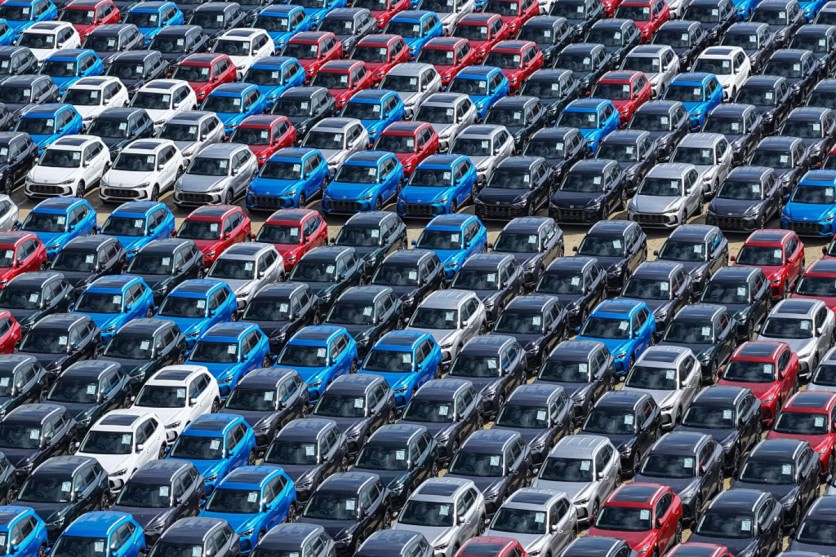
Chinese-made MG ZS vehicles, produced by SAIC Motor, are parked at a vehicle storage yard awaiting shipment for export in Yantai, in eastern China's Shandong province, on August 31, 2026. CN-STR/AFP via Getty Images
China on Tuesday released its most comprehensive framework yet governing how its automakers must behave in foreign markets — a 20-article code covering pricing discipline, data governance, labor protections, and anti-corruption compliance that arrives as Chinese vehicle exports set records and trading-partner governments push back against the tactics Chinese brands deployed at home. The document was confirmed by the commerce ministry the same morning on its official website.
The document, jointly issued by the Ministry of Commerce (MOFCOM), the Ministry of Industry and Information Technology (MIIT), and the State Administration for Market Regulation, is nonbinding in formal character but carries the weight of three senior ministries behind it — and lands at a moment when the diplomatic cost of disorderly overseas competition has become unmistakable. China exported 8.32 million vehicles to more than 200 countries and regions in 2025, according to customs data cited in the MOFCOM circular, while Chinese companies have established manufacturing investments in 80 countries.
The pace has accelerated sharply in 2026: approximately 5.18 million passenger vehicles were exported in the first seven months alone, including roughly 2.77 million new energy vehicles — a 129 percent year-on-year increase.
Read more: China's Auto Regulator Issues New Rules to Stop Race-to-the-Bottom Pricing
'Initial Signs' of Discount Wars Prompted Regulators to Move
The proximate trigger for the guidelines is visible in the competitive behavior that Chinese automakers have already begun exporting. Independent analyst Gao Shen told the South China Morning Post that the "initial signs of discount wars abroad" had prompted regulators to step in. Thailand investigated BYD dealers over discounting practices as early as 2024, following a pattern of consumer complaints about opaque pricing.
The domestic context is not incidental. The Chinese auto industry has lost an estimated 471 billion yuan in losses — approximately $70.1 billion — in output value over the past three years from aggressive domestic price competition, according to the China Automobile Dealers Association. A separate wave of domestic pricing rules from the State Administration for Market Regulation in February 2026 banned below-cost vehicle pricing to squeeze out competitors or monopolize the market. The September guidelines are the overseas extension of that same regulatory logic — directing the same discipline outward.
The most immediately consequential provisions address pricing conduct. The guidelines instruct automakers to base their suggested retail prices on actual production costs and prevailing international market conditions, and explicitly warn against using price as a tool to gain unfair competitive advantage. Companies must establish clear price tiers for different vehicle configurations in each overseas market and avoid the frequent, substantial price swings that have become a defining feature of China's own domestic market — and that have already begun appearing abroad. Dealers and agents are owed pricing autonomy: the document calls on manufacturers to respect local partners' right to set their own retail prices and to define the terms of sales incentives clearly.
Labor Violations Abroad Offer a Preview of What the Framework Aims to Prevent
The labor standards section of the new guidelines is directly relevant to documented problems that Chinese automakers are already generating in overseas markets. The guidelines call on companies to comply with host-country employment laws, recruit employees based on equal opportunity and fair treatment principles, and strengthen skills training and employee protection.
Those requirements land as BYD faces active investigations on two continents over its labor practices. China Labor Watch's March 2026 report on BYD's Szeged, Hungary factory documented seven-day weeks at BYD Hungary, workers brought into the country on improper visas, wage withholding used to prevent workers from leaving, and workers directed to tell labor inspectors that they worked only standard hours. Hungary's labor office opened investigation into the findings. BYD was subsequently raised in European Parliament as the first Chinese company to face such scrutiny over labor abuses at a European factory.
In Brazil, BYD's Camaçari factory attracted a separate government investigation. Brazil's Public Labor Ministry accused BYD and two of its Chinese labor contractors of trafficking into slavery-like conditions and formally added BYD to the national registry of employers who have subjected workers to conditions analogous to slavery in April 2026. BYD has disputed the characterizations in both investigations.
These incidents represent exactly the category of compliance failure the new guidelines are designed to prevent — and illustrate that the gap between aspiration and enforcement may be the framework's most important unresolved question.
Read more: China EV Sales Slide 13% in H1 2026: Only 3 Brands Profitable as Export Push Soars
Scale of the Overseas Expansion That Required a Compliance Framework
The policy context for the guidelines is a Chinese automotive export sector that has grown to a scale few observers foresaw five years ago. Chinese companies have established automotive manufacturing investments in over 80 countries and regions. The pace has not slowed in 2026: NEV exports surged 147.8% in July, reaching 540,000 units and accounting for 58.8 percent of total passenger-vehicle exports for the month.
That expansion has accelerated a strategic shift from product-only exports toward the buildout of full overseas manufacturing and supply chains. BYD is commissioning an electric car factory in Szeged, Hungary, with trial production began January 2026. Geely entered into a joint venture with Ford at Ford's Almussafes, Valencia facility — giving the company Geely EV production at Ford Spain and its first EU production site, announced by Spanish Prime Minister Pedro Sánchez in July 2026. Chery has revived the former Nissan plant in Barcelona through a joint venture with Spanish brand Ebro. SAIC is pursuing manufacturing plans for its MG brand in Spain.
Shi Yonghong, vice president of the China Chamber of Commerce for Import and Export of Machinery and Electronic Products, told Shanghai Securities News that building factories and operating locally abroad creates compliance obligations in areas such as environmental protection, taxation, employment, and data localization that are far more complex than those attached to simple product exports.
Do China's Data Compliance Promises Apply When Beijing Comes Asking?
The guidelines' data governance section deserves particular scrutiny. As Chinese automakers deploy increasingly sophisticated driver-assistance and over-the-air update systems globally, the document instructs them to ensure that data collection, use, retention, and cross-border transfer comply with applicable rules in each market — and that consumers' personal information is adequately protected.
What the guidelines cannot do is override China's National Intelligence Law (2017). Article 7 of that law requires all Chinese organizations and citizens to support, assist and cooperate with national intelligence work in accordance with the law. This obligation is not subject to waiver by company privacy policy, overseas incorporation address, or contractual commitment to foreign customers. A Chinese automaker operating in Europe or the United States can promise GDPR compliance in its user agreements and still be legally compelled to cooperate with Chinese intelligence agencies when asked — and cannot disclose that compulsion to its foreign customers.
China's Data Security Law (2021) separately requires that important data stored domestically in China — a category that specifically includes large-scale vehicle location data, national key research and development program data, and sensitive geographic information — be stored domestically within China and subject to security assessment before being transferred abroad. China's Automotive Data Cross-Border Transfer Guidelines, effective July 1, 2026, added sector-specific data transfer rules covering OEMs, suppliers, and autonomous-driving service providers.
The new overseas conduct guidelines acknowledge this territory by instructing companies to comply with local data rules while protecting consumer information. They do not resolve the structural conflict: a Chinese-owned connected vehicle operating in the European Union is simultaneously subject to GDPR and to its manufacturer's legal obligations under Chinese national security law. Regulators in the United States, the European Union, and Australia have all raised concerns about data-gathering capabilities of connected vehicles manufactured in China on precisely this basis.
Situating the Framework in a Shifting Trade Landscape
The new document complements two earlier MOFCOM guidelines in 2025 — one on anti-corruption compliance and one on corporate social responsibility for overseas operators — forming what industry experts describe as a developing support architecture for Chinese multinationals operating abroad.
The auto-specific timing reflects a trade environment that has grown considerably more complex. The European Union imposed anti-subsidy tariffs on Chinese EVs in late 2024 — reaching 35.3 percent for SAIC, 18.8 percent for Geely, and 17 percent for BYD, stacked on top of the standard 10 percent rate. In January 2026, Brussels and Beijing published a price undertaking framework guidance under which Chinese manufacturers would commit to a minimum import price in exchange for tariff waivers — an approach derived from the WTO Anti-Dumping Agreement's Article 8 framework on voluntary export commitments. Volkswagen Anhui became the first Chinese-produced EV exporter to have a price undertaking accepted, when the EU Commission accepts VW Anhui undertaking in February 2026. The United States, meanwhile, has maintained a 100 percent tariff on Chinese-made electric vehicles.
Those negotiations remain ongoing as of September 2026, with broader implementation across Chinese brands still pending. In that context, Beijing's decision to issue formal domestic guidance instructing its automakers to behave in an orderly manner in overseas markets carries both a regulatory and a diplomatic dimension — it signals to trading partners that China is taking the competitiveness concerns seriously, while giving Chinese companies a clearer framework as they navigate multiple, sometimes conflicting, legal regimes simultaneously.
BYD, despite leading the overseas export surge, saw BYD export growth and revenue decline in H1 2026 — with export sales rising 67.8 percent year-on-year to 792,000 vehicles, but H1 revenue falling 7.1 percent to CN¥344.8 billion (approximately $51.3 billion) as domestic market weakness more than offset the export gains.
Nonbinding, but Not Without Institutional Weight
The guidelines do not specify penalties for non-compliance, and neither MOFCOM nor MIIT detailed formal enforcement mechanisms when releasing the document. Companies must still comply independently with the laws and policies of each host country and relevant international bodies — the guidelines provide a framework and a reference point, not a substitute for local legal counsel.
Analysts note that in China's regulatory culture, non-binding guidance from three senior ministries carries institutional weight. Prior industry-specific conduct guidelines have been followed by more prescriptive rulemaking when voluntary adherence proved insufficient. Whether the auto guidelines follow the same trajectory will depend in large part on how overseas markets assess the behavior of Chinese automakers over the coming 12 to 24 months — and on the outcomes of the ongoing EU-China price commitment negotiations.
For trading partners assessing China's intentions, the framework is a meaningful signal. For Chinese automakers building factories in Hungary, Spain, and Brazil, it is a compliance checklist that is arriving, in some cases, after the violations it describes have already been documented.
Frequently Asked Questions
What do China's new overseas conduct guidelines actually require Chinese automakers to do?
The 20-article framework, jointly issued by MOFCOM, MIIT, and the State Administration for Market Regulation on September 1, 2026, covers four main areas: pricing conduct (base prices on actual costs and market conditions; avoid steep, frequent price swings; respect dealer pricing autonomy); labor and operations (comply with host-country employment laws, equal opportunity standards, and environmental obligations); data governance (ensure connected-vehicle data collection and cross-border transfer comply with host-country rules and protect consumer privacy); and compliance architecture (anti-corruption programs, antitrust compliance, intellectual property protection). The guidelines are nonbinding — they do not specify penalties — but carry the weight of three senior Chinese ministries and are expected to be followed in a regulatory culture where such guidance typically precedes more prescriptive rules.
If a Chinese automaker promises to protect my data under local privacy law, does that override China's national security obligations?
No. China's National Intelligence Law (2017), Article 7, legally compels all Chinese organizations to cooperate with state intelligence work when required. This obligation cannot be waived by a company's privacy policy, its overseas incorporation address, or the physical location of its servers. A Chinese automaker can lawfully commit to GDPR compliance in its EU user agreements and still be subject to compulsory cooperation with Chinese intelligence agencies — a request it is also prohibited from disclosing to its foreign customers. The new overseas conduct guidelines instruct companies to comply with local data rules and protect consumer information; they do not and cannot supersede this national security legal obligation. Regulators in the EU, US, and Australia have all flagged this structural conflict in assessments of Chinese connected-vehicle data risks.
How does this connect to the EU's tariffs on Chinese electric vehicles?
The European Union imposed definitive anti-subsidy tariffs on Chinese-made battery electric vehicles in October 2024 — reaching 17 percent for BYD, 18.8 percent for Geely, and 35.3 percent for SAIC, stacked on the standard 10 percent rate. In January 2026, the EU and China published guidance on price undertaking arrangements under which Chinese manufacturers commit to minimum import prices in exchange for tariff waivers. Volkswagen Anhui was the first to have a price undertaking accepted. Those negotiations are ongoing as of September 2026, with broader implementation across Chinese brands still pending. Beijing's new overseas pricing conduct guidelines — which instruct Chinese automakers to base prices on actual costs and avoid using price to gain unfair competitive advantage — are directly aligned with the price-commitment framework the EU is seeking, and appear designed in part to demonstrate diplomatic good faith in those ongoing negotiations.
What should companies that compete with Chinese automakers in overseas markets know?
The guidelines represent Beijing's formal position on how it expects its automakers to compete internationally — and signal that disorderly pricing, opaque promotions, and noncompliance with local labor and data rules are now officially out of bounds. In practice, the compliance gap between the guidelines' stated expectations and documented behavior (BYD labor investigations in Hungary and Brazil; Thai dealer pricing complaints) is significant. Trading partners and competing automakers should treat the guidelines as a meaningful institutional commitment that nonetheless requires real enforcement capacity to translate into market behavior. The most consequential test will be whether the EU-China price-commitment framework delivers observable pricing discipline — or whether the guidelines remain aspirational while competitive undercutting continues.

-
 C114 Communication Network
 -
 Communication Home
