
 Search

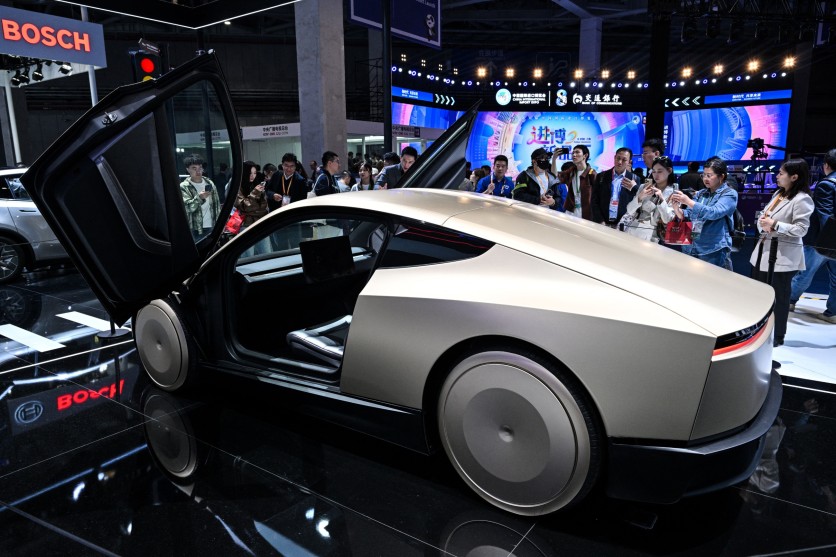
A Tesla Cybercab car is seen at the Tesla stand during the 8th International Import Expo (CIIE) in Shanghai on November 6, 2025. HECTOR RETAMAL/AFP via Getty Images
Tesla will hold its Cybercab launch event tonight at 4:45 PM CT (5:45 PM ET) at Gigafactory Texas in Austin — an invite-only gathering that will put invited passengers in a vehicle with no steering wheel, no brake pedal, and no way for a human inside to take control, authorized for commercial passenger service by Tesla's own self-certification under Texas law, not by any independent regulatory agency. That distinction is the one thing tonight's event does not celebrate — and it is the one thing a rider boarding a Cybercab should understand before they do.
Texas Senate Bill 2807, which took effect May 28, 2026, created a commercial autonomous vehicle authorization framework that requires operators to attest to SAE Level 4 capability through the Texas Motor Carrier Credentialing System. Tesla filed its self-certification the same day the law took effect. No state agency verified the technical claim. No federal agency has cleared the Cybercab for passenger service. The vehicle is legally authorized because Tesla said it is.
Tonight, invited guests — selected through a sweepstakes open to Robotaxi riders between August 17 and 23, and through direct "exclusive access" email invitations — will be among the first members of the public to ride in a car whose authorization rests entirely on its manufacturer's word. Tesla's invite-only event sweepstakes selected attendees from riders and email recipients.
What Tonight Is and Is Not
Tonight is not a regulatory milestone. The Cybercab carries an EPA Certificate of Conformity — certification number TTSLV00.0L1A, issued May 26, 2026 — that classifies it as a battery-electric zero-emission vehicle. The EPA certificate says nothing about whether the car is safe to drive autonomously. It says nothing about Level 4 capability or the reliability of Tesla's Full Self-Driving software. It is a fuel economy and emissions document.
The National Highway Traffic Safety Administration has not independently evaluated the Cybercab's autonomous driving system. What the agency has done is something the Cybercab's boosters are not emphasizing tonight: in March 2026, NHTSA escalated a probe into 3.2 million Tesla vehicles to an Engineering Analysis — the last step before the agency can seek a recall — after finding that Tesla's camera-only FSD system failed to detect and warn drivers appropriately under degraded visibility conditions such as glare and airborne obscurants. The Cybercab runs a different software branch than the consumer FSD vehicles covered by EA26002. But it runs the same camera-only architecture — eight cameras, no lidar, no radar — that the probe specifically identified as the failure point.
Tonight's weather forecast for Austin includes cloudy skies and possible rain from a developing tropical depression — conditions that sit at the center of an active federal investigation.
What the Cybercab Actually Is
The Cybercab is a two-seat electric coupe with no steering wheel, no pedals, no side mirrors, and no provision for a human occupant to take manual control from inside. Its EPA-certified production specifications, drawn from test group TTSLV00.0L1A, are different from the prototype figures that have circulated since the October 2024 concept unveiling.
The production Cybercab carries a 47.6 kWh lithium-ion battery running at 326 volts — substantially larger than the 35 kWh figure that appeared in early community estimates. Its single motor, rated at 163 kW (219 horsepower), drives the front wheels — making the Cybercab Tesla's first front-wheel-drive production vehicle in the company's history. Curb weight is 3,113 pounds (1,412 kg) — lighter than a Tesla Model 3 Long Range, which weighs approximately 3,966 pounds (1,799 kg), a gap explained by the two-seat configuration and stripped interior. Under EPA laboratory conditions, the Cybercab returned an unadjusted combined range of 418.2 miles; the real-world adjusted range is approximately 293 miles, consistent with Tesla's own stated target of "close to 300 miles." According to its EPA certification data, it was rated at 165 watt-hours per mile — the most energy-efficient figure the EPA has ever certified for a production vehicle.
The vehicle does not have a charging plug. It charges exclusively through wireless inductive pads: a ground-mounted coil generates a magnetic field that transfers energy to a receiver beneath the car. Tesla secured an FCC waiver in February 2026 to use ultra-wideband (UWB) transceivers for millimeter-precise pad alignment, with Bluetooth as the initial pad-detection handshake. The charging rate observed in Tesla's own simulation was approximately 19 kW — enough to replenish the full battery in about two-and-a-half hours during off-peak fleet downtime, not rapid charging by consumer standards, but viable for a vehicle designed to cycle continuously through a service area. Tesla has permitted plans for a dedicated Austin charging hub whose Phase 2 includes 80 wireless vehicle chargers — one of the first concrete fleet-scale deployments of inductive charging for any commercial EV operator.
The front-wheel-drive layout is a deliberate fleet-economics choice, not an oversight. A single front-mounted motor eliminates the rear driveshaft, rear motor housing, and rear drive unit from a vehicle designed for urban passenger cycles at moderate speed — where the performance limitations of FWD (torque steer at high acceleration, understeer in sharp cornering) are operationally irrelevant. The savings in cost and mechanical complexity compound across a fleet of thousands.
How Does Tesla Cybercab's Autonomous System Actually Work?
The Cybercab runs Tesla's Hardware 4 (AI4) compute platform with Full Self-Driving version 15 — a software branch the company is developing specifically for its Robotaxi fleet, separately from the consumer FSD version that personal Tesla owners receive.
FSD v15's defining architectural change is scale. Its predecessor, FSD v14, runs a driving neural network of approximately one billion parameters — the learnable weights the system uses to interpret camera input and decide how to drive. FSD v15 targets ten billion parameters, a tenfold expansion intended to improve the system's handling of complex and unexpected driving scenarios. Tesla VP of AI Software Ashok Elluswamy confirmed the Robotaxi fleet was already running early v15 builds at the company's Q2 2026 earnings call on July 22, and said the system would be "ridiculously safe and capable" in its completed form.
The critical qualifier: at that same earnings call, Elluswamy disclosed that approximately 40 percent of the seven planned improvement tracks for v15 had been merged into the builds running on the fleet. The 380,000 unsupervised miles the Robotaxi fleet had accumulated by late July were driven on an architecture that Tesla's own development roadmap describes as incomplete. The safety data being generated tonight — including from any Cybercab rides — is validation data for an unfinished system, not the finished product.
The Hardware 4 platform carries 16 gigabytes of onboard memory — a constraint for a 10-billion-parameter model. Tesla addresses this through knowledge distillation: a machine-learning technique that compresses a large "teacher" model into a smaller "student" model that retains most of the original's performance while fitting in the available hardware. Tesla has not published distillation accuracy benchmarks, and no independent researcher can verify whether edge cases handled correctly by the full 10-billion-parameter model are preserved in the compressed version running on Hardware 4.
The autonomy stack is vision-only: eight cameras, no lidar, no radar. Elon Musk has long characterized lidar as unnecessary, arguing that humans navigate with eyes alone and that cars should do the same. Waymo's VP of onboard software, Srikanth Thirumalai, offered the direct contrary argument in an August 27, 2026 blog post reflecting on 200 million fully autonomous miles: cameras alone are insufficient for safe, full-scale autonomy, Thirumalai wrote, and attempting to upgrade a driver-assist system to full autonomy is "a false summit." Waymo's latest system uses 13 cameras, four lidar units, and six radars.
NHTSA's Engineering Analysis EA26002 found that Tesla's camera-only system failed to detect common roadway conditions that impaired camera visibility and failed to provide alerts when camera performance had deteriorated until immediately before the crash occurred in nine incidents that have so far been linked to the probe. One of those nine incidents was fatal. The Cybercab's software branch is separate from the consumer FSD system under investigation, but Tesla's v15 Robotaxi builds share the camera-only perception architecture.
How Cybercab Self-Certification Works — and What It Does Not Verify
Texas SB 2807 established the state's commercial autonomous vehicle authorization framework in 2025. When it took effect May 28, 2026, Tesla self-certified its software as SAE Level 4 and registered its vehicles through TxMCCS — the Texas Motor Carrier Credentialing System — the same day. Operators must attest to SAE Level 4 capability, maintain appropriate insurance, share first-responder interaction plans with the Texas Department of Public Safety, and keep an active vehicle list. The authorization TxDMV grants is based on those self-submitted materials. No TxDMV engineer inspects the autonomous driving system. No state agency drives the vehicle in a standardized test course.
SAE Level 4 itself is an ODD-specific classification, not a universal capability claim. A vehicle designated Level 4 operates without human intervention within a defined Operational Design Domain — a specific set of geographic, speed, weather, and road-type conditions. Outside that ODD, the vehicle either cannot operate or must come to a safe stop. Tesla's self-certification says its vehicles are Level 4 capable; it does not publish the Operational Design Domain that certification covers, nor how the ODD boundaries were determined and tested. The self-certification framework creates no mechanism for verifying this.
This is meaningfully different from — and structurally related to — the NHTSA crash self-reporting gap that TechTimes documented on August 19. In that case, Tesla's self-reported "zero at-fault" incident record rested on narratives the agency acknowledged "may be incomplete or unverified." The self-certification framework governing tonight's Cybercab rides is the prospective version of the same structural gap: Tesla determines whether the vehicle is safe to deploy, just as Tesla determines whether a crash was its fault.
TxDMV's enforcement standard for revoking an authorization is specific: the vehicle must be "not in safe operational condition" and must "endanger the public" at a level meeting the Texas Penal Code definition of serious bodily injury or death. Property damage incidents, near-misses, and system limitations that don't produce injury do not trigger regulatory intervention under the current framework.
Read more: Tesla's 'Zero At-Fault' Robotaxi Record Rests on Unverified Self-Reports
What Cybercab Joins: The Existing Robotaxi Fleet
Tonight's event is not Tesla's entry into the robotaxi business. Tesla launched its first commercial Robotaxi service in Austin in June 2025, initially with human safety monitors aboard, and expanded to fully unsupervised Model Y rides in Austin, Dallas, Houston, Miami, Orlando, and Tampa during 2026.
As of late August 2026, Tesla's registered autonomous vehicle fleet in Texas totaled 315 vehicles — 270 Model Ys plus 45 Cybercabs registered August 31 — compared to Waymo's 736 Texas-registered robotaxis. Nationally, Waymo operates approximately 3,500 vehicles across 11 US metropolitan areas, completing roughly 500,000 paid rides per week and having accumulated more than 220 million fully autonomous (rider-only) miles. Tesla's 380,000 unsupervised Robotaxi miles through July 22 represent less than a week of Waymo's current operational tempo.
The Cybercab is purpose-built to accelerate that ratio. Where the Model Y is a consumer vehicle adapted for robotaxi use, the Cybercab was engineered from the ground up for continuous fleet operation: fewer parts, no vestigial driver-interface components, and a vehicle-economics profile that Elon Musk has said should produce operating costs around $0.20 per mile at scale — rising to $0.30–$0.40 per mile when taxes are included. By comparison, the American Automobile Association estimates the average cost of owning and operating a conventional vehicle in the US runs above $0.50 per mile, and consumer ride-hailing services typically charge $1.50 to $3.00 or more per mile to passengers. Tesla's longer-term platform model envisions individual owners deploying their Cybercabs on the Tesla Network — a marketplace for autonomous rides akin to Airbnb for vehicles — generating income when the owner is not using the car.
Tesla also announced in February 2026 that it intends to sell the Cybercab to individual consumers for under $30,000, with deliveries targeted before the end of 2027. Prediction markets as of the event date give Tesla only about 17–18% odds of hitting the sub-$30,000 price point within 2026.
Read more: Dallas Robotaxi Zone Grows 50 Percent as Tesla Registers First 45 Cybercabs in Texas
Does Cybercab Battery Range Meet Fleet Needs? What the Numbers Actually Show
The EPA's 47.6 kWh battery and 293-mile adjusted range figure represents a deliberate fleet-economics tradeoff. An urban robotaxi cycling through a geofenced Austin service area rarely needs 293 miles between charges — a typical ride is a few miles, and a fleet vehicle covering 12-hour operating windows (6 AM to 10 PM, Tesla's current Robotaxi schedule) at normal urban speed will use a fraction of that capacity. The smaller battery lowers per-unit manufacturing cost compared to Tesla's consumer lineup, where the Model 3 Long Range carries a 75 kWh pack (approximately 58% more energy storage). At 165 Wh/mi efficiency — the highest ever recorded by the EPA for a production vehicle — the Cybercab stretches its modest battery considerably further per dollar of energy than any other US-market EV.
The inductive-only charging creates a fleet-specific operational dependency: every Cybercab must autonomously navigate to a charging pad, align with millimeter precision using its FSD stack, and initiate a charge cycle without human intervention. Tesla's Austin charging hub, now in permitted development, will include 80 wireless chargers in Phase 2. At approximately 19 kW per pad, fully replenishing a depleted battery takes about 2.5 hours. For a fleet that operates on fixed daily windows, this is manageable — but it also means a charging infrastructure failure, pad obstruction, or FSD self-parking error takes a vehicle offline in a way that is not recoverable without human intervention, removing one of the claimed advantages of a fully autonomous fleet.
Where Regulators Stand Outside Texas
Texas's self-certification framework is the most permissive commercial AV authorization in the US, and it is where Tesla has chosen to launch. Other jurisdictions have moved differently.
Nevada's Transportation Authority initially granted Tesla a robotaxi permit in late July 2026 that capped Tesla's Las Vegas Strip fleet at 10 — a significant rebuke of Tesla's application for 5,000. On August 20, the Nevada Transportation Authority voted unanimously to replace that cap with a full Clark County permit authorizing up to 5,000 Tesla vehicles alongside 1,000 each for Waymo and Uber — a combined authorization the Nevada board described as one of the largest commercial robotaxi fleet approvals any US state has issued. Tesla's Cybercab chief engineer Eric Earley told Nevada regulators the 5,000 ceiling was not a target the company expected to reach; the realistic one-year deployment target is approximately 2,500 vehicles.
California has not granted explicit state regulatory approval for Cybercab commercial operations, even as the vehicle has been spotted operating without a safety driver in the state. That unresolved front represents a potential constraint on Tesla's national expansion timeline.
At the federal level, the AV Safety Data Act introduced by Senator Edward Markey in January 2026 — which would require NHTSA to mandate reporting of fleet size and vehicle miles traveled alongside crash counts, enabling real per-mile safety comparisons across operators — has not been enacted. Without it, comparing Tesla's and Waymo's safety performance on an apples-to-apples basis remains impossible, as autonomous vehicle specialist Alex Roy noted to TD Cowen analyst Itay Michaeli after the last NHTSA data release.
The Business Case and What Tonight Represents
Elon Musk has framed the Cybercab as a structural shift in transportation economics: "the cost of autonomous transport will be so low that you can think of it like individualized mass transit." Whether that argument holds depends on whether Tesla can demonstrate that FSD v15, at its projected full scale and with its camera-only architecture, produces the reliability required to sustain a commercial passenger fleet — and on whether the current regulatory self-certification model survives contact with the public, the press, and eventually the federal agencies that have not yet set binding standards for Level 4 commercial operators.
Tonight's launch event at Gigafactory Texas will be livestreamed publicly from 4:45 PM CT. Guests who board a Cybercab this evening are not just experiencing a new product. They are the first passengers in a vehicle whose safety authorization was written by the vehicle's own manufacturer, running software its developer describes as approximately 40 percent complete, with a camera-only perception system that the federal government is formally investigating for failure under common real-world conditions. That is what "the future of autonomy" looks like from the inside of a regulatory framework that has not yet caught up to the technology it is authorizing.
Frequently Asked Questions
Can anyone ride a Tesla Cybercab tonight, and how do I get access going forward?
Tonight's launch event is invite-only: attendees were selected either through a sweepstakes drawing from Robotaxi riders who took trips between August 17 and 23, or through direct "exclusive access" email invitations Tesla sent to selected recipients. Attendees must be at least 21 years old and pass government-issued ID checks at the venue; each invitee may bring one approved companion, but not a content creator. The event will be livestreamed publicly starting at 4:45 PM CT. For general public access after tonight, the Tesla Robotaxi app (available on iOS and Android) is the booking platform; riders join a waitlist, and coverage is currently limited to Austin, Dallas, Houston, Miami, Orlando, and Tampa. Cybercabs are expected to begin appearing in the app for public bookings in the days after the launch event, though Tesla has not confirmed a specific date.
What does "Level 4 self-certified" actually mean for a Cybercab rider?
SAE Level 4 means the vehicle can operate without human intervention within a defined Operational Design Domain — a specific set of geographic, environmental, and road-type conditions. The critical detail for Cybercab riders is that Tesla self-certified this Level 4 status under Texas SB 2807 with no independent technical verification from any state or federal agency. Tesla has not published what Operational Design Domain it certified — meaning there is no publicly available document specifying the exact conditions under which the Cybercab's Level 4 claim holds. Riders are trusting Tesla's own determination that the vehicle's camera-only FSD v15 (currently running at about 40 percent completion) meets the Level 4 standard within its Austin operating geofence. The Texas framework's enforcement threshold requires bodily injury or death — not property damage or system failures that don't produce physical harm.
How does Cybercab's camera-only approach compare to Waymo, and why does it matter?
Waymo uses 13 cameras, four lidar units, and six radar sensors in its current-generation vehicle, providing sensor redundancy so that if one input type is degraded, others can compensate. Waymo's VP of onboard software Srikanth Thirumalai outlined the multi-sensor argument in an August 27, 2026 blog post. Tesla's Cybercab uses eight cameras and nothing else. Waymo's VP of onboard software Srikanth Thirumalai argued publicly in late August 2026 that cameras alone cannot deliver safe, full-scale autonomy, and that trying to upgrade a driver-assist system to full autonomy is "a false summit" — a pointed criticism of Tesla's development path. NHTSA's Engineering Analysis EA26002, opened in March 2026, specifically found that Tesla's camera-only FSD system failed to detect or warn drivers of degraded visibility from glare and fog in nine incidents including one fatality. That probe covers the consumer FSD system, not the Robotaxi's v15 branch — but the underlying sensor architecture is identical. Waymo has accumulated more than 220 million fully autonomous (rider-only) miles; Tesla's entire Robotaxi fleet has accumulated approximately 380,000 unsupervised miles.
Why does the Cybercab have no charging plug, and what does that mean for fleet operations?
The plug-free design is a deliberate choice for autonomous fleet operations: a vehicle that charges itself without human help can theoretically cycle between service and charging indefinitely, with no staff required to physically connect or disconnect cables. The Cybercab uses inductive charging pads in designated hubs; it approaches a pad autonomously, uses ultra-wideband transceivers for millimeter-precise alignment, and charges at approximately 19 kW — enough to replenish its 47.6 kWh battery in about 2.5 hours. The tradeoff is that the system requires precisely maintained charging pads, functional FSD self-parking, and dedicated hub infrastructure that does not yet exist at scale outside Tesla's own facilities. Tesla's planned Austin charging hub will include 80 wireless chargers in Phase 2. An alignment failure or pad obstruction takes the vehicle offline and cannot be resolved without a human, which creates a single point of failure that plug-in fleets do not face in the same way.

-
 C114 Communication Network
 -
 Communication Home
