
 Search

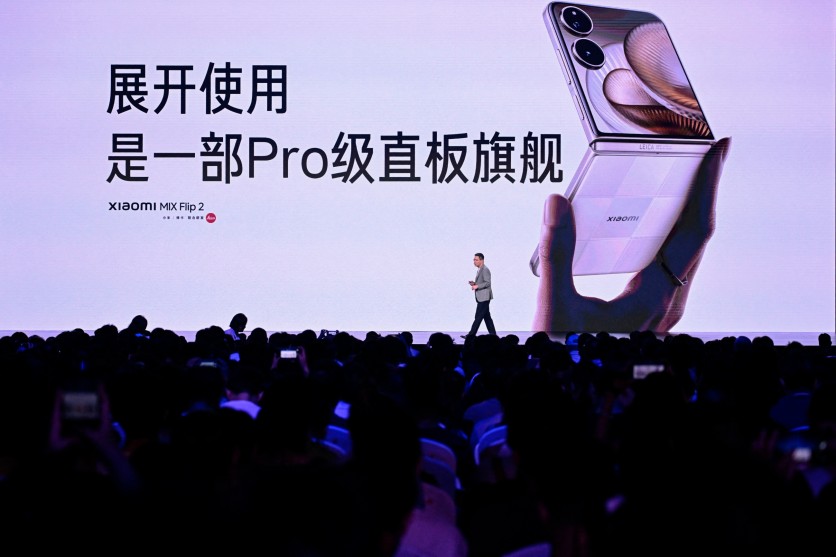
Lu Weibing, the President of Chinese electronics company Xiaomi, introduces Xiaomi mix flip 2, a foldable smartphone, during a launching event in Beijing on June 26, 2025. WANG ZHAO/gettyimages.com
China's CXMT announced on August 29 that it has entered mass production of LPDDR6 memory and named the Xiaomi 18 Fold as the first device to carry it — resolving the open question TechTimes posed four weeks ago when the August 2 coverage concluded that "whether CXMT chips appear in any first-wave LPDDR6 devices remains unconfirmed." The announcement arrived alongside CXMT's first post-IPO earnings — first-half 2026 revenue of ¥150.3 billion (approximately $22.3 billion) on an 874% year-on-year surge — and, in the same news cycle, a federal lawsuit against the Pentagon over the company's Chinese Military Company designation. The foldable is scheduled to launch in September 2026.
The announcement does not mean CXMT has definitively beaten every rival to production. SK Hynix announced development validation complete in March and had publicly guided to H2 2026 mass production shipments, with Xiaomi widely reported as its first customer; SK Hynix's LPDDR6 status for the Xiaomi 18 Fold series has not been independently clarified as of this writing. What CXMT has done is become the first company to publicly confirm mass production alongside a named debut device — a different and more specific claim than being first to produce LPDDR6 anywhere in the world. The Xiaomi 18 Fold is the first confirmed commercial product to carry LPDDR6 from any supplier; whether SK Hynix chips also appear in the device remains an open question.
The Xiaomi 18 Fold is not Xiaomi's highest-volume launch in September 2026. The Xiaomi 18 Pro and 18 Pro Max, launching simultaneously, use Qualcomm's Snapdragon 8 Elite Gen 6. Reuters reports the Xiaomi 18 Fold's shipment target at 200,000 to 300,000 units — a limited-production premium foldable. That figure is meaningful as a proving ground but does not represent the volume CXMT needs to challenge Samsung and SK Hynix at scale. The Xiaomi Pad 9 Pro Max will also launch with the Xring O3 and CXMT LPDDR6 in September, giving the chip pair a second commercial debut in a large-screen context.
Read more: CXMT Nears LPDDR6 Production: DUV Ceiling Shows Up in 12.8 Gbps vs. 14.4 Gbps Gap
What LPDDR6 Actually Delivers — and Why the Speed Number Needs Explanation
LPDDR6, standardized by JEDEC as JESD209-6 in July 2025, represents a structural redesign of how mobile memory communicates with a processor — not merely a speed bump. Where LPDDR5 connected each memory die to the processor over two 32-bit subchannels, LPDDR6 uses four 24-bit subchannels — a wider, more parallel architecture that delivers higher concurrency and lower latency, particularly important for the simultaneous, mixed-workload data patterns of on-device AI inference. The standard accommodates data rates from 10.667 Gbps at the base to 14.4 Gbps at the maximum specification ceiling, with peak aggregate bandwidth reaching 38.4 gigabytes per second per die at the high end — roughly twice the effective throughput of LPDDR5X.
CXMT's production chips are rated at 12,800 Mbps (12.8 Gbps) peak, running at 10,667 MT/s in the Xiaomi 18 Fold alongside the Xring O3 system-on-chip per the company's interim report specifications. At that operating rate, the Xring O3 achieves 113.8 gigabytes per second of memory bandwidth — a 48% increase over the Xring O1's LPDDR5X implementation. The 12.8 Gbps ceiling, however, is not a conservative first-generation target. It is the upper limit of what CXMT's deep-ultraviolet lithography process can reliably yield. SK Hynix's equivalent LPDDR6, built on its 1c EUV process, reaches the 14.4 Gbps specification ceiling — 11% higher — precisely because EUV's single-pass 13.5-nanometer exposure accumulates far fewer circuit-alignment errors than the multi-pass DUV process CXMT uses. ASML has not shipped any EUV machines to China, and Dutch export regulations maintained under US pressure prohibit it — meaning this 1.6 Gbps gap reflects a structural equipment constraint, not a design choice, and will persist regardless of CXMT's R&D spending.
On-device AI performance is exactly where the bandwidth difference registers. Running large language models locally on a smartphone is increasingly a memory-bandwidth problem: the processor executes quickly, but stalls while waiting for model weights to stream from memory. At 113.8 GB/s, the Xring O3 substantially reduces that bottleneck for models that fit within device storage — and opens a meaningful performance gap over LPDDR5X handsets for the AI tasks that a technical readership is most likely to care about.
The Xring O3 and the Xiaomi 18 Fold: A Domestic Technology Alliance
Xiaomi unveiled the Xring O3 at its chip technology conference in Beijing on August 24. Built on TSMC's N3P 3-nanometer node, the chip integrates 24 billion transistors within a 133 square millimeter (approximately 0.21 square inch) die, configures ten CPU cores entirely from high-performance tiers — eliminating the small efficiency cores every other Android chip maker uses — and records an AnTuTu v11 benchmark score of 5,228,014, the first mobile SoC past five million points. That benchmark score was recorded in Xiaomi's own lab; independent validation on retail hardware under sustained real-world thermal conditions will tell a different story, as it always does.
The Xring O3 is the first Xiaomi chip designed from the ground up to support LPDDR6, which means Xiaomi and CXMT co-designed their relationship into the silicon itself — the chip's memory controller and signal path are built for the standard that CXMT is now producing. That matters structurally: LPDDR memory is soldered directly to the smartphone's circuit board, not installed in a removable module. Switching memory suppliers mid-generation requires a new board design. The CXMT-Xiaomi 18 Fold relationship locks in, at minimum, this product cycle.
The relationship is not merely commercial. Xiaomi is a strategic investor in CXMT — it participated as a named strategic investor in CXMT's ¥66.6 billion (approximately $9.9 billion) Shanghai STAR Market IPO in July 2026, alongside Alibaba Cloud and Meituan. Lei Jun, Xiaomi's founder and CEO, personally confirmed the pairing on social media following CXMT's Weibo announcement — a public signal that the two companies view this as a strategic milestone, not merely a supply agreement.
How CXMT Reached Mass Production — and What "Mass Production" Actually Means Here
Standard mobile DRAM development advances through four sequential milestones: single-die verification, development validation, small-batch qualification, and full mass production. As recently as August 1, 2026, CXMT was completing the development validation stage; the company's prospectus, filed May 27, 2026 with the Shanghai Stock Exchange, still classified LPDDR6 under "preliminary research" as of December 31, 2025. The jump from development validation to confirmed mass production in less than four weeks reflects either an unusually rapid qualification cycle or a compressed reporting timeline — and either way, it is a genuine milestone.
CXMT's 2026 interim report, filed with the Shanghai Stock Exchange, states that LPDDR6 samples have been provided to major customers for validation and that mass production is being accelerated. The interim report discloses a peak speed of 12,800 Mbps and a maximum capacity of 16GB per chip, on a 16Gb die design. What neither the interim report nor the mass production announcement discloses is yield — the percentage of produced chips that meet specification — or absolute volume. "Mass production" signals that the production line is running and yielding usable product at commercial quantities; it does not indicate competitive-scale volume against SK Hynix or Samsung, which produce tens of millions of LPDDR units per quarter.
The speed of CXMT's generational progression is nevertheless striking. The company moved LPDDR5X products into mass production in May 2025, and is now announcing LPDDR6 mass production approximately fifteen months later. CXMT employed 7,491 research and development staff as of the first half of 2026 — 33% of its total workforce — and spent ¥6.859 billion (approximately $1.02 billion) on R&D in that period alone, up 87% year-on-year. Industry observers have noted that CXMT appears to be recruiting engineers with DRAM experience from Samsung, SK Hynix, and Micron.
Read more: Xiaomi Xring O3 Tops 5M AnTuTu With All-Big-Core CPU and First LPDDR6 Mobile Chip
What This Means for Korean and American Memory Makers
CXMT now holds approximately 7 to 10% of the global DRAM market by revenue — up from roughly 3% in the first half of 2025 — according to estimates from Omdia and Counterpoint Research. For the first time, a Chinese DRAM maker can credibly claim a product at the generational frontier of mobile memory.
SK Hynix's LPDDR6 advantage — 14.4 Gbps vs. 12.8 Gbps, built on EUV lithography — remains real and is structurally unreachable by CXMT under current export controls. But the competitive question for Android OEMs is not solely who produces the faster bin. It is who produces the adequate bin in sufficient volume at competitive price. CXMT's DUV manufacturing process requires approximately 30% more wafer starts than EUV per bit of DRAM produced, according to Nomura analyst estimates — a cost-per-bit disadvantage that is currently masked by the elevated DRAM pricing environment created by the AI server memory boom. Samsung and Micron have redirected significant wafer capacity toward high-bandwidth memory for data centers, making the mobile LPDDR segment less contested than it would otherwise be — and that is exactly the opening CXMT needs.
The LPDDR memory architecture creates a natural advantage for early suppliers: because LPDDR is soldered directly to the circuit board rather than installed in a replaceable module, OEMs must commit to a supplier at the board design stage. CXMT now has a confirmed design win with Xiaomi for the Xring O3 platform. That relationship will span two to three product cycles at minimum, giving CXMT a durable position in Xiaomi's supply chain regardless of how SK Hynix's LPDDR6 volume ramps.
What's on CXMT's Expansion To-Do List
CXMT's ambitions extend well beyond smartphones. The company's interim report identifies mobile, server, and automotive applications for LPDDR6, noting that server and automotive deployments will require separate reliability evaluations and customer certifications. Counterpoint Research has flagged CXMT's use of its IPO proceeds for capacity expansion in both high-bandwidth memory (HBM) and LPDDR6 as a key watchpoint for the second half of 2026. Whether CXMT can convert the Xiaomi 18 Fold milestone into broader OEM adoption — Oppo, Vivo, Honor, and eventually international brands — is the commercial question that determines whether this is a durable inflection point or an impressive but limited first step.
What Chinese Law Means for Buyers and Enterprise Procurement Teams
As a company headquartered in Hefei, China, CXMT operates under Chinese law — including China's National Intelligence Law (2017), whose Article 7 requires all organizations and citizens to support, assist, and cooperate with national intelligence work, with no corporate opt-out under Article 14. China's Data Security Law (2021) and Cybersecurity Law (2016, amended 2026) add data-handling obligations and government-access requirements. These are fixed legal conditions of sourcing from a Chinese company — not contingent on CXMT's stated privacy policy or on the physical location of its servers.
For consumer buyers, the practical exposure from LPDDR6 chips specifically is limited: memory chips store and retrieve data at the direction of the smartphone's processor. A CXMT LPDDR chip installed in your Xiaomi 18 Fold does not independently transmit your data anywhere. The legal exposure falls on CXMT's own corporate operations, manufacturing records, and supply chain data — not on end-user device data.
For enterprise and government buyers, the compliance landscape is governed by a specific statutory schedule. The Department of Defense's direct procurement ban on CXMT-designated entities took effect June 30, 2026, under Section 805 of the FY2024 NDAA. An indirect ban — covering goods with embedded CXMT components — takes effect June 30, 2027. All federal agencies will be barred from procuring any semiconductor products from CXMT starting December 23, 2027, under Section 5949 of the FY2023 NDAA. Organizations with DoD contracts or federal procurement certifications should run supply-chain compliance review before specifying devices or components that may contain CXMT memory.
CXMT filed a lawsuit on August 28 in the US District Court for the District of Columbia to challenge its Chinese Military Company designation, naming Defense Secretary Pete Hegseth as a co-defendant. According to the complaint, CXMT alleges the designation is "arbitrary, lacked evidence, and violated due process." The company had provided information to the Pentagon for over a year seeking removal; the DoD published a notice in February 2026 indicating CXMT would be removed, then withdrew the notice the same day before relisting CXMT in June. Xiaomi successfully achieved removal from the same list via litigation in 2021; Alibaba filed a similar challenge in June 2026. The outcome of CXMT's suit may determine whether enterprise compliance timelines shift — but buyers cannot count on litigation success as a planning assumption.
Where the Race Goes Next
The Xiaomi 18 Fold's September launch will be the first real-world test of CXMT's LPDDR6 in a production consumer device. Performance benchmarks from the device — not CXMT's lab — will provide the first indication of whether 12,800 Mbps design speed translates into consistent performance at commercial yield. If the pairing delivers on its bandwidth promise, it creates a validated case for Oppo, Vivo, and Honor to qualify CXMT's LPDDR6 for their own 2027 flagship programs, potentially establishing CXMT as a credible second source for mobile DRAM that Android OEMs have been lacking.
For the broader memory industry, the message is structurally significant even with the caveats. Samsung, SK Hynix, and Micron have controlled essentially all of the mobile DRAM market at every generational frontier. As of August 29, a fourth maker — operating on legacy equipment, under export controls, while simultaneously suing the US Defense Department — has entered mass production of the newest standard and has a device to prove it. Volume, yield, and sustained performance under real-world conditions remain unverified. The first handset carrying CXMT's next-generation memory is nonetheless real, and it is scheduled to reach customers next month.
Frequently Asked Questions
What is LPDDR6, and how much faster is it than what phones have now?
LPDDR6 (defined by JEDEC's JESD209-6 standard, published July 2025) redesigns mobile memory's interface architecture from two 32-bit subchannels to four 24-bit subchannels per die, enabling higher concurrency and lower latency — particularly for on-device AI workloads that require simultaneously streaming large amounts of model weight data. In the Xiaomi 18 Fold, CXMT's LPDDR6 delivers 113.8 gigabytes per second of memory bandwidth running at the base 10,667 MT/s rate — a 48% increase over the LPDDR5X implementation in Xiaomi's previous chip generation, and significantly better for sustained AI inference than LPDDR5X-equipped competing flagships. The standard's ceiling is 14.4 Gbps; CXMT's chips reach 12.8 Gbps, an 11% gap that reflects the DUV lithography ceiling, not a design limit that future software updates can bridge.
Is CXMT's LPDDR6 actually the world's first, or did SK Hynix get there first?
The accurate framing: CXMT is the first company to publicly confirm mass production of LPDDR6 and simultaneously name a specific commercial device as its debut vehicle. SK Hynix had publicly guided to H2 2026 mass production shipments and was widely reported as Xiaomi's first LPDDR6 customer — but as of this reporting, SK Hynix has not confirmed a specific device or announced mass production as CXMT has. Whether SK Hynix chips also appear in Xiaomi's September launches is unconfirmed. CXMT's LPDDR6 runs at 12.8 Gbps peak vs. SK Hynix's 14.4 Gbps specification ceiling — the gap traces directly to CXMT's DUV-only process vs. SK Hynix's EUV 1c process, and it is not closeable under current export controls. Xiaomi claims the world's first confirmed commercial LPDDR6 device; the claim stands with that specific sourcing context attached.
Should US enterprise buyers worry about purchasing devices with CXMT memory?
The DoD's compliance framework provides concrete timelines that enterprise buyers should build into their procurement planning. The direct DoD procurement ban on CXMT-listed entities is already in effect as of June 30, 2026. The indirect ban covering products with embedded CXMT components takes effect June 30, 2027. The federal agency-wide procurement ban takes effect December 23, 2027 under Section 5949 of the FY2023 NDAA. Organizations with defense contracts, federal certifications, or supply-chain compliance requirements should audit their device and component sourcing before those deadlines. For private-sector buyers, no blanket prohibition exists — but CXMT's Chinese Military Company designation and the legal obligations that apply to all Chinese companies under the National Intelligence Law (2017) are fixed conditions of the relationship that procurement teams should understand, not risks to weigh against benchmark scores.
What does CXMT's revenue growth tell a smartphone buyer about the company's staying power?
CXMT posted ¥150.3 billion (approximately $22.3 billion) in first-half 2026 revenue — a 874% year-on-year increase — and swung from a ¥2.3 billion loss in the same period of 2025 to ¥77.6 billion net profit (approximately $11.5 billion). That growth reflects elevated DRAM pricing driven by the AI server boom — not CXMT winning market share from Samsung and SK Hynix in a normal pricing environment. When the DRAM pricing cycle moderates, CXMT's 30% cost-per-bit disadvantage from DUV manufacturing becomes the determining margin factor. For a smartphone buyer, the key question is not CXMT's revenue but whether CXMT's LPDDR6 volume is sufficient to give your OEM a reliable supply chain for a device you want to buy — and whether CXMT's compliance posture affects your enterprise's ability to procure that device after 2027.

-
 C114 Communication Network
 -
 Communication Home
