
 Search

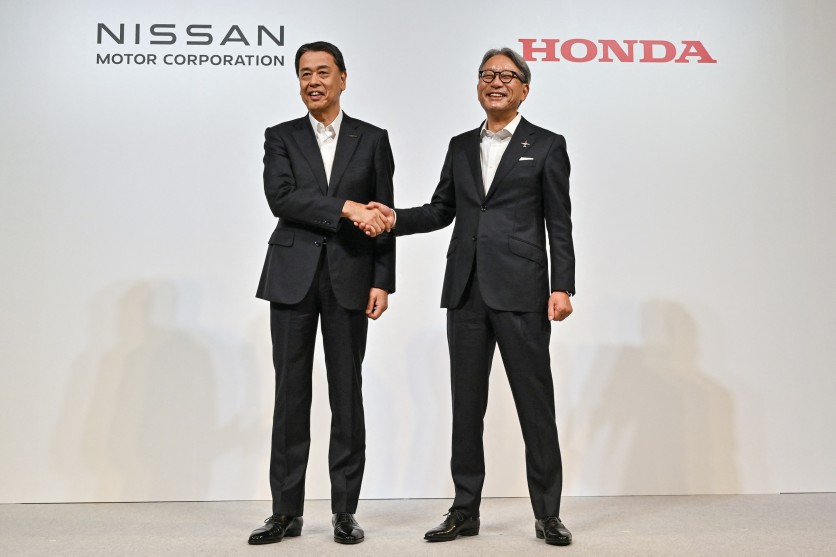
Makoto Uchida (L), president and CEO of Japanese auto maker Nissan, shakes hands with Toshihiro Mibe (R), director, president and representative executive officer of auto maker Honda, following a press conference in Tokyo. RICHARD A. BROOKS/AFP via Getty Images
Eighteen months after a landmark merger collapsed in acrimony over a control dispute, Honda Motor and Nissan Motor have found a narrower but arguably more durable way to work together — one that requires no equity swap, no holding company, and no question of either brand becoming a subsidiary of the other. The two Japanese automakers signed a joint development agreement on August 31, 2026, to standardize the core electronic control units (ECUs) and software that will power their next-generation vehicles, with deployment planned beginning in fiscal year 2029. Mitsubishi Motors, in which Nissan holds a 26% stake, said it is actively considering joining the collaboration and remained in discussions with both carmakers on potential areas of partnership.
The outcome reveals something specific about how the software-defined vehicle era is actually being managed: sharing code may be more durable than sharing ownership. The same development economics that made a merger look attractive — spreading enormous software R&D costs across a larger production base — are fully achievable through a technology standardization pact. The merger required governance, control, and brand hierarchy. The software deal requires only matching hardware specifications and a common runtime environment.
What Honda and Nissan Are Actually Standardizing
At the technical heart of the August 31 announcement are two categories of hardware. The first is high-performance main ECUs — central computers sometimes called High Performance Computers — that are built on systems-on-chip (SoCs) and serve as the primary brain of a software-defined vehicle (SDV). The second is zone ECUs, which manage functions across distinct physical regions of a car — front, rear, and cabin zones. Together, these form what the industry calls the electrical/electronic, or E/E, architecture of a next-generation SDV.
Read more: Honda, Nissan In Talks of Merger Amidst Struggles in EV Market, To Make Them the 3rd Largest
This two-layer design replaces the traditional approach, in which a modern vehicle might carry 70 to 100 dedicated ECUs, each running its own fixed firmware for a specific task — engine control, brakes, windows, climate, mirrors — with no easy way to update or extend their behavior after the car leaves the factory. Under the zonal model, zone ECUs manage clusters of sensors and actuators in their physical area and communicate with the central HPC over an automotive Ethernet backbone, dramatically reducing the weight and length of wiring in the vehicle while creating a coherent computing hierarchy that can receive over-the-air (OTA) software updates.
By agreeing on common specifications for both ECU types, Honda and Nissan can share the same foundational computing stack — hardware designs, operating system, and key middleware — while each company retains full freedom over the application-layer software that shapes the character of individual models and brands. Nissan's CEO, Ivan Espinosa, has signaled this balance publicly: the goal is to standardize the underlying software infrastructure while preserving each brand's distinct product identity.
The shared OS is also specifically designed to support OTA software updates, enabling vehicles to receive feature improvements and bug fixes after purchase — a capability Tesla has offered since 2012 and uses to resolve approximately 40% of vehicle recalls without requiring a dealer visit. Japanese automakers have drawn sustained criticism from analysts and investors for lagging on this capability; the Honda-Nissan deal is a direct response to that competitive gap.
How a Failed Merger Became a Software Deal
The backdrop to the August 31 agreement is one of the more dramatic episodes in recent automotive history. In December 2024, Honda and Nissan signed a merger MOU to explore a full business integration that would have created the world's third-largest automaker, with Mitsubishi Motors also included in the discussions.
By February 2025, merger talks had collapsed. Honda had proposed restructuring the arrangement so that Nissan would become a wholly owned Honda subsidiary — a condition Nissan's board rejected outright, according to reporting by Fortune and AFP. Honda, in turn, grew frustrated with the pace of Nissan's internal restructuring. The memorandum was terminated. Both companies suffered reputational bruises, and the fallout contributed to leadership changes at Nissan.
What kept a future collaboration alive was that both companies had been running a quieter, more technical track of cooperation since March 2024, focused on SDV platform research. That work deepened in August 2024 with a joint SDV research MOU covering joint research into SDV fundamentals, battery specifications, and charging infrastructure. Honda's May 2026 business briefing confirmed that management was actively exploring SDV and software cooperation with Nissan, and Nikkei reported in late July 2026 that OS standardization discussions were underway, describing a potential deal based in part on Nissan's existing cloud-based software development platform.
Why the Economics of Software Demand Scale
The timing of the August 31 agreement reflects a competitive reality that makes shared software infrastructure necessary for both companies. Software-defined vehicles — cars whose features, safety systems, and driving dynamics can be configured and updated entirely in software — are rapidly becoming the dominant paradigm for premium and mass-market vehicles alike. The global SDV market is projected to reach $301 billion by 2034, roughly a sevenfold increase from 2023 levels.
Developing a vehicle operating system qualified to automotive safety standards is enormously expensive. Every component of the software that controls safety-critical functions — braking, steering, airbag deployment — must meet ISO 26262 safety standard, the international functional safety standard for road vehicles. Certifying an OS for ASIL D (the highest safety integrity level), maintaining it across a fleet of millions of vehicles, and testing every OTA update path is a capital-intensive, multi-year undertaking.
Honda's own software ambitions illustrate the scale of the investment. In a May 2026 business briefing, Honda committed ¥1.0 trillion (approximately $6.25 billion USD at the exchange rate of approximately 160 yen to the dollar as of August 31, 2026; conversions are approximate) to software technologies over three years, setting what the company called a "Triple Half" target: halving development cost, timeframe, and workload compared with 2025. Honda has been deploying its ASIMO OS — named for the company's humanoid robot program — on its Honda 0 Series electric vehicles launched globally from 2026.
Nissan has been building its own parallel infrastructure. In December 2025, Nissan announced a cloud-based development environment called the Nissan Scalable Open Software Platform, built on Amazon Web Services, claiming a 75% reduction in software test execution time and a unified engineering environment for more than 5,000 developers.
The problem is that neither platform alone offers enough scale. Honda sold approximately 3.7 million vehicles globally in fiscal year 2024; Nissan approximately 3.5 million. Spreading the fixed costs of OS development, safety certification, and test infrastructure across a combined base of roughly 7.2 million annual vehicles nearly doubles the return on each engineering dollar invested. If Mitsubishi formally joins, the combined base grows further still.
Japan Versus Europe Versus Tesla: Who Is Sharing What
Honda and Nissan are not the first automakers to reach this conclusion. European manufacturers have been pursuing similar software consolidation strategies, with varying structures. BMW, Volkswagen Group, Mercedes-Benz, Bosch, Continental, ZF, and others signed a memorandum of understanding in June 2025 to jointly develop a shared open-source automotive software stack called Eclipse S-Core, targeting series-production readiness by 2026 and vehicle rollout by 2030.
Volkswagen has taken a different route alongside its consortium participation: a partnership with Rivian valued at up to $5.8 billion, through which VW, Audi, and Porsche are expected to adopt Rivian's zonal software stack beginning around 2027. BMW debuted its "Neue Klasse" architecture in 2025 with the iX3's four-superbrain compute design, deploying four centralized "superbrain" compute units that replace hundreds of traditional ECUs, with each superbrain handling a distinct domain — vehicle dynamics, automated driving, infotainment, and basic vehicle functions.
Toyota — the dominant Japanese automaker and a looming presence in any discussion of domestic consolidation — has been developing its own SDV platform jointly with Mazda, contributing to open-source SDV reference work alongside both companies. Toyota was notably absent from the Honda-Nissan announcement.
On the other side of the competitive ledger, Tesla resolves approximately 40% of its vehicle recalls via software updates delivered over the air — without requiring a dealer visit — demonstrating the operational and reputational dividend that mature OTA infrastructure delivers. In China, Huawei Technologies and BYD have been building sophisticated in-house SDV stacks that integrate autonomous driving, infotainment, and energy management more fluidly than most legacy OEMs have managed to date.
What Sharing Code Means — and What It Does Not
It is worth being precise about what the August 31 agreement does not include, because coverage of Honda and Nissan has been colored for two years by merger speculation.
The companies are not sharing vehicle platforms, body structures, powertrains, or manufacturing facilities. No new joint venture is being formed. No shares are being exchanged. Honda's Form 6-K SEC filing for the deal explicitly noted that the agreement is not anticipated to have a material impact on Honda's consolidated financial results for the fiscal year ending March 2027 — signaling that the heavy capital expenditures associated with the program lie further out.
The collaboration is, by design, modular. Both companies retain complete autonomy over their product strategies, brand identities, and everything a consumer sees and touches. What they are sharing is the invisible infrastructure: the computing fabric and software runtime environment on which their future cars will run. A Honda Civic and a Nissan Sentra built from FY2029 onward may share the same underlying OS kernel and zone ECU hardware specifications while looking, feeling, and driving completely differently — in the same way that an iPhone and a Samsung Galaxy share an ARM processor architecture without producing an identical experience.
How Shared Platforms Could Change What Both Companies Sell
The largest implication of a shared 7-million-vehicle-scale software platform is one neither company has yet articulated publicly: when enough vehicles share the same underlying OS and ECU specifications, the platform becomes viable territory for third-party software developers and component suppliers. The automotive industry's own analysts have explicitly compared the trajectory to the smartphone OS market — in which a handful of dominant platforms (iOS, Android) enabled app ecosystems that generated far more value than the platforms themselves.
That dynamic is currently accessible only to Tesla, whose fleet is large enough to attract developer and supplier investment in its proprietary stack. A combined Honda-Nissan platform representing roughly 7.2 million annual vehicles — potentially growing to include Mitsubishi — changes that calculus, at least for the Japanese market and its global supply chain.
Whether the two companies will open their shared architecture to third parties, or treat it as a private infrastructure play, has not been announced. But the underlying platform scale that makes such an ecosystem possible is exactly what the August 31 agreement is building.
What the 2029 Deployment Target Requires
The fiscal 2029 target — meaning vehicles on sale from April 2029 onward under the Japanese fiscal year calendar — gives both companies roughly three years to finalize specifications, complete joint development, validate the architecture against ISO 26262 automotive safety standards, and integrate it into production-ready vehicle designs.
Honda has already hinted at the direction of travel. Its ASIMO OS, being deployed on 2026 Honda 0 Series models, provides a working reference architecture. Nissan's Scalable Open Software Platform gives Nissan's 5,000+ software engineers a cloud-based testing and development infrastructure. The JDA appears to be tasked with producing a next-generation successor to both platforms that both companies' next-gen models can run.
Mitsubishi's decision on participation is expected in the coming months. A three-way collaboration would give the shared architecture an even broader production base, potentially making it a de facto standard for a meaningful portion of Japanese automotive output — and a more credible counterweight to Tesla's proprietary stack and the emerging Chinese SDV ecosystems that are reshaping global vehicle software competition.
Frequently Asked Questions
What did Honda and Nissan actually agree to on August 31, 2026?
Honda and Nissan signed a joint development agreement to establish common specifications for the core electronic control units in their next-generation vehicles — specifically the high-performance main ECUs (central computing brains built on systems-on-chip) and zone ECUs (area controllers for front, rear, and cabin zones) — along with a shared in-vehicle operating system, key middleware, and vehicle control software. The architecture is planned for deployment in both companies' vehicles beginning in fiscal year 2029. No equity was exchanged and no new corporate entity was created; this is purely a technology standardization pact.
Did Honda and Nissan try to merge, and why did that fail?
Yes. The companies signed a merger memorandum of understanding in December 2024 that would have created the world's third-largest automaker. The talks collapsed in February 2025 after Honda proposed making Nissan a wholly owned subsidiary — a structure Nissan's board rejected, having expected an equal partnership under a joint holding company. The August 31 software deal is the outcome that emerged from the continued, quieter SDV research collaboration that had been running since March 2024 alongside the merger discussions.
What is a software-defined vehicle, and why does sharing ECUs and an OS matter?
A software-defined vehicle is a car whose features, safety systems, and driving behavior are controlled and can be updated through software rather than fixed hardware. Traditional vehicles have 70 to 100 or more dedicated electronic control units — each running firmware for one specific task — that cannot be meaningfully upgraded after manufacture. SDVs consolidate this into a small number of high-performance computers and zone controllers running a shared operating system, which allows automakers to deliver new features, fix problems, and comply with changing regulations via over-the-air software updates after the car is sold. Sharing ECU specifications and an OS across two companies' combined annual production of roughly 7.2 million vehicles dramatically lowers the per-vehicle cost of developing and certifying that software infrastructure.
What does this deal mean for Honda and Nissan as automotive software competitors?
When enough vehicles share the same underlying OS and ECU specifications, the platform becomes large enough to attract third-party software developers and component suppliers — similar to how the iOS and Android app ecosystems emerged from smartphone platforms large enough to justify outside investment. That dynamic has so far been available primarily to Tesla and to Chinese software-first automakers like BYD. A combined Honda-Nissan platform at 7.2 million annual vehicles, potentially including Mitsubishi, changes that calculus for Japanese automakers specifically. Whether the companies will open the architecture to outside developers has not yet been announced.

-
 C114 Communication Network
 -
 Communication Home
