
 Search

Minisforum.com
The gap between Valve's Steam Machine and the first compact small-form-factor PCs built around AMD's RDNA 4 architecture is no longer theoretical. In a head-to-head benchmark comparison published August 30, 2026, hardware reviewer ETA Prime ran Minisforum's newly launched 895D7 — equipped with a Vastarmor Radeon RX 9060 XT 16GB — against Valve's $1,049 living-room PC under identical SteamOS installs, and the RDNA 4 machine won every 4K title tested by a margin as wide as 127 percent. The 895D7 costs $1,639 in that configuration — $590 more than the Steam Machine's base price — and that price differential frames the choice more than any single frame-rate number does.
What Minisforum Built: MoDT in an 8.47-Liter Chassis
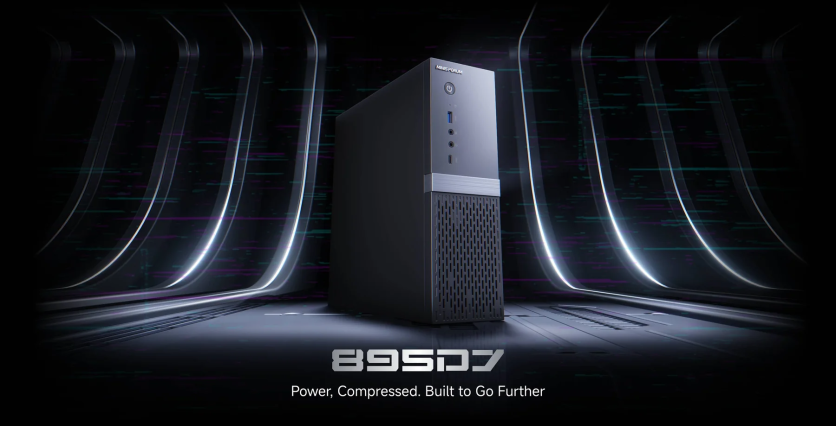
The 895D7 belongs to a category called MoDT — Mobile on Desktop — in which a laptop-class processor in a BGA package is mounted on a Mini-ITX motherboard inside a small desktop chassis rather than into a laptop. Minisforum chose AMD's Ryzen 9 8945HX for this build: a 16-core, 32-thread Dragon Range refresh chip with a base clock of 2.5 GHz and a boost ceiling of 5.4 GHz. Unlike a conventional laptop, the 895D7's chassis lets the chip run at up to 100W in Balance Mode — significantly above what any laptop's thermal system can sustain for a similar chip.
The system's defining feature is a PCIe 5.0 x16 expansion slot — rare in a sub-10-liter machine — that accommodates a low-profile discrete GPU. Minisforum currently offers the 895D7 paired with the Vastarmor Radeon RX 9060 XT 16GB, a dual-slot low-profile card from AMD's latest RDNA 4 generation running at up to 140W. The chassis itself measures 312 × 93 × 292 mm (approximately 12.3 × 3.7 × 11.5 inches), giving it a total volume of 8.47 liters — taller and slimmer than Valve's compact cube, and roughly three times the volume of the Steam Machine's ~3-liter form factor. A 400W internal ATX power supply, two DDR5 SO-DIMM slots supporting up to 96GB, dual M.2 PCIe 4.0 NVMe slots, Wi-Fi 7, Bluetooth 5.4, and 2.5 Gigabit Ethernet round out the core specs.
Barebone units start at $495 on Amazon. The fully equipped configuration ETA Prime benchmarked — 32GB DDR5, 1TB SSD, and the Vastarmor RX 9060 XT — comes in at $1,639. An RTX 5060 8GB configuration is also listed but had not shipped as of this writing.
What Valve Built: Steam Machine's RDNA 3 Cube
Valve's Steam Machine began shipping to reservation holders on June 30, 2026, with the first purchase invitations sent the day before. The base price is $1,049 for the 512GB model, rising to $1,349 for the 2TB version. Valve acknowledged the price exceeded its original targets, attributing the increase to an AI-driven DRAM shortage that pushed DDR5 and GDDR6 contract prices sharply higher between the November 2025 announcement and the June launch.
Inside the cube — which measures 162.4 × 156 × 152 mm (approximately 6.4 × 6.1 × 6 inches) — is a semi-custom AMD Zen 4 CPU with six cores and 12 threads clocked up to 4.8 GHz, paired with a semi-custom AMD RDNA 3 GPU carrying 28 compute units running at a sustained 2.45 GHz clock and a 110W thermal envelope. The GPU draws on a dedicated 8GB of GDDR6 video memory — a meaningful architectural upgrade over the Steam Deck's unified memory pool — for approximately 8.8 teraflops of raw FP32 compute. Independent reviewers at GamersNexus found the GPU delivers performance comparable to RTX 3060 in real-game benchmarks: strong at 1080p, capable at 1440p, and noticeably constrained at 4K on demanding titles.
Every 4K Benchmark Went to the 895D7
ETA Prime installed SteamOS on the Minisforum 895D7, creating a direct comparison on the same software platform. The performance gap at 4K resolution favored the 895D7 in every title tested.
In Cyberpunk 2077 at 4K Ultra settings, the 895D7 averaged 26 frames per second against the Steam Machine's 19 FPS — a 44 percent advantage. The margin widened considerably in Shadow of the Tomb Raider at the Very High preset, where the 895D7 delivered approximately 77 percent more frames. The largest gap appeared in Horizon Zero Dawn Remastered, where the 895D7 was 127 percent faster than the Steam Machine at 4K.
These are not marginal benchmark noise. A 127 percent frame-rate advantage means the 895D7 delivered more than twice the frame output of the Steam Machine in that title at that resolution. A 44 percent advantage in Cyberpunk 2077 moves the game from a low-20s average — below the 24 FPS threshold many consider the minimum for playable motion — to a low-26-FPS average that, combined with FSR 4 frame generation, can reach a fluid 60 FPS or above.
Read more: Steam Machine Goes on Sale Today: Valve's $1,049 Living Room PC Begins Shipping
Why RDNA 4 Beats RDNA 3 at 4K: Architecture and VRAM
Two engineering factors explain the benchmark gaps, and both are structural rather than configurable.
VRAM ceiling: Modern games at 4K with high-quality textures routinely push past 8GB of video memory. When a GPU's VRAM buffer is exceeded, the system must fetch texture data from system RAM across the PCIe bus — a process orders of magnitude slower than VRAM access. The Steam Machine's 8GB GDDR6 is exposed to this constraint in demanding 4K titles; the 895D7's RX 9060 XT carries 16GB GDDR6, providing double the headroom before the performance cliff appears. This is not a driver issue or a software gap — it is a fixed hardware limit.
FSR 4 frame generation: AMD's fourth-generation upscaling technology uses a fully machine-learning upscaling pipeline that requires FP8 hardware — second-generation AI accelerators introduced with RDNA 4. AMD has confirmed that FSR 4 frame generation is not officially supported on RDNA 3 GPUs because RDNA 3 lacks native FP8 hardware support. Note that AMD released FSR 4.1 upscaling to RDNA 3 GPUs via an INT8 path in July 2026 — but FSR 4 frame generation, the feature that synthesizes intermediate frames to multiply effective output frame rates, remains exclusively available on RDNA 4 hardware. The Steam Machine's GPU is therefore limited to FSR 3.1 frame generation, an older spatial-upscaling approach that produces more ghosting and lower image stability than FSR 4's ML pipeline.
The critical implication: this gap is not closeable by a software update to the Steam Machine. RDNA 3 physically lacks the FP8 hardware units that FSR 4 frame generation requires. As more games add FSR 4 frame generation support — and as FSR 4 becomes the standard rather than a premium option — the performance divide between RDNA 3 and RDNA 4 at 4K is expected to widen, not narrow. A buyer purchasing the Steam Machine today is locking into the RDNA 3 generation's frame-generation ceiling for the hardware's lifetime.
For context: the RX 9060 XT 16GB is approximately 27 percent faster than an RTX 3060 at 1440p in aggregated gaming benchmarks, and significantly more capable at 4K specifically due to the doubled VRAM headroom.
What the Six-Hundred-Dollar Premium Actually Buys
The $590 gap between a $1,049 Steam Machine and a $1,639 Minisforum 895D7 purchases specific engineering capabilities that the benchmark results quantify.
On the 895D7's side of the ledger: 16GB GDDR6 versus 8GB GDDR6; RDNA 4 native FSR 4 frame generation support versus RDNA 3's FSR 3.1 limitation; a 16-core Ryzen 9 running at 100W versus a six-core custom chip running at approximately 30W; a PCIe 5.0 x16 upgrade slot that allows GPU replacement when a future card offers compelling improvement; and full Windows compatibility alongside SteamOS, meaning no anti-cheat library restrictions.
On the Steam Machine's side: Valve's purpose-built living-room optimization, including near-silent acoustics (GamersNexus measured approximately 23–24 dBA under load — effectively inaudible in a quiet room), a compact cube form factor that fits under a television without visual intrusion, and a plug-and-play SteamOS experience refined across years of Steam Deck development. The Steam Machine also runs its GPU at approximately 42°C above ambient under load — a thermal management achievement the 895D7's taller chassis accomplishes differently, with the Vastarmor card's dual fans venting through the 93mm chassis height.
The 895D7's 93mm (approximately 3.7-inch) chassis height is a real constraint: it limits GPU compatibility to low-profile dual-slot cards only. Not every RDNA 4 card ships in a low-profile form factor, and the selection of compatible upgrades is narrower than a standard mid-tower build would offer. Buyers planning to use the barebone configuration should verify GPU dimensions before purchasing.
For consumers committed to a living-room 1080p-to-1440p experience who value silence and simplicity, the Steam Machine remains a well-engineered product at a lower price. For consumers who specifically want 4K-capable compact gaming and are comfortable with a larger chassis and a higher budget, the 895D7 with the RX 9060 XT delivers a confirmed performance advantage that the benchmark data now quantifies precisely.
Read more: Piston V Mini-PC Hits Kickstarter: OCuLink eGPU Port Undercuts Steam Machine at Half Price
Does Valve's FSR Upscaling Close the Gap?
Valve has marketed the Steam Machine as targeting "up to 4K" gaming, with FSR upscaling doing substantial work to achieve that target. That framing is accurate at 1080p and 1440p, where the RDNA 3 GPU combined with FSR 3.1 delivers playable results. At native 4K with demanding settings, however, the combination of the VRAM ceiling and the FSR 3.1 frame-generation limitation means the Steam Machine is working harder and producing lower image quality than an RDNA 4 card running FSR 4 at the same resolution target.
FSR 4 itself is not merely a software update — it represents a qualitative shift in upscaling approach. According to independent testing by Digital Foundry, FSR 4 eliminates the ghosting in particle effects that FSR 3.1 exhibited, delivers sharper texture and surface detail, and produces significantly more stable motion than FSR 3 in side-by-side comparisons. Granting FSR 3.1's limitations on the Steam Machine's RDNA 3 GPU, the performance gap ETA Prime measured reflects both raw compute headroom and upscaling quality — two compounding disadvantages at 4K.
How Does the RX 9060 XT Rank Against the Steam Machine's GPU?
The Steam Machine's GPU, independently benchmarked by GamersNexus as performing in the RTX 3060 and RX 6600 tier, represents solid 2021-era midrange performance. The RX 9060 XT 16GB is AMD's 2025 entry-to-midrange RDNA 4 card — and sits meaningfully above that benchmark class. In aggregated real-game benchmarks at 1440p, the RX 9060 XT 16GB leads the RTX 3060 by approximately 27 percent at 1440p; at 4K, the VRAM advantage amplifies the gap further because the RTX 3060's 12GB and the Steam Machine's 8GB GDDR6 both encounter the VRAM ceiling sooner than the RX 9060 XT's 16GB.
Is the Minisforum 895D7 Safe to Buy From a Chinese Manufacturer?
Minisforum is operated by Shenzhen Meigao Electronic Equipment Co., Ltd., headquartered in Shenzhen, Guangdong, China. That address means three Chinese national laws apply to the company and to the data that flows through its products, regardless of where the device is physically located or sold.
China's National Intelligence Law (2017), Article 7 requires that "any organization or citizen shall support, assist, and cooperate with state intelligence work in accordance with law." This obligation is not optional and is not waivable by corporate privacy policy.
The Data Security Law (2021) compels data handlers operating under Chinese jurisdiction to share data with the government on request and subjects all data processing by Chinese companies to state oversight.
The Cybersecurity Law (2017, amended 2025) requires data localization and grants Chinese authorities the right to request source code, encryption keys, and other technical information from Chinese technology companies.
A Department of Homeland Security advisory notes that under the National Intelligence Law, the Chinese government has the ability to direct Chinese firms to covertly install backdoors or security flaws in equipment — and that foreign equipment suppliers are not exempted from these obligations even when their equipment has left China.
To be precise about what is documented versus what is structural: no independent third-party security audit of the Minisforum 895D7 has been published. No Minisforum-specific incidents involving malware, backdoors, or unauthorized data collection have been documented. A separate Chinese mini PC brand, AceMagic, shipped units containing Redline Stealer and Bladabindi malware — attributed to a manufacturing error in boot-time optimization code rather than deliberate surveillance, and resolved in subsequent production runs. This is category context, not evidence against Minisforum specifically.
What the law creates is a structural condition, not a proven incident: a company subject to China's National Intelligence Law cannot legally refuse a government intelligence request about its products or the data they handle. Readers in sensitive enterprise, legal, government-adjacent, or healthcare environments should weigh this alongside the performance numbers.
What buyers can do: Perform a clean operating system installation before first use — the standard recommendation for any mini PC from any Chinese manufacturer — to eliminate factory image risk. Apply standard Windows privacy settings to minimize telemetry. For sensitive environments, network segmentation (placing the device on a separate VLAN with restricted routes to internal resources) reduces the exposure surface of any theoretical unauthorized access. No mitigation fully addresses the structural legal condition described above.
SFF Gaming Market in August 2026
The Minisforum 895D7 is not alone in this category. Competitors including Beelink and Hasee have launched MoDT-class machines targeting similar configurations in 2026. The Hasee Ares Mini R78D, for example, launched with eGPU support on August 30, 2026. What the 895D7's ETA Prime comparison adds is the first published 4K benchmark data for this new generation of compact discrete-GPU desktops running head-to-head against the Steam Machine on the same operating system.
The Steam Machine, for its part, occupies a fundamentally different product philosophy: a sealed, living-room-optimized SteamOS appliance with Valve's full software optimization stack, no user-replaceable GPU, near-silent acoustics, and a price anchored to actual 2026 component costs. It remains a capable 1080p-to-1440p gaming machine with access to roughly 90 percent of the Steam library through Proton, for buyers who do not prioritize 4K and do not need Windows.
The data from ETA Prime's comparison makes the tradeoff legible in a way it was not before August 30: buyers choosing between these two machines now know precisely how much 4K performance the $590 price gap represents, and they know the architectural reason — RDNA 4's FSR 4 machine-learning frame generation pipeline and doubled VRAM — that makes that gap structural rather than incidental. Which side of that tradeoff matches a buyer's living room, budget, and threat model is the decision that matters.
ⓒ 2026 TechTimes. All rights reserved.
Frequently Asked Questions
Is the Minisforum 895D7 actually worth $590 more than the Steam Machine for 4K gaming?
The benchmark data says yes for buyers whose primary use case is 4K gaming on demanding titles. ETA Prime's comparison confirmed the 895D7 with the Vastarmor RX 9060 XT was 44 percent faster in Cyberpunk 2077 at 4K, 77 percent faster in Shadow of the Tomb Raider, and 127 percent faster in Horizon Zero Dawn Remastered — all at 4K. At 1080p and 1440p the gap narrows substantially, and at those resolutions the Steam Machine's lower price and living-room polish become stronger arguments. The question a buyer should ask is not "which is faster" but "at what resolution am I actually gaming and how much do I value silence, compactness, and SteamOS integration versus Windows flexibility and 4K headroom."
Why can't the Steam Machine's RDNA 3 GPU run FSR 4 frame generation natively — and does that matter?
FSR 4's machine-learning-based frame generation requires FP8 hardware accelerators — dedicated floating-point-8 compute units that AMD introduced with the RDNA 4 architecture. RDNA 3 lacks these FP8 units; AMD released FSR 4.1 upscaling to RDNA 3 in July 2026 via an INT8 path, but FSR 4 frame generation itself — the feature that synthesizes intermediate frames to multiply effective output frame rates — is not officially supported on RDNA 3. The Steam Machine is therefore limited to FSR 3.1 frame generation for its lifetime, since the architectural gap is hardware, not software. As more games integrate FSR 4 frame generation as their primary frame-rate multiplier, RDNA 3 users will either miss that feature entirely or rely on older FSR 3.1 quality. For 4K gaming specifically, this compounds the raw performance gap with a qualitative upscaling gap.
What data does the Minisforum 895D7 collect, and who can access it?
Minisforum is a Chinese company (Shenzhen Meigao Electronic Equipment Co., Ltd.) subject to China's National Intelligence Law, Data Security Law, and Cybersecurity Law. These laws legally compel Chinese companies to cooperate with government intelligence requests and share data on demand — obligations that apply regardless of where the device is sold or used. The 895D7 is a PC running Windows or SteamOS; it does not have its own proprietary OS or embedded connectivity that differs from any other Windows PC. The relevant risk is not device-specific telemetry but the company's legal obligation to cooperate with Chinese government requests about its products and data they handle. No independent third-party security audit of the 895D7 has been published. Performing a clean OS installation before first use is recommended for any Chinese-manufactured mini PC.
Does the 895D7's 93-millimeter (3.7-inch) chassis height limit which GPUs can be used in it?
Yes. The PCIe 5.0 x16 slot in the 895D7 accepts only low-profile dual-slot graphics cards — the 93mm (approximately 3.7-inch) chassis height physically prevents full-height GPU installation. Minisforum currently offers the system with the Vastarmor Radeon RX 9060 XT LP (140W) or lists an RTX 5060 8GB configuration (not yet shipping as of August 2026). Buyers purchasing the $495 barebone must verify that any card they install is specifically a low-profile design; standard desktop GPUs will not physically fit.

-
 C114 Communication Network
 -
 Communication Home
