
 Search

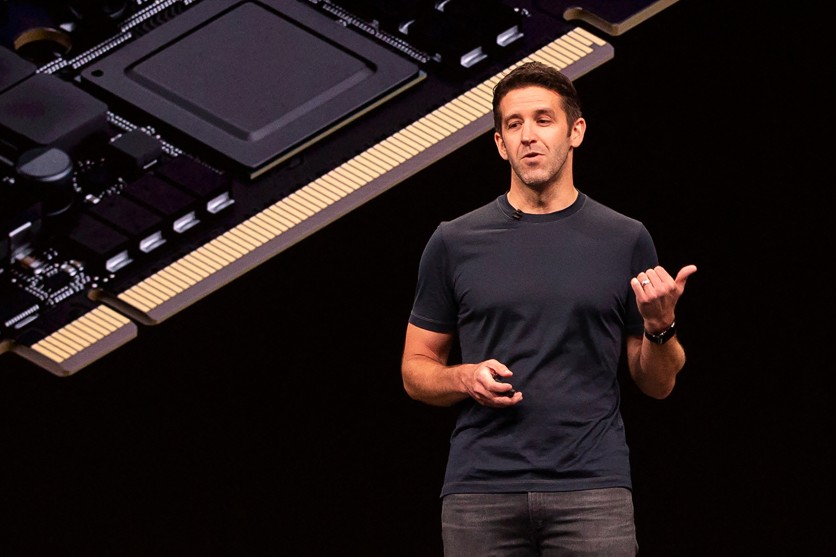
Apple's Vice president of Hardware Engineering John Ternus discusses the internal hardware of the Mac Pro during Apple's Worldwide Developer Conference (WWDC) in San Jose, California on June 3, 2019. Apple's chief executive Tim Cook hands over the company's reins to it's vice president of hardware engineering John Ternus on September 1, 2026. Cook spent nearly three decades at Apple, which he has led as CEO since 2011. Brittany Hosea-Small/gettyimages.com
John Ternus became the chief executive officer of Apple on September 1, 2026, stepping into the top job at the world's most valuable technology company with a specific combination of assets and liabilities no previous CEO has faced: unmatched hardware expertise, a Gemini AI licensing dependency he did not negotiate, a foldable iPhone set to debut in eight days, and no public record of his own on any of the technology-policy questions that will define his tenure. The board of directors unanimously approved the transition following a long-term succession planning process.
Tim Cook's final public act in the role he held for 15 years was a farewell posted to X on August 31: "Sending lots of love to the Apple community on my last day as CEO. My title changes tomorrow, but the love I have for the Apple community never will. Thank you for being a constant source of inspiration. My gratitude is endless, and I'm excited for the next chapter!" Cook had already been honored at a farewell gathering eight days earlier — roughly 200 Apple employees filled the Caffé Macs cafeteria at Apple Park for an evening of tributes, with OneRepublic performing for Apple staff. As of midnight EDT September 1, the title, the authority, and the questions that come with them belong to Ternus.
Ternus has no public record in the domains that will define his most consequential decisions. He has not testified before Congress, not appeared in regulatory proceedings, not published positions on antitrust, data privacy, AI governance, or trade policy. That is not a criticism; it reflects the role he held for 25 years, which was building hardware, not managing governments. But it means that on the most legally and geopolitically fraught issues Apple will face in the next 12 months, Cook retains the institutional standing and Ternus is starting from zero. Whether that arrangement functions as seamless division of labor or structural dual-authority will be one of the most closely watched governance questions of his first year.
Read more: Tim Cook to Become Apple's Executive Chairman as John Ternus Takes Over as CEO
Apple's Eighth CEO: Who Is the Man Holding the Title Now?
Ternus, 51, is a mechanical engineer by training and an Apple lifer by career. He graduated from the University of Pennsylvania in 1997 with a mechanical engineering degree, then spent four years designing virtual reality headsets at a company called Virtual Research Systems before joining Apple's product design team in July 2001. His first project was the Apple Cinema Display. That detail matters: the man now running the world's most valuable technology company got his start working on a monitor.
His rise through Apple's hardware organization was methodical and largely invisible to the public. By 2013 he was vice president of hardware engineering under Dan Riccio, with oversight of AirPods, Mac, and iPad. He took on iPhone hardware in 2020, was elevated to senior vice president in January 2021 when Riccio pivoted to Apple's AR/VR effort, and added Apple Watch to his brief in late 2022. He is, by any measure, the Apple executive who has touched the most hardware in the company's history — every major product line, every major generation, for a quarter century. Apple's CEO transition announcement confirms Ternus joined in 2001 and became SVP of Hardware Engineering in 2021.
His most consequential contribution was the Mac's transition from Intel to Apple Silicon. The M-series chips Ternus's team designed around are systems-on-chip that place the CPU, GPU, Neural Engine, and memory onto a single unified die, eliminating the bandwidth bottleneck that had separated processors from graphics in conventional architectures. The fanless M1 MacBook Air — a laptop that dramatically outperformed its fan-cooled predecessor on both battery life and sustained workloads — was the most vivid demonstration of what that integration enabled. For Ternus, that transition was the proof of a thesis he has articulated throughout his career: that controlling both the chip and the chassis unlocks engineering tradeoffs no external silicon provider can match. A full explanation of Apple Silicon's unified architecture ran in a prior TechTimes piece.
He is only the eighth person to serve as chief executive of Apple Inc. in the company's history, following Michael Scott, Mike Markkula, John Sculley, Michael Spindler, Gil Amelio, Steve Jobs, and Tim Cook.
What Cook Built: A $4.7 Trillion Company and an AI Debt
The company Ternus now runs is almost unrecognizably larger than the one Cook inherited in 2011. Cook took over an Apple worth approximately $350 billion and left behind one that briefly touched $5 trillion in market capitalization in July 2026, settling around $4.7 trillion at the handover. Shareholders who held through Cook's entire tenure earned approximately 2,740% returns.
Under Cook, Apple's annual revenue grew from $108 billion in fiscal year 2011 to more than $416 billion in fiscal year 2025; the Apple Newsroom announcement confirms those figures. Services — the App Store, iCloud, Apple Music, Apple TV+, Apple Fitness+, Apple Arcade, and Apple Pay — grew from a negligible contributor into a business generating approximately $109 billion in annual revenue by fiscal 2025, a high-margin recurring-revenue engine that Wall Street values more richly than hardware. The Apple Watch became the world's best-selling watch by units. AirPods created the modern wireless-earbud category. The Apple Silicon transition is now studied in business schools as a case study in vertical integration. A comprehensive Cook-era retrospective published in June 2026 covers those years in depth.
What Cook did not deliver is harder to quantify but not hard to name. No new Apple product since the iPhone has reached iPhone-scale cultural or financial impact. Apple Vision Pro — the mixed-reality headset that launched in early 2024 at $3,499 — was technologically extraordinary and commercially modest. Most consequentially, Apple fell behind its rivals in generative artificial intelligence. Siri, promised a major overhaul at WWDC 2024, repeatedly slipped; Apple paid approximately $250 million to settle a class action over advertised-but-undelivered Siri capabilities. When rivals were shipping AI assistants that could book restaurants and write code, Apple was shipping notification summaries.
Cook's answer, announced in January 2026, was to rent the frontier capability rather than build it. Apple agreed to pay Google $1 billion annually to license a custom 1.2-trillion-parameter Gemini model — roughly eight times the size of Apple's own Apple Intelligence models — to power a rebuilt Siri capable of cross-app actions and multi-turn conversation. Cook framed this as a shrewd allocation: large language models are commoditizing, Apple Silicon handles the privacy layer and on-device inference, and renting the cloud brain is cheaper than the billions Google, Microsoft, Amazon, and Meta spend annually building their own. He told investors on his final earnings call that the company still does not have a complete plan for the compute bill as Gemini usage scales. That gap — an acknowledged open question about the long-term economics of the central pillar of Apple's AI strategy — is now Ternus's problem.
What Cook Keeps
Cook's move to executive chairman is not a ceremonial exit. Apple's own announcement defined his brief with unusual specificity: he will assist with policymaker relationships — specifically, Apple's relationships with the Trump administration and the Chinese government — at precisely the moment both are live and consequential.
Apple is the subject of an active Department of Justice antitrust suit over the iPhone's market position; settlement talks in July 2026 were ongoing as recently as that month. Apple's manufacturing base remains concentrated in China, where any further escalation of US-China trade tensions would hit the company directly. Cook spent years cultivating personal relationships with both the Trump administration and Chinese officials that enabled Apple to navigate tariff exposure more successfully than competitors.
Ternus has no such record. He has not testified before Congress, not appeared in regulatory proceedings, not published positions on antitrust, data privacy, AI governance, or trade policy. That is not a criticism; it reflects the role he held for 25 years, which was building hardware, not managing governments. But it means that on the most legally and geopolitically fraught issues Apple will face in the next 12 months, Cook retains the institutional standing and Ternus is starting from zero. Whether that arrangement functions as seamless division of labor or structural dual-authority will be one of the most closely watched governance questions of his first year.
The First Test: What Will Eight Days Tell Us?
Apple's next product event, "Surprise and Shine," is scheduled for September 9, 2026, at 10 a.m. PT at Apple Park in Cupertino — eight days from today. It will be Ternus's first public appearance as chief executive and his first opportunity to reveal, in the choices he makes on stage, what kind of CEO he intends to be.
The headliner is the iPhone Ultra, Apple's first foldable iPhone and its most significant hardware departure since the 2017 iPhone X. The device is expected to use a book-style design with a titanium frame, an outer display of approximately 5.3 to 5.5 inches (13.5 to 14 cm), and an inner display of approximately 7.6 to 7.8 inches (19.3 to 19.8 cm). Touch ID integrated into the power button is expected in place of Face ID. Starting price is expected around $1,999, though configurations with more storage could reach $2,500. iPhone Ultra specs and event details have been reported by 9to5Mac.
The engineering tradeoff at the center of that device is specific and has already surfaced in public. Apple built and tested a compact Apple Pencil prototype designed specifically for the iPhone Ultra, then shelved it after engineers confirmed the inner display cannot withstand stylus-tip pressure without permanent marking. The reason is materials physics: a standard iPhone uses Corning's Gorilla Glass, which rates roughly 6 to 7 on the Mohs mineral hardness scale. The iPhone Ultra's inner display, which must flex without cracking at the hinge, uses ultra-thin glass that achieves approximately Mohs 5 after chemical strengthening, with a polymer protective layer on top that rates closer to Mohs 2 to 3 — roughly the hardness of a fingernail. Samsung faced the identical constraint when it dropped the S Pen from the Galaxy Z Fold 7. TechTimes covered the iPhone Ultra pencil decision in detail the day before the transition. The engineering path forward requires either harder glass chemistry that does not sacrifice foldability, or a stylus tip redesigned to distribute pressure over a larger area. Neither exists in commercial production as of 2026.
This limitation is worth naming clearly because the iPhone Ultra at $1,999 and up will be the most expensive iPhone Apple has ever sold, and the durability expectations a buyer brings to a $1,999 device are not the same as those they bring to a $999 one. Ternus, who oversaw the materials engineering decisions that produced this device, is now the CEO who will answer for what it can and cannot do.
Also expected at the September 9 event: the iPhone 18 Pro and Pro Max, powered by the new A20 Pro chip on a 2nm manufacturing process — the first 2nm chip Apple has shipped, expected to deliver performance and efficiency gains of roughly 18% and 30% respectively over its predecessor. The event will also likely include Apple Watch Series 12 and Apple Watch Ultra 4.
Notably absent from the September stage will be the standard iPhone 18, the iPhone Air 2, and the iPhone 18e. Apple is, for the first time in the product's history, formally splitting its annual iPhone launch cycle: premium models in September 2026, mass-market models in spring 2027. That structural shift changes Apple's holiday quarter dynamics, carrier relationship calendars, and revenue recognition timing in ways that analyst coverage has barely begun to model. As one industry analysis noted, the split is arguably as consequential as any new hinge.
Tim Cook will not appear at the event. It belongs to Ternus.
Read more: The Tim Cook Era Ends: A Deep Dive Into the 15 Years That Made Apple a $4 Trillion Giant
The AI Question That Has No Answer Yet
The hardest problem on Ternus's desk on Day One is one he cannot solve in eight days. Apple's artificial intelligence strategy is, at its core, a licensing arrangement with a competitor. Google Gemini — the 1.2-trillion-parameter model Apple is paying approximately $1 billion a year to access — powers the rebuilt Siri that will debut at the September 9 event. Apple's own Apple Intelligence models handle lighter tasks on-device, using the Neural Engine integrated into every Apple Silicon chip. The heaviest tasks go to Gemini via Private Cloud Compute, Apple's privacy-focused server architecture designed to process queries without data retention.
The bet has a logic. Apple Silicon's unified memory architecture, which places CPU, GPU, and Neural Engine on a single die sharing the same memory pool, makes on-device AI inference unusually efficient — handling tasks locally that would require cloud processing on conventional hardware. As models become more efficient and Apple's chips become more capable, Apple's thesis holds that an increasing share of AI workloads will run on the device itself, minimizing dependency on Gemini. TechTimes has explained how Apple Silicon enables on-device AI in a previous analysis.
The risk is the mirror of the logic. Frontier model capability continues to expand faster than on-device inference can absorb. If Google raises the price of Gemini access, changes its privacy terms, or — more subtly — pursues its own AI assistant strategy in ways that conflict with Apple's, Apple has no comparable fallback at frontier scale. Cook acknowledged on his final earnings call that the compute bill math has not been fully solved. Ternus inherits a strategy with a known open variable and no announced plan to close it.
His predecessor's framing, reported in multiple profiles, was that AI is a "marathon, not a sprint." That framing reassures institutional investors worried about Apple overpaying for AI infrastructure. It will be tested by the pace of rivals. ChatGPT and Anthropic's Claude were the two most downloaded free apps on the iOS App Store as of the transition. The apps Apple's customers are choosing to supplement Siri are the ones Apple is competing with.
Price Pressure Ternus Cannot Walk Back
One of the most concrete things Ternus inherits is a wave of price increases his predecessor set in motion. In June 2026, Apple raised Mac and iPad prices by 17 to 33%, citing an extraordinary surge in memory chip costs driven by AI data center demand bidding up DRAM and NAND supply. Apple's stock fell more than 6% in a single session on the day of the announcement, its worst decline since April 2025. Industry analysts — notably Counterpoint Research director Tarun Pathak, citing component costs — estimated that pressure could add $150 to $200 per iPhone when the next iPhone pricing is revealed, weighted toward higher-memory configurations. In late August, Apple also raised Apple TV+ subscription prices and Apple One prices as well.
Memory shortage analyst forecasts are not optimistic about near-term relief. SK Hynix's chief executive warned in July 2026 that 2027 could be the worst year for supply shortages in the semiconductor industry's history, as documented in TechTimes' Q3 2026 earnings coverage. The AI-driven demand for high-bandwidth memory has absorbed a large share of global production, leaving conventional DRAM and NAND — the components that go into iPhones, Macs, and iPads — scarce and expensive. Ternus did not cause this dynamic. He cannot quickly resolve it. His first iPhone launch will reveal whether the price increases consumers face in September are manageable or whether they trigger the kind of upgrade-cycle hesitation that threatens Apple's most important revenue line.
How Will Apple's AI Strategy Change Under Ternus?
Ternus has not made a public statement diverging from the Gemini licensing deal, the Private Cloud Compute architecture, or Apple's general "hardware-first AI" philosophy. He has no documented independent positions on AI governance, data privacy legislation, antitrust policy, or any other technology-regulatory domain.
The organizational structure around AI has already changed. John Giannandrea, Apple's longtime AI chief, retired in spring 2026. His successor, Amar Subramanya, joined from Microsoft (where he was vice president of AI) and previously spent 16 years at Google, including as head of engineering for Google's Gemini Assistant — a notable hire given that Gemini is now Siri's foundation. Craig Federighi, Apple's software chief, and Mike Rockwell, creator of Vision Pro, have taken expanded roles in AI product direction. On hardware, Johny Srouji was named Apple's chief hardware officer on April 20, 2026, absorbing Ternus's former engineering organization and reporting to the new CEO.
That structure gives Ternus a team already built and running. The question his first keynote will begin to answer — and his first earnings call will accelerate — is whether he adds a strategic perspective of his own on AI direction, or inherits Cook's bet wholesale and waits for the next chip generation to validate it.
Apple's Eighth CEO
John Ternus is the eighth person to lead Apple Inc. since the company was founded, and only the third since Apple's modern era was established under Steve Jobs. Jobs was the archetypal product visionary. Cook was the operations and diplomacy executive. Ternus is a hardware engineer — the first in the role.
That distinction carries a specific implication. An engineer's Apple is an Apple that believes the decisive battles in technology are fought in silicon, materials, thermal design, and manufacturing tolerance. The Apple Silicon story — where owning the chip enabled the fanless MacBook Air, the M1 Ultra's unified 192GB memory pool, and now the 2nm A20 Pro — is the most powerful evidence for that belief. The iPhone Ultra's foldable hinge, its ultra-thin glass display, its dual-cell battery, its titanium frame: every one of those is an engineering problem Ternus's organization solved, or nearly solved, before he became CEO.
What remains is the demonstration that the same engineering instincts translate into the broader strategic and commercial leadership the role requires — navigating AI partnerships, managing a DOJ antitrust case, replacing the diplomatic standing Cook built over 15 years, and deciding whether the Gemini dependency is a bridge to a better Apple Intelligence or a permanent concession of the AI layer to a competitor. Those questions do not have engineering answers.
September 1, 2026 is Day One. September 9, 2026 will be the first evidence.
Frequently Asked Questions
Who is John Ternus and why is he Apple's new CEO?
Ternus is a mechanical engineer who joined Apple in 2001 and spent 25 years overseeing hardware development for every major Apple product line — iPhone, iPad, Mac, Apple Watch, AirPods — becoming senior vice president of hardware engineering in 2021. Apple's board selected him as Tim Cook's successor because his engineering background aligns with the company's strategy of using tightly integrated hardware and custom silicon (Apple Silicon) as a competitive moat in the AI era. He became CEO effective September 1, 2026, with Cook moving to executive chairman. The Apple CEO transition announcement confirmed the board approved the transition unanimously.
What is Apple's AI strategy under Ternus, and does he control it?
Apple is currently licensing a custom 1.2-trillion-parameter Gemini model from Google for approximately $1 billion a year to power a rebuilt Siri, while handling lighter AI tasks on-device using the Neural Engine in Apple Silicon chips. This deal was negotiated under Cook's watch and announced in January 2026. Ternus has not publicly stated a divergent view on the arrangement. As of September 1, all strategic decisions — including whether to deepen, renegotiate, or eventually replace the Gemini dependency — are his to make. Cook acknowledged on his final earnings call that the long-term compute cost remains an open question.
What is the iPhone Ultra and what should buyers know before the September 9 reveal?
The iPhone Ultra is Apple's first foldable iPhone, expected to be announced at the September 9 "Surprise and Shine" event in Cupertino. It is expected to use a book-style form factor with an outer display of about 5.3 to 5.5 inches (13.5 to 14 cm), an inner display of about 7.6 to 7.8 inches (19.3 to 19.8 cm), a titanium frame, an A20 Pro chip, and Touch ID in the power button. Starting price is expected around $1,999. Buyers should be aware that the inner display uses ultra-thin glass significantly softer than standard iPhone glass — Apple already shelved a planned Apple Pencil accessory for it after engineers found the inner display scratches from stylus pressure. This is the same durability tradeoff Samsung has encountered with its foldable S Pen.
What does Tim Cook still do at Apple, and does that create a governance problem?
Cook is now executive chairman, a board role with a defined operational brief: engaging with policymakers around the world, specifically meaning Apple's relationships with the Trump administration and the Chinese government. He does not have day-to-day management authority, but he retains the most geopolitically sensitive external relationships Apple has at a moment when an active DOJ antitrust case and ongoing US-China trade tensions make those relationships consequential. Ternus has no established record in any of these domains. Whether Cook's continued involvement functions as effective division of labor or creates ambiguity about who speaks for Apple on policy questions is an open governance question for the new CEO's first year.

-
 C114 Communication Network
 -
 Communication Home
