
 Search

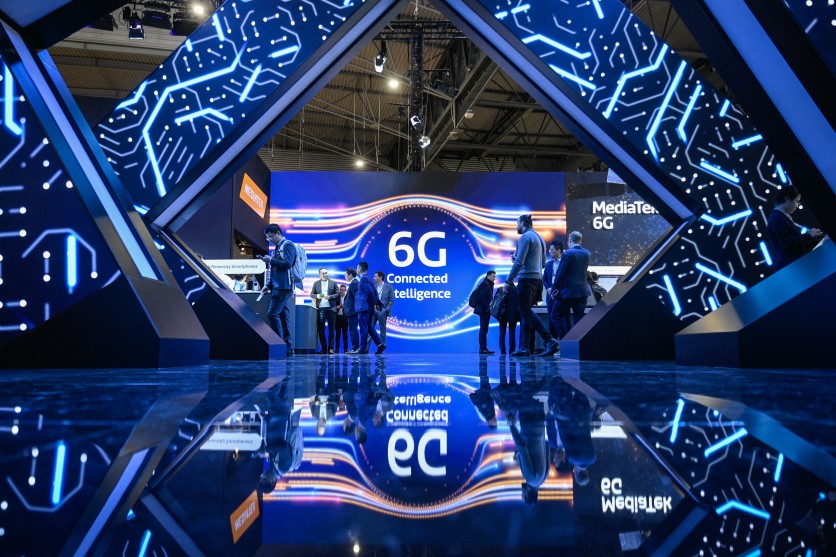
Signage showing 6G is displayed during the MWC (Mobile World Congress), the world's biggest mobile fair, in Barcelona on March 3, 2025. Surrounded by investment and innovation projects, the Mobile World Congress (MWC) kicks off today in Barcelona amid a context of euphoria but also tensions over artificial intelligence (AI), whose rapid advancement is shaking up the tech sector. JOSEP LAGO/AFP via Getty Images
The Federal Communications Commission released draft rules on July 1 for a spectrum auction that will determine which U.S. wireless carriers own the airwaves that define 5G and 6G capacity for the next decade — and the agency has scheduled a binding vote for July 22. If the rules pass as expected, the auction of 160 MHz of upper C-band spectrum (3.98–4.14 GHz) will go forward no later than July 2027, with winning bidders authorized to light up service across the top 75 U.S. markets by December 2030.
Chairman Brendan Carr announced the vote on June 30, describing a timeline that is "years ahead of where a lot of people were thinking it was going to land." The commission has moved from a Notice of Proposed Rulemaking to a draft Order faster than it has for any prior 5G-era proceeding. What makes this auction materially different from any that preceded it — and more consequential than its headline numbers suggest — is not the 160 MHz alone. It is what happens when that spectrum is combined with the 280 MHz of lower C-band spectrum already in carriers' hands.
Why 440 MHz of Contiguous Mid-Band Is the Real Story
The draft rules would harmonize the newly auctioned upper C-band with the lower C-band frequencies cleared by the FCC's 2020 proceeding and auctioned in December 2020, stitching together a contiguous 440 MHz block stretching from 3.70 to 4.14 GHz. The FCC and carriers describe this as a "super-band."
That term has a specific engineering meaning. Mid-band spectrum in the 3.7–4.14 GHz range falls within 5G's n77 band (3.3–4.2 GHz) under 3GPP standards. At these frequencies, radio waves travel far enough to cover large geographic cells without requiring tower-on-every-corner density, and carry enough data per hertz to deliver meaningful capacity improvements over 4G. Industry researchers have called this range the "Goldilocks" zone of 5G: neither as range-limited as millimeter-wave (above 24 GHz, which cannot penetrate walls and reaches only city-block distances) nor as capacity-constrained as low-band spectrum (below 1 GHz, which covers rural areas well but carries relatively little data). GSMA Intelligence projects that mid-band 5G alone will deliver more than $610 billion in global GDP impact by 2030, representing roughly 65% of 5G's total projected socioeconomic value.
The contiguous structure of the 440 MHz block matters because 5G NR (New Radio) supports carrier aggregation — the ability to combine multiple frequency channels into a single wideband pipe. A carrier holding contiguous spectrum across the full 440 MHz range can, in principle, build channels far wider than anything currently deployed in the U.S., dramatically increasing throughput per cell site without adding new towers. Combined with massive MIMO antenna arrays (which use 64 to 128 antenna elements at C-band frequencies to focus energy and multiply capacity), the super-band is the foundational infrastructure for both advanced 5G and eventual 6G services. The FCC's own estimates, cited in its July 1 draft order fact sheet, project that the combined spectrum release could contribute up to $264 billion in GDP, support 1.5 million new jobs, and generate $388 billion in consumer surplus.
Carr described the stakes plainly: "This really sets up America to lead the world in next-gen connectivity, whether it's 5G, 6G, or other forms of wireless services."
FCC Goes Beyond Congressional Floor
Congress enacted legislation in 2025 requiring the FCC to auction at least 100 MHz of upper C-band spectrum by July 2027. The draft order exceeds that minimum by 60 MHz, auctioning the full 160 MHz available in the 3.98–4.14 GHz range.
The decision to go to 160 MHz was contested. CTIA, the wireless trade association, lobbied aggressively for the maximum available slice, arguing that more spectrum translates directly into network capacity and faster speeds for consumers. CTIA President and CEO Ajit Pai — a former FCC chairman — called the auction "one of the most economically significant auctions of the decade, generating billions in economic growth, creating millions of jobs, expanding broadband competition, and building the foundation for AI and 6G leadership."
The National Association of Broadcasters pushed back sharply. The NAB urged the FCC to limit the auction to the congressional minimum of 100 MHz, warning that the upper C-band is already "operating at its practical limit" and that clearing 160 MHz would create what the organization called a Tetris-like problem for live broadcast production — sports, news, and events coverage that relies on C-band satellite feeds for reliable high-quality video distribution.
The FCC's draft rules propose to address broadcaster concerns through a structured transition, drawing on lessons from the lower C-band clearing. The commission's draft notes it will auction 3,248 new flexible-use licenses throughout the contiguous United States.
The Wireless Infrastructure Association welcomed the scope. WIA President and CEO Patrick Halley said: "We are pleased that the Commission is going beyond the minimum directed by Congress to make 160 MHz of prime midband spectrum available and harmonizing operational rules across the C-Band, unlocking new economies of scale and creating more value from this scarce resource."
Aviation Safety: The 60 MHz Constraint and What It Actually Requires
The 5G signal in the upper C-band stops at 4.14 GHz. Aircraft radio altimeters — the only instruments aboard commercial aircraft that measure height above ground level (AGL) — operate at 4.2 to 4.4 GHz. That 60 MHz gap between the top of the auctioned spectrum and the bottom of the altimeter band is the central engineering constraint shaping the FCC's draft rules.
Radio altimeters were designed under standards established in the 1970s (RTCA DO-155, EUROCAE ED-30, and ARINC707-7) that did not anticipate high-powered 5G transmitters nearby. Altimeters on older aircraft lack the out-of-band signal rejection needed to filter strong adjacent-band emissions. When Verizon and AT&T began lighting up lower C-band 5G service in January 2022, Boeing and Airbus had already warned the FAA that out-of-band emissions from 5G transmitters near airports could bleed into the altimeter band and produce erroneous altitude readings. The FAA issued a special airworthiness information bulletin and Verizon and AT&T voluntarily delayed C-band 5G near airports.
The upper C-band is 60 MHz closer to the altimeter band than the lower C-band was at 3.98 GHz. The FCC's draft rules address this with three overlapping safeguards developed through close coordination with the FAA: limits on the power of auctioned 5G signals, limits on the height of 5G transmission towers (taller towers send signals farther, increasing the risk of reaching aircraft during approach and landing), and a buffer band between the auctioned frequencies and the altimeter band.
The FAA has stated it is "confident that the use of radio signals from the FCC's 5G auction can safely coexist with aviation after years of FAA-led testing and technical analysis." The agency will issue its own complementary rule later this summer requiring aircraft operators to upgrade older altimeters to models with stronger out-of-band rejection. Winning auction bidders will be required to fund rebates for airlines needing to purchase and install upgraded altimeter systems — a cost requirement embedded in the FCC draft rules themselves.
Read more: Verizon and AT&T to Pause the Rollout of 5G Network to Work with FAA in Aircraft Safety
Read more: FCC Rip-and-Replace: 42% of Huawei and ZTE Projects Done as Supply Chain Delays Double
What Satellite Operators Lose — and Why Ku-Band Is Not a Simple Swap
The upper C-band clearing requires displacing SES and other satellite operators who currently rely on the 3.98–4.14 GHz range for video distribution and broadcast services to cable headends and broadcast facilities across the United States. This is the engineering problem the NAB's "Tetris-like" warning describes — and it is materially different from what happened during the lower C-band clearing.
The lower C-band auction (December 2020) raised a record $81.1 billion. In that proceeding, satellite operators were required to repack their services into a narrower remaining slice of the same C-band frequency range. They did not need new satellites. They compressed existing services into fewer transponders. That transition completed more than two years ahead of its original December 2025 deadline, in part because $9.3 billion in accelerated relocation payments created financial incentives to move fast.
The upper C-band transition has no equivalent "compression" option. Because satellite operators are being cleared from the upper end of the band — the final slice of C-band they occupied after the first clearing — there is nowhere within C-band to repack. SES has told the FCC it will need to build and launch five entirely new hybrid Ku-band satellites with C-band uplink capabilities, plus two in-orbit backups, to continue serving its U.S. content distribution customers. The total cost of that transition: approximately $3.6 billion plus $150 million in contingencies.
The additional $777 million SES has flagged — for new integrated receiver decoders at cable headend earth stations — exists because of a fundamental physical difference between C-band and Ku-band: rain.
C-band signals (3.7–4.2 GHz) are nearly immune to rain attenuation. At those frequencies, raindrops are too small relative to the radio wavelength to scatter or absorb the signal significantly. Ku-band (12–18 GHz) does not share this property. At higher frequencies, rain droplets are comparable in size to the signal's wavelength and absorb meaningfully more energy. In high-precipitation regions — the Gulf Coast, the Southeast, tropical reception zones — Ku-band downlinks experience signal fading during heavy rain events that C-band does not.
SES has proposed a mitigation architecture that includes higher-power Ku-band satellites, larger receive antennas (3.7 meters rather than the smaller dishes typical of Ku-band installations), and a terrestrial IP packet recovery network — a standards-based system (using RIST, the Reliable Internet Stream Transport protocol) that detects missing packets caused by rain fade and re-delivers only the affected data to the specific cable headend experiencing the fade, rather than retransmitting a full broadcast feed.
This recovery infrastructure is what the $777 million is for. It is not a standard cost of a satellite transition; it is the cost of compensating for a fundamental propagation property that C-band has and Ku-band does not. The FCC has stated that total incentive payments to satellite operators will be less in aggregate than those paid after the lower C-band auction — but the SES transition plan reveals that the technical challenge is significantly greater than what a simple dollar comparison suggests. Specific incentive and rebate dollar amounts remain redacted from the public version of the draft order and will be released with the July 22 vote.
Is This the Fastest FCC Has Ever Moved on Spectrum?
The FCC explicitly characterized its process as unprecedented in speed: the commission moved from a Notice of Proposed Rulemaking to a draft Order faster than in any prior 5G-era auction. Carr credited close coordination with the FAA and NTIA for making the accelerated schedule possible.
This is also the first auction of new commercial spectrum in approximately five years, following the recent completion of Auction 113 for AWS-3 spectrum. The lower C-band auction — the proceeding that created the lower half of the proposed super-band — closed in February 2021, with AT&T, Verizon, and T-Mobile spending $81.1 billion combined.
The draft rules propose that winning bidders begin providing wireless service in the upper C-band in December 2030 for the top 75 U.S. markets, with remaining markets in the contiguous United States following in July 2031. Carr described this as years ahead of earlier projections. The auction itself must be completed no later than July 2027 under the congressional mandate.
Carr signaled that further spectrum action is planned. The FCC is working on auctions in additional bands for 2028, though no specific frequencies were identified in the June 30 announcement.
Racing China to 6G: Why the Timing Matters Beyond 5G
The competitive context for this auction extends well beyond near-term 5G capacity. China's wireless carriers have deployed 5G-Advanced infrastructure across more than 330 cities, operating under 3GPP Release 18 specifications — a lead that analyst firm Omdia estimates at 12 to 18 months over Western carriers. Chinese carriers and Huawei are already accumulating real-world field data at the Upper 6 GHz band (6,425–7,125 MHz), data that will directly shape the architectural assumptions written into the 6G global standard. China's 5G-A lead at MWC
The 440 MHz contiguous C-band super-band is the United States' primary infrastructure answer to that lead. Unlike spectrum scattered across discontiguous bands, a contiguous 440 MHz block allows 5G and 6G radio equipment to be upgraded through software and hardware radio upgrades at existing tower sites rather than requiring entirely new network builds. When 6G NR equipment reaches commercial readiness — targeted by the 3GPP process for the early 2030s — U.S. carriers with the super-band in hand will be able to activate 6G services on the same infrastructure they are building today for 5G. That is the specific sense in which the July 22 vote is a decision about 6G as much as 5G.
Read more: MWC Shanghai 2026 Closes: Huawei Pushes U6 GHz as First Commercial 5G-A Launches Loom
Read more: MWC Shanghai 2026: China Leads 330 Cities in 5G-A as 6G Standards Race Tightens
The July 22 vote is expected to pass. If it does, the upper C-band auction will proceed no later than July 2027, satellite operators will begin a multi-year transition off frequencies they have used for decades, airlines will be required to upgrade their altimeters, and the carriers that win the most licenses will own the backbone of American wireless for the next generation.
Frequently Asked Questions
What is the upper C-band and why is this FCC vote important for 5G?
The upper C-band refers to the 3.98–4.14 GHz portion of radio spectrum, which sits just above the lower C-band frequencies (3.70–3.98 GHz) already deployed for 5G by AT&T, Verizon, and T-Mobile. The July 22 FCC vote will set the rules for auctioning this 160 MHz of spectrum, and if those rules are adopted, it will create a contiguous 440 MHz mid-band block — a "super-band" — that carriers can use to build wider 5G channels with dramatically more capacity. Mid-band spectrum at these frequencies travels far enough to cover large geographic areas while carrying far more data than lower-frequency bands, making it the core capacity layer of 5G. The vote matters because it locks in the architecture that U.S. carriers will build on for both 5G and eventual 6G.
When will upper C-band 5G actually reach consumers?
Under the FCC's draft rules, winning bidders from the 2027 auction will be authorized to begin providing wireless service in the upper C-band in December 2030 for the top 75 U.S. markets, with the remaining markets in the contiguous United States following in July 2031. FCC Chairman Brendan Carr described the December 2030 start date as "years ahead of where a lot of people were thinking." Consumers will not notice the upper C-band as a separate experience — service will be delivered through the same 5G devices people use today, and upgraded speeds and capacity will appear gradually as carriers light up the new frequencies.
Why are satellite operators warning that moving to Ku-band is not as simple as it sounds?
SES — the primary satellite operator serving U.S. broadcasters from the upper C-band — has estimated the cost of clearing 160 MHz of spectrum at approximately $3.6 billion, with $150 million in contingencies. A significant portion of that cost, roughly $777 million, covers a terrestrial IP recovery network designed to compensate for a fundamental physical difference: C-band signals are nearly immune to rain, while Ku-band signals (which satellite operators must use after the clearing) are susceptible to rain fade — signal attenuation during heavy precipitation. In high-rainfall regions, a Ku-band downlink can lose meaningful signal strength during storms, while a C-band link would be unaffected. The IP recovery network re-delivers only the missing data packets to affected cable headends when rain disrupts a satellite link. Unlike the lower C-band clearing, which required only repacking existing satellite services, the upper C-band clearing requires five entirely new hybrid Ku-band satellites and two in-orbit backups — a materially more complex transition.
How does the upper C-band auction connect to the race with China for 6G leadership?
China's carriers have deployed 5G-Advanced networks across more than 330 cities under 3GPP Release 18 standards — an estimated 12 to 18 months ahead of U.S. carriers in advanced 5G deployment. China and Huawei are accumulating real-world performance data at frequencies that will directly influence how 6G is standardized globally. The 440 MHz contiguous C-band super-band the FCC is building toward is the United States' primary infrastructure response: a contiguous block at existing cell tower sites means that when 6G radio equipment becomes commercially available in the early 2030s, U.S. carriers can activate 6G service on the same infrastructure they will be building out between 2027 and 2030 for upper C-band 5G. Nations that control harmonized mid-band spectrum at scale are better positioned to lead 6G deployments — and to set the terms of global equipment compatibility.

-
 C114 Communication Network
 -
 Communication Home
