
 Search

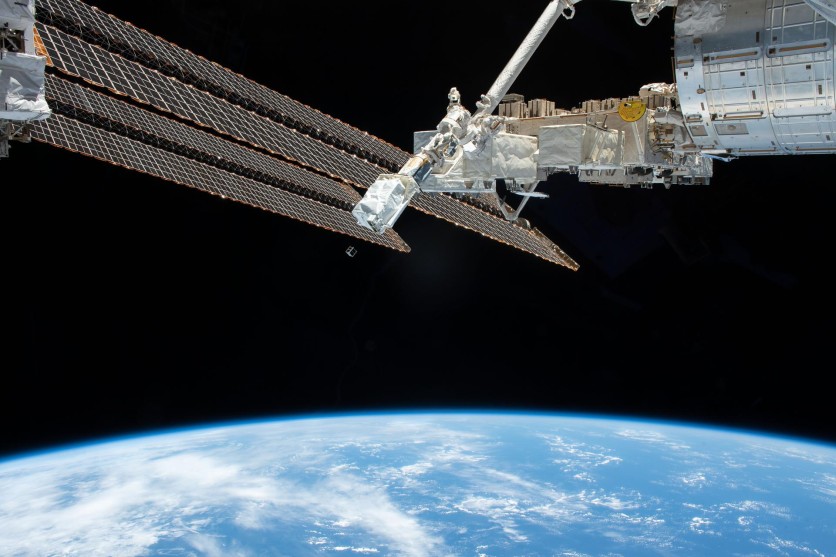
iss063e003633 (4/28/2020) --- The Quetzal-1 CubeSat is seen as it deploys from the JEM Small Satellite Orbital Deployer aboard the International Space Station. Quetzal-1 is Guatemala’s first satellite. It was developed in-house at Universidad del Valle de Guatemala (UVG) and tests a multispectral remote sensor prototype composed of a camera, a piezoelectric motor, and a filter carousel designed to acquire images at different wavelengths. NASA
Nvidia, the dominant force in AI chips, is hiring engineers to help build AI data centers in space — a sign that its orbital ambitions are moving from concept toward actual development as it competes to define the next generation of AI infrastructure.
A job posting is a modest thing, but it is also a tell. Nvidia putting real hiring behind its "SPACE-1" project suggests the idea is graduating from a splashy slide at its GTC conference into staffed engineering work — even as the effort remains, by every honest measure, very early.
From a Slide to a Staffed Project
The company recently posted a listing for a Principal Systems Software Architect for SPACE-1, the software-focused follow-on to an earlier opening for an orbital-data-center system architect that covered hardware and satellite links. SPACE-1 is an orbital data center module built on Vera Rubin, Nvidia's next-generation AI computing platform, which the company unveiled at its GTC conference in March; Nvidia says the Space-1 Vera Rubin module delivers up to 25 times more AI compute per GPU than the H100 for space-based inference.
According to the posting, the new hire would develop core software to keep AI systems running reliably in conditions unlike anything on the ground, and Nvidia wants the module to operate for at least five years and withstand up to 8,000 thermal cycles in sun-synchronous orbit. The listing sets a high bar — 15-plus years of systems-software experience, with space or large-scale systems work preferred — for a base salary the posting puts at $272,000 to $431,250, plus stock.
Why Orbit, and Why It's So Hard
The push stems from the AI industry's "power bottleneck." As AI data-center construction surges in the U.S. and elsewhere, strain on power grids, water shortages for cooling, and local opposition to large facilities have become flashpoints. Orbit dangles an appealing escape: a satellite in the right orbit sees the sun almost continuously, so it draws abundant, near-24-hour solar power without touching a strained grid, and it needs no land, no municipal water, and no zoning permits.
The problem is everything else, and the engineering is brutal. The first obstacle is heat. A data center's other great cost is cooling, and in the vacuum of space there is no air or water to carry heat away. As CEO Jensen Huang put it at GTC, "In space, there's no convection, there's just radiation" — meaning the only way to shed the waste heat of power-hungry GPUs is to radiate it into space through large, heavy panels, an unsolved problem at data-center scale. The second is radiation itself, which degrades chips and corrupts data, forcing both hardened hardware and software that can detect and recover from errors on its own. The third is power timing: even a sun-synchronous orbit passes through eclipse periods when sunlight is blocked, so the system has to ride through on stored power. The fourth is permanence — a chip that fails in orbit generally cannot be repaired, since fixing or upgrading anything means launching again. And the fifth is cost: every kilogram to orbit is expensive, which, for now, likely keeps space less cost-efficient than a building on the ground. On a recent earnings call, Huang acknowledged the economics "are poor today but will improve over time."
Read more: SpaceX AI1 Orbital Data Center Bets on Space Power and Cooling: Economics Stay Unproven
Nvidia Isn't Alone
The race is real even if the payoff isn't proven. SpaceX, following its combination with the AI company xAI, is exploring space-based AI infrastructure — Elon Musk has floated a million-satellite orbital constellation and has filed with regulators toward it — and Google is running orbital-compute experiments through "Project Suncatcher," having tested its TPUs against simulated low-Earth-orbit radiation. Nvidia, whose chips both rivals depend on, is positioning to supply the compute layer of whichever vision pans out.
SPACE-1 is already more than a job posting. Nvidia has named six commercial partners — Axiom Space, Starcloud, Planet Labs, Aetherflux, Kepler Communications, and Sophia Space — and last November Starcloud sent an Nvidia H100 to orbit, the first Nvidia GPU in space. Still, that single chip is essentially the entire real-world track record so far.
The Case for Skepticism
Plenty of serious people doubt the premise. SoftBank's Masayoshi Son, who chairs the $500 billion Stargate AI initiative, has argued the chip costs, launch prices, and inter-satellite latency make orbital compute irrelevant to the AI race's decisive years, and OpenAI's Sam Altman and AWS's Matt Garman have voiced similar doubts. It is worth noting, as one analysis pointed out, that many of the loudest skeptics have large stakes in terrestrial infrastructure succeeding — but so, too, do the boosters have stakes in orbit. The likeliest near-term uses, analysts suggest, are narrow ones that play to space's strengths: processing satellite imagery where it's captured, off-planet data backup, and latency-tolerant batch jobs, rather than training frontier models in the sky.
Read more: Orbital AI Data Centers: Son Cites Latency and Launch Cost as SpaceX Race Heats Up
Whether Nvidia's next battleground — beyond AI chips, for the whole AI infrastructure stack — lies beyond Earth is becoming a real question. For now, the most accurate way to read the SPACE-1 posting is not as a data center going up, but as Nvidia buying a cheap option on the possibility that one eventually will.
Frequently Asked Questions
Is Nvidia building data centers in space?
Not yet. Nvidia has announced a space-specific computing module called SPACE-1 (the Vera Rubin Space Module), named commercial partners, and is now hiring engineers to develop the software for orbital systems — but no Nvidia-powered orbital data center is operating. The only Nvidia hardware in orbit so far is a single H100 GPU that partner Starcloud sent up in November 2025. The current job posting signals that Nvidia is moving from concept toward development, not that a space data center exists.
What is SPACE-1 / the Vera Rubin Space Module?
SPACE-1 is Nvidia's orbital data center module, built on its Vera Rubin AI computing platform and unveiled at the company's GTC conference in March 2026. Nvidia says it delivers up to 25 times more AI compute per GPU than the older H100 for space-based inference, and is engineered for the size, weight, and power constraints of orbit. It is intended to process data from satellite sensors in space rather than sending all of it back to Earth, and to support orbital data centers, geospatial intelligence, and autonomous space operations.
Why put AI data centers in orbit?
The main driver is what the industry calls the "power bottleneck." Building AI data centers on the ground increasingly runs into strained electrical grids, scarce water for cooling, and local opposition to large facilities. In orbit, a satellite can collect near-continuous solar power without drawing on a grid, and needs no land, municipal water, or zoning permits. Proponents see that as a way to expand AI computing capacity beyond the limits constraining terrestrial construction — though whether it is cheaper than building on the ground remains unproven.
What are the challenges of space data centers?
They are substantial. Cooling is hard because the vacuum of space has no air or water to carry heat away, leaving only radiative cooling through large panels. Radiation degrades chips and corrupts data, requiring hardened hardware and self-correcting software. Power must be managed through eclipse periods when sunlight is blocked. Hardware generally cannot be repaired once in orbit, so a failure may mean a total loss. And high launch costs likely keep orbital compute more expensive than ground-based data centers for now. These obstacles are why critics — including SoftBank's Masayoshi Son and OpenAI's Sam Altman — question whether orbital data centers will matter in the near term.

-
 C114 Communication Network
 -
 Communication Home
