
 Search

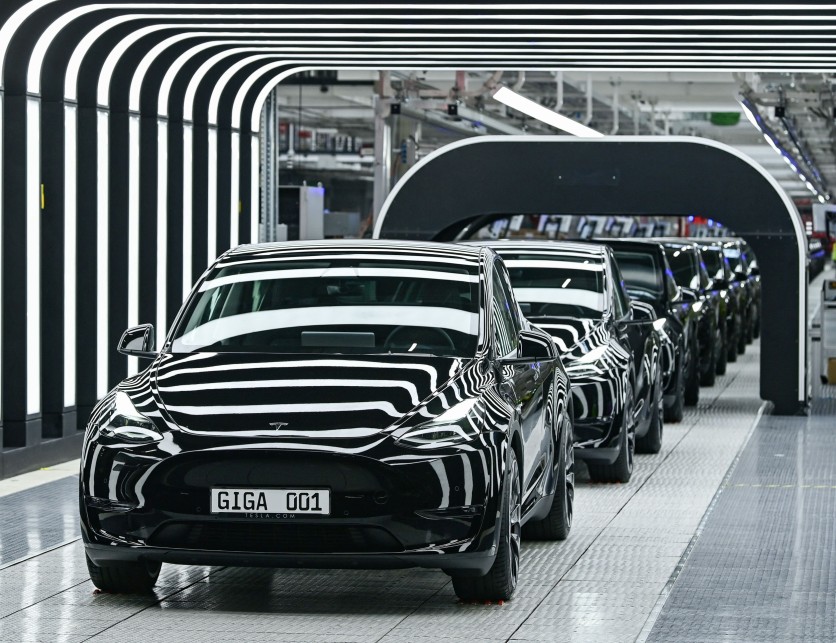
A line of electric vehicles of the model Y is pictured during the start of the production at Tesla's "Gigafactory" on March 22, 2022 in Gruenheide, southeast of Berlin. - US electric car pioneer Tesla received the go-ahead for its "gigafactory" in Germany on March 4, 2022, paving the way for production to begin shortly after an approval process dogged by delays and setbacks. Patrick Pleul/Getty Images
On June 29, 2026, Tesla AI chief Ashok Elluswamy announced that FSD v14 Lite — firmware build 2026.20.5.1 — had begun rolling out to Hardware 3 early-access customers, ending a 16-month software freeze for roughly four million owners who paid as much as $15,000 for a product that Tesla has now confirmed will never deliver what its own name promised. The update is real and worth installing. The promise it represents is not.
"Full Self-Driving" names a capability defined by SAE International's J3016 taxonomy as Level 4 or higher autonomy — a system that monitors the driving environment and does not require a human to intervene. Tesla's product has always been Level 2: the driver must remain attentive and ready to take control at every moment. For years, Tesla insisted that gap would close through software. On April 22, 2026, during the company's first-quarter earnings call, CEO Elon Musk closed that door permanently: "Unfortunately, Hardware 3, I wish it were otherwise, but Hardware 3 simply does not have the capability to achieve unsupervised FSD." The reason is physics, not software: HW3's memory bandwidth — the rate at which data moves between memory and processor during AI inference — is roughly one-eighth that of the Hardware 4 chip Tesla has been shipping since January 2023.
v14 Lite is the consolation. Lawsuits, a Department of Justice criminal probe, and up to $14.5 billion in litigation exposure are the consequences.
What v14 Lite Actually Delivers
The engineering achievement is genuine. Tesla's AI team compressed the full FSD v14 neural network — an end-to-end model that translates raw camera images directly into steering and throttle commands — from a version sized for HW4's memory footprint down to fit within HW3's 8 gigabytes of RAM. The full v14 model requires approximately 12.5 gigabytes of addressable memory to run without degradation; HW3 cannot accommodate it. To make the port work, engineers applied quantization, converting the model's floating-point parameters from 32-bit precision down to INT8 integers, reducing memory demand at the cost of some inference accuracy. Musk acknowledged the scale of the challenge on X: "The AI3 computer only has ~15% of the effective memory bandwidth of AI4, so this was a tough challenge."
The result is a supervised driving system that brings HW3 owners meaningfully closer to the HW4 experience in several concrete ways. According to Tesla's release documentation, Start FSD from Park — which allows the car to pull itself out of a parking space and begin a route without manual engagement — is now available on HW3 for the first time. Arrival Options let drivers pre-select where the vehicle parks at the destination: a parking lot, the street, a driveway, or curbside. Automatic shifting between Drive and Reverse arrives as well, enabling point-to-point routing that handles parking maneuvers without driver input. Speed Profiles now apply on HW3, including Sloth mode at the conservative end, though the more aggressive Mad Max mode was not included in this build.
Beyond new features, Tesla says the underlying driving behavior has been significantly improved across navigation handling, merges and forks, pedestrian interactions, traffic lights, and vehicle cut-in scenarios. Early tester Zack, posting on X, reported zero interventions on a drive from Culver City to Hollywood, including autonomous parking at the Tesla Diner Supercharger.
Why the Compression Has a Permanent Ceiling
The improvement is real. The ceiling is also real, and it is set in silicon.
HW3's memory subsystem uses LPDDR4 memory running at roughly 68 gigabytes per second. HW4 uses GDDR6 at approximately 384 gigabytes per second. That bandwidth differential — more than five-to-one in raw terms, which Musk describes as roughly eight-to-one in effective throughput given the models that run on each — determines how much of a neural network can be loaded and executed per inference cycle. The modern FSD v14 model is an end-to-end architecture: one large neural network reads from eight cameras simultaneously and computes steering and throttle inputs without intermediate hand-coded rules. That model is bandwidth-hungry by design. Quantizing it to fit HW3 introduces quantization noise — approximation error in the model's weights — that manifests as hesitation in complex edge cases: unprotected left turns, construction zones, low-light intersections. The HW3 camera hardware compounds the constraint: 1.2-megapixel sensors versus the 5-megapixel sensors on HW4, meaning the neural network receives less scene detail at distance, reducing early-detection capability at highway speeds. No software update changes either limitation. The full v14 build will not even install on HW3 — Tesla enforces hardware gating that produces a boot failure if the uncompressed model is pushed to the older chip.
Read more: Tesla Full Self-Driving Safety Statistics Called Misleading as EU-Wide Vote Looms
What "Full Self-Driving" Was Always Promising
Tesla marketed Hardware 3 at its April 2019 Autonomy Day with a specific, falsifiable claim: every vehicle produced at that time had "all the hardware necessary, compute and otherwise, for Full Self-Driving." In March 2019, Musk had written on X that anyone who purchased Full Self-Driving would receive a free FSD computer upgrade. Buyers who took Tesla at its word paid between $8,000 and $15,000 for the FSD package over the following years. Many held on through a decade of delays, reassured that the gap between the product and the promise was a software problem that future updates would close.
The April 22 admission closed that reading permanently. FSD v14 Lite, however well it performs, is labeled "FSD (Supervised)" — a Level 2 driver-assistance system. The driver must remain attentive and ready to intervene at all times. No future software update will make an HW3 vehicle operate without supervision. That ceiling is in the chip.
What emerged in parallel is a pattern of actions suggesting Tesla understood its legal exposure before the earnings call. In June 2026, Electrek reported that Tesla had retroactively added "Supervised" to FSD purchase agreements that owners had signed years earlier — in some cases making the original contract documents inaccessible. Tesla also deleted a 2016 blog post stating every vehicle leaving its factory had "the hardware needed for full self-driving capability at a safety level substantially greater than that of a human driver." That post remains accessible through the Internet Archive. California's Office of Administrative Hearings ruled in December 2025 that Tesla's use of the terms "Autopilot" and "Full Self-Driving" in marketing constituted deceptive advertising under state law.
The Lawsuits and the DOJ Probe
The legal reckoning is now multidimensional.
On June 4, 2026, Migliaccio & Rathod LLP filed a federal class-action lawsuit in the Northern District of California — Waller v. Tesla, Case No. 3:26-cv-5350 — on behalf of owners of vehicles equipped with Hardware 1 through Hardware 3. The named plaintiff, David Waller of Kentucky, purchased a 2020 Model S for $81,790 and paid an additional $7,000 for the FSD package on June 29, 2020 — exactly six years before the v14 Lite rollout began. The complaint, which seeks a jury trial on counts of fraud by misrepresentation, fraud by omission, breach of express warranty, and unjust enrichment, uses Musk's own April 22 statement as its central exhibit, arguing it "finally admitted the truth" after years of contrary assurances.
A separately certified class action brought by Cotchett, Pitre & McCarthy covers California buyers who purchased FSD between October 2016 and August 2024 and opted out of arbitration. Judge Rita F. Lin certified that class in August 2025, finding evidence Tesla failed to deliver on its promised autonomy. The court accepted a full-refund theory for damages, meaning class members could potentially recover the entire $5,000 to $15,000 they paid for FSD. Combined global litigation exposure is estimated at up to $14.5 billion.
A California arbitrator has already ordered Tesla to refund $10,600 to one FSD buyer. A $243 million jury verdict in the Benavides wrongful-death case was upheld by a federal judge on February 20, 2026. Tesla faces a Department of Justice criminal probe into its self-driving marketing claims. Internationally, the Dutch collective action organized by Mischa Sigtermans has attracted more than 6,600 participants from 29 countries, representing an estimated 6.5 million euros in FSD purchases on vehicles that Tesla's Hardware 4-only European approval locked out. Thousands of Tesla owners in Australia joined a separate class action in October 2025. In China, ten owners attended a Beijing court hearing in May 2026, seeking $583,000 in damages plus triple compensation under Chinese consumer protection law.
Read more: Tesla Autopilot Claim in Fatal Katy Crash Hits 3.2 Million-Vehicle Recall Probe
What Tesla Has Offered in Return
Following the April earnings call, Tesla outlined two options for HW3 owners who purchased FSD. The first is a trade-in discount toward a new HW4-equipped vehicle. The second is a hardware retrofit — replacing the AI3 computer, installing higher-resolution 5-megapixel cameras, and rewiring the internal wiring harness to handle the increased data throughput the new chip requires. This is not a board swap. The HW3-to-HW4 transition requires partial vehicle disassembly and new camera mounts — substantially more invasive than prior hardware upgrades.
To handle that scope across millions of vehicles, Musk proposed building dedicated urban conversion facilities — "microfactories" — in major metropolitan areas. No confirmed timeline, retrofit pricing, or facility locations have been announced as of June 30, 2026. The FSD Transfer Program, which had previously allowed owners to move their FSD license to a new vehicle, was closed on March 31, 2026 — eliminating one of the cleaner exit paths before any retrofit alternative was operational.
What v14 Lite Means for Hardware 3 Owners Today
FSD v14 Lite is worth installing on its own terms. The driving experience on city streets and highways is expected to be substantially better than what HW3 owners have been living with since February 2025. Point-to-point routing with automated parking — the capability that defines FSD as a usable daily feature rather than a highway convenience tool — arrives for the first time. For supervised daily driving, the improvement may be significant.
What v14 Lite does not and cannot change: HW3 vehicles will remain Level 2 driver-assistance systems. A driver must remain in the seat, alert, hands available, ready to intervene. No software update will alter that classification for this hardware. The next major FSD architecture — v15, which Tesla has indicated is a Hardware 4 priority — is not expected to port to HW3. Consumer Reports' Jake Fisher, senior director of the organization's Auto Test Center, has previously described FSD owners as effectively paying to be test engineers for developing technology, a characterization that now applies to the v14 Lite build's early-access phase.
Whether Tesla's proposed hardware retrofit program eventually makes HW3 owners whole — and on what timeline, at what confirmed cost, and through what verified infrastructure — remains entirely unresolved. Until there is a confirmed schedule, confirmed pricing, and an operational facility, the retrofit offer occupies the same category as many commitments Tesla has made about Full Self-Driving over the past decade: a promise of what is coming, documented in the absence of the thing itself.
Frequently Asked Questions
Will Hardware 3 Tesla vehicles ever achieve unsupervised Full Self-Driving?
No. Tesla CEO Elon Musk confirmed on April 22, 2026 that Hardware 3 cannot achieve unsupervised FSD due to a permanent memory bandwidth constraint — the chip has roughly one-eighth the effective memory bandwidth of Hardware 4, and that gap cannot be overcome through software updates. All future HW3 software, including v14 Lite, will remain Level 2 driver-assistance systems requiring active driver supervision at all times.
Can Hardware 3 owners get a free hardware upgrade?
Tesla has announced a retrofit program for owners who purchased the FSD package, which would replace the AI3 computer, upgrade cameras from 1.2 to 5 megapixels, and rewire the vehicle. No confirmed pricing, timeline, or facility locations have been announced as of June 30, 2026. The FSD Transfer Program that allowed owners to move their license to a new vehicle was closed on March 31, 2026. A trade-in discount toward a new Hardware 4-equipped vehicle has been offered, though specific terms have not been published.
Is Tesla facing a lawsuit over FSD and Hardware 3?
Yes — multiple. A federal class action filed June 4, 2026 (Waller v. Tesla, Case No. 3:26-cv-5350) covers owners of Hardware 1 through Hardware 3 vehicles who paid for FSD. A certified California class action covers FSD buyers from October 2016 through August 2024. A Department of Justice criminal probe into Tesla's self-driving marketing claims is also active. Combined global litigation exposure is estimated at up to $14.5 billion.
What does the FSD v14 Lite update include for Hardware 3 owners?
v14 Lite (firmware 2026.20.5.1) is a compressed version of the FSD v14 neural network, quantized to fit within Hardware 3's 8-gigabyte memory limit. It adds Start FSD from Park, destination arrival options (parking lot, street, driveway, or curbside), automatic shifting between Drive and Reverse, and Speed Profiles including Sloth mode. The update delivers improved driving behavior across navigation, lane handling, and pedestrian interactions — but remains a supervised Level 2 system. Mad Max mode and Actually Smart Summon speed upgrades were not included in this build.

-
 C114 Communication Network
 -
 Communication Home
