
 Search

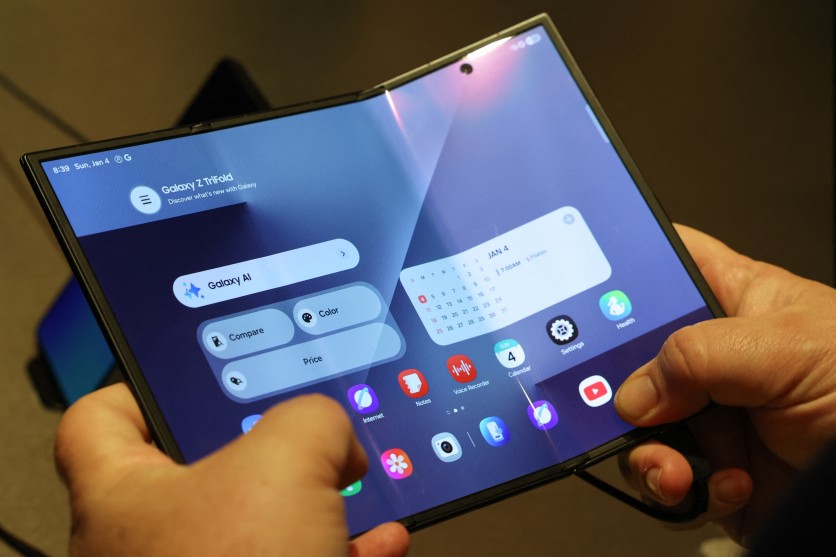
An attendee folds the display of the Samsung Galaxy Z TriFold smart phone during the Samsung Electronics First Look event ahead of the Consumer Electronics Show (CES) in Las Vegas, Nevada on January 4, 2026. Patrick T. Fallon/AFP via Getty Images
Samsung Display will expand a sixth-generation OLED line at its Asan campus — its first new line investment in three years — to keep up with surging panel demand from Apple's foldable iPhone and other next-generation devices, according to a June 30 report by The Elec.
What looks like a routine capacity story is really about how Apple's most ambitious new screens are bending the economics of display manufacturing. The new line is not about making more of the same phone panels; it is about the fact that the devices straining Samsung Display's factories are physically bigger — and bigger panels change the math of what a line can produce.
Why Bigger Screens Force a New Line
A Gen-6 OLED line processes glass "mother sheets" of a fixed size — here about 15,000 of them a month — and dices each sheet into individual panels. How many finished panels a line can make therefore depends on how large each panel is: cut a sheet into many small smartphone screens and you get a lot of panels; cut it into a few large ones and you get far fewer.
That is the heart of why Samsung Display needs more capacity even without a flood of new orders. Samsung Display's A3 and A4 small-and-medium OLED lines are running at 80–90% utilization, and the new products straining them have unusually large panel areas. The foldable iPhone — for which Samsung Display is the exclusive panel supplier under a three-year deal, with first-year shipments estimated at a wide range of 6 to 11 million units — has a far larger unfolded screen than a standard phone, closer to an iPad mini, and the iPad mini OLED is larger too. Each such unit consumes more OLED area and weighs more heavily on Gen-6 capacity than an ordinary smartphone order, so even flat unit demand translates into a capacity crunch. Apple is also expected to apply "four-sided bending" OLED — curving all four edges of the panel to form a nearly bezel-less front — to a 20th-anniversary iPhone, which would enlarge and complicate the panel further.
Read more: Samsung and LG Display Start OLED Production for Apple Premium Lineup as BOE Is Shut Out
A Fast, Cheap Expansion — and a Bottleneck Rivals Can't Clear
Samsung has decided to add Gen-6 OLED equipment to its A4 factory in Asan, South Chungcheong Province, with capacity of about 15,000 substrate sheets a month, The Elec reported; the line isn't yet named, and equipment spending will be split across this year and next, with a detailed schedule expected to firm up in August. Because vacant space already exists — including areas where older lines were dismantled — Samsung can slot in the new tooling without major construction, leveraging existing Gen-6 infrastructure to relieve bottleneck processes and improve its ability to handle next-generation products.
The second advantage is more durable. Japan's Nikon is expected to supply 14 lithography (exposure) units — up from an initially discussed 10 to 11 — and Canon Tokki one deposition unit. Industry sources estimate each exposure tool at around 30 billion won ($19.6 million), putting 14–15 units near 500 billion won ($327 million); adding front-end, back-end, construction, automation, and contingency, they put the total at roughly 3 trillion to as much as 4 trillion won ($2 billion to $2.6 billion). Those are estimates, not confirmed figures. The deposition machine that lays down the OLED material is the single hardest tool to obtain, and Canon Tokki, the world leader, has had its capacity largely pre-booked by Samsung Display — which leaves Chinese rivals trying to build competing lines facing multi-year waits for the one piece of equipment they cannot do without.
Read more: Apple Plans Transparent-Electrode Upgrade for 2028 Four-Edge OLED iPhone: Samsung, LG Display Production Lines
Part of a ₩67 Trillion National Plan
The investment also fits a larger picture. As part of the South Korean government's "three major mega-projects" unveiled June 29, Samsung said Samsung Display would build a base in Asan for next-generation smartphone displays — including foldables — and ultra-high-resolution micro-displays, a plan it valued at 67 trillion won ($44 billion). This A4 Gen-6 expansion is the next-generation smartphone-display portion of that program.
Taken together, the picture is of a supplier widening an already commanding lead: it holds the exclusive foldable contract, the empty cleanroom space to expand quickly, and a lock on the bottleneck equipment, all folded into a national industrial plan. The detailed schedule, and the final scale of the spending, should come into clearer focus in August.
Frequently Asked Questions
Why is Samsung Display expanding its OLED line?
According to a June 30 report by The Elec, Samsung Display is adding a sixth-generation OLED line at its A4 factory in Asan to meet surging demand from Apple's foldable iPhone and other next-generation devices. Its existing A3 and A4 lines are already running at 80–90% utilization. A key reason is that the new Apple devices use unusually large panels, which consume more of a line's fixed sheet capacity per unit than ordinary smartphone screens, so the company needs more capacity even without a large jump in unit orders. It is Samsung Display's first new line investment in three years.
Who supplies the foldable iPhone's display?
Samsung Display is the exclusive supplier of the OLED panel for Apple's first foldable iPhone, under a reported three-year exclusive agreement. First-year panel shipments have been estimated across a wide range — roughly 6 to 11 million units, depending on the source — reflecting the uncertainty around a first-generation product. Samsung Display's long lead in foldable OLED manufacturing, and rivals' difficulty matching its technology and securing equipment, are the main reasons Apple has relied on it as the sole supplier for this device.
What is four-sided bending OLED?
"Four-sided bending" refers to an OLED panel design that curves the display around all four edges of a phone, rather than just the left and right sides, to create a nearly bezel-less front. Apple is expected to apply this technology to a future 20th-anniversary iPhone. Because curving all four edges enlarges and complicates the panel, it increases the OLED area and manufacturing difficulty per device, adding to the capacity demands that are driving Samsung Display's line expansion.
Why are large OLED panels harder to produce?
OLED lines process glass substrate sheets of a fixed size and cut each sheet into individual panels. A line's monthly sheet capacity is fixed, so the larger each panel is, the fewer finished panels a line can produce from the same number of sheets. Devices like the foldable iPhone, whose unfolded screen approaches the size of an iPad mini, and the larger iPad mini OLED therefore consume far more of a line's capacity per unit than a standard smartphone panel. That is why rising demand for large-panel devices can strain capacity even when total unit volumes are not dramatically higher, prompting investments like the new Gen-6 line.

-
 C114 Communication Network
 -
 Communication Home
