
 Search

Devenex
Devenex enters the enterprise AI market at a moment when artificial intelligence is no longer only producing answers. It is beginning to execute.
Inside large organizations, AI agents, automated processes, system events, and human-triggered workflows are moving beyond analysis and recommendation. They can modify records, approve workflows, trigger payments, launch processes, and take actions that carry the authority of the enterprise behind them. That shift changes the risk. The question is no longer only whether an AI system gave the right response. The question is whether the enterprise can govern what happens before an action takes effect.
"Enterprises are moving into an execution era," says Shoaib A. Khan, Co-Founder and CEO of Devenex. "The issue is not simply what AI agents know. It is what they are permitted to do."
That is the structural gap Devenex was built to close. Devenex is the Execution Control Plane for enterprises, an infrastructure that sits between intent and execution. Its role is specific: before an enterprise action moves forward, Devenex policy evaluates it, requires explicit authorization, binds it to identity, and records it as an Evidence Pack -audit grade proof of every Governed Agentic Execution (GAE).
The source of the action does not have to be an AI agent. It can be a human operator, an automated process, or a system event. Devenex is built for the agentic era, but its scope is broader than AI alone. It governs enterprise execution itself.
"An action should not become real simply because a system is able to perform it," says Shoaib. "It should become real because the enterprise can prove it was allowed, authorized, and recorded before it happened."
That distinction matters because much of the enterprise technology stack still treats governance as something that happens after the fact. Monitoring tools, logs, dashboards, and observability platforms can help explain what happened. They can alert teams after a threshold is crossed or provide a record when someone needs to reconstruct a sequence of events. That is useful, but it is not the same as governance.
API gateways manage APIs, not intent. Workflow tools orchestrate steps, not accountability. Automation tools prioritize speed, not Policy.
Devenex's position is that enterprises need a control layer before execution, not a record of regret afterward.
"Downstream evidence has value, but it is not control," Shoaib says. "True governance has to operate at the point where intent is still reversible."
The market timing is not theoretical. Gartner projects that by 2028, a third of enterprise software will incorporate agentic AI, up from less than 1% in 2024 (Gartner, 2026).
STAMFORD, C. (2026) Gartner expects most enterprises to abandon assistive AI for outcome‑focused workflow by 2028,
Those signals point to the same problem. Enterprises are not struggling only with whether AI agents can perform useful work. They are struggling with whether they can scale that work without losing control over who authorised what, which policy applied, why the action proceeded, and whether proof exists.
Those four questions are the center of Devenex's architecture.
Additionally, every governed execution passes through stages: Canonical Plan, Authorization Record, Execution Trace, and Evidence Pack before it becomes operational.
That model is designed to support enterprise compliance needs around the EU AI Act, SOC 2, and ISO 42001. The distinction is important. Devenex is not presented as a compliance certificate. It is an infrastructure architected to help enterprises demonstrate GAE under the frameworks as a unit of accountability that is increasingly shaping AI deployment.
"Compliance cannot depend on a team rebuilding the story after something happens," Shoaib says. "The evidence has to be created as part of the action itself."
The company is backed by Abacus, the Global enterprise technology group with nearly 40 years of experience, more than 5,000 resources across four continents, and more than 1,500 enterprise clients. That institutional foundation is central to the Devenex story. Governance infrastructure is not a consumer AI feature or a lightweight software add-on. It sits close to compliance, risk, security, and operational authority. Enterprises in regulated environments need confidence that the team behind the product understands mission-critical technology at scale.
Abacus has spent decades helping enterprises through major technology transitions, from systems of record and integration to workflow automation and API governance. Devenex applies that experience to the next transition: agentic AI moving from pilot to production. In that respect, a much-needed unit of accountability, the Governed Agentic Execution, plays a pivotal role in adhering to compliance standards.
"Governance vendors cannot ask regulated enterprises to trust theory alone," says Aly Kuly Khan, Co-Founder and Chairman of Devenex. "They need delivery history, enterprise context, and an understanding of what accountability requires in production."
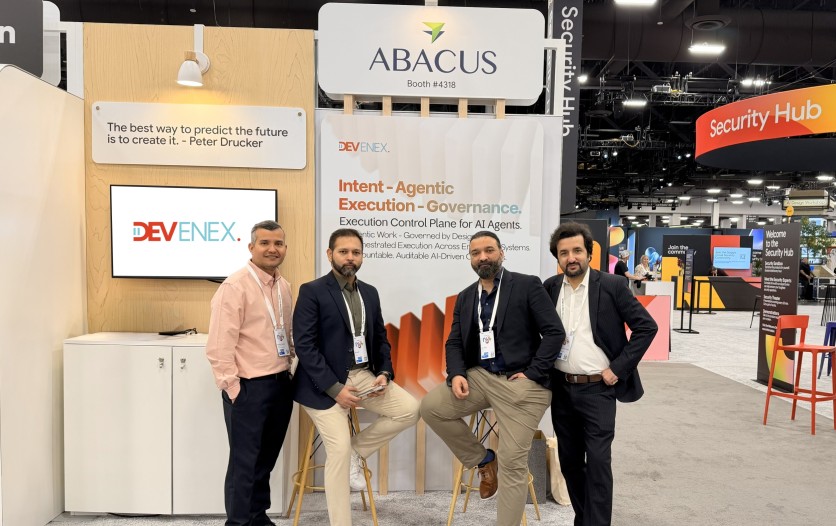
Devenex launched at Google Cloud Next 2026 in Las Vegas on April 22, 2026. The timing matters because agentic AI is becoming a live enterprise concern, not a future planning topic. Organizations are already experimenting with agents and automated workflows that can act across systems. The question is whether those actions are governed before they become operational facts.
The product supports SaaS, hybrid, and self-deployed models, allowing enterprises to adopt it within their own security requirements and at their own pace. It is also system-of-record neutral and cloud-native, designed to govern across existing enterprise environments without replacing systems of record, integration platforms, or identity providers.
That flexibility is part of the larger thesis. Governance cannot become another deployment bottleneck. If it takes too long to implement, enterprises will move ahead without it and try to govern later. Devenex was built around the opposite premise: Governed Agentic Execution has to become part of enterprise infrastructure from the start.
The agentic era will not be defined only by what AI systems can generate. It will be defined by what they are allowed to do. Enterprises that solve that question early will scale AI with more confidence, clearer evidence, and less exposure. Enterprises that treat governance as downstream will face the consequences downstream.
Devenex is built on the belief that execution should not outrun accountability.
"Governed execution is not a future standard," Aly says. "It is the minimum operating model for enterprises that want AI agents to act inside real systems."
For more information, visit the Devenex website.

-
 C114 Communication Network
 -
 Communication Home
