
 Search

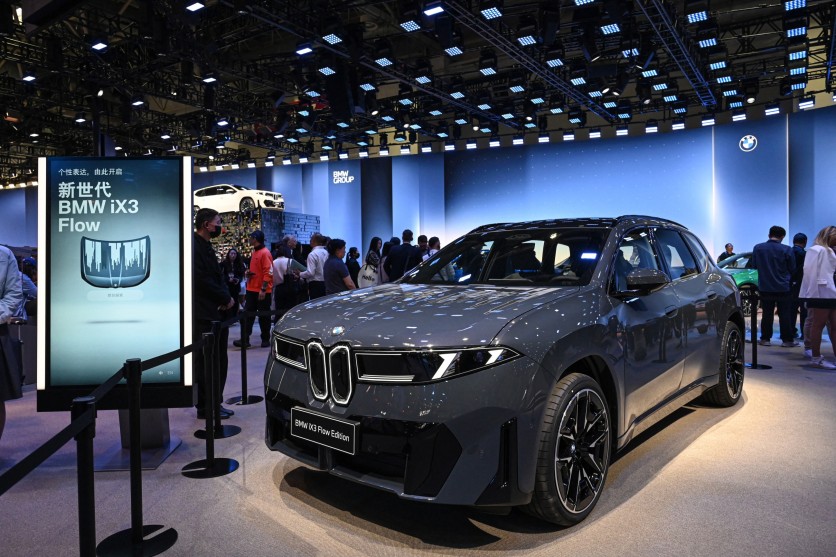
A BMW iX3 is seen on display on the opening day of the Beijing Auto Show in Beijing on April 24, 2026. JADE GAO/AFP via Getty Images
BMW has confirmed that its San Luis Potosí facility in central Mexico will build both the iX3 crossover and the i3 sedan from 2027 — making it the only plant in the Americas selected to produce the German automaker's next-generation Neue Klasse electric vehicles. The announcement, timed to the tenth anniversary of the plant's foundation stone laying, arrives as BMW navigates more than $1 billion in projected annual tariff costs from 25-percent Section 232 duties on vehicles from Mexico that fail US-Mexico-Canada Agreement content thresholds — and it signals that the company is pressing forward regardless of that headwind, as confirmed in BMW Group's official anniversary statement.
Exchange rate as of July 24, 2026; conversions are approximate. The total investment in the expansion is €800 million (approximately $910 million USD), according to independent EV trade reporting on the announcement.
BMW Finally Names the Models for San Luis Potosí
BMW revealed in February 2023 that Neue Klasse electric vehicles would come to Mexico from 2027, but declined at the time to say which ones. That uncertainty ended this week. Klaus von Moltke, president and CEO of BMW Plant San Luis Potosí, confirmed at the plant's tenth-anniversary ceremony that the two models are the Neue Klasse i3 sedan and the Neue Klasse iX3 crossover — known internally by the code names NA0 and NA5, respectively, per BMW Group's official statement on the ceremony.
San Luis Potosí becomes one of only four BMW production sites worldwide selected to assemble Neue Klasse vehicles, alongside Debrecen in Hungary, Munich in Germany, and Shenyang in China, as confirmed by electrive's reporting on the announcement. It is also one of only five global sites authorized to build BMW's sixth-generation (Gen6) battery packs. That dual designation — Neue Klasse vehicle assembly AND Gen6 battery production under one roof — is what the €800 million (~$910M) expansion buys: a more than 110,000-square-meter (1.18 million square foot) expansion of the plant's footprint, with more than €500 million (~$569 million) dedicated to a new high-voltage battery assembly center covering over 80,000 square meters (861,000 square feet).
The iX3 is expected to begin production in Mexico in August 2027, approximately two years after it first launched at Debrecen. The i3 sedan, whose Munich production is scheduled to begin in August 2026, will follow at San Luis Potosí thereafter, as reported in TechTimes' detailed guide to the BMW i3 sedan for US buyers. Both models will share the expanded assembly line with existing combustion-engine vehicles during the production ramp-up.
Read more: BMW's iX3 Prototype Showcases Gen6 eDrive: 800 km Range & 400 kW Charging
What the Neue Klasse iX3 and i3 Actually Are
For buyers unfamiliar with the Neue Klasse platform, these are not updated versions of previous BMW electrics — they are built on an entirely new architecture designed exclusively for battery-electric vehicles, with no shared components with BMW's current combustion or hybrid platforms, as detailed in BMW Group's Neue Klasse platform overview.
The iX3, which launched at IAA Mobility in September 2025 and entered production in Debrecen in late 2025, has already drawn more than 50,000 European orders without most buyers having sat in one — a signal of pent-up demand. In the United States, the iX3 50 xDrive currently starts at $61,500 and is being sourced from Debrecen. BMW has not confirmed a US market allocation for the future Mexico-built iX3 — American buyers should note that Debrecen-built production is the US supply source at least through the initial ramp-up in San Luis Potosí.
The i3 sedan — the Neue Klasse's second model and not to be confused with BMW's discontinued i3 hatchback of the 2010s — opened European order books in June 2026 at a starting price of £57,905 in the United Kingdom, as covered in TechTimes' BMW i3 buyers guide. BMW has confirmed a 2027 model year for the US, but has not released official American pricing.
Why BMW's Mexico Investment Is Effectively Locked In
The scale of the battery center investment is not incidental. It reflects an engineering reality that goes beyond standard manufacturing economics: the Gen6 battery in the Neue Klasse is structurally integrated into the vehicle body itself — the battery housing serves as a load-bearing element of the car's chassis, with cylindrical cells installed directly into that housing during the body assembly phase, not bolted on as a finished pack at the end of the line, as BMW Blog's technical deep dive on the Gen6 architecture explains.
That integration is precisely why only five sites in the world — Debrecen, Munich, Shenyang, Spartanburg (for future models), and now San Luis Potosí — are authorized to build the Gen6 battery, per electrive's coverage of the announcement. A facility cannot produce a Neue Klasse vehicle without a co-located, synchronized battery assembly center. The €500 million (~$569M) battery center is not optional supporting infrastructure. It is the engineering precondition for building the car. Once that center is operational, the cost of reversing the commitment would exceed the cost of proceeding — tariff environment notwithstanding.
Von Moltke addressed the tariff climate directly at the anniversary ceremony: "In a context of constant changes for the automotive industry, our message is clear: we remain confident in Mexico, we remain confident in San Luis Potosí, and we remain investing in the future we will build together," according to BMW Group's official anniversary statement.
That confidence has a technical backstop the diplomatic language does not need to name.
Gen6 Battery: What Buyers in the Americas Need to Know
The sixth-generation eDrive system is the most significant engineering change BMW has made to its electric vehicles since it introduced the i3 hatchback in 2013. Key differences from previous BMW EV architecture, as detailed in BMW Group's Gen6 technology documentation:
BMW switched from prismatic (flat, rectangular) lithium-ion cells to cylindrical cells in the 4695 format (46 mm diameter, 95 mm height). The new cells achieve roughly 20 percent greater energy density than the Gen5 prismatic cells, with a pack mass approximately 60 to 70 kilograms (132 to 154 lbs) lighter for an equivalent capacity. The iX3 is available with an 82.7 kWh pack or a 108.7 kWh pack, per battery technical analysis from batterydesign.net.
The system voltage jumps to 800 volts, enabling peak DC charging at up to 400 kilowatts — enough to add more than 350 km (217 miles) of range in approximately ten minutes under optimal conditions. A full 10-to-80-percent charge takes around 21 minutes at a capable station, as confirmed in BMW's official US pricing and specs release. The EPA-certified range for the iX3 50 xDrive has been confirmed at up to 434 miles (698 km), making it one of the longer-range EVs in the premium crossover segment.
The platform also introduces native bidirectional charging (V2H, V2G, V2L) — meaning a Neue Klasse vehicle can serve as a home battery backup or supply power to external devices, per BMW Group's Gen6 technology documentation.
How Does BMW's Mexico Plant Compare to Debrecen and Munich?
San Luis Potosí has a production history that distinguishes it from a typical low-cost contract facility. The plant began operations in 2019 and has since produced more than 550,000 vehicles, including the 3 Series, the 2 Series Coupé, and the high-performance M2 — both of the latter assembled exclusively in Mexico for global distribution, as documented in BMW Group's official anniversary statement. Cumulative investment at the site is approaching $2 billion USD. The plant currently employs approximately 3,700 people, and the Neue Klasse expansion is creating around 1,000 additional jobs, with more than 500 dedicated to the new battery assembly center.
By the second year of Neue Klasse production, the battery facility is expected to reach an annual output of approximately 140,000 Gen6 packs across two shifts. Total Neue Klasse vehicle capacity at the plant is projected at approximately 175,000 units per year once the ramp-up is complete, according to BMWBlog's reporting on the San Luis Potosí production plans.
Debrecen in Hungary, BMW's first purpose-built EV-only facility, began Neue Klasse production in late 2025 and is the current exclusive source of the iX3 for European and US markets. Munich's main plant — BMW's historical heart — is transitioning to i3 sedan production beginning August 2026, and will focus exclusively on electric vehicles by 2027. Shenyang in China serves BMW's large domestic Chinese EV market with Neue Klasse variants built in partnership with Brilliance Auto. San Luis Potosí is the western hemisphere's only entry in that short list.
Tariff Headwinds and the USMCA Question US Buyers Should Watch
BMW is among the automakers that have reported or projected more than $1 billion in tariff-related costs. Section 232 national security tariffs of 25 percent took effect in April 2025 on vehicles from Mexico that do not meet the USMCA's 75-percent North American content threshold, per tariff guidance published by CalcMyTariff. Mexico's total automotive exports to the US fell 5.1 percent year over year in the first four months of 2026, a direct consequence of that tariff structure.
The first USMCA joint review in the agreement's history is underway in July 2026, with Mexico and the US reportedly having narrowed their list of outstanding disputes from 54 to 14. For BMW, the key question is whether Mexico-built Neue Klasse vehicles will qualify for USMCA duty-free treatment — which turns on whether the Gen6 battery's supply chain can source enough North American content to meet the 75-percent threshold. BMW has not confirmed a USMCA compliance plan for the Neue Klasse; given that the plant's battery center is still under construction, that determination is likely 12 to 18 months away.
BMW's global export strategy provides some insulation from US-specific tariff risk. San Luis Potosí was conceived from the outset as a global export hub, not a US-centric production site. Depending on the model year and model variant, between 30 and 42 percent of current San Luis Potosí output goes to the United States, while up to 40 percent of certain models — currently the 2 Series Coupé and M2 — goes to China. The remainder reaches Europe, the Middle East, Latin America, and Asia-Pacific, markets Mexico can access via its extensive free trade agreement network. That geographic diversification means BMW is not wholly dependent on USMCA outcome for the Mexico investment to be viable.
Read more: BMW i3 Electric Sedan: 563-Mile WLTP Claim, Real-World Range Gap, 800V Gen6 Tech
What Mexico's Automotive Sector Gains
San Luis Potosí — a central Mexican state whose exports have grown an estimated 1,600 percent since BMW's arrival in 2016 — will become the first premium automotive manufacturing location in Mexico, and the first BMW facility in North America, to build fully electric vehicles and their battery systems under one roof, per BMW Group's official anniversary announcement. That milestone matters beyond BMW's own supply chain: it establishes Mexico as a serious participant in EV manufacturing at a moment when the industry's geographic center of gravity is shifting rapidly.
The announcement is also a data point in the broader nearshoring trend. Supply chain disruptions during the pandemic years exposed the risk of over-relying on a single manufacturing region; BMW's decision to distribute Neue Klasse production across Hungary, Germany, China, and Mexico reflects an explicit hedge against that vulnerability, as electrive's reporting on the global Neue Klasse production network makes clear. For Mexico's government, whose negotiating agenda at the USMCA review centers on protecting automotive sector competitiveness, the BMW announcement is the kind of forward-investment signal that strengthens its negotiating position.
Frequently Asked Questions
Will the BMW iX3 and i3 built in Mexico be sold in the United States?
BMW has not confirmed a US market allocation for Mexico-built Neue Klasse vehicles. As of July 2026, American buyers purchasing an iX3 receive a model built at BMW's Debrecen plant in Hungary. Mexico production is scheduled to begin in mid-to-late 2027, and any US delivery timeline for Mexico-built vehicles will depend on both production ramp-up progress and the outcome of the ongoing USMCA 2026 joint review, which determines whether those vehicles enter the US duty-free or face a 25-percent Section 232 tariff.
How is BMW's sixth-generation Gen6 battery different from previous BMW EV batteries?
The Gen6 system replaces BMW's previous flat, prismatic lithium-ion cells with cylindrical cells in the 4695 format, achieving roughly 20 percent greater energy density at the cell level and enabling a system voltage of 800 volts — up from 400 volts in earlier BMW EVs. The most consequential engineering change is structural: the Gen6 battery housing is integrated directly into the vehicle's body structure, meaning cells are installed during the body assembly phase rather than added as a finished pack. This allows BMW to save weight and packaging space but requires a fundamentally different manufacturing facility — which is why only five sites globally are authorized to build it, as detailed in BMW Group's Gen6 technical documentation.
Why does BMW's Mexico plant need a $569M battery center just to build the iX3 and i3?
Because the Gen6 battery cannot be built separately and shipped to the assembly line — its housing is part of the car's body structure. The cells must be installed into the housing during the body shop phase. That means the battery center must be physically adjacent to and synchronized with vehicle body assembly, which is why €500 million (~$569M) of BMW's total €800 million (~$910M) expansion goes specifically to the new high-voltage battery assembly facility. A plant without that center simply cannot produce a Neue Klasse vehicle, as batterydesign.net's technical analysis of the structural integration explains.
What does the USMCA 2026 review mean for buyers considering a BMW EV?
The USMCA review, the first in the agreement's history and currently underway in July 2026, will determine whether Mexico-produced vehicles can continue entering the US market duty-free or remain subject to 25-percent Section 232 tariffs on non-USMCA-compliant goods. For a hypothetical $65,000 BMW iX3 built in Mexico, a 25-percent tariff represents a $16,250 added cost — a figure that would either compress BMW's margins or be passed through to buyers, per tariff guidance from CalcMyTariff and USMCA strategic analysis from the Baker Institute. BMW has not released pricing for Mexico-built Neue Klasse models, and confirmation of US market allocation has not been made. Buyers considering a Neue Klasse purchase in 2027 should watch USMCA review developments closely, as the outcome will directly shape what BMW-built-in-Mexico vehicles cost in the American market.

-
 C114 Communication Network
 -
 Communication Home
