
 Search

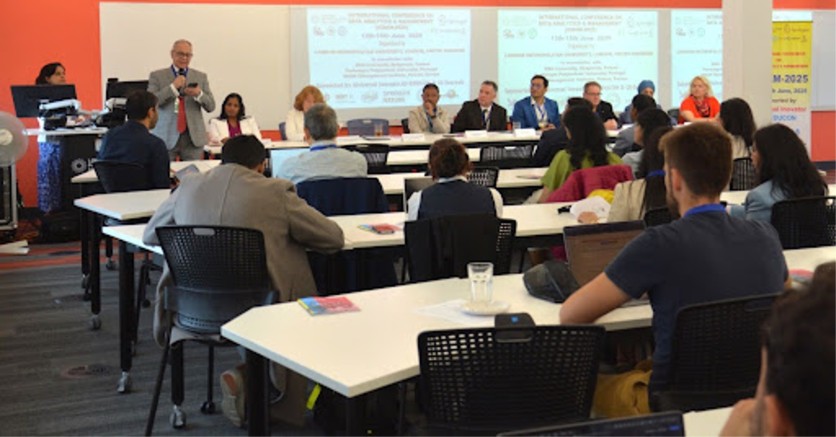
ICDAM Conference
Every June, London Metropolitan University becomes a meeting point for researchers trying to solve the kinds of technical problems that eventually shape real industries. The International Conference on Data Analytics and Management, or ICDAM, brings together work from across machine learning, cybersecurity, wireless systems, cloud computing, and related fields, with submissions spanning 27 technical categories and a reported acceptance rate of around 17 percent. That level of selectivity has helped make the conference a respected venue for research that aims to do more than sound interesting on paper.
In 2025, Sachin Singh received the ICDAM Best Paper Award for his research on AI-driven detection and mitigation of Distributed Denial of Service (DDoS) attacks in 5G networks — one of the telecom industry's most urgent vulnerabilities. The recognition was significant on its own, but the real force of the paper came from what it represented: a study grounded in an increasingly urgent industry problem, backed by operational experience, and aimed squarely at the future of network security.
Why This Problem Now Commands So Much Attention
5G expanded what wireless networks can do, but it expanded the attack surface just as quickly. Billions of devices, ultra-low latency, cloud-native architecture, and multi-vendor environments have created a system that is faster and more capable than anything before it, but harder to defend with legacy methods. Static rule sets and threshold-based alarms were built for simpler network behavior. They struggle in systems where malicious traffic can imitate legitimate activity and adapt in real time.
That is the problem at the heart of Sachin Singh's research. Singh has spent years working across large-scale wireless programs, research-led telecom problem solving, and next-generation network operations. In this work, he examined how machine learning models trained on real network behavior can identify abnormal traffic patterns in context instead of depending on fixed signatures alone. His work moves the conversation beyond conventional detection logic and toward a more intelligent security model — one that reads behavior.
AI-driven detection is increasingly seen across the telecom sector as essential to protecting modern mobile infrastructure as 5G networks scale and become more distributed. Industry discussion has moved steadily toward automation, observability, and AI-assisted network intelligence as necessary tools for managing the complexity of new wireless environments. Singh's research advances that discussion with clear timing and practical weight.
More importantly, the paper introduces a more definitive line of thinking: context-aware behavioral modeling can do what traditional rule-based systems often cannot, especially in fast-moving environments where threat patterns mutate quickly.
Where Research Meets Real Network Conditions
What gives Singh's work its real authority is that it is shaped by field conditions. A key part of that background is his work in EchoStar's ORCID Lab, the Open RAN Center for Integration and Deployment, supported through a $50 million award from the U.S. Department of Commerce's National Telecommunications and Information Administration. In ORCID, trusted participants could test and validate Open RAN solutions on a live, commercial-grade Open RAN 5G network.
That kind of experience matters because the hardest security problems in telecom rarely appear in isolation. They show up in messy, high-pressure, multi-vendor environments where timing, performance, compliance, and resilience all collide. Those same conditions run through Singh's broader body of work. His published research includes papers on Open RAN in multi-vendor environments, AI-driven 5G optimization, observability in wireless networks, and machine learning applications for network security and performance management.
Rather than treating 5G security as a narrow cyber issue, Singh's research places it inside the broader realities of network behavior, interoperability, and systems governance. In practical terms, that means moving from reactive alerting toward models that can identify abnormal patterns in the context of how live telecom systems actually function. It is a more operational way of thinking about security — and one that aligns with where the industry is heading.
"As 5G networks become increasingly cloud-native and distributed, operators are moving toward AI-driven security models that can identify abnormal behavior in real time rather than relying solely on static signatures," Singh said.
That broader industry reality gives Singh's work added resonance, as it addresses a pressing need across the market.
From Published Research to Applied System Development
The work does not stop at publication. Beyond research papers, Singh's contributions extend to applied system development aimed at real-world deployment problems in telecommunications. He has developed a United States patent-pending Open Radio Access Network Component Testing and Validation Portal System intended to standardize cross-vendor interoperability testing before deployment. Within EchoStar, the portal was used to support onboarding and interoperability validation for Open RAN partners across multiple vendor environments.
Singh holds registered design rights issued by the UK Intellectual Property Office for a Cloud-Based Data Processing Unit and a 5G-enabled Smart City Infrastructure device, both reflecting applied work in telecom and smart infrastructure systems tied to next-generation connectivity. He has also filed an Indian patent publication focused on a deep learning method for detecting and preventing cyber threats in IoT environments, extending his work into AI-driven security for connected systems beyond the core telecom stack.
The conference recognized one paper, but the paper itself sits within a profile that includes registered intellectual property in telecom and smart infrastructure systems, sustained publication in 5G and Open RAN research, and hands-on work in operational telecom environments. The research mattered because it emerged from a practitioner already working at the fault lines of the problem.
What ICDAM 2025 ultimately revealed about AI-driven 5G security is that the field is moving toward smarter, behavior-aware defenses grounded in real network conditions. It also revealed that research is most powerful when it helps operators develop a better framework for acting on it. In that sense, Singh's contribution feels timely for the conference, but even more timely for the industry it was written to serve.

-
 C114 Communication Network
 -
 Communication Home
