
 Search

Alpinecars.com
The 2026 Goodwood Festival of Speed closes Sunday with something the automotive world has been waiting a decade to see: three distinct electric and hybrid powertrain architectures — each engineered to solve a different physical constraint — completing real competitive hillclimb runs in front of a live crowd. Alpine's A110 FUTURE has spent all four days validating a split cell-to-pack battery layout that is the first publicly demonstrated engineering answer to the weight-distribution problem that has kept EV sports cars from replacing their combustion equivalents. Toyota's GR GT made its first undisguised European dynamic debut with a purpose-built V8 hybrid transaxle. And BYD's Yangwang U9 Xtreme, already the holder of the fastest single-direction top speed run ever recorded for a production car, navigated a tight nine-corner hillclimb on the same 1,200-volt platform that it used to reach 308.4 mph in Germany last September.
The Timed Shoot-Out Final, where the weekend's fastest machines compete for the outright hillclimb title, begins at 14:55 BST — approximately 09:55 ET — this afternoon. Dan Ticktum in the Formula E Gen 4 car, who posted a 44.7-second run in Friday's Official Practice, is the session pace-setter. The outright hillclimb record — 39.08 seconds set in 2022 by Max Chilton in the electric McMurtry Spéirling fan car — is not expected to fall today.
Alpine's Split-Pack Battery Solves a Problem Flat-Pack EVs Cannot
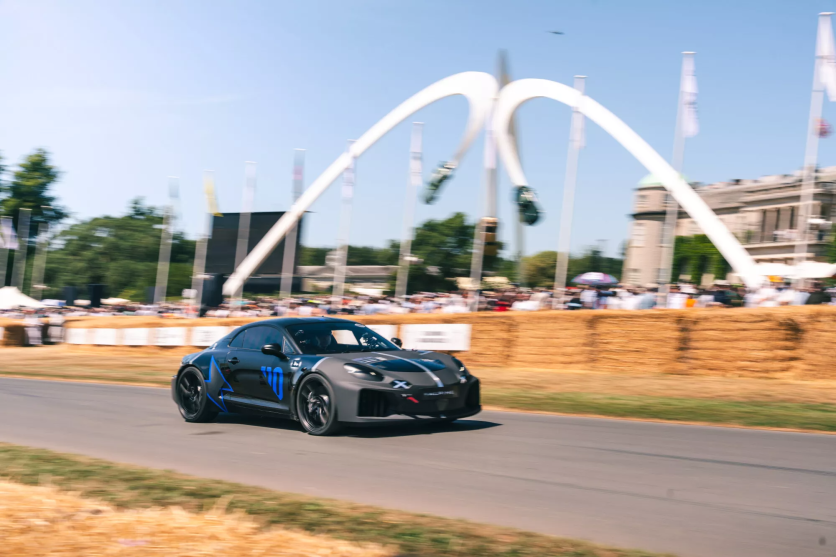
The most architecturally significant debut of the 2026 festival is a car that cannot be bought: the Alpine A110 FUTURE, a development mule built to validate the Alpine Performance Platform ahead of the third-generation A110 electric sports car, due in production form in late 2026 or early 2027.
Every prior EV sports car has faced the same constraint. Placing a single large battery pack flat across the vehicle floor — the industry-standard skateboard layout — optimizes packaging efficiency and manufacturing simplicity. It does not allow engineers meaningful control over front-to-rear weight distribution. The result has been either a heavier car than the model it replaces, or one whose handling character diverges from its combustion predecessor.
Alpine's engineers built a different answer. The A110 FUTURE runs two separate cell-to-pack battery packs — one positioned where the combustion engine previously sat, the other ahead of the cabin — with energy distributed 25% front and 75% rear. That specific ratio achieves a 40:60 front-to-rear weight distribution, replicating the balance that defines the current A110's handling character. The packs use high-pressure die-cast aluminum casing that contributes directly to structural stiffness without requiring a separate chassis element, making the battery a structural load-bearing component rather than cargo sitting inside a frame.
The electrical system runs on 800 volts — double the standard of most current EVs — enabling ultra-fast charging speeds and sustaining the performance output of the dual rear e-motors without thermal saturation. Those motors are driven by 3-in-1 e-machines with silicon carbide (SiC) inverters, a material choice that matters. Conventional silicon inverters generate heat as a byproduct of switching current; SiC switches current more precisely and at higher temperatures, reducing cooling mass and inverter size while improving efficiency. The permanent magnet synchronous motors are rated to spin to 21,500 rpm, and a 400V boost charging topology runs alongside the primary 800V system to broaden charging compatibility.
Active Torque Vectoring 2.0 coordinates the two rear motors in real time, acting as an electronic differential that distributes torque between the rear wheels on a millisecond timescale — faster than any mechanical limited-slip differential. Alpine CEO Philippe Krief has described this specifically as the engineering answer to the weight penalty of EV conversion: a heavier car that responds with millisecond precision to cornering demands can match, or exceed, the feel of a lighter car with mechanical handling aids.
Pierre Gasly, after his Thursday debut run with the Duke of Richmond as passenger, said in a statement that Alpine "continues to show that an electric sports car can be lighter, sharper and really enjoyable to drive." The mule ran the hill on all four days, giving Alpine's engineers a sustained real-world dataset on the platform's dynamic behavior under repeated hillclimb loads. Target output is approximately 464 hp, with curb weight targeting roughly 1,500 kg — significantly heavier than the current A110's 1,100 kg but meaningfully lighter than most performance EVs. These figures remain unconfirmed and subject to change before production launch.
Production of the current petrol A110 ended on July 1, 2026, when the 28,701st example — an A110 R 70 in Alpine Blue — left the Dieppe factory in Normandy, closing a 35,450-unit production run across both generations since 1969. The electric A110 FUTURE took to the Goodwood hill eight days later.
The platform will also underpin a roadster derivative and a new A310 — a 2+2 grand tourer targeting Porsche 911 competition, expected around 2028.
Read more: Alpine A110 Electric Mule Debuts at Goodwood With 800V Split-Battery Architecture
Toyota's GR GT Makes Europe's First Undisguised Dynamic Debut
Toyota's Gazoo Racing used this year's festival for the first undisguised dynamic European appearance of the GR GT road car and its track-only sibling, the GR GT3. Both previously appeared in camouflage at the 2025 festival.
At the core of the GR GT is Toyota's first 90-degree bank-angle 4.0-litre twin-turbocharged V8 — an entirely new unit not derived from any existing Toyota powerplant — paired with a single-motor hybrid system integrated directly into the transaxle. The transaxle integration is the architectural choice that separates the GR GT from most contemporary hybrid supercars: rather than placing an e-motor on a separate axle and running the combustion and electric outputs in parallel, Toyota has combined them into a single rear-mounted unit, concentrating the hybrid system's mass at the rear and reducing the mechanical complexity of the power delivery path. Combined output targets 650 PS (641 hp) with maximum torque of 850 Nm (627 lb-ft), with an official 0–62 mph target under 4.0 seconds and a maximum speed approaching 199 mph.
The chassis uses an all-aluminum body frame prioritizing low weight, high rigidity, low center of gravity, and aerodynamic stability. Production is scheduled to begin in 2027, with cars sold through select Lexus dealerships.
The track-only GR GT3 shares the V8 twin-turbo architecture but is built to FIA GT3 specification on an all-aluminum frame — the first GT3-spec car Toyota has built on this material. It measures 4,785 mm in length with a 2,725 mm wheelbase.
Toyota's hillclimb program at the 2026 festival also included the Le Mans-winning TR010 Hybrid No. 7 — the car that gave Toyota its sixth overall Le Mans victory in June, piloted by Mike Conway, Kamui Kobayashi, and Nyck de Vries, and currently leading both the 2026 FIA World Endurance Championship driver and manufacturer standings. The Lexus LFA Concept, a static display previewing a future battery-electric supercar sharing the GR GT's aluminum architecture, also appeared at the Toyota/Lexus stand.
Yangwang U9 Xtreme: What 1,200 Volts Means at Hillclimb Speed
The Yangwang U9 Xtreme — the performance flagship of BYD's ultra-luxury Yangwang sub-brand — arrived at Goodwood for its European debut with the most extreme numerical claim in the paddock. On September 14, 2025, at Germany's ATP Automotive Testing Papenburg proving ground, the U9 Xtreme reached 308.4 mph (496.22 km/h) in a run certified by ATP, surpassing the Bugatti Chiron Super Sport's 304.8 mph mark from 2019. It is the fastest single-direction top-speed run ever completed by a production car.
An important qualification applies to this figure: standard Guinness World Records methodology requires a two-directional average within one hour. The U9 Xtreme's run was conducted in a single direction, which excludes it from the official Guinness production car speed list. Yangwang's own materials describe the result as a "certified top speed" rather than a Guinness record.
The U9 Xtreme's technical foundation for the speed run is its 1,200-volt electrical platform — the highest voltage of any production vehicle currently available — an increase from the standard U9's 800V system. That voltage step allows the platform's battery to improve power density by approximately 170% over the base car's configuration, per BYD's data. Four ultra-high-speed electric motors operate at up to 30,000 rpm, built from the thinnest super-silicon steel in mass production at just 0.1mm per layer, delivering a combined output of approximately 3,000 hp and a power-to-weight ratio of 1,217 hp per tonne. Only 30 examples are planned for the entire production run.
At Goodwood's nine-corner, 1.16-mile hillclimb, the same platform demonstrated a different capability: the DiSus-X intelligent body control system managed the car's chassis attitude on the tight, low-speed corners without modification. The U9 Xtreme also holds the production EV Nürburgring Nordschleife lap time of 6:59.157 — the first production-spec EV to complete the circuit in under seven minutes, though that time has not yet appeared on the Nürburgring's official certified list.
Yangwang is a sub-brand of BYD, a company headquartered in Shenzhen, China. China's National Intelligence Law (2017), Article 7, requires all Chinese organizations to "support, assist, and cooperate with national intelligence efforts in accordance with law." China's Cybersecurity Law (2017), Article 28, requires network operators to provide technical support to public security and national security organs. Both obligations apply to BYD regardless of where its vehicles are sold. The scope of Article 7's data-sharing obligation is contested by legal scholars, but Article 28's technical-cooperation requirement is not. For a full analysis of BYD's data obligations, documented security research findings, and UK regulatory status, see the TechTimes coverage below.
Read more: Denza Z Hits Goodwood: Five-Minute Charging, 1,604 PS, and China's Data Obligation
Day-by-Day: What the 2026 Festival Delivered
The 2026 Goodwood Festival of Speed, running Thursday July 9 through Sunday July 12 at Goodwood House in West Sussex, was built around the theme "The Rivals — Epic Racing Duels", marking the 60th anniversary of Ford's 1-2-3 finish over Ferrari at the 1966 Le Mans 24 Hours, the 50th anniversary of the Hunt vs. Lauda 1976 Formula 1 Championship, and the 30th anniversary of Damon Hill's 1996 world title.
Thursday was the largest single-day reveal slate in the event's recent history. Alongside the Alpine A110 FUTURE's dynamic debut, BYD Group staged what it described as its biggest Goodwood display to date — 2,016 square metres — headlined by the global debut of the Denza Z Coupé, a 1,604 PS three-motor all-electric 2+2 designed by Wolfgang Egger. The Red Bull RB17 — Adrian Newey's 4.5-litre V10 hypercar — made its first public dynamic appearance, driven by Newey himself alongside F1 drivers Isack Hadjar and Yuki Tsunoda.
Friday opened the Timed Shoot-Out Official Practice at 14:05. The Toyota GR GT and GR GT3 made their European dynamic debuts in the Supercar sessions. Reports from the event placed Ticktum's Formula E Gen 4 car quickest in practice at 44.7 seconds, with Romain Dumas in the Ford Super Mustang Mach-E approximately a second behind. The Forest Rally Stage presented by Subaru ran the Dacia Sandrider — winner of the 2026 Dakar Rally — piloted by Sébastien Loeb.
Saturday was the event's social peak. 2025 Formula 1 World Champion Lando Norris took the McLaren MCL60 up the hill before receiving the Goodwood House balcony tribute, a ceremony marking world champions and sporting greats. Timed Shoot-Out Qualifying ran at 14:50. Ferrari completed a six-car F1 historical program marking 75 years since Scuderia Ferrari's first World Championship Grand Prix victory at Silverstone in 1951, running the F300, F1-2000, F2007, and SF21. The Cartier Style et Luxe concours d'élégance took place on the estate lawn.
Sunday brings the Timed Shoot-Out Final at 14:55 BST. 1996 Formula 1 World Champion Damon Hill has a particular role at today's close, with the Williams team — including principal James Vowles, Luke Browning, and Jamie Chadwick — joining Hill for the 30th anniversary celebration. The Shoot-Out entry list spans pre-war Grand Prix machinery through Formula E single-seaters, production road cars, and the full range of contemporary GT machinery.
Other Technology Highlights
Formula E Gen 4 made Goodwood's most ambitious EV competition appearance to date. Ticktum's car may run at elevated power in the Sunday final — reports indicate organizers could permit up to 700 kW (940 hp) on slick tires.
McLaren brought three separate narratives: the 788HS, a limited-production send-off to the 720S generation; the historic MCL60 driven by Norris on Saturday; and the MCL-HY, the team's new Le Mans hybrid hypercar scheduled to contest the FIA World Endurance Championship from 2027, making its first hillclimb run at this event.
Gordon Murray Automotive brought all four current models, every one powered by a naturally aspirated Cosworth-built V12 and representing one of the last committed holdouts against forced induction at the hypercar level. The T.50s Niki Lauda made its debut as the first customer-ready production car.
Ferrari's program included three dynamic debuts: the Amalfi (front-mid V8), the 296 Speciale A (880 cv plug-in hybrid spider), and the 849 Testarossa (1,050 cv twin-turbo V8 and three-motor plug-in hybrid grand tourer). The 20th anniversary of the Ferrari XX Client Program was also marked.
The Hunt vs. Lauda Anniversary was woven through the event — James Hunt's 1976 Championship-winning McLaren M23D ran on the hill, while Gerhard Berger received the Saturday balcony tribute connecting the event's rivalry theme to the Hunt/Lauda era.
The 1966 Le Mans tribute produced one of the event's most visually striking moments: chassis P/1046, P/1015, and P/1016 — the three Ford GT40 MkIIs from that famous finish — appearing together on the hill for what Magneto Magazine described as a historically unprecedented gathering of the three cars.
Where to Watch
The Goodwood Road & Racing YouTube channel is carrying a free live stream. Sunday's main broadcast began at 08:55 BST; the Timed Shoot-Out Final begins at 14:55 BST (09:55 ET). For those at the event, all 12 grandstands along the hillclimb from the Startline to Molecomb Corner are accessible with Roving Grandstand passes.
The 2026 Goodwood Revival, which will bring the three Le Mans-winning GT40s back to the estate, is scheduled for September.
Is the Performance EV Transition Actually Happening?
The 2026 festival's answer is: yes, in distinct stages. Alpine's A110 FUTURE is not a finished car — it is a rolling engineering test that confirms the split-pack architecture can be driven dynamically without the weight-balance compromise that has haunted every prior EV sports car. Toyota's GR GT is the first new V8 hybrid supercar from a Japanese manufacturer in years, and its transaxle integration approach is a different bet from Alpine's pure-EV route — an acknowledgment that the customer for a 650 PS grand tourer still values combustion character alongside electrification. And the Yangwang U9 Xtreme's 1,200V platform demonstrates that for a different buyer category — one for which 30 units at extreme price represents the entire market — the engineering ceiling of EV performance is not yet visible.
Three architectures, three market positions, all on the same hill on the same four days. The Timed Shoot-Out this afternoon will determine which is fastest on 1.16 miles of road in West Sussex. The more durable question — which architecture looks most prescient in 2030 — will take longer to answer.
Frequently Asked Questions
What is the Alpine A110 FUTURE, and how is its battery different from other EVs?
The A110 FUTURE is a development mule — not a production car — built by Alpine to validate the Alpine Performance Platform before the third-generation electric A110 launches in 2026 or 2027. The architecture's defining departure from industry convention is its split battery: rather than a single large flat pack across the vehicle floor (the standard "skateboard" layout), Alpine uses two separate cell-to-pack battery packs positioned one front and one rear, with energy split 25% to the front and 75% to the rear. That ratio achieves a 40:60 front-to-rear weight distribution matching the current petrol A110's handling balance — a distribution no skateboard-layout EV can replicate. Paired with 800V architecture, SiC inverters, and dual-motor active torque vectoring, the platform is the first publicly tested engineering answer to the weight-distribution problem that has made EV sports cars handle differently from their combustion equivalents.
Is the Yangwang U9 Xtreme officially the world's fastest production car?
The U9 Xtreme completed a single-direction run of 308.4 mph at Germany's ATP Papenburg in September 2025, which ATP certified. However, the standard Guinness World Records methodology requires a two-directional average within one hour — a condition the U9 Xtreme did not meet. Guinness has not recognized the record, and Wikipedia's production car speed record list currently excludes the U9 Xtreme on those grounds. Yangwang's own materials describe the result as a "certified top speed" rather than a Guinness record. Whether that distinction matters to the 30 buyers acquiring the car may depend on how they define the question.
What is the 800V advantage, and why does it matter for sports car design?
An 800V EV system operates at double the voltage of the 400V systems used in most current EVs. For the same power output, doubling the voltage halves the current required — which means thinner wiring, less heat in the power electronics, and the ability to charge at rates exceeding 300 kW without significant thermal stress. For sports car design specifically, the low-current environment also allows the SiC-based power electronics to be made smaller and lighter, reducing the packaging mass penalty that electric drivetrains impose. The Alpine A110 FUTURE's 800V system is directly connected to its weight target: at 800V with SiC inverters, the power electronics are compact enough that the overall system can approach the mass efficiency of a combustion drivetrain with a gearbox, even with two battery packs.
Does BYD's Chinese ownership affect how buyers should evaluate the Yangwang U9 Xtreme?
BYD is headquartered in Shenzhen, China. China's National Intelligence Law (2017), Article 7, requires all Chinese organizations to cooperate with state intelligence work. China's Cybersecurity Law (2017), Article 28, requires technical support to be provided to public security authorities. Both obligations apply to BYD as a condition of operating under Chinese law, regardless of where its products are sold or where its servers are located. The scope of Article 7 is contested by legal scholars — it may not require proactive data sharing in all circumstances — but Article 28's technical-cooperation requirement is not contested. For a full analysis of BYD's documented data practices, security research findings, UK regulatory status, and practical steps for buyers, see the detailed coverage linked in the Yangwang section above.

-
 C114 Communication Network
 -
 Communication Home
