
 Search

Volvocars.com
Volvo Cars began rolling out native Apple Music integration to more than two million existing vehicles on July 7, 2026 — a wireless software update that delivers the change without a dealer visit, a hardware swap, or a new car purchase. Owners of the EX90, ES90, XC90, S90, V90, XC60, S60, V60, XC40, EX40, and EC40, from model year 2020 onward, gain direct access to Apple Music from the car's built-in touchscreen or voice controls once the update arrives. The company is also offering eligible new and returning subscribers up to three months of Apple Music at no cost, redeemable through the Volvo Cars app through July 6, 2027.
The announcement marks the most significant in-car audio expansion since Volvo's March 2026 Volvo Car UX overhaul — then the largest over-the-air update in automotive history — and extends Apple Music's native automotive footprint beyond General Motors, which added the service to select Cadillac and Chevrolet models in December 2025.
Read more: GM Rolls Out Apple Music App Support with Spatial Audio; CarPlay Still Unavailable
Eleven Models, One Wireless Download
The OTA update covers every Volvo model running Android Automotive OS — the automaker's full-stack, Google-built infotainment operating system. Owners sign in with an existing Apple account and their playlists, library, and live radio access become available immediately via the Volvo Cars app. For owners switching from Spotify or Tidal, Apple Music includes a library-transfer tool that imports existing playlists without rebuilding them manually.
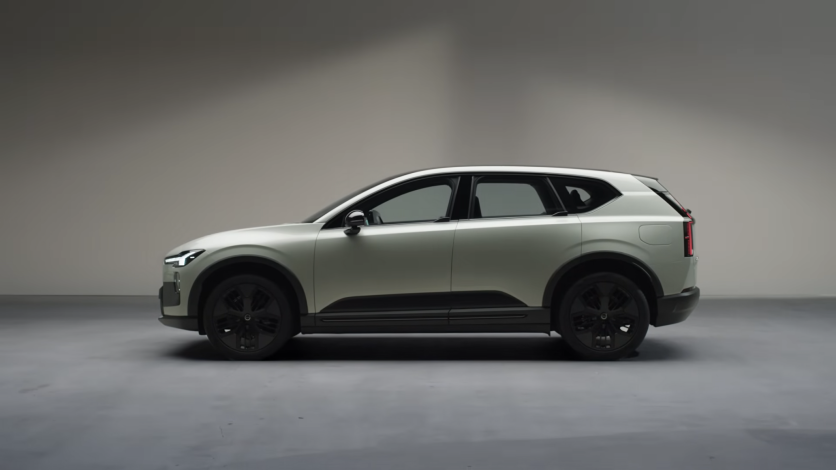
Volvo did not commit to a specific rollout date for individual model lines, noting only that timing may vary depending on the car model. The EX60 — Volvo's newest fully electric crossover, with U.S. pricing starting at $58,400 for the single-motor trim and $60,750 for the dual-motor AWD version — will ship with Apple Music pre-installed when customer deliveries begin this summer.
What "Native" Actually Means for the Audio Signal
Apple Music has been technically accessible in Volvo cars before this update, but only through Apple CarPlay — a phone-projection protocol where the iPhone handles all computing and the car's screen functions as a remote display. The distinction matters for audio quality.
CarPlay routes Apple Music's audio signal from the phone's processor through a USB or wireless connection to the car's digital-to-analog converter, bypassing portions of the vehicle's own audio calibration in the process. The car's amplifier receives a pre-processed audio stream; the vehicle's own tuning stack has limited visibility into what it is amplifying.
The native Android Automotive OS app changes that pathway entirely. Apple Music runs directly on the car's own system-on-chip, communicating with the vehicle's audio hardware abstraction layer — the software interface between the operating system and the physical amplifier, speakers, and digital signal processor. No phone sits in the signal path. This architectural difference is what enables Dolby Atmos to function as intended: the object-based audio renderer operates on the car's processor, placing up to 128 discrete sound objects in three-dimensional space and mapping them to whatever speaker configuration is installed. On a phone-projection pathway, the Atmos metadata is decoded on the phone and transmitted to the car as a pre-rendered multi-channel stream, compressing what Atmos is engineered to do.
Spatial Audio Arrives on EX60, EX90, and ES90 with Bowers & Wilkins
The Dolby Atmos experience is available on the EX60, EX90, and ES90, and only through the optional Bowers & Wilkins premium audio system. Volvo's engineering rationale for limiting Spatial Audio to these three models centers on acoustics: electric vehicles run without combustion engine noise, which reduces ambient cabin sound levels substantially and allows the audio system to operate closer to its acoustic limits. The EX60, EX90, and ES90 also include additional soundproofing that Volvo says creates a more controlled acoustic environment than its other models.
The Bowers & Wilkins system in these vehicles uses what the company calls True Sound technology, meaning the speaker array has been acoustically calibrated specifically to each car model's cabin geometry — its dimensions, reflective surfaces, and listening positions. This per-model tuning is what allows Dolby Atmos to deliver convincing spatial cues in a car cabin, where the listener's fixed head position and low ceiling create a fundamentally different acoustic environment than a home theater.
Alwin Bakkenes, head of global software engineering at Volvo Cars, described the engineering ambition: "Many of our customers use Apple Music on their phones or in their homes today. By bringing Apple Music directly into our cars, we're making them an extraordinary place to experience music." He added that the integration is intended to deliver "exactly the emotional listening experience artists intended."
OTA at Scale: What It Proves About Software-Defined Vehicles
The delivery mechanism is as significant as the feature itself. Updating two million cars over the air — without a recall notice, a service appointment, or a hardware modification — demonstrates what the automotive industry's "software-defined vehicle" shift looks like in practice. Features arrive post-purchase. Ownership is not the high-water mark of the car's capability.
Volvo has been delivering OTA updates since its 2020 models and was one of the founding OEM partners in the Android Automotive OS platform. That early commitment is what makes a retroactive update of this scale possible: the company's entire 2020-and-later lineup shares a common software architecture, meaning a single app certified for Android Automotive OS can be deployed to the full fleet simultaneously. Spotify and Tidal were already available as native apps through the Google Play Store on these vehicles; Apple Music is now a third native option on the same platform.
OTA updates do carry a documented, if low, risk. Consumer Reports confirmed that a Volvo XC90 driver was involved in a crash in May 2025 after an update affected braking functionality; Volvo issued a corrective OTA shortly after. Stacey Higginbotham, a policy fellow at Consumer Reports, has noted that all software updates carry the possibility of real-world errors regardless of testing rigor. The Apple Music update is an app-layer change — not a firmware update touching safety-critical systems — which places it in a materially lower risk category than powertrain or braking software.
Apple Music's Expanding Automotive Footprint
The Volvo rollout is part of a broader Apple Music integration push across automotive platforms. General Motors announced native Apple Music support for 2025 and 2026 Cadillac and Chevrolet models in December 2025. Apple Music and ChatGPT integrated in the same month. A TikTok integration in March 2026 added full-song playback for Apple Music subscribers within the short-form video app. Bandsintown event listings began appearing on Apple Music artist pages that same month. Volvo is the latest and largest-scale addition to that partnership timeline.
Apple Music now counts over 100 million subscribers globally as of early 2026, placing it as the second-largest on-demand music streaming service after Spotify. Native automotive integration — rather than phone-dependent projection — is one of the ways Apple positions the service as a distinct proposition for users who want listening quality independent of their phone's battery level or connection stability.
Frequently Asked Questions
Which Volvo models get Apple Music in the 2026 OTA update?
The update covers eleven models running Android Automotive OS from model year 2020 onward: the EX90, ES90, XC90, S90, V90, XC60, S60, V60, XC40, EX40, and EC40. The new EX60 will ship with Apple Music pre-installed when deliveries begin this summer. Timing of the OTA rollout varies by model.
What is the practical difference between native Apple Music and using Apple Music through CarPlay?
CarPlay is a phone-projection protocol: the iPhone does the processing and the car screen is a remote display, which means Apple Music audio is decoded on the phone and sent to the car. Native Android Automotive OS integration runs Apple Music directly on the car's processor and routes audio through the vehicle's own digital signal processor. For Dolby Atmos specifically, this means the object-based audio renderer operates on the car's chip with full access to the Bowers & Wilkins audio system's calibration — producing spatial audio as the format intends rather than as a pre-rendered phone output transmitted to the car. A phone is not required.
Does every Volvo getting Apple Music also get Spatial Audio?
No. Dolby Atmos Spatial Audio is available only on the EX60, EX90, and ES90, and only through the optional Bowers & Wilkins premium sound system. These models also feature advanced soundproofing that Volvo says improves the acoustic environment for high-fidelity playback. Owners of the other eight models in the update will still get the full Apple Music library and features, just without the Atmos spatial rendering.
How do I claim the free Apple Music trial in my Volvo?
Eligible new and returning Apple Music subscribers can redeem up to three months of Apple Music at no cost through the Volvo Cars app. The offer applies to all eleven models receiving the OTA update and is valid until July 6, 2027. Existing Apple Music subscribers can simply sign in with their Apple account once the update installs on their vehicle.

-
 C114 Communication Network
 -
 Communication Home
