
 Search

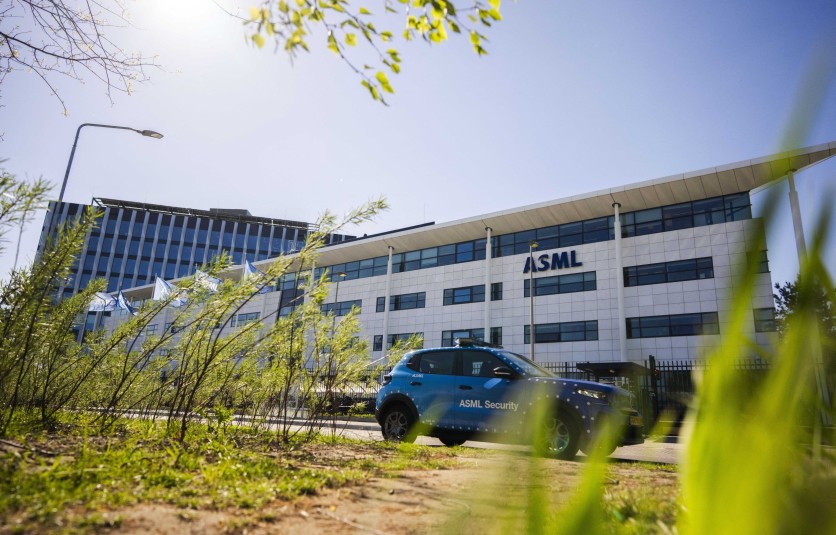
Dutch tech giant ASML's corporate headquarters in Veldhoven during its general shareholders' meeting on April 22, 2026. ASML, which makes cutting-edge machines to manufacture semiconductor chips, said on April 15, 2026 Freek VAN DEN BERGH/Getty Images
The most consequential number in artificial intelligence this week will not come from a hyperscaler's quarterly filing or a GPU shipment tally. It will emerge from Veldhoven, the Netherlands, before U.S. markets open on Wednesday, July 15, when ASML Holding releases its Q2 2026 results and with them the freshest reading on whether the AI chip investment cycle is still accelerating — or quietly approaching a ceiling. For investors holding semiconductor positions, Wednesday's print from the world's sole supplier of extreme ultraviolet lithography machines is, in practical terms, the most important data point of the earnings season so far.
ASML designs and manufactures the only machines on earth capable of printing the circuit patterns on the most advanced chips. Every leading-edge AI processor — every graphics processing unit in a data-center rack, every high-bandwidth memory stack in a training cluster — requires one of these systems. There is no second supplier, no workaround, no substitute. That structural monopoly makes ASML's order book something no other company's quarterly report can replicate: a genuine, unsmoothed, forward-looking signal for the entire industry's appetite for advanced silicon capacity.
Why Net Bookings Move Markets More Than Revenue
Wall Street's consensus on Wednesday's headline figures is manageable. Analysts expect total net sales to land between €8.4 billion and €9.0 billion — the range ASML itself guided in April — with gross margin of roughly 51% to 52% and earnings per share near $7.98, representing roughly 75% growth over the same quarter a year earlier, according to analysts' Q2 2026 consensus forecast.
Those figures, however solid, are largely locked in. ASML recognizes revenue only when a system is installed and accepted at a customer facility, a process that typically lags orders by twelve to eighteen months. The number that will move markets on Wednesday is net bookings — new orders signed during the quarter — because bookings represent the earliest visible commitment that chipmakers are actually placing capacity bets, not merely discussing them.
The baseline for comparison is formidable. In Q4 2025, ASML's Q4 2025 earnings release showed net bookings of €13.2 billion, of which €7.4 billion came from EUV systems specifically — a figure that more than doubled analyst consensus at the time and sent the stock to fresh highs. The company closed 2025 with a total backlog of €38.8 billion — roughly eighteen to twenty-four months of revenue visibility already secured. Bank of America's upgraded ASML target to $2,345 reflected that trajectory, with analysts maintaining a Buy rating and calling the EUV order trajectory sustainable.
ASML's Q1 2026 results announcement confirmed the momentum. ASML posted €8.8 billion in net sales at a 53.0% gross margin — at the high end of guidance — and raised full-year revenue guidance from €34–39 billion to €36–40 billion. CEO Christophe Fouquet attributed the revision to customers accelerating their capacity expansion plans. "Demand for chips is outpacing supply," he said in the earnings statement.
If Q2 bookings arrive at a level comparable to Q4 2025 or Q1 2026, it signals that the AI infrastructure buildout — already the most capital-intensive in semiconductor history — is not decelerating. A meaningful shortfall feeds the "AI peak demand" narrative that has circulated intermittently since late 2025.
How EUV Lithography Works: Why Its Order Book Leads the Entire Industry
To understand why ASML's order book is the industry's most forward-loaded signal, it helps to trace the dependency chain backward from a finished AI chip.
When Microsoft, Google, Amazon, or Meta commits capital to expanding AI training capacity, that decision flows into GPU and accelerator orders from Nvidia or AMD. Those commitments then require TSMC, Samsung, or Intel Foundry to add wafer capacity — which means ordering lithography equipment, including EUV systems, at least twelve to eighteen months in advance. ASML's net bookings therefore reflect hyperscaler investment decisions before those decisions appear in any tech company's capital expenditure report.
EUV machines work by using a laser to strike tiny tin droplets at a rate of roughly 50,000 per second, generating a plasma that emits 13.5-nanometer extreme ultraviolet light. That light, reflected through a series of precision-polished mirrors inside a vacuum chamber, is then focused onto a silicon wafer to trace circuit patterns as small as a few nanometers. Each complete system weighs approximately 180 metric tons, requires roughly thirty specialized freight loads for transport, and demands a team of ASML engineers for installation, calibration, and ongoing maintenance. There is no other company manufacturing anything like it.
TSMC's record 2026 capital expenditure plan runs to $52–56 billion — the highest in the company's history — and is directed primarily toward ramping its 2-nanometer N2 and N2P nodes, all of which depend on ASML EUV. SK Hynix's record EUV order disclosure in March 2026 committed 11.95 trillion won — approximately $7.97 billion — to EUV equipment purchases from ASML by the end of 2027, the largest single EUV order ever publicly disclosed. ASML plans to ship approximately 60 low-NA EUV systems in 2026, roughly 25% more than in 2025, and is targeting capacity for 80 systems in 2027 — a ramp that management has said depends on sufficient customer orders materializing, which is precisely why Q2 bookings carry so much weight.
The next-generation variant — High-NA EUV, formally the Twinscan EXE:5200B — adds a further dimension. Priced at approximately $380–400 million per unit, High-NA EUV uses a higher numerical aperture (0.55 vs 0.33 for current-generation systems) to enable 1.7 times smaller features and 2.8 times greater transistor density. ASML plans to ship ten High-NA systems in 2026. Intel is deploying them for its 14A node; SK Hynix has committed to two units for advanced memory applications, as detailed in ASML's 2026 High-NA EUV shipment roadmap.
TSMC has publicly stated it will not adopt High-NA EUV before 2029, with senior executives citing cost as the primary obstacle. UBS's May 2026 ASML reinstatement as the firm's top European semiconductor pick estimated that High-NA EUV can deliver cost savings of 20–40% on critical chip layers compared with alternative multi-patterning approaches — a tradeoff that, at sub-2nm nodes, is expected to eventually make the machine's price defensible even for customers that are currently deferring. TSMC's deferral creates what analysts have characterized as a fundamental split among leading customers on the pace of technology adoption, one that will shape ASML's High-NA revenue timeline through at least the end of the decade.
Read more: ASML EUV China Accusation: Lutnick Claims Breach, ASML Counts All 314 Machines
Read more: ASML EUV Components in China: US Cites Shipment Evidence as BIS Enforcement Looms
China Revenue, Export Controls, and a Diplomatic Confrontation
The cleaner narrative — relentless EUV demand from AI-driven customers in Taiwan, South Korea, and the United States — has been complicated throughout 2026 by a cascading series of developments that have turned ASML's China exposure into the quarter's most consequential risk variable.
China was ASML's largest single market in 2025, representing approximately 33% of total revenue. By Q4 2025, that share had reached 36% of net system sales. Then, in Q1 2026, it fell sharply to 19% as existing restrictions on more advanced deep ultraviolet systems began to take full effect. ASML had guided investors in January to expect China at roughly 20% of 2026 total sales even before additional legislative action.
What changed in April was that Congress moved. On April 2, 2026, a bipartisan group of lawmakers introduced the Multilateral Alignment of Technology Controls on Hardware Act — the MATCH Act. The legislation would extend restrictions beyond EUV — which ASML has never shipped to China — to cover DUV immersion lithography systems, the older-generation tools that Chinese chipmakers have continued to source. Critically, it would also ban the servicing and maintenance of equipment already installed in Chinese fabs. Chipmaking tools are not static infrastructure: they require continuous calibration, spare parts, software updates, and field support from ASML engineers. Without that maintenance, process yields in Chinese fabs would degrade over months, not years. The MATCH Act cleared the House Foreign Affairs Committee on April 22 in what committee members described as the most significant export control markup in the history of Congress, as covered in the MATCH Act's April 2026 introduction.
DUV machines covered by the legislation represent approximately one-fifth of ASML's expected 2026 revenue. According to analysts' MATCH Act revenue impact estimates, Quilter Cheviot estimated that a broad DUV ban could translate to roughly a 5% hit to overall ASML revenue — a meaningful compression of upside, even if not a structural break of the growth thesis. Bank of America's scenario analysis placed a full ban on immersion tools plus services at a potential 14–15% revenue reduction and a 16–17% cut to operating income.
Lutnick's Allegation, ASML's Rebuttal, and the BIS Enforcement Precedent
In June, the geopolitical pressure on ASML reached a more acute register. Bloomberg's June 19 report on the allegation revealed that U.S. Commerce Secretary Howard Lutnick had raised concerns with senior ASML executives that an EUV lithography machine — or critical components and transport equipment associated with one — may have reached China in violation of export controls. ASML's response was categorical: the company stated it has never delivered an EUV system or any component designed for one to China, and that it tracks all 314 machines globally via remote telemetry. ASML circulated a formal document in Washington titled "No indication of any ASML EUV System in China," accounting for all 314 operational machines and 26 decommissioned systems — none in China. U.S. officials, while claiming to possess evidence, declined multiple requests from Bloomberg to produce it.
The accusation triggered a selloff; ASML shares' June 22 52-week high of $1,959.04 on Nasdaq was reached on June 22, before the stock fell roughly 7.5% over the following days as the allegation circulated.
The BIS enforcement context matters. Applied Materials' February 2026 BIS settlement of $252.5 million with the Commerce Department's Bureau of Industry and Security resolved allegations of routing 56 ion implanter units and components through its South Korean subsidiary to SMIC — after receiving explicit BIS notification that a license was required. That settlement established that component-level transfers, not only complete restricted systems, can trigger major enforcement action under the Export Administration Regulations. ASML's situation, if the U.S. allegation were to progress toward formal enforcement, would be evaluated under the same legal framework.
In a striking balancing act, Dutch Trade Minister Sjoerd Sjoerdsma traveled to Washington in late June — the same visit during which he signed the Pax Silica declaration, the U.S.-led multilateral framework coordinating semiconductor and AI supply chains — and used the occasion to lobby directly against the MATCH Act. The Netherlands had attended the Pax Silica initiative's December launch but delayed formal signature until the June summit, as reported in Dutch Pax Silica signing and MATCH Act lobbying. Prime Minister Rob Jetten also raised ASML's situation in White House meetings during the same period. Sjoerdsma's remarks after Washington meetings made the Dutch position explicit: "Export control simply works best when countries cooperate out of conviction, rather than when policy is imposed across the border."
Read more: Even TSMC Says ASML's Newest Machine Is Too Expensive: The $400 Million Chip Bottleneck
Read more: ASML Stock Hits $674B Europe Record, Musk Terafab Bet Drives Fresh Surge
What Will Wednesday's Earnings Call Actually Answer?
Against this backdrop, the July 15 earnings call will carry four distinct questions that markets will try to resolve before the opening bell.
The first is whether Q2 bookings sustain the momentum of Q4 2025 and Q1 2026. Bank of America entered this week noting that it expected ASML's 2027 order backlog to be effectively fully booked before management even reports Q2 results. A booking print that confirms or exceeds that expectation signals the AI infrastructure cycle is still in early-to-mid innings. A shortfall, even a modest one, would feed the "AI peak demand" narrative and trigger a reassessment of the timeline.
The second is China guidance. Analysts will listen carefully for whether management updates its 20%-of-sales projection for 2026 in light of the MATCH Act's legislative progress and ongoing diplomatic friction. Any indication that Chinese customers are placing pull-forward DUV orders ahead of potential restrictions could temporarily inflate near-term bookings while obscuring the medium-term demand picture.
The third is High-NA EUV commentary. With TSMC publicly deferring adoption until at least 2029 and ASML's 2027 capacity targets dependent on sufficient customer orders materializing, management's language around High-NA customer commitments will be closely parsed. Wells Fargo's $2,200 ASML price target, maintained with an Overweight rating, came alongside analyst Joe Quatrochi's forecast that the 2027 wafer fabrication equipment market could reach approximately $190 billion, up from an earlier estimate of $180 billion.
The fourth — the one the draft's framing has understated — is whether management will directly address the Lutnick allegation and its regulatory implications. Wednesday's call is the first formal opportunity for CEO Fouquet and CFO Roger Dassen to characterize ASML's compliance posture, describe any active BIS conversations, and quantify what, if any, licensing risk the company is actively managing. Given the Applied Materials precedent — $252.5 million for component-level transfers, not a complete restricted system — any disclosure of an ongoing BIS inquiry would be a market-moving event independent of the bookings print itself.
ASML's Order Book Is the AI Chip Cycle's Earliest Honest Measurement
ASML does not make chips. It makes the machines that make the machines. That position at the top of the semiconductor equipment stack means its order book encodes something no AI company's revenue report can replicate: the actual pace at which the industry is committing capital to expand the physical infrastructure on which AI runs.
TSMC's Q2 2026 results due July 16 will follow ASML's by one day. The sequencing matters. ASML's bookings and backlog will set the interpretive frame for how investors read TSMC's capacity expansion commentary, its AI demand language, and whatever signals management sends about N2 and A16 ramp timing. The two reports are complementary reads on the same underlying cycle — one from the equipment layer, one from the foundry layer — but ASML's arrives first, and its order book extends further into the future than any quarterly revenue figure.
For investors holding semiconductor positions — direct ASML exposure, TSMC, Nvidia, memory names like SK Hynix or Micron, or broad semiconductor ETFs — Wednesday morning's print is the most consequential data point of the earnings season so far. Not because it will confirm what already happened last quarter, but because it will offer the first unobscured look at where the industry's most important customer commitments are pointing next.
The question of whether the AI chip boom is real and durable will not be settled by one quarterly report. But the EUV order book is, by structural design, the earliest place that answer shows up.
ASML reports Q2 2026 results before U.S. market open on Wednesday, July 15. TSMC follows Thursday, July 16. ASML shares traded at approximately €1,608 on Euronext Amsterdam as of July 10, up roughly 63% year-to-date.
Disclosure: This article is for informational purposes only and does not constitute investment advice.
Frequently Asked Questions
Why do ASML's net bookings matter more than its revenue for predicting the AI chip cycle?
Revenue recognized by ASML reflects systems installed and accepted by customers — a process that typically follows an order by twelve to eighteen months. Net bookings reflect commitments made in the current quarter by chipmakers who won't receive or install the machines until next year or beyond. Because hyperscalers must commit to AI infrastructure expansion months before that expansion appears in any tech company's capital expenditure report, ASML's order book is structurally the earliest place that commitment becomes auditable. A strong bookings quarter means fabs are still expanding; a shortfall means someone, somewhere in the AI supply chain, has paused.
What is the MATCH Act and what would it mean for ASML shareholders?
The MATCH Act, introduced in the U.S. House on April 2, 2026, would extend export restrictions beyond EUV — which ASML has never sold to China — to cover DUV immersion lithography systems and, critically, ban the servicing and maintenance of equipment already installed in Chinese fabs. DUV and related service revenue accounts for roughly one-fifth of ASML's expected 2026 sales. If the bill passes in its current form, analysts estimate the revenue impact at somewhere between 5% and 15% of ASML's total, depending on whether a full-service ban is included. The Netherlands has formally opposed the bill's extraterritorial provisions while simultaneously signing the U.S.-led Pax Silica semiconductor supply chain accord.
Is ASML facing a real compliance risk from the Lutnick EUV allegation, and what would the legal exposure look like?
ASML has categorically denied shipping any EUV machine or EUV-specific component to China, and has circulated documentation in Washington accounting for all 314 operational EUV systems worldwide — none in China. U.S. officials have not publicly produced evidence supporting their allegation. However, the February 2026 Applied Materials settlement — in which BIS imposed a $252.5 million penalty for routing 56 ion implanter components through a South Korean subsidiary to SMIC, without an EUV system ever being in China — established that component-level violations are sufficient for major enforcement action under the Export Administration Regulations. If BIS were to determine that EUV-related components or transport equipment reached China without required authorizations, the legal exposure would be evaluated under the same framework, regardless of whether a complete EUV system was ever delivered.
How does High-NA EUV fit into the AI chip boom, and why does TSMC's 2029 deferral matter for ASML's growth story?
High-NA EUV — the next-generation system priced at approximately $380–400 million per unit — enables 1.7 times smaller features than current EUV systems and is essential for chips at and below 2 nanometers. Intel is the most aggressive early adopter, deploying it for its 14A node; SK Hynix is using it for advanced memory. TSMC, ASML's single largest customer, has publicly stated it will not use High-NA before 2029, citing cost. UBS analysts estimate High-NA can cut patterning costs by 20–40% on critical layers once at scale, which should eventually drive broader adoption — but TSMC's deferral compresses ASML's near-term High-NA revenue and concentrates the technology's commercial timeline into a narrow set of customers. How ASML's management discusses High-NA customer commitments on Wednesday will be one of the most closely watched signals on the call.

-
 C114 Communication Network
 -
 Communication Home
