
 Search

Porsche.com
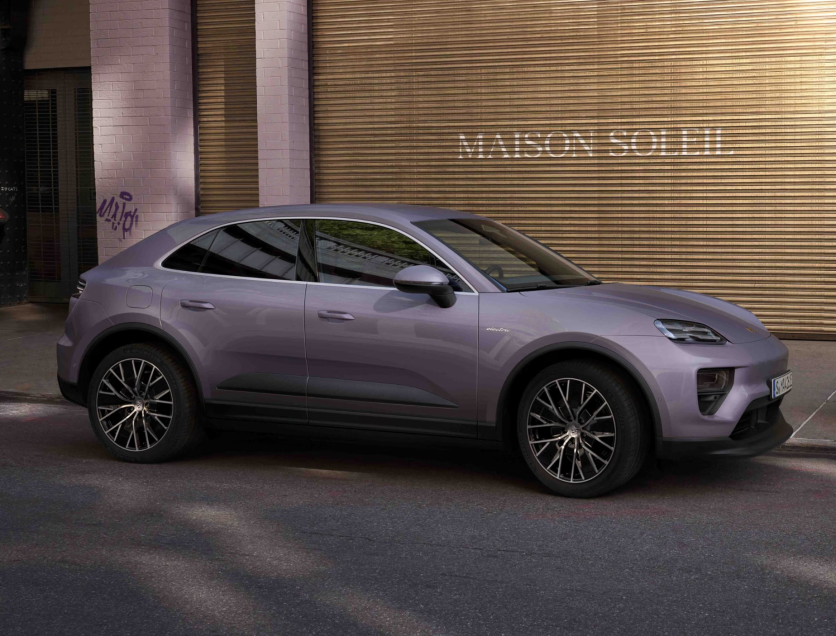
As the 2026 Goodwood Festival of Speed opened today in West Sussex, England, Porsche confirmed what analysts had anticipated since its Q1 earnings call: production of the gasoline-powered Macan will stop at the end of this month, making the all-electric Macan the sole version of the nameplate going forward. What should have been a clean narrative about a triumphant platform transition is complicated by the sales data Porsche published for the first half of 2026 — of the 35,315 Macans delivered through June, 19,695 carried a gas engine while only 15,620 were purely electric, according to Porsche's H1 2026 sales. The ICE Macan is ending production with its combustion counterpart still outselling the electric model it nominally replaced.
For US buyers, the practical implication is a narrowing purchase window. Porsche CFO Jochen Breckner said on the Q1 earnings call that the company would stockpile as many ICE Macans as possible from remaining supplier parts, and that some inventory is expected to reach American customers into 2027. That window is finite and, critically, not replenishable — buyers who want the original gas-powered Macan after current inventory is gone will wait until at least 2028 for a combustion Macan under a different name.
The completion of this transition makes Porsche the first major premium automaker to retire its highest-volume model's combustion powertrain entirely — a milestone the brand simultaneously celebrates and quietly walks back. Porsche is already developing a combustion-and-hybrid compact SUV, codenamed M1 internally, built on the same Premium Platform Combustion architecture used by the latest Audi Q5, with an expected arrival around 2028. That vehicle will not carry the Macan name, as covered in Motor1's reporting on Porsche's gas Macan replacement.
Read more: Porsche Macan EVs to Bring Rear-Wheel Drive Variants, Lighter With Increased Range
ICE Macan's Final Chapter: Cybersecurity Killed It in Europe Before Commercial Pressure Could
The original Macan's European exit had little to do with the EU's 2035 internal-combustion ban. The car was removed from European markets in July 2024 because Porsche chose not to certify the aging first-generation platform under UN Regulation 155, the cybersecurity management system standard that became mandatory for all new vehicles across the EU that month. Obtaining a Cybersecurity Management System (CSMS) certificate requires manufacturers to demonstrate that security is embedded across the entire vehicle lifecycle — design, production, and post-sale updates — and Porsche concluded that engineering a 12-year-old platform into compliance was not worth the investment for a model it was already planning to discontinue.
Production then continued at Porsche's Leipzig plant for non-European markets through mid-2026, with the US remaining the most commercially significant destination. Porsche CFO Jochen Breckner said on the earnings call that Porsche would send as many ICE Macans to the United States as possible, citing strong demand from American buyers who lost the $7,500 federal EV tax incentive last year. The math is uncomfortable for Porsche: the very market that most wants the gas Macan is also the one where the EV's commercial case is most challenged.
The original Macan was no ordinary vehicle in Porsche's lineup. In production since spring 2014 — when European deliveries began — the model became the brand's highest-volume nameplate, ultimately surpassing one million total Macan units produced by 2025, per Porsche's millionth Macan milestone. Its retirement leaves the brand in a position it has not occupied since before the Macan's debut: without a high-volume entry-level SUV in active production.
What Porsche Got Wrong, and What It Is Doing About It
The candor from Porsche's leadership about the transition's commercial miscalculation has been unusual for a company of this scale. Oliver Blume — who moved to focus solely on leading the Volkswagen Group at the start of 2026 after stepping down as Porsche CEO — acknowledged in public comments earlier this year that Zuffenhausen had misjudged the market. "We were wrong about the Macan," Blume said. "Based on the data available at the time and our assessment of our markets, we would make the same decision again. Today, the situation is different. We have responded and are adding combustion engines and hybrids."
The data Blume was referring to showed that in 2025, the Macan Electric narrowly outsold its ICE sibling globally — 45,367 EV units versus 38,961 combustion — a result that appeared to vindicate the transition. But those numbers no longer hold. In H1 2026, with the ICE Macan already unavailable in Europe, the combustion version still led globally. Porsche's broader financial position compounds the urgency: profit after tax fell by more than 90 percent in 2025, to approximately €310 million from roughly €3.6 billion the prior year, while total revenue dropped by about 10 percent, according to Porsche's 2025 financial results.
The M1-codenamed replacement is the operational answer. It will share architecture with Audi's current Q5, following the same logic as the original Macan, which also shared its platform with an earlier Q5 generation. Porsche's current CEO Michael Leiters has been explicit that platform sharing will not dilute the product. "We have to make sure that this is a real Porsche," Leiters said. "And this needs some content, some product substance, some technology, which is new on this car." When the replacement arrives, it will carry a new name — Porsche has stated that the Macan badge belongs to the electric generation going forward.
How the 800V PPE Platform Actually Works
The Macan Electric's core technical advantage over its ICE predecessor — and over most of its EV competitors — is the Premium Platform Electric, co-developed by Porsche and Audi as a purpose-built electric architecture for the premium vehicle segment. Understanding why that matters requires understanding what 800V architecture actually changes.
Conventional EV platforms operate at 400 volts. At that voltage, there is a hard physics ceiling on how quickly the battery can accept charge: pushing charging power higher requires either higher voltage or higher current, and higher current means more heat, more copper, and more cooling infrastructure. An 800V system doubles the voltage, which allows the same charging power to flow at half the current — dramatically reducing heat generation and enabling significantly faster charge rates with physically lighter wiring, as detailed in Audi and Porsche's PPE platform specification. The Macan Electric charges at up to 270 kW on a compatible DC fast charger, enough to take the 100 kWh battery (approximately 95 kWh usable) from 10 to 80 percent in roughly 21 minutes under optimal conditions. Independent tests have confirmed the car briefly exceeds its rated spec, with State of Charge's independent test recording a 285 kW peak during a controlled session at an EVgo charger.
The platform also solves a real-world charging infrastructure problem: the majority of DC fast chargers in the US and Europe operate at 400 volts, not 800. Rather than requiring a separate DC-DC booster module (an approach some competitors use), Porsche's PPE architecture handles the voltage mismatch by splitting the 800V battery pack into two parallel 400V banks during charging. Each half draws up to 135 kW simultaneously. A reader with a 400V fast charger nearby does not need a separate adapter or a special site — the Macan manages the conversion internally.
The efficiency gains extend beyond charging. The PPE uses silicon carbide semiconductors in the inverter's power electronics — a material that runs at roughly 60 percent higher efficiency than conventional silicon, as documented in Audi's PPE silicon carbide inverters specification — contributing approximately 20 additional kilometers of real-world range compared to an equivalent system using silicon inverters. The motors themselves use hairpin (rectangular-wire) windings that pack more copper into the stator grooves than conventional round-wire designs, raising power density without increasing motor size.
Performance figures follow from this architecture. The Macan 4 Electric produces 402 horsepower from its dual-motor all-wheel-drive setup, reaching 60 mph in approximately 5.2 seconds. The Macan Turbo Electric produces up to 630 horsepower in overboost with launch control active, covering the same sprint in 3.1 seconds — figures that match or exceed dedicated sports sedans from a decade ago, from an SUV body. The platform also establishes a rear-biased weight balance, placing the rear motor as far rearward in the chassis as possible. A 2026 GTS trim, available since earlier this year, slots between the 4S and Turbo with up to 563 horsepower and a sport-tuned adaptive air suspension with an electronic limited-slip rear differential.
Software as New Lifecycle: Promise and Early Reality
The shift from gas to electric Macan is not only a powertrain change — it is a change in what "owning a Porsche over time" means. The ICE Macan had a static hardware lifecycle. The Macan Electric runs on Android Automotive OS, connects to the My Porsche app, and receives software updates over the air (OTA) that can change the car's behavior, add navigation improvements, refine driver-assistance algorithms, and introduce new features — including, potentially, paid feature unlocks — without a dealer visit. A gaming ecosystem through the Porsche App Center allows in-car gaming on the infotainment display while the vehicle charges.
Porsche has already used OTA to address real issues on early cars: two NHTSA safety recalls on 2024–2025 models — one for backup cameras that failed to display properly (ASA3), one for headlights exceeding maximum brightness output (ARC5) — were addressed through software updates and, where needed, dealer inspections. The OTA architecture makes such corrections faster and less disruptive than a physical recall for a combustion vehicle.
The promise of continuous improvement through software depends, however, on execution. VW Group's software development arm, CARIAD, which provides the software infrastructure for PPE-based vehicles, has a documented history of quality failures on earlier MEB-platform models — delays, software bugs, and laggy infotainment that drew widespread owner complaints on the ID series. The Macan Electric's early ownership record, while not catastrophic, already shows the pattern: inconsistent software behavior, occasional system reboots, and DC fast-charging variability that owner forums attribute to software state management rather than hardware defects. For buyers evaluating the OTA-driven value proposition, the question is not whether Porsche can deliver improvements wirelessly — it demonstrably can — but whether the software infrastructure has matured enough to do so reliably at the expected cadence.
What the Gap Means for the Segment
When Porsche introduced the Macan in 2014, it established a template that rivals then scrambled to follow: Porsche dynamics, compact dimensions, enough practicality to justify daily use. The BMW iX3, Mercedes-Benz EQC, and Audi Q6 e-tron — also PPE-based — now compete in the same premium compact EV SUV space that the Macan Electric is entering as its sole representative.
The real-world performance of the 800V charging architecture changes the competitive calculation in a specific way. At a 270 kW charger, the Macan Electric can add roughly 60 miles of range in four minutes of charging — a rate that, for buyers who fast-charge on road trips rather than exclusively home-charge, compresses the practical range disadvantage compared to combustion. A Macan 4 achieves approximately 260 miles at a steady 75 mph, versus around 308 miles on the EPA cycle, a 16 percent gap that experienced EV owners will plan around, per Recharged's highway range test. For US buyers, it is worth noting that the Macan Electric currently uses a CCS1 port as standard; accessing Tesla Superchargers requires Porsche's NACS adapter, which became available in September 2025.
The segment race is shifting away from horsepower comparisons and toward the software layer that surrounds the hardware. OTA update cadence, navigation and charging-stop planning quality, and subscription-feature ecosystems are increasingly how premium EV brands differentiate. Porsche has the architecture in place. Whether it has the software execution to capitalize on it is the open question the Macan Electric's 2026 ownership cohort will answer.
Porsche says it will share further details about its broader product lineup strategy at a Capital Markets Day planned for fall 2026, where it is expected to outline its Strategy 2035 roadmap. Until then, the Macan Electric is the nameplate — and the ICE inventory sitting in US dealers is a fast-depleting alternative for buyers who are not yet ready to make the switch.
Frequently Asked Questions
Can I still buy a gas-powered Porsche Macan?
In the United States, yes — for now. Porsche has been stockpiling ICE Macan inventory for the US market ahead of the production shutdown at the end of July 2026, and deliveries from that remaining stock are expected to continue into 2027. Once that inventory is sold, there will be no replacement until a new combustion/hybrid compact SUV under a different name arrives around 2028. The Macan nameplate itself is now reserved exclusively for the electric model.
How does the Macan Electric's 800V charging work at a regular fast charger?
Most DC fast chargers in the US operate at 400 volts, not the Macan Electric's 800-volt native architecture. Rather than requiring a separate adapter or onboard booster module, the Macan's PPE platform splits its battery pack into two parallel 400V banks during charging, with each half drawing up to 135 kW simultaneously — giving up to 270 kW total on an 800V-capable station, and up to 135 kW on a standard 400V charger. The process is automatic and transparent to the driver.
Why did Porsche remove the gas Macan from Europe before discontinuing it everywhere else?
The ICE Macan lost its EU type approval in July 2024 under UN Regulation 155, the European cybersecurity standard that became mandatory for all new vehicles that month. Porsche chose not to invest in obtaining a Cybersecurity Management System certificate for the aging first-generation platform, which required proving that digital security measures were embedded across the vehicle's full lifecycle. This was a regulatory compliance exit, not an emissions issue — the EU's 2035 combustion ban played no direct role.
Will the software on the Macan Electric keep improving after purchase?
Porsche has demonstrated that it can push meaningful updates over the air — two NHTSA safety issues in 2024–2025 were addressed via software patches without requiring most owners to visit a dealer. The underlying Android Automotive OS platform supports both infotainment and deeper firmware updates. That said, early Macan Electric owners have reported intermittent software inconsistencies, and VW Group's software development division (CARIAD) has a documented track record of quality problems on earlier platforms. Buyers should expect improvement over the model's life — but the pace and reliability of those updates will depend on software infrastructure execution that is not yet fully proven.

-
 C114 Communication Network
 -
 Communication Home
