
 Search

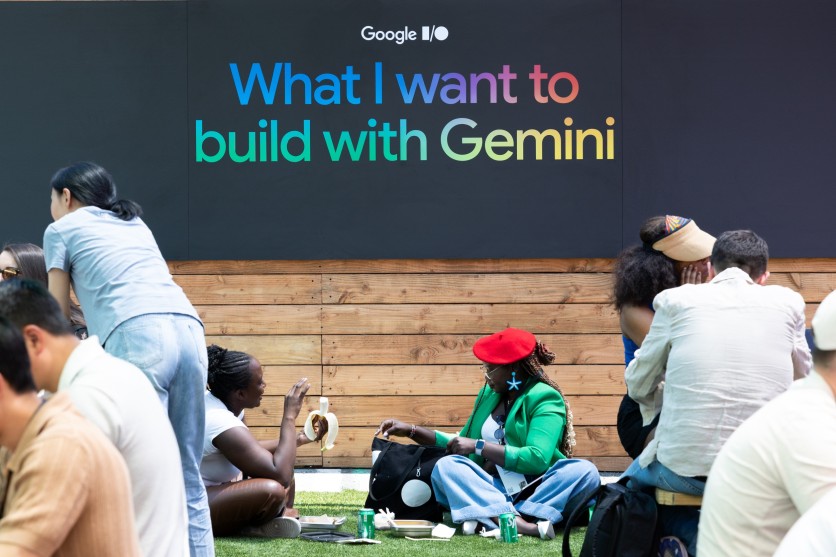
Attendees sit below a Gemini sign at Google I/O on May 19, 2026 in Mountain View, California. The two day developers conference highlights Google's new products and technologies including their AI developments. Benjamin Fanjoy/Getty Images
Google released Gemma 4 12B on June 3, 2026 — a 12-billion-parameter open-weight model that processes text, images, audio, and video without separate encoder networks, and runs on any laptop or workstation equipped with 16GB of RAM or VRAM. The model is available immediately, at no cost, under the Apache 2.0 license, giving developers and businesses unrestricted rights to deploy, modify, and commercialize it.
For developers who have been waiting for a capable open multimodal AI that fits on hardware they already own, the practical answer arrived yesterday.
Google Gemma 4 12B Eliminates Separate Encoders for Multimodal Input
Most multimodal AI systems bolt separate subsystems onto a language backbone. A vision encoder — typically 150 million to 550 million parameters in mid-size models — processes image patches before handing tokens to the language model. A separate audio encoder — an additional 300 million parameters — handles raw audio signals through a 12-layer conformer stack before passing them on. Each encoder runs its own forward pass, occupying its own slice of VRAM and adding latency every time the model receives a non-text input.
Gemma 4 12B removes both. In their place, Google engineered two lightweight projection layers that route all modalities directly into the same decoder-only transformer.
For vision, a 35-million-parameter embedder replaces the 27-layer vision transformer previously used in mid-size Gemma models. Raw image patches — sampled at 48×48 pixels — are projected to the language model's hidden dimension via a single matrix multiplication, with a factorized coordinate lookup attaching spatial position information at the point of projection. No separate forward pass. No frozen encoder weights.
For audio, the approach goes further: the encoder is eliminated entirely. Raw 16 kHz audio is sliced into 40-millisecond frames — each frame a 640-float vector — and projected linearly into the same embedding space the model uses for text tokens. The result is that a spoken question and a typed question enter the transformer through the same input pathway, at the same representational level.
This unified design has a concrete practical consequence for self-hosters: the total vision processing overhead drops from a 27-layer vision transformer to a single matrix multiplication. The audio pipeline, which previously required 12 conformer layers before the language model saw a single token, now requires one linear projection. The overall model fits in 16GB of VRAM at full 16-bit precision — and at 4-bit quantization, which Unsloth has made available on day one, inference runs on approximately 8GB, covering gaming laptops and MacBook Pro configurations with M-series chips.
How Encoder-Free Architecture Changes Fine-Tuning
The architectural consolidation carries an additional benefit that matters for applied AI developers: fine-tuning becomes a single-pass operation.
In encoder-based multimodal models, the vision and audio encoders are typically frozen during downstream training. Only the language model's weights update, which means the model's visual and audio representations are locked to whatever the pre-trained encoder learned. Achieving true end-to-end multimodal adaptation requires co-tuning the encoder and the language backbone simultaneously, which multiplies memory requirements and engineering complexity.
Because Gemma 4 12B's vision and audio inputs share the same weights as its text pathway, a LoRA adapter or full fine-tune automatically covers all three modalities in a single pass. A developer building a specialized medical imaging assistant, for example, can fine-tune on paired image-text examples without managing two separate optimizer loops or freezing half the model.
Local Multimodal AI: What Gemma 4 12B Can Actually Do
The unified architecture supports a 256,000-token context window — sufficient to process roughly 200 pages of text, a lengthy codebase, or a multi-hour audio session in one pass. Supported input modalities are text, images at variable resolution, audio, and video. Output is text only: the model analyzes and reasons about multimodal inputs but does not generate images, audio, or video.
On standardized benchmarks, Google reports that Gemma 4 12B approaches the performance of its larger 26B Mixture-of-Experts sibling while requiring roughly half the memory. On GPQA Diamond — a graduate-level science reasoning benchmark — the 12B model scores 78.8, a figure that would have been unusual for a model at this parameter count in previous generations. Those claims remain based on Google's own evaluations. As WinBuzzer noted in coverage published June 4, independent laptop benchmarks testing real-world latency, memory pressure, and multimodal accuracy under concurrent load had not been conducted as of the release date.
For workloads where frontier performance on specialized domains — medical reasoning, legal analysis, complex mathematical derivation — is the primary requirement, larger closed models still outperform the 12B. The model's value is in the workloads it enables locally that previously required a cloud API: document analysis combining text and images, real-time audio transcription and speaker identification, and agentic coding assistants that can read screenshots and manipulate files without sending data offsite.
Multi-Token Prediction Reduces Inference Latency
Google ships Gemma 4 12B with a dedicated Multi-Token Prediction drafter — a lightweight companion model that speculatively generates several candidate tokens in parallel while the main model verifies them. When the drafter's predictions are accurate, the effective throughput for the main model increases because multiple tokens are confirmed in a single verification pass rather than generated sequentially.
This matters specifically for agentic workflows, where latency compounds across dozens or hundreds of tool-call cycles. The LiteRT-LM local serving infrastructure that Google released alongside the model adds stateless prefix caching, which stores tokenized prompt prefixes in memory and skips re-prefilling when the same context is reused — a meaningful optimization for coding assistants and document-analysis agents that operate against long, stable system prompts.
Where Gemma 4 12B Fits in the Open-Model Landscape
The encoder-free approach is not unique to Google. Meta's Llama 4 Scout, released earlier this year, adopted a similar architectural philosophy for vision processing. Gemma 4 12B is notable for applying it at 12 billion parameters — a size that fits the laptop-class deployment target — and for extending it to audio, which Llama 4 Scout does not support at this scale.
Within Google's own lineup, the 12B fills a gap between the mobile-oriented E4B and the 26B Mixture-of-Experts model that targets dedicated GPU workstations. The Gemma 4 family now spans a hardware range from phones to servers, with the Apache 2.0 license applying uniformly.
The Apache 2.0 licensing itself represents a meaningful change from earlier Gemma generations. Gemma 1, 2, and 3 released under Google's own "Gemma Terms of Use," which imposed usage restrictions that enterprise legal teams often flagged as incompatible with commercial deployment. The shift to Apache 2.0 — which began with the April 2, 2026 Gemma 4 launch and applies to the 12B — removes those barriers. Google reports that Gemma 4 models have crossed 150 million downloads since the family launched in April; the broader Gemma series across all generations has surpassed 400 million total downloads.
How to Run Google Gemma 4 12B Locally
Model weights are available as of June 3 on Hugging Face and Kaggle. Day-one support covers Hugging Face Transformers, llama.cpp, MLX, SGLang, vLLM, and Unsloth for local inference and fine-tuning. Consumer-facing launchers LM Studio and Ollama already carry the model. For macOS users on Apple Silicon, Google released new desktop applications — Google AI Edge Gallery and Google AI Edge Eloquent — that run the model natively, including a voice-input interface.
For production cloud deployment, Google supports the model through Gemini Enterprise Agent Platform Model Garden, Cloud Run, and Google Kubernetes Engine. For developers who want a local OpenAI-compatible API server, the LiteRT-LM litert-lm serve command launches one directly on the developer's machine, making existing coding tools that integrate with OpenAI's API — such as Continue and Aider — drop-in compatible.
Frequently Asked Questions
What RAM does Google Gemma 4 12B require to run locally?
Google states the model runs on devices with 16GB of VRAM or unified memory at standard 16-bit precision. At 4-bit quantization — available via Unsloth and llama.cpp on day one — the model runs on approximately 8GB, covering most gaming laptops and many MacBook Pro configurations with M-series chips.
Is Google Gemma 4 12B free to use commercially?
Yes. The model is released under the Apache 2.0 license, which permits free use, modification, redistribution, and commercial deployment without royalties or usage restrictions. This is a change from earlier Gemma generations, which used Google's proprietary Gemma Terms of Use.
What is an encoder-free multimodal AI model?
Traditional multimodal AI systems process images and audio through separate encoder networks before passing tokens to the language model. Gemma 4 12B eliminates those encoders, instead projecting image patches and raw audio frames directly into the language model's embedding space through lightweight linear layers. The result is a single decoder-only transformer that handles all four input modalities — text, images, audio, and video — with a lower memory footprint and reduced inference latency.
How does Gemma 4 12B compare to the larger Gemma 4 26B model?
Google's benchmarks show the 12B model approaching the performance of the 26B Mixture-of-Experts variant while requiring roughly half the memory. On the GPQA Diamond graduate-level reasoning benchmark, the 12B scores 78.8. These figures are drawn from Google's internal evaluations; independent third-party benchmarks on consumer laptop hardware had not been published as of June 4, 2026.

-
 C114 Communication Network
 -
 Communication Home
