
 Search

Wistron.com
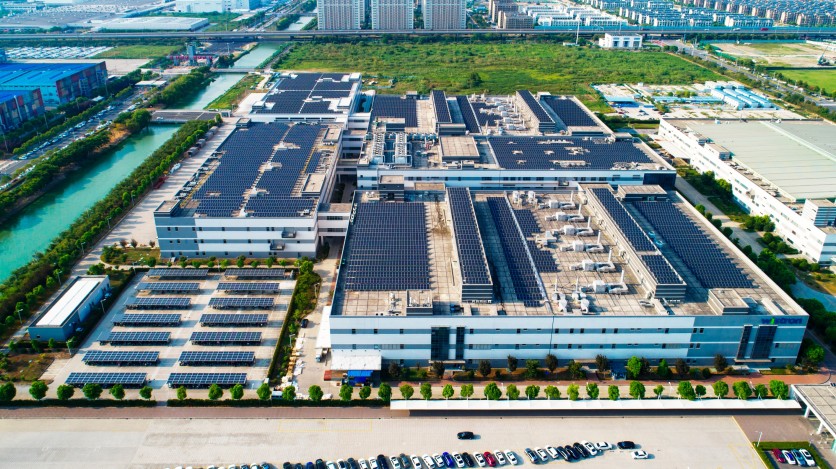
Wistron Corporation's new Fort Worth factory opened July 21 and immediately began mass-producing NVIDIA's GB300 Grace Blackwell Ultra Superchip — marking the first time the most powerful AI data center system in the world has been assembled and tested on American soil. The $700 million D1 facility, a 324,000-square-foot (30,100 square meters) greenfield plant in Fort Worth's AllianceTexas industrial park, is Wistron's first U.S. manufacturing facility and represents the first domestic source for the GPU systems that hyperscalers use to run — not just train — modern AI models at commercial scale.
NVIDIA founder and CEO Jensen Huang appeared at the opening ceremony alongside Wistron Chairman Simon Lin, Fort Worth Economic Development Director Jessica Rogers, and Taiwan's Representative to the United States Alexander Tah-ray Yui. Huang personally signed the first GB300 Superchip produced at the facility — a system he described as containing roughly 1.5 million individual parts, weighing approximately 2 tons (4,000 lbs), and carrying a price tag of around $4 million per unit, according to NVIDIA's official account of the ceremony.
"We're producing them like phones, right here in Wistron, cranking them out in volume because the world needs all of these machines to drive the intelligence infrastructure," Huang said at the ceremony.
What the GB300 Actually Does — and Why Inference Matters
The GB300 Grace Blackwell Ultra is not simply a faster GPU. It is a rack-scale system that integrates 72 Blackwell Ultra GPUs with 36 ARM-based Grace CPUs into a single coherent compute domain, all connected by NVIDIA's fifth-generation NVLink interconnect at 130 terabytes per second of total bandwidth — more than enough to allow all 72 GPUs to function as a unified processing fabric rather than communicating over slower PCIe or InfiniBand connections, as detailed on NVIDIA's GB300 NVL72 specifications page.
The key architectural distinction is NVLink-C2C, the coherent interconnect between the Grace CPU and the Blackwell GPUs that allows the CPU to directly address GPU memory and vice versa, eliminating the data-copy bottleneck that slows traditional CPU-plus-GPU configurations. The full NVL72 rack delivers 1,440 petaflops of FP4 compute and 576 terabytes per second of combined memory bandwidth, with a total fast memory pool of 37 terabytes — large enough to keep entire frontier AI models resident without repeated loading from slower storage.
Critically, Blackwell Ultra is explicitly optimized for inference — the phase of AI where a trained model actually responds to user queries — rather than training. It doubles attention-layer acceleration versus standard Blackwell and provides 1.5x more high-bandwidth memory per GPU (288 gigabytes of HBM3e versus 192 gigabytes in the prior B200 generation). Independent benchmark analysis published by TechTimes in July 2026 showed the GB300 NVL72 delivering up to 25 times more tokens per watt than Hopper-generation hardware on DeepSeek V4 Pro — the kind of inference efficiency that determines data center economics. What Fort Worth is now building, in other words, is not research hardware. It is the infrastructure that delivers AI services to end users.
That distinction matters for the supply chain story. Much of the policy and media attention in U.S. AI manufacturing has focused on semiconductor fabrication — silicon wafers, advanced packaging, TSMC's Arizona compound. What the Wistron D1 plant does is different: TrendForce confirmed the facility conducts L6-level assembly, the highest integration tier in electronics manufacturing, taking individual chips and components and integrating them into complete, tested, rack-scale AI server systems ready for data center deployment. This is why the Fort Worth plant's opening matters to hyperscaler procurement teams independently of the wafer-level manufacturing story.
Read more: Tokens per Watt Determines AI Factory Revenue as Power Constraints Tighten
Built in a Virtual World Before Construction Began
Before a single foundation was poured at AllianceTexas, Wistron engineers built a complete digital twin of the D1 facility using NVIDIA's Omniverse simulation platform. The virtual replica incorporated NVIDIA's Nemotron and Cosmos frontier AI models alongside Omniverse, PhysicsNeMo, and Metropolis libraries, creating a physics-accurate model of the factory floor where engineers could validate assembly line layouts, stress-test production workflows, and train workers on standard operating procedures — all before the physical building existed.
The recursive dimension is genuinely notable: NVIDIA's own software stack was used to design and optimize the factory that manufactures the hardware that runs that software. The same Omniverse platform that BMW, Foxconn, TSMC, and Caterpillar use to simulate their factories was applied to the plant that makes the chips their simulations run on. Wistron's use of pre-construction simulation also signals a manufacturing paradigm shift for high-complexity AI hardware assembly: when each rack is worth millions of dollars and contains 1.5 million components, validating workflows in simulation before physical tooling is a risk management decision, not a marketing exercise.
The factory itself runs on NVIDIA accelerated computing infrastructure, making it a production showcase for the system it manufactures.
Vera Rubin Is Already on Deck
The D1 facility currently operates two manufacturing cells: one producing the GB300 Grace Blackwell Ultra, and a second being stood up for NVIDIA's next-generation Vera Rubin Superchip, announced at CES 2026 in January. Vera Rubin pairs a new 88-core ARM-based Vera CPU with the Rubin GPU, which replaces HBM3e memory with next-generation HBM4 and delivers up to 50 petaflops of FP4 compute per chip. The Vera Rubin NVL144 platform — 144 GPUs in one rack — delivers 3.3 times the performance of the GB300 NVL72. NVIDIA confirmed Vera Rubin entered full production in June 2026.
Wistron President and CEO Jeff Lin confirmed that a follow-on D2 facility is also in planning, which the company says will carry twice the production capacity of D1. Wistron Chairman Simon Lin framed Fort Worth as a long-term commitment rather than a single-cycle position: "In the next couple of years, this location will be one of the most important, as we build AI infrastructure here in the United States. We are going to empower AI from Texas."
That Vera Rubin production cells are being added to D1 before D1 has even finished ramping for GB300 reflects the pace at which NVIDIA's roadmap moves and, correspondingly, the pace at which any domestic AI manufacturing partner must adapt. Huang noted that demand for AI servers is roughly doubling each year, and that D1 — despite its $700 million price tag — represents only around 5% of NVIDIA's total manufacturing capacity.
Read more: Nvidia Vera Rubin Enters Full Production: Samsung, SK Hynix, Micron Named HBM4 Suppliers
Jobs, Texas, and the Reindustrialization Argument
The D1 facility had created more than 500 jobs in the Fort Worth area as of its opening, spanning manufacturing technicians, engineers, logistics staff, and roles across plumbing, electrical, and construction trades. Wistron projects the site will reach 1,000 employees by the end of 2026, according to NVIDIA's reporting on the opening.
NVIDIA's broader U.S. manufacturing partner network — which now includes TSMC in Arizona, Foxconn in Houston, Coherent in Sherman, Texas, and Corning in North Carolina and Texas — spans 43 states. Economic consultancy Public First estimated that NVIDIA-driven AI demand will contribute $485 billion to U.S. GDP in 2026, supporting more than 100,000 jobs tied to AI infrastructure.
"Manufacturing is an essential pillar for every economy and every country," Huang said at the ceremony. "Building chip plants, packaging plants, computer system plants like this, and AI factories all over the United States, has allowed the United States to really reindustrialize for the first time in a long time."
Governor Greg Abbott had welcomed the announcement of the Texas plants in April 2025, noting that "Texas leads the nation in semiconductor manufacturing and advancements in technology."
The day after D1's opening, Wistron's shares on the Taiwan Stock Exchange surged 9.7% — a market signal that investors regard the Fort Worth milestone as validating Wistron's pivot from notebook and server assembly toward high-margin AI infrastructure manufacturing.
Where Does Fort Worth Fit in the Supply Chain?
The D1 plant's opening does not exist in a vacuum. It arrives in the context of the US-Taiwan trade agreement finalized in January 2026, which reduced U.S. tariffs on Taiwanese goods from 20% to 15% in exchange for $250 billion in direct Taiwanese investment in U.S. industries and $250 billion in credit guarantees. The deal specifically included preferential treatment for Taiwanese semiconductor and technology companies meeting onshoring benchmarks — the precise category of investment Wistron's D1 plant represents.
TSMC separately committed $165 billion to its Arizona compound under the same policy framework, covering wafer fabrication and advanced packaging. What distinguishes Fort Worth from TSMC's Arizona facilities is the product tier: Wistron is assembling NVIDIA's current data center flagship at L6 integration — the final, complete system level — not a prior-generation product or a component sub-assembly.
This distinction matters for hyperscaler procurement. U.S.-based AI infrastructure buyers — Microsoft, Google, Amazon, Meta, Oracle — can now source GB300 NVL72 systems domestically, reducing lead times associated with fully offshore assembly and reducing logistics risk exposure. For NVIDIA, the Fort Worth opening is one concrete piece of evidence that its $500 billion domestic manufacturing commitment is moving from pledge to production floor.
Taiwan's government has separately noted that wholesale relocation of the island's semiconductor ecosystem to the United States is not feasible at any near-term scale — the depth of specialized engineering talent, supplier ecosystems, and infrastructure in Taiwan's Hsinchu and Taichung corridors cannot be replicated quickly. What Wistron's Fort Worth plant represents is a complementary layer: final system assembly and testing in the United States, with upstream components still flowing from Taiwan. The supply chain has been partially shortened, not replaced.
Frequently Asked Questions
What is the NVIDIA GB300 Grace Blackwell Ultra, and why is it called a superchip?
The GB300 Grace Blackwell Ultra is NVIDIA's current data center flagship — a rack-scale system integrating 72 Blackwell Ultra GPUs and 36 ARM-based Grace CPUs into a single coherent compute domain. It is called a "superchip" because the Grace CPU and Blackwell GPU are paired on a single module via NVLink-C2C, a coherent interconnect allowing direct memory sharing between the two processor types. The full NVL72 rack delivers 1,440 petaflops of FP4 compute — optimized specifically for AI inference and agentic workloads rather than model training.
How does Wistron's Fort Worth plant differ from TSMC's chip factories in Arizona?
TSMC's Arizona facilities fabricate silicon wafers — the raw chip dies at the earliest stage of production. Wistron's D1 plant conducts L6-level assembly: the highest integration tier, taking chips and components already fabricated elsewhere and integrating them into complete, rack-scale AI server systems ready for data center deployment. The two operations are complementary, not competing, and both are part of NVIDIA's $500 billion U.S. manufacturing commitment.
What does it mean that the GB300 is "inference-optimized" rather than focused on training?
Training is the phase where an AI model learns from data — a one-time or periodic operation. Inference is the phase where the trained model responds to user queries — a continuous, high-volume commercial operation. The GB300 doubles attention-layer acceleration compared to prior Blackwell, and carries 1.5x more memory per GPU, making it particularly efficient for the workloads data centers run constantly to deliver AI services. Independent analysis has shown the GB300 NVL72 delivering up to 25 times more tokens per watt than the prior Hopper generation on leading AI models — meaning the Fort Worth factory is building the commercial delivery infrastructure for AI, not just research hardware.
How did Wistron design and build the D1 factory so quickly?
Wistron built a complete digital twin of the D1 facility using NVIDIA's Omniverse platform before any physical construction began. The virtual replica — incorporating NVIDIA's Nemotron and Cosmos AI models and PhysicsNeMo physics simulation framework — allowed engineers to validate assembly line layouts, stress-test production workflows, and train workers on standard operating procedures in a simulated environment. This pre-construction simulation approach compressed design cycles, reduced physical rework risk, and allowed Wistron to begin mass production immediately upon opening.

-
 C114 Communication Network
 -
 Communication Home
