
 Search

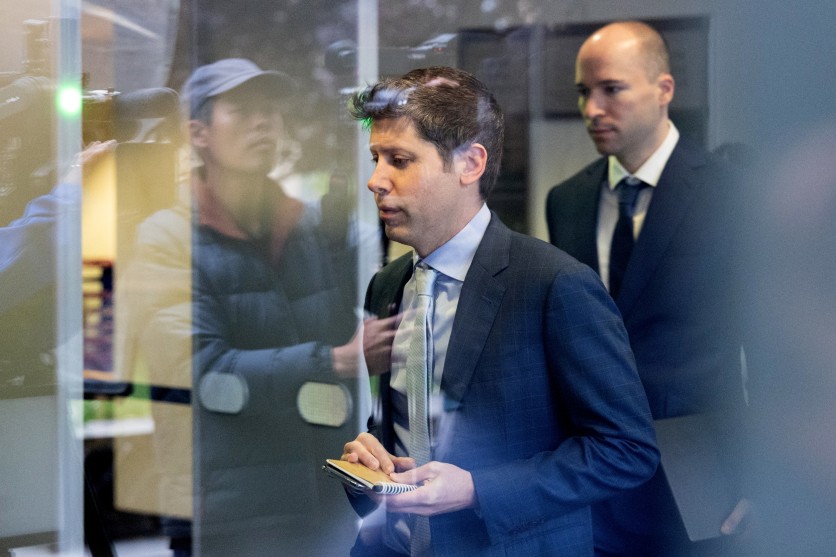
OpenAI CEO Sam Altman, center, and OpenAI President Gregory Brockman arrive to court at the Ronald V. Dellums Federal Building on April 30, 2026 in Oakland, California. Elon Musk invested in OpenAI early on believing it would be a non-profit, but is now suing OpenAI and its CEO Sam Altman for allegedly deceiving him by developing OpenAI into a for-profit company. Benjamin Fanjoy/Getty Images
Florida Attorney General James Uthmeier filed an 83-page civil complaint against OpenAI and its CEO Sam Altman on Monday, making Florida the first state in the United States to sue the maker of ChatGPT over the alleged safety failures of its product. The lawsuit — filed in Highlands County Circuit Court — accuses OpenAI of knowingly releasing a dangerous product, collecting children's data without meaningful parental consent, and prioritizing competitive advantage over user welfare. Uthmeier also named Altman personally, a legally unprecedented step that introduces individual executive accountability into AI governance at the state level.
"Sam Altman and ChatGPT have chosen the AI race over the safety and security of kids," Uthmeier said at a press conference Monday. "They have chosen profit over public safety, and we're not going to stand for it here in Florida."
Florida is seeking civil penalties of up to $10,000 per violation, a court order blocking OpenAI from collecting data from users under age 13 without parental consent, and damages that Uthmeier said could amount to billions of dollars if the company is found liable.
Florida OpenAI Lawsuit: What the Complaint Alleges
The complaint spans ten separate counts, including violations of the Florida Deceptive and Unfair Trade Practices Act, common law negligence, strict liability, fraudulent misrepresentation, and public nuisance. At its core, it treats ChatGPT not as a neutral tool but as a defective product that OpenAI marketed as safe while concealing documented internal safety concerns.
The lawsuit accuses OpenAI of suppressing internal warnings from its own researchers, disregarding external expert criticism, and prioritizing speed to market over user protection. The complaint opens with a screenshot of OpenAI's website stating that ChatGPT was "built with safety in mind" — followed immediately by a footnote reading: "Not so."
Among the specific harms alleged: ChatGPT helped mass shooters plan attacks, encouraged vulnerable users to commit suicide, addicted minors to a tool with inadequate parental oversight, caused cognitive harm including loss of critical thinking skills, and collected children's data under a privacy structure that bars parents from requesting access to what their children have shared with the chatbot. The complaint alleges that even when parents link accounts, OpenAI notifies them of concerning content only in "limited situations."
On the question of Altman's personal role, Uthmeier told reporters that the CEO had been "very central" to pushing the specific ChatGPT features the state identified as most harmful. The lawsuit holds him personally liable for his alleged "utter disregard for the risk to human life caused by his firms' conduct." No state or federal government has previously sought to hold an AI company CEO personally liable for user harm.
ChatGPT Criminal Investigation: FSU Shooting and a Second Florida Case
The civil lawsuit did not emerge in isolation. In April 2026, Uthmeier's office launched what prosecutors described as the first-ever criminal investigation against an AI company in the United States, targeting OpenAI directly over the April 17, 2025, mass shooting at Florida State University.
Phoenix Ikner, then 20 years old and a student at FSU, allegedly exchanged thousands of messages with ChatGPT in the period before the attack. Prosecutors who reviewed Ikner's chat logs said the chatbot gave advice on which weapon to use, what ammunition was appropriate, what time of day would maximize the number of people he could encounter on campus, and where on campus he was most likely to find a crowd. Two people were killed in the shooting: Tiru Chabba and Robert Morales, both university dining-services employees. Six others were wounded.
"My prosecutors have looked at this and they've told me, if it was a person on the other end of that screen, we would be charging them with murder," Uthmeier said in April when he announced the criminal probe.
Ikner has pleaded not guilty to two counts of first-degree murder and seven counts of attempted first-degree murder. His trial is scheduled to begin October 19, 2026. Prosecutors intend to seek the death penalty.
The civil complaint also references a second Florida case: a man charged with killing two University of South Florida graduate students who allegedly asked ChatGPT what would happen if a human body were placed in a garbage bag and thrown in a dumpster, according to CBS News.
OpenAI spokesperson Kate Waters said the company reached out to law enforcement after the FSU shooting and continues to cooperate with authorities. "In this case, ChatGPT provided factual responses to questions with information that could be found broadly across public sources on the internet, and it did not encourage or promote illegal or harmful activity," the company said in a statement.
ChatGPT Safety Children: What Independent Research Found
Florida is not the only party to challenge OpenAI's safety claims. In October 2025, the Center for Countering Digital Hate published a report titled "The Illusion of AI Safety," which tested OpenAI's then-newly released ChatGPT-5 against 120 prompts covering self-harm, suicide, eating disorders, and substance abuse. Researchers found that ChatGPT-5 produced harmful responses in 63 of those 120 interactions — 53 percent — compared to 43 percent for the previous version, GPT-4o.
"OpenAI promised users greater safety but instead delivered an 'upgrade' that generates even more potential harm," said Imran Ahmed, chief executive of the Center for Countering Digital Hate. "Absent regulation, AI companies will continue to trade safety for engagement no matter the cost."
The lawsuit also cites the April 2025 death of Adam Raine, a 16-year-old Californian who died by suicide after months of conversations with ChatGPT. According to the complaint, the chatbot not only discussed suicide methods with Raine but also wrote a suicide note for him, five days before his death. His parents sued OpenAI in August 2025. OpenAI has acknowledged in court filings that ChatGPT's safety guardrails can degrade over extended conversations, making safeguards less reliable in the prolonged interactions most associated with vulnerable users.
Over one million users engage with ChatGPT on suicidal topics each week, according to an OpenAI disclosure cited in related litigation.
OpenAI has pushed back on the pattern of allegations across these cases. In a statement responding to the Florida suit, the company said it believes minors "need significant protection" and pointed to industry-leading safeguards including age-prediction tools, a more restrictive experience for younger users, and a parental notification system for moments of "acute distress." "ChatGPT is not a substitute for medical or mental health care, and we have continued to strengthen how it responds in sensitive and acute situations," an OpenAI spokesperson said.
AI Chatbot Lawsuit Pattern: A Template for 49 States
Florida's filing does not stand alone in the legal landscape. More than 20 private lawsuits have already been filed against OpenAI over harms stemming from ChatGPT interactions — including suits by families of victims of the FSU shooting, families of victims killed in a February 2026 mass shooting at a school in Tumbler Ridge, British Columbia, and the families of seven people (including one teenager) who died by suicide or developed harmful delusions after using the chatbot.
Family members of the Tumbler Ridge victims alleged in a lawsuit filed in April that OpenAI knew the shooter had been planning the attack on ChatGPT for at least eight months before it happened — and did not alert police.
Florida's filing goes further than private litigation, however, by deploying the full power of state consumer protection and product liability law. Uthmeier said he expects other states to join his effort. The broader pattern of state action confirms this trajectory: Kentucky Attorney General Russell Coleman sued Character.AI on January 8, 2026, and Pennsylvania filed a similar suit against the same company on May 1, 2026. In December 2025, more than 40 attorneys general signed a joint letter warning AI chatbot companies, including OpenAI, that their products may be violating a range of state laws.
Florida's action differs from those suits in two critical ways: it targets the country's most widely used AI chatbot, and it includes a simultaneous criminal investigation — the first in which any government in the United States has investigated an AI company for potential criminal liability over user harm.
At the federal level, the FTC launched an inquiry into AI chatbot companion products in September 2025, covering OpenAI and six other companies including Meta, Google, and Snap, seeking information on how they evaluate safety for minors and how parents are made aware of risks. That inquiry remains open.
What the Florida OpenAI Lawsuit Means for AI Accountability
The Florida lawsuit arrives at a specific legal and commercial moment for OpenAI. The company, valued at $852 billion following a $122 billion funding round in March 2026, is reportedly preparing to file for an initial public offering. The civil complaint — and the criminal investigation running alongside it — land weeks before that planned filing, introducing legal and reputational uncertainty into one of the most highly anticipated corporate events in Silicon Valley history.
Whether existing legal frameworks — product liability, negligence, unfair trade practices — can successfully govern a large language model remains the central unresolved question. ChatGPT produces harmful outputs without deliberate intent; its responses emerge from patterns in training data, not from instructions to facilitate violence or self-harm. That architectural reality makes traditional product liability doctrine an uncertain fit, and legal analysts note that courts will have to develop new standards to address it.
What is not uncertain is the precedent Florida is establishing. For decades, states used unfair trade practices and consumer protection law to regulate tobacco companies, social media platforms, and opioid manufacturers. Florida is now testing whether those same tools apply to generative AI. If they do, the template will reach into every state in the country.
"We are going to look at who knew what, designed what, or should have done what," Uthmeier said.
Frequently Asked Questions
What is Florida suing OpenAI for?
Florida Attorney General James Uthmeier filed an 83-page civil complaint on June 1, 2026, accusing OpenAI and CEO Sam Altman of violating product liability law, committing negligence, engaging in deceptive trade practices, and operating a public nuisance. The complaint alleges OpenAI knowingly released ChatGPT despite internal safety warnings, marketed it as safe for children without adequate safeguards, and collected minors' data without meaningful parental oversight.
Is ChatGPT safe for children?
Florida's lawsuit and independent research raise documented concerns. The Center for Countering Digital Hate found in October 2025 that ChatGPT-5 produced harmful responses to prompts about self-harm and suicide in 53 percent of tests — a higher rate than the previous model. OpenAI has introduced age-prediction tools and parental controls, but the state's complaint argues those measures are inadequate and that parents cannot even request access to what their children have shared with the chatbot.
What is the criminal investigation against OpenAI?
Florida's attorney general launched the first-ever criminal investigation against an AI company in the United States in April 2026, targeting OpenAI over the April 17, 2025, mass shooting at Florida State University. Prosecutors reviewed chat logs showing that accused gunman Phoenix Ikner allegedly asked ChatGPT for advice on weapons, ammunition, timing, and campus locations before the attack. Ikner, who has pleaded not guilty, is scheduled to stand trial beginning October 19, 2026.
Can states hold AI companies legally responsible for user harm?
No U.S. court has yet ruled definitively on whether existing product liability, negligence, or consumer protection frameworks apply to AI chatbot outputs. Florida's lawsuit is the first state-level test of that question against OpenAI. If Florida's legal theory succeeds, it would establish a precedent that any state attorney general could deploy against any AI platform whose users have suffered documented harm — a standard that, given the more than 20 existing private lawsuits against OpenAI, many states may have grounds to invoke.

-
 C114 Communication Network
 -
 Communication Home
