
 Search

Polestar.com
Polestar and Volvo Cars build vehicles side by side at the same Volvo factory in Charleston, South Carolina. Both brands are owned by China's Geely Holding. But last June, the US Department of Commerce's Bureau of Industry and Security denied Polestar the authorization it needed to keep selling new cars in America, while Volvo walked away with a clearance. The reason was not what Polestar puts in its cars or where it builds them. The reason was where its data goes.
That difference — between a brand whose vehicle connectivity systems route data through Geely's China-based server infrastructure and one that restructured its data pipeline away from China — is the operative mechanism of the Connected Vehicle Rule, the Biden-era national security regulation that now makes Polestar the first established automaker formally barred from the American new-car market under a data-security prohibition.
How Polestar Got Banned While Volvo Did Not
The BIS rule finalized in January 2025 restricts the sale of vehicles whose telematics and connectivity software have a "sufficient nexus" to China or Russia. The rule covers any automaker owned, controlled, or subject to the jurisdiction of those countries, and it applies regardless of where the vehicle is physically assembled. A car built in South Carolina can be banned if the software stack and data routing that powers its connectivity systems runs through a Chinese-controlled cloud.
The technical target is the Vehicle Connectivity System — the combination of telematics control unit, cellular modem, Bluetooth, satellite communications, and GPS modules that together allow a modern vehicle to receive over-the-air updates, report location data, and communicate with external networks in real time. Data from those systems flows from the car to a cloud server; the BIS evaluates server ownership and the jurisdiction controlling it under the rule.
Volvo secured an authorization in May 2026 after engaging in what the company described as bilateral governance and data talks with BIS and other officials on its governance structure, technical architecture, and data security. The exemption required Volvo to restructure its data governance so that VCS data would not flow through Chinese servers. Polestar did not undertake that restructuring.
BIS denied Polestar authorization on June 25, 2026. Polestar announced its US exit the same day, confirming it would wind down US new-vehicle sales after existing 2026 model-year inventory is exhausted. The company declined to appeal. And — in a disclosure that drew significant attention from US dealers — Polestar's US head of product Peter Wexler wrote to dealers in August acknowledging that the company was still seeking an official explanation from the Commerce Department for why its application had been denied while Volvo's was approved, given that the two brands share hardware, software, and a manufacturing facility.
The Polestar 3 and the Volvo EX90 are built on the same platform, in the same plant. The ban has nothing to do with either vehicle's design. It is about data.
Why China's Laws Make Server Location Decisive
The legal architecture underlying the Connected Vehicle Rule begins with China's National Intelligence Law of 2017. Article 7 of that law states explicitly that all organizations and citizens must "support, assist, and cooperate with national intelligence efforts in accordance with law." Article 10 extends cooperation obligations to organizations at the direction of intelligence agencies. Article 11 extends the reach to overseas activities that affect Chinese national security interests.
For Geely — a Chinese company subject to Chinese law — these provisions mean that no corporate privacy policy, no Western business structure, and no physical location of a data center can independently guarantee that data flowing through Geely-controlled servers will remain private from the Chinese government. This is the structural concern that makes the server routing question decisive. A vehicle whose telematics data routes through Geely infrastructure in China is not merely owned by a Chinese company in a technical sense. It is connected to data infrastructure that Chinese law can compel its operator to surrender on demand.
This is also why the rule is not satisfied by manufacturing a car in South Carolina. The vehicle's physical origin is irrelevant to whether the data it generates is accessible to a foreign government. What matters is the software supply chain and the destination of the data those systems transmit.
Polestar's Financial Position at the US Exit
On September 3, 2026, Polestar published its H1 2026 results alongside the unveiling of its "Formula 2030" design concept showcar — a pairing that illustrated the company's strategic position with some clarity: aspirational design ambitions running alongside the most difficult operating environment in its short history.
Revenue for the first half of 2026 came in at approximately $1.3 billion, down roughly 4 percent year-on-year, as intensified competition, tariffs, and unfavorable model mix pressed on margins. Vehicle sales volume increased only about 0.4 percent over the same period in 2025. Net losses for the six months reached approximately $842 million — a significant figure, though roughly 29 percent smaller than the comparable loss in the first half of 2025. CEO Michael Lohscheller cited the H1 operating loss improvement — 43 percent lower year-on-year — as evidence of ongoing operational improvement.
Polestar's stock fell sharply on the H1 results release. The company simultaneously downgraded its full-year 2026 sales growth forecast, cutting it from a previously projected low-double-digit volume increase to a low-to-mid single-digit range and citing the US regulatory exclusion as a primary factor.
The numbers underline why the US exit, while significant, did not break the company. In the first quarter of 2026, Polestar's non-US sales share reached 94 percent of its total retail volumes. Europe accounts for close to 80 percent of global retail volume. The US represented roughly 6 percent of sales — meaningful, but not existential.
Formula 2030: Design Ambition Meets Regulatory Reality
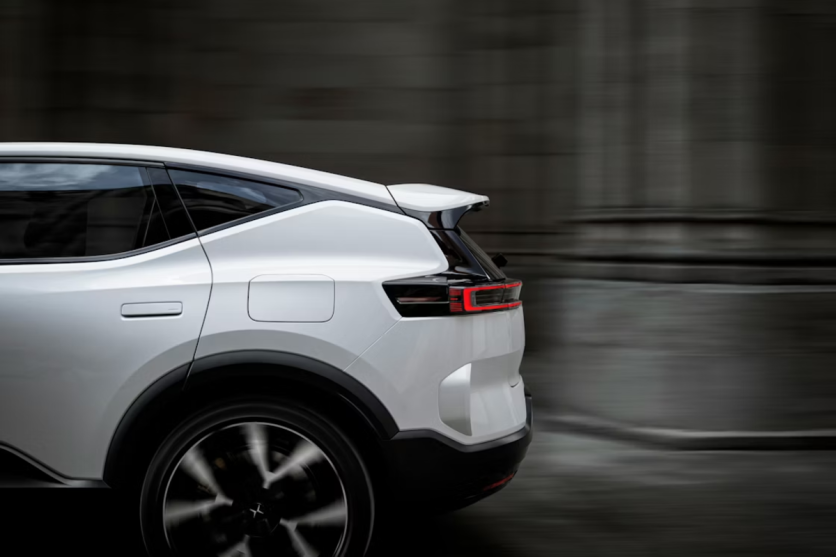
The Formula 2030 showcar, developed under head of design Philipp Römers, is intended to signal the aesthetic direction Polestar's upcoming generation of vehicles will take. A low-slung silhouette with a motorsport-influenced vertical windshield wiper distinguishes the concept visually, while Römers has said the design will evolve from rather than replace the brand's existing visual identity — including the signature Dual Blade headlights that appear across the current lineup.
Polestar said investors, retailers, and select customers will receive a private preview of the showcar at the company's headquarters in Gothenburg, Sweden, before a wider global debut later this year — coinciding with a planned media drive for the updated Polestar 4 SUV. The Formula 2030 concept is expected to inform the design direction of the all-new Polestar 2, currently planned for a 2027 launch, and the Polestar 7 compact SUV expected in 2028.
Whether the design exercise translates into commercial momentum is a separate question. The next generation of Polestar vehicles will launch into a market where the brand has already lost its American presence. For consumers in Europe, Southeast Asia, Eastern Europe, Latin America, and Canada — the markets Lohscheller identified as growth priorities — the showcar signals continued investment. For the American market, it signals investment in vehicles that cannot be sold here.
What Existing US Owners Are Facing
Polestar has committed to honoring all existing warranties, continuing over-the-air software updates, and maintaining its US service network for vehicles already on American roads under its "Polestar Promise" owner commitment. Polestar's existing owner warranty coverage spans four years or 50,000 miles for manufacturing defects, with battery and electric motor protection extending to eight years or 100,000 miles.
Many US Polestar service points share facilities with Volvo dealers, providing useful continuity. But analysts have flagged a longer-term concern: as new-vehicle inventory disappears from showrooms, dealers lose the financial incentive to maintain full Polestar operations, and owners may face longer service trips, slower parts availability, and diminished technician familiarity with the vehicles over time.
Resale value anxiety has been immediate. Polestar has offered discounts as deep as $25,000 on remaining US inventory of the Polestar 3 and Polestar 4 as it clears existing stock. The resulting price pressure has made used Polestars cheaper — and drawn comparisons among prospective buyers to the fire-sale pricing that followed Fisker's 2024 bankruptcy. The situations are structurally different: Polestar remains a solvent, operating company globally. But the resale concern is real: market sentiment on a brand that has exited a market corrects quickly, regardless of the brand's underlying viability.
D.L. Byron, a Washington state owner who purchased a certified pre-owned Polestar 2 just before the ban announcement, described the experience in terms that have resonated widely among existing owners: the car runs well, but the infrastructure around it — resale confidence, service network visibility, brand continuity — has shifted on a government decision made without any input from the people who own the vehicles.
Is There a Hardware Problem Coming in 2030?
The Connected Vehicle Rule operates in two phases. Software-related prohibitions took effect for the 2027 model year — which is why Polestar can continue selling 2026 and earlier inventory now, but cannot sell new 2027 model-year vehicles. A separate hardware ban takes effect for the 2030 model year, or January 1, 2029 for vehicle components sold without a model year designation.
The hardware restrictions cover the physical components of the Vehicle Connectivity System — the telematics control units, GPS modules, cellular modems, and Bluetooth chipsets themselves, if those components were designed, manufactured, or supplied by entities with a China or Russia nexus.
What this means for existing US Polestar owners is still being worked out. The rule as written applies to new sales and imports, not to vehicles already registered and on the road. But if a Polestar owner's VCS hardware was sourced from Chinese-linked suppliers — which is plausible given Geely's supply chain — future parts replacements or repairs involving those components could become more complicated as 2030 approaches. Polestar has not publicly addressed this dimension. It is a gap worth watching.
Why Volvo Made It Through the Same Process Polestar Did Not
The question is straightforward; the answer is less so. Neither BIS nor Polestar has issued a formal public statement explaining in technical detail why the two brands received different outcomes despite sharing Geely ownership and a South Carolina manufacturing plant.
What is known: Volvo engaged in an active bilateral negotiation with BIS — restructuring data governance away from China to satisfy the rule's "sufficient nexus" standard before the exemption was granted in May 2026. Polestar, by its own account, expected an authorization based on prior communications, but received a denial in June. Polestar then declined to appeal or pursue an exemption.
That sequence — Volvo negotiates and restructures; Polestar expects and does not negotiate; Polestar then does not appeal — is the factual record. The dealer lawsuit filed by New Jersey's Prestige Imports on August 12, 2026, draws a sharper conclusion from that sequence: that Polestar was never seriously attempting to secure authorization, and instead allowed the regulatory outcome to serve as cover for a US market withdrawal it had been planning for approximately two years.
Prestige Imports — which operates two New Jersey Polestar outlets — sued Polestar for franchise violations in Bergen County Superior Court, seeking at least $25 million in damages. The complaint alleges that Polestar violated New Jersey's Franchise Practices Act by sending a "force majeure" letter in July 2026 — invoking the government's ban as grounds to exit its franchise obligations without the 60-day notice or good cause the act requires. The suit further alleges that Polestar continued encouraging US dealers to invest in expansion — including a multiyear Bergen County project approved as recently as February 2026 — even as it prepared to leave.
Republican Senator Bernie Moreno of Ohio, in a July interview with CBT News, offered his own assessment: "Polestar screwed Polestar, it wasn't screwed by the US government." Polestar has declined to comment on the litigation.
The allegations in the Prestige Imports franchise case are unproven. But the underlying factual claim — that Volvo demonstrated compliance was achievable through active engagement, while Polestar declined to pursue the same path — is supported by the public record and has not been disputed by Polestar.
Europe, Manufacturing, and the Road Forward
Polestar's near-term product pipeline continues regardless of its US status. Production of the Polestar 4 SUV has been running at its Busan, South Korea facility, with a new variant of the model expected in fourth-quarter 2026 customer deliveries. Polestar 5 performance sedan first customer deliveries are expected to begin in the coming weeks. The all-new Polestar 2 is planned for a 2027 launch, and the Polestar 7 compact SUV — which Polestar has confirmed will be manufactured in Europe — is targeted for 2028.
The European manufacturing decision for the Polestar 7 is directly tied to the regulatory lesson of the US exit. Building the Polestar 7 in Europe rather than China addresses both supply chain vulnerability under rules like the Connected Vehicle Rule and potential future trade exposure from EU or US tariffs on China-manufactured vehicles. It also provides, in principle, an architecture from which European data routing — rather than Geely China routing — could be the default for the next generation's VCS infrastructure.
Whether that makes a future European-built Polestar eligible for US authorization is an open regulatory question. The Connected Vehicle Rule evaluates company ownership and software supply chain nexus, not manufacturing location — as the Polestar 3's South Carolina production made clear. Polestar would need to demonstrate, as Volvo did, that its data governance architecture genuinely decouples VCS data from Chinese jurisdiction. So far, the company has not signaled it intends to make that case.
Lohscheller's June 2026 strategic statement remains Polestar's public position: "The automotive industry is entering a new phase, based on regional dynamics. Our strategy reflects that, with Europe being our largest growth engine and our plan to manufacture Polestar 7 in Europe."
Frequently Asked Questions
Why was Polestar banned from selling new cars in the US?
The US Department of Commerce's Bureau of Industry and Security denied Polestar authorization under the Connected Vehicle Rule, a national security regulation that restricts the sale of vehicles whose telematics and connectivity software has a "sufficient nexus" to China or Russia. Polestar is majority-owned by Geely, a Chinese company, and its connected vehicle systems route data through Geely's China-based infrastructure. Under China's National Intelligence Law of 2017 (Article 7), all Chinese organizations must cooperate with the Chinese government's intelligence work — which means no private data policy can independently protect data that flows through Geely's servers. That structural legal condition, combined with Polestar's ownership structure, produced the regulatory outcome.
Why did Volvo get a US exemption while Polestar did not?
Volvo, also owned by Geely, actively negotiated with BIS and restructured its data governance and technology architecture — specifically ensuring that VCS data does not flow through Chinese-controlled servers — before receiving authorization in May 2026. Polestar apparently expected authorization based on prior discussions but did not undertake an equivalent restructuring, declined to appeal after denial, and declined to pursue the same exemption pathway Volvo used. A pending franchise lawsuit by New Jersey dealer Prestige Imports alleges Polestar was never seriously seeking authorization. BIS has not publicly explained the specific technical or procedural differentiation between the two cases.
Could Polestar have avoided the US ban?
Based on publicly available information, almost certainly yes — the Volvo exemption demonstrates that a Geely-owned brand could satisfy the Connected Vehicle Rule through bilateral data governance negotiations with BIS. Polestar, by its own account, was expecting approval without having undertaken equivalent restructuring, then declined to appeal or negotiate further after denial. Whether that reflects a genuine technical constraint — Polestar's deeper integration with Geely's software stack may make VCS data decoupling harder than it was for Volvo — or a strategic decision to use the regulatory outcome as a low-friction exit from a US market accounting for only 6 percent of sales is the question at the center of the dealer lawsuit currently working through New Jersey courts.
What does the US ban mean for people who already own a Polestar?
Polestar has committed to honoring existing warranties (4 years/50,000 miles on manufacturing defects; 8 years/100,000 miles on battery and electric motors), continuing over-the-air software updates, maintaining parts availability, and keeping its US service network operational under the "Polestar Promise." Most US Polestar service points share facilities with Volvo dealers, providing near-term continuity. The primary concerns for existing owners are resale value — which has already declined as the market prices in the brand's US exit — and long-term service network sustainability as new-vehicle sales end and dealer financial incentives shift.

-
 C114 Communication Network
 -
 Communication Home
