
 Search

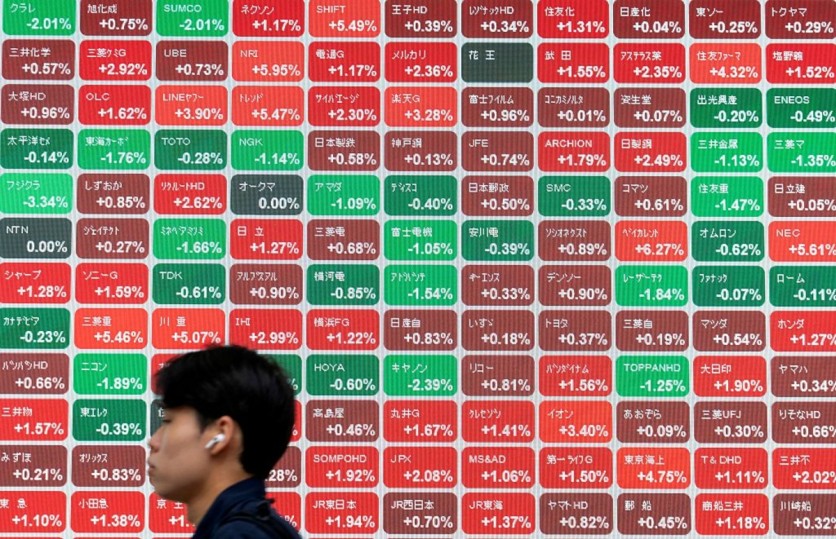
A man walks past an electronic quotation board displaying the Nikkei 225 stock prices on the Tokyo Stock Exchange along a street in Tokyo on June 29, 2026. Kazuhiro NOGI/AFP via Getty Images
On Monday, Japan's benchmark Nikkei 225 index climbed 1,378 points — or 2.12% — to close at 66,399, powered almost entirely by a handful of high-priced artificial intelligence and semiconductor-related stocks. The day's top gainers, Kioxia Holdings and SoftBank Group, each advanced well over 6%, while the broader Tokyo market quietly told a different story: of the Tokyo Stock Exchange's Prime Market listings, 883 stocks fell as only 630 rose.
That gap — a headline surge while most shares declined — is not a contradiction. It is a structural feature of how the Nikkei 225 is built, and understanding it matters to any investor who uses the index as a gauge of Japanese market health or a signal for global AI momentum.
Why the Nikkei and the Market Can Point in Opposite Directions
The Nikkei 225 is a price-weighted index structure unique to the benchmark. Unlike the S&P 500, which weights each stock by its total market value, the Nikkei assigns influence based on each company's share price alone. A stock trading at ¥58,780 (approximately $377) — Kioxia's closing level on Monday — carries roughly 120 times the index weight of a ¥500 stock, regardless of the companies' relative economic size. When a small cluster of high-priced technology names rises sharply, the headline Nikkei number can jump meaningfully even as the majority of listed companies decline.
Monday's session was a textbook example. The Topix index, Japan's market-cap-weighted alternative, rose just 22.57 points to 4,125.80 — a fraction of the Nikkei's percentage gain, and a clearer representation of what actually happened across the broader market.
What Drove the Day: Chips, Memory, and an OpenAI Signal
The spark arrived from Wall Street's Friday session. Despite the Dow Jones Industrial Average falling 271 points on September 4 — weighed down by stronger-than-expected US payroll data that reinforced expectations of another Federal Reserve rate hike — the Philadelphia chip index surged 3% as investors focused on AI hardware demand rather than rate risk. Nvidia, Marvell, and AMD all gained sharply, while Dell Technologies, which had reported earnings on September 1 and reportedly raised its full-year AI infrastructure outlook, surged approximately 16% on September 4. The reported catalyst: speculation that OpenAI was approaching the unveiling of a next-generation model widely expected to require substantially greater volumes of high-bandwidth memory and advanced AI accelerators.
That momentum carried directly into Tokyo. Chicago Nikkei futures settled well above the Osaka close on Friday evening, the index opened at 65,600 — already up 579 points — and pushed past 66,460 at its intraday peak before some profit-taking trimmed the advance slightly into the close.
Who Won, and Why Their Prices Make the Nikkei Jump
Kioxia Holdings, Japan's NAND flash memory maker and the world's largest NAND manufacturer by market share as of mid-2026, surged 7.93% to ¥58,780 (approximately $377). Kioxia listed on the Tokyo Stock Exchange in December 2024 at ¥1,455 per share — roughly $9 at the time — and has since become the country's largest company by market capitalization, having surpassed Toyota in June 2026 on the strength of AI-driven NAND demand. The company's high share price means even a mid-single-digit percentage move contributes disproportionately to the Nikkei headline.
SoftBank Group, whose sprawling portfolio of AI-infrastructure bets includes major stakes in OpenAI, Arm Holdings, and a network of robotics and data-center ventures, climbed 6.82%, approaching the ¥6,000 mark (approximately $38). Fujikura, a manufacturer of optical fiber and data-center cabling critical to high-bandwidth AI networks, rose 5.9%. Tokyo Electron, the semiconductor equipment giant and one of the world's top two or three equipment makers, gained 5.3%, while chip-testing specialist Advantest added 2.6%. Renesas Electronics gained 3.1% and Rohm climbed 7.8%, reflecting broad confidence in Japan's position across the global semiconductor supply chain.
Japan occupies a distinctive — and often underappreciated — position in the global chip industry. According to research from the Observer Research Foundation, Japanese firms control roughly 56% of the global semiconductor materials market and approximately 32% of the semiconductor manufacturing equipment market. Unlike South Korea and Taiwan, which dominated chip design and manufacturing, Japan retained near-dominance of the upstream infrastructure: the chemicals, photoresists, precision instruments, and testing equipment that all chipmakers worldwide depend on. When AI demand surges, Tokyo Electron and Advantest benefit directly — regardless of which company's chips end up in the final data center.
How Does This Link AI to HBM to Kioxia to Fujikura?
High-bandwidth memory (HBM) is a three-dimensional DRAM architecture stacked in 4 to 12 layers and mounted directly alongside an AI processor using through-silicon vias (TSVs), creating an extremely wide data bus in a compact footprint. Nvidia's H100 GPU, for instance, uses HBM3 to deliver approximately 3.35 terabytes per second of memory bandwidth — the rate-limiting factor for training and running large AI models. When OpenAI or another major AI lab signals demand for a next-generation model, the immediate downstream effect hits HBM producers (primarily SK Hynix and Samsung in South Korea), then cascades to NAND flash makers like Kioxia (which is exploring HBM conversion of some of its existing Japanese fabrication plants), then to equipment makers like Tokyo Electron and Advantest whose tools are required at every step of chip production, and finally to optical fiber suppliers like Fujikura, which provides the high-bandwidth interconnects that link AI servers within data centers.
This explains why South Korea's KOSPI surged on Monday as well, with Samsung Electronics and SK Hynix — one of the dominant suppliers of HBM chips for AI training — both posting strong gains. Institutional investors increasingly treat the two markets as interconnected nodes in a single AI hardware trade. When Seoul's memory giants rally, Tokyo's equipment makers, substrate suppliers, and testing-equipment companies tend to follow.
The Macro Backdrop: Rate Pressure and a Looming BOJ Decision
While Monday's session was powered by technology momentum, the surrounding macro environment grew more complicated. Oil prices remained elevated near $97 a barrel, an acute concern for Japan, which imports virtually all of its energy. The yen traded around ¥156 to the dollar, a level reached after Japanese authorities spent a record ¥15.4 trillion (approximately $96 billion) in yen-buying foreign-exchange intervention between late July and late August 2026 — the largest monthly intervention on record, according to Japan's Finance Ministry, after the yen hit ¥163.99 per dollar in July, a 40-year low. On September 7, the Finance Ministry reported that Japan's foreign reserves posted record decline in August, reflecting the cost of that intervention.
The Bank of Japan, which hiked rates to 1.0% on June 16, 2026 — the highest level since 1995 — faces a consequential September 17–18 policy meeting. Markets were pricing approximately a 75% probability of another quarter-point increase, following BOJ Deputy Governor Ryozo Himino's statement that the central bank would consider raising rates at every meeting "including the next one." The 10-year Japanese government bond yield has recently crossed 3% for the first time in roughly three decades, raising the discount rate applied to future corporate earnings and increasing the government's already substantial borrowing costs.
Prime Minister Sanae Takaichi's administration is pursuing an ambitious ¥370 trillion (approximately $2.37 trillion) public and private investment agenda targeting semiconductors, AI infrastructure, defense, and energy security through 2040. On Monday, technology momentum proved strong enough to override rate pressure at the index level — but the weak breadth, in which most Prime Market stocks actually declined, suggested investors remain selective rather than broadly bullish on Japan.
What the Nikkei's Headline Number Doesn't Tell You
For a US investor watching the Nikkei headline, the structural reality is worth keeping in mind: the index can surge 2% while the majority of Japanese stocks fall, and it does so reliably whenever AI-related semiconductor stocks lead the day. The Topix — market-cap-weighted, broader, and a more accurate representation of overall Japanese market breadth — rose less than 0.55% in percentage terms on Monday, and 883 TSE Prime stocks fell while only 630 rose. Those numbers tell a substantially different story than the +1,378 headline.
The next major tests will arrive quickly. US consumer price index data is expected later this week. The Federal Reserve's rate decision is scheduled for September 16 — one day before the BOJ's pivotal September 17–18 meeting begins. How both central banks signal the path ahead will determine whether Monday's chip-led rally can broaden into a more sustained advance, or whether it remains a powerful but structurally narrow episode driven by a small cluster of very expensive stocks.
Frequently Asked Questions
Why did the Nikkei rise so much Monday while most Japanese stocks actually fell?
The Nikkei 225 is a price-weighted index, meaning higher-priced stocks carry disproportionate influence regardless of a company's total market value. On September 7, 2026, a small cluster of very high-priced semiconductor and AI-related stocks — Kioxia at ¥58,780 (approximately $377), SoftBank approaching ¥6,000 (approximately $38) — rose sharply, pushing the headline index up 2.12%. Meanwhile, 883 of the Tokyo Stock Exchange's Prime Market stocks declined while only 630 advanced. The market-cap-weighted Topix index, which is a better gauge of overall market breadth, rose far less.
What is high-bandwidth memory (HBM), and why does an OpenAI model announcement move Japanese chip stocks?
HBM is a three-dimensional memory chip architecture mounted directly alongside AI processors to deliver the extreme data throughput that training large AI models requires — Nvidia's H100 uses HBM3 to provide approximately 3.35 terabytes per second of bandwidth. When AI labs signal demand for next-generation models, the downstream effect runs through HBM producers (South Korea's SK Hynix and Samsung), then to Japanese companies that supply the semiconductor manufacturing equipment (Tokyo Electron, Advantest), testing systems, materials, and optical interconnects (Fujikura) used to produce those chips. Japan holds approximately 56% of the global semiconductor materials market and roughly 32% of equipment — making Tokyo a leveraged beneficiary of any increase in AI chip production.
What does the Bank of Japan's upcoming September decision mean for Japanese equities?
The BOJ is expected to raise its benchmark interest rate — already at 1.0% since June 2026, a 31-year high — by another quarter-point at its September 17–18 meeting, according to market pricing. Higher interest rates increase the discount rate applied to future corporate earnings, which typically puts downward pressure on equity valuations, particularly for high-growth technology stocks trading at elevated price-to-earnings multiples. If the BOJ signals further tightening beyond September, AI-related stocks that have led Japan's 2026 bull market could face valuation pressure even as underlying chip demand remains strong.
How should US investors interpret a Nikkei headline gain?
Check the Topix alongside the Nikkei, and look at breadth data (advances vs. declines) when available. When AI and semiconductor stocks lead, the Nikkei's price-weighted structure means the headline number can be significantly more optimistic than what the broader Japanese equity market experienced that day. A Topix gain close to the Nikkei gain signals broad market participation; a much smaller Topix gain relative to the Nikkei headline signals concentration — exactly what occurred on September 7, 2026.

-
 C114 Communication Network
 -
 Communication Home
