
 Search

Gigabyte.com
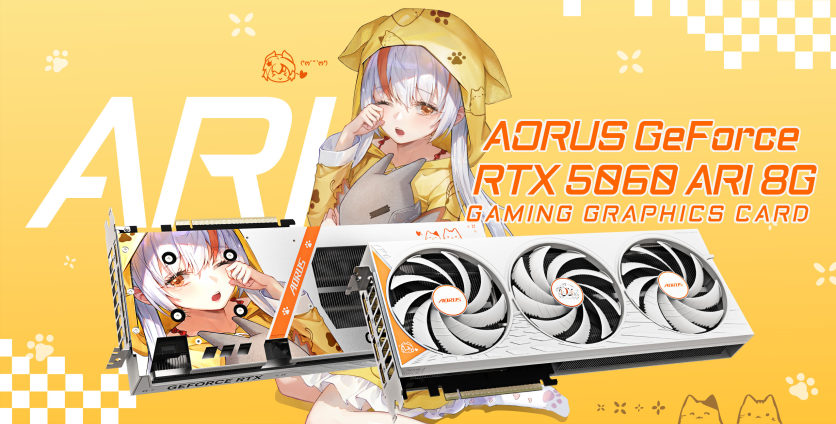
GIGABYTE's first original-character anime GPU just became something you can actually buy. The AORUS GeForce RTX 5060 ARI 8G — built around GIGABYTE's in-house ARI mascot and the most visually distinctive RTX 5060 on the market — appeared in the official AORUS European store on September 6, priced at €491 to €499 depending on country. Third-party sellers have already pushed listings to €629, while the official store also shows an alternative regional listing at €412.89.
The launch gives European PC builders their first real opportunity to purchase the card. GIGABYTE released its ARI 8G press release on August 14 without disclosing pricing or regional store availability at the time. The gap between announcement and storefront availability ended with this week's listing — just over three weeks after the card made its European public debut at the AORUS INFINITY Gamescom 2026 showcase in Cologne.
Performance Is Borrowed, Design Is the Point
Before anything else, buyers should understand what the ARI actually is under the shroud. Mechanically, it is a near-identical variant of the AORUS GeForce RTX 5060 ELITE 8G — GIGABYTE's existing premium RTX 5060 model. Both cards carry the same triple-fan WINDFORCE cooling system, the same 2,722 MHz factory boost clock (versus NVIDIA's 2,497 MHz reference specification, a 9% uplift), and the same underlying GPU configuration. The ARI replaces the ELITE's black finish with a white shroud and backplate, overlays ARI character artwork across the rear panel, and adds RGB lighting along the card's side. Those changes are cosmetic. The GPU inside, the memory configuration, and the cooling architecture are carried over wholesale.
The premium for all of that is roughly €15 — the AORUS ELITE 8G lists in the same store at €476 at the time of this listing. Whether that gap is reasonable depends entirely on whether the buyer values the visual identity. As a performance investment, the two cards are interchangeable.
Read more: Not Just Flagships: NVIDIA Raises GPU Kit Costs Across Entire GeForce Lineup
What Is the ARI GPU Actually Doing Technically?
The ARI 8G runs on NVIDIA's GB206-250 GPU, manufactured on TSMC's 4-nanometer process node. The die measures 181 square millimeters (approximately 7.1 square inches) and contains around 21.9 billion transistors — a meaningful density increase over prior-generation mainstream GPUs. The full configuration gives buyers 3,840 CUDA cores, 120 Texture Units, 48 Render Output Units, 30 4th-generation Ray Tracing Cores, and 120 5th-generation Tensor Cores for AI acceleration.
Memory is 8 GB of GDDR7 running at 28 Gbps across a 128-bit bus, delivering approximately 448 GB/s of bandwidth — roughly a 65% improvement over 272 GB/s available to the RTX 4060 on an equivalent-width bus. That bandwidth gain is the RTX 5060's most meaningful architectural improvement over its predecessor, and it compensates partially for the 128-bit bus width that limits peak throughput compared to wider-bus alternatives at similar price points.
A note worth flagging for technically-minded buyers: multiple other RTX 5060 cards on the market — from MSI, Yeston, Maxsun, and ASUS — have begun shipping with a different GPU die altogether. Those cards use a cut-down GB205 RTX 5070 die. NVIDIA bins excess GB205 dies by disabling processing units to meet RTX 5060 specifications — the final CUDA core count and memory configuration come out identical to a GB206 card, but the physical die is larger, rectangular rather than square, and typically requires a 16-pin power connector instead of the single 8-pin used by GB206 designs. The GIGABYTE ARI uses the original GB206-250 and an 8-pin connector, matching the board design inherited from the ELITE. Performance between the two die variants is essentially equivalent in practice.
The cooling system GIGABYTE uses on the ARI — the WINDFORCE system with the patented Hawk Fan design — is claimed to achieve 53.6% higher air pressure and 12.5% greater air volume compared to conventional fans, according to the company. Adjacent fans rotate in opposite directions to minimize turbulence at the fan boundary. A large copper contact plate sits directly on the GPU die, with composite copper heat pipes routing heat to the fin stack. Server-grade thermal gel covers the VRAM modules and MOSFETs. A Dual BIOS switch on the card lets users toggle between Performance and Silent modes. These are the same features present on the ELITE — they carry over to the ARI unchanged.
What Are the 128-bit Bus Trade-offs at Real Gaming Resolutions?
The RTX 5060's 128-bit memory interface is its most frequently cited limitation, and it deserves a clear-eyed evaluation. At 1080p — the card's intended primary resolution — 448 GB/s of GDDR7 bandwidth handles the current AAA game library without meaningful constraint. Smaller framebuffers at 1080p reduce memory pressure, leaving more headroom for texture assets before VRAM exhaustion occurs.
At 1440p, the picture is more conditional. With graphics settings at Ultra and ray tracing enabled, demanding titles begin approaching the 8 GB ceiling faster than they would on a card with more VRAM. When that ceiling is reached, the GPU begins streaming texture data across the PCIe bus to system RAM — a bandwidth mismatch that produces the characteristic micro-stuttering documented in multiple 2025–2026 game reviews. Under more typical 1440p settings — High or Medium with selective ray tracing — the RTX 5060 remains an effective card. Users planning to play at 1440p Max settings in the most demanding current titles should treat the 8 GB constraint as a real consideration.
At 4K, the card is not a strong match regardless of the design on the backplate.
Gamescom, Computex, and the ARI Ecosystem
The ARI GPU did not arrive without context. GIGABYTE debuted the character's expansion into graphics hardware at AORUS INFINITY Gamescom 2026 in Cologne, where the AORUS INFINITY booth showcased the ARI's European debut alongside the company's flagship INFINITY Series motherboards and gaming monitors. The Gamescom appearance was part of a broader rollout that GIGABYTE framed under the "AORUS INFINITY" theme — a unified aesthetic ecosystem for its premium hardware line.
The ARI ecosystem predates the GPU. The character was introduced with GIGABYTE's AORUS motherboard series, and this year's B850 AORUS ELITE-P ICE — announced ahead of Computex 2026 — brought the ARI aesthetic to a full ATX motherboard, complete with ARI character artwork on the chipset cover. Buyers who pair that board with the ARI GPU will have a coordinated interior build built around the same character. GIGABYTE has positioned this as the AORUS "Waifu Series" — hardware for enthusiasts who want systems that function as aesthetic objects.
Read more: NVIDIA RTX 50 GPU Shortage: Supply Cut 20%, Prices Climbing, No Desktop Refresh Confirmed
What's Inside the Box: A Blind-Box Collectible Doll
Every AORUS ARI 8G ships with an exclusive ARI collectible doll, five blind-box color variants packed randomly with each card. The buyer doesn't know which variant they'll receive until they open the box. GIGABYTE describes this as a "moment of discovery" — framing the unboxing as part of the product experience rather than a secondary detail.
This mechanic is borrowed directly from the blind-box toy market — the tradition, originating in Japan's capsule-toy (gashapon) culture and brought to mainstream Western retail by brands like Pop Mart, of packaging collectibles so that buyers must accept randomized results. Applied to a GPU box, it's a first for mainstream PC hardware at this price tier. Prior anime-themed GPU products from other brands have included art prints, stickers, or thematic packaging — not randomized collectibles designed to encourage repeat purchasing or trading. Whether that resonates with a buyer depends on how much they care about the ARI character specifically. For a buyer motivated purely by the GPU's specifications, it is packaging noise. For the target buyer — someone already invested in the AORUS ARI aesthetic — it adds a layer of engagement the hardware industry rarely attempts.
The anime PC hardware market is growing as a category, with buyers increasingly prioritizing "aesthetic cohesion" — matching character art across components — over specifications alone. GIGABYTE's ARI line, with its original character rather than a licensed IP, positions the company as a potential long-term player in that space rather than a one-off collaboration.
Is the AORUS ARI Available Outside Europe?
As of September 7, 2026, GIGABYTE has not confirmed US pricing, a US store listing, or a specific availability date for North American buyers. The European store launch appears to be the first confirmed retail availability globally. The card carries NVIDIA's reference MSRP of $299 for the base RTX 5060 — custom cards from AIBs like GIGABYTE routinely sell above that baseline, and the ARI's aesthetic premium would push it above the ELITE's price regardless of region.
Currency conversions in this article are approximate based on exchange rates as of September 7, 2026.
Frequently Asked Questions
Is the AORUS ARI RTX 5060 faster than the standard AORUS ELITE 8G?
No. The ARI 8G and the AORUS ELITE 8G share the same factory boost clock of 2,722 MHz, the same WINDFORCE triple-fan cooling system, and the same underlying GPU configuration. The performance gap between them is effectively zero in real-world use. The ARI edition costs approximately €15 more than the ELITE at official store pricing — that premium reflects the anime artwork, the white finish, and the included blind-box collectible doll, not additional processing capability.
What makes the blind-box doll significant beyond being a pack-in toy?
The blind-box mechanic — random variants unknown to the buyer until unboxing — is borrowed from Japan's gashapon toy tradition and brands like Pop Mart, which built a global collectible business around exactly this randomized-reveal format. GIGABYTE applying it to a GPU is the first time the mechanic has appeared in mainstream PC hardware at this price point. It signals that GIGABYTE is treating the ARI product line as merchandise in addition to hardware — a position that has precedent in the gaming peripheral and anime merchandise markets but is genuinely new for a graphics card targeting everyday buyers.
Should European RTX 5060 buyers wait for US prices before deciding?
For buyers in Europe, the €491 official store price is already available and represents a manageable €15 premium over the AORUS ELITE. Third-party listings at €629 are not competitive with the official price — the official AORUS store is the right place to buy. US buyers have no confirmed listing or pricing yet, and no timeline has been given. Buyers wanting the ARI specifically should watch for a US store announcement; buyers who want the same performance without the design premium should consider the AORUS ELITE 8G at €476 in Europe.
Does the RTX 5060's 128-bit memory bus cause real performance problems?
At 1080p — the card's primary target resolution — the answer is generally no. The 28 Gbps GDDR7 memory provides 448 GB/s of bandwidth, which is sufficient for the current game library at 1080p settings up to Ultra in most titles. At 1440p with maximum graphics quality and ray tracing, the 8 GB VRAM ceiling becomes a real constraint in demanding titles, manifesting as micro-stuttering when VRAM fills and texture data must stream from system RAM. Users planning a primarily 1440p Ultra build with the most demanding current games should factor this into their decision.

-
 C114 Communication Network
 -
 Communication Home
