
 Search

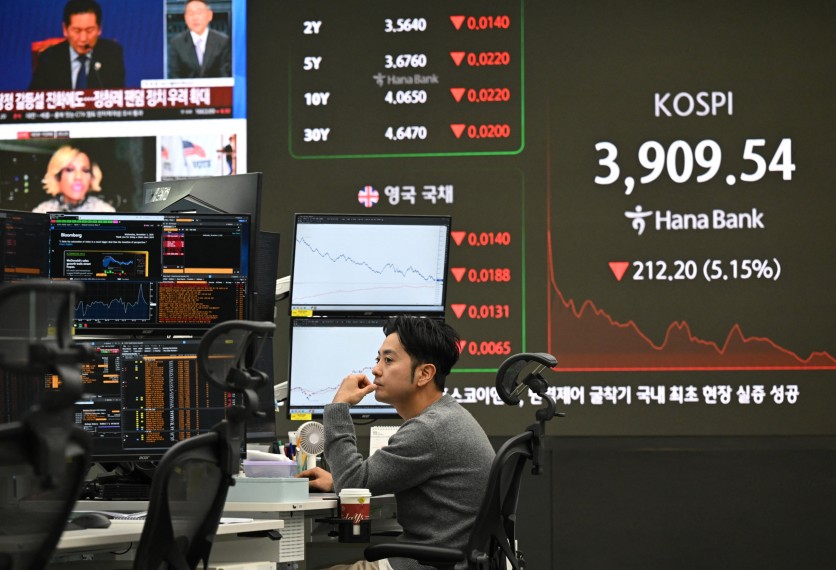
A currency dealer monitors exchange rates as a screen shows South Korea's benchmark stock index in a foreign exchange dealing room at the Hana Bank headquarters in Seoul on November 5, 2025. JUNG YEON-JE/gettyimages.com
The global memory market crossed a threshold on Monday that no prior shortage cycle has reached: Samsung Electronics and SK Hynix, the two companies that together control roughly 64% of worldwide DRAM revenue, now hold fewer than 10 days of finished memory inventory, according to a September 7 report from KB Securities. That figure — published on the same morning that market research firm TrendForce released data showing the DRAM industry generated $154.73 billion in revenue during the second quarter of 2026, a 59.5% jump from Q1 — is not just a new low. It means the supply chain now has essentially no buffer. Any disruption of consequence — a weather event, a labor action, a geopolitical escalation — could drive inventory to zero within days, not weeks.
"Beyond a simple recovery in demand, a situation could arise in which the volume available for sale itself is depleted," Kim Dong-won, head of research at KB Securities, told Seoul Economic Daily on Monday. Kim characterized the coming year as likely to bring "the tightest supply conditions in history."
The news did not collapse the market. Shares of SK Hynix surged 8.3% to ₩1,783,000 (approximately $1,327) in Seoul trading on Monday, and Samsung Electronics climbed 5.7% to ₩270,000 (approximately $201), as investors read the inventory warning as confirmation of sustained pricing power. The rally extended a move that began Friday after OpenAI unveiled GPT-6 Astra, its most capable AI model to date — a system that OpenAI President Greg Brockman characterized as potentially an early sign of artificial general intelligence. If Astra drives enterprises to delegate more complex, multi-step tasks to AI agents, data centers will require significantly more high-bandwidth memory, server DRAM, and storage to support those workloads — directly compounding the supply gap that KB Securities quantified Monday morning.
Why Normal Inventory Levels Are Decades Away
To understand why sub-10-day inventory is historically abnormal, it helps to know what normal looks like. In a healthy DRAM market, manufacturers carry 30 to 45 days of finished-goods inventory — enough to absorb a production hiccup, according to industry supply chain benchmarks, a shipping delay, or a sudden demand surge without triggering spot market chaos. Sub-10-day inventory is roughly the equivalent of a grocery store with three days of bread on the shelf: technically still open, but one storm away from empty aisles.
The immediate cause is a manufacturing arithmetic problem embedded in the structure of the sixth-generation High Bandwidth Memory standard, HBM4. Every HBM4 module stacks 16 individual DRAM dies vertically — up from 12 dies in the HBM3E generation currently shipping in most AI accelerators — connected through thousands of microscopic through-silicon vias (TSVs), which are vertical electrical channels drilled through each thinned die. The thinning process (each die is ground to approximately 30 microns), the TSV drilling, and the thermal-compression bonding required to align each die to micron-level tolerances all introduce yield losses that do not exist in the manufacture of flat DDR5 memory. The result is that producing one HBM4 module consumes roughly three times the wafer capacity of producing an equivalent amount of conventional DRAM — a ratio that KB Securities' Kim cited directly in Monday's report, and that multiple independent industry analyses have confirmed.
As Samsung and SK Hynix each accelerate their HBM4 ramps — Samsung entered mass production in February 2026, SK Hynix in June 2026, ahead of its original September schedule — every step up in HBM4 output mechanically removes approximately three steps of conventional DRAM capacity from the market. The progression from 12-die HBM3E to 16-die HBM4 stacks makes this generation's displacement effect roughly one-third worse than the prior one on a per-module basis.
Read more: Nvidia CFO Says Demand Points to 140% Growth: Supply Delivers Only Half
A Market Already Running at Full Speed
The scale of the market those depleted inventories must serve puts the shortage in context. According to TrendForce's Q2 2026 DRAM revenue report, released Monday, the global DRAM market generated $154.73 billion in revenue between April and June — a 59.5% sequential jump and a figure that would have been unimaginable as recently as 2024.
Samsung led the field with a 39.4% market share, its revenue rising 63.4% quarter-on-quarter to $60.98 billion — aided by its early move into HBM4 mass production and the strongest bit shipment growth among the major three suppliers. SK Hynix ranked second with a 24.9% share — down from 28.8% in Q1 — and revenue of $38.59 billion, up 37.9%. Its share erosion reflects a structural characteristic of HBM supply agreements: long-term fixed-price contracts delay the recognition of price increases in average selling prices even as spot market rates surge. Micron, which concentrated its available capacity on higher-margin server DRAM, posted the sharpest revenue increase among the three at 65.5%, reaching $36 billion, and lifted its share to 23.3%.
Even beyond the three dominant producers, the shortage signal is propagating through the market. Taiwanese chipmakers Nanya, Winbond, and PSMC — focused on mature-process DRAM — posted quarterly revenue gains of 68.3%, 75.8%, and similar magnitudes respectively, primarily by absorbing demand that Samsung, SK Hynix, and Micron can no longer fully serve.
How AI Is Absorbing Every Tier of Memory at Once
What distinguishes the current shortage from prior DRAM cycles is that AI infrastructure is simultaneously draining every product tier. Historically, manufacturers could partially offset a shortage in one segment by reallocating capacity from another. That valve is closed.
Server DDR5 for LLM training and inference workloads is being absorbed alongside HBM allocations. Enterprise SSDs — required for the dataset stores, model checkpoints, and retrieval-augmented generation pipelines that underpin commercial AI deployments — face their own inventory drawdown. KB Securities projects that bit-demand growth for DRAM and NAND will exceed supply growth by more than 10 percentage points in 2027 as these pressures converge. Separately, the firm projects that global hyperscaler AI infrastructure spending will reach approximately $1.3 trillion in 2027, up 60% from the previous year, with memory's share of that total climbing to 57% from just 14% in 2024.
The OpenAI commitment already consuming a portion of that supply is substantial. In October 2025, Samsung and SK Hynix jointly signed a letter of intent with OpenAI to supply 900,000 DRAM wafers per month in support of the Stargate AI infrastructure project — a commitment that will absorb significant forward capacity for years. Reports as of Monday suggest the Korean leg of Stargate has slowed somewhat, which KB Securities noted as a risk variable to its bullish outlook.
"AI servers will absorb demand for not only HBM but also server DDR5 and enterprise SSDs," Kim said Monday, "potentially leading to a historic shortage."
Samsung's memory division chief Kim Jaejune warned in the company's April 2026 earnings report that "significant shortages" across memory products are expected to continue through at least 2027. SK Hynix's chief financial officer confirmed earlier this year that the company's entire 2026 HBM output had been sold. Micron made a parallel statement regarding its own HBM allocation — and CEO Sanjay Mehrotra has described aggregate industry supply as "substantially short of the demand for the foreseeable future," with the company meeting only 50% to 65% of what key customers are requesting.
Meritz Securities analyst Kim Sunwoo has estimated that DRAM suppliers are currently meeting only 75% to 80% of demand in the second half of 2026, with that fulfillment rate potentially falling to around 60% in 2027.
What the HBM4 Ramp Does to the Capacity Equation
The capacity numbers make the shortage's persistence mechanically legible. SK Hynix has dedicated approximately 30% of its total DRAM capacity to HBM in 2026, with analysts expecting that figure to approach 40% by 2027. The company's new M15X extension fab in Cheongju — which uses extreme ultraviolet (EUV) lithography and advanced cleanroom automation — began wafer production in Q1 2026, but remains in a gradual ramp, with material capacity impact not expected before mid-2027. The advanced packaging facility known as P&T7 is being expedited, with completion of its first cleanroom now targeted for the end of 2027.
Samsung, meanwhile, is targeting a roughly 47% increase in HBM production capacity to approximately 250,000 wafers per month by year-end, concentrated around its Pyeongtaek P4 line. A new P5 facility is not expected to be operational until 2028. TrendForce's modeling projects that from 2026 through 2027, the three major suppliers will focus primarily on accelerating process node migrations rather than increasing raw wafer starts, meaning actual bit supply growth will remain modest even as capital expenditure rises.
DB Securities analyst Seungyeon Seo raised the firm's SK Hynix price target on Monday to ₩2,300,000 (approximately $1,711) from ₩2,000,000 (approximately $1,488), pointing to accelerating HBM4 shipments and strengthening pricing across the product stack.
Read more: Inventec Warns AI Memory Crunch Has Reached Servers: Lead Times Hit 40-Plus Weeks
Is the Stock Disconnect Finally Correcting?
Despite the record demand tailwind, Samsung and SK Hynix shares had fallen approximately 38% from their three-month peaks before Monday's rally, pushing their price-to-earnings ratios based on next year's projected earnings to roughly three times. Kim Dong-won characterized that valuation as "extreme undervaluation." "Samsung Electronics and SK Hynix are expected to consecutively set record-high performances for the next three years," Kim said, "and large-scale shareholder return policies are also anticipated to continue. Given the extreme undervaluation, a strong revaluation is set to begin, and we maintain both companies as top picks in the semiconductor sector."
Monday's rally — SK Hynix +8.3%, Samsung +5.7% — came on two simultaneous catalysts: the KB Securities inventory report and the AI infrastructure optimism generated by OpenAI's GPT-6 Astra release. Meritz Securities analyst Hwang Soo-wook argued Monday that cheaper AI tokens expand workloads, not reduce them — countering the view that falling token prices signal weaker hardware demand, noting that cheaper AI encourages enterprises to delegate longer and more complex tasks to AI agents — expanding total compute workloads rather than shrinking them.
The disconnect between record earnings and declining valuations reflects two investor concerns: whether AI infrastructure capital expenditure will be sustained at current levels, and whether the memory makers will ramp capacity quickly enough to avoid customer defection to alternative architectures. Kim's report addressed both directly, calling for record earnings over the next three years and a "strong re-rating" of both stocks.
TrendForce, for its part, projects that conventional DRAM contract price growth will moderate to 13–18% quarter-on-quarter in Q3 2026 — slower than prior quarters, partly because PC and smartphone customers are beginning to resist further price increases, and partly because some server demand is shifting toward lower-capacity RDIMMs. Consumer DRAM is expected to see the strongest continued price growth, given how sharply suppliers have cut back allocation to that segment.
What the Sub-10-Day Threshold Means for Buyers
For the technology industry beyond the balance sheets of chipmakers in Suwon and Icheon, the supply depth figure has concrete procurement implications. Cloud providers building AI inference infrastructure, enterprises planning server refresh cycles, and consumer electronics manufacturers all sit downstream of a supply bottleneck with essentially no cushion remaining.
Enterprise buyers still operating on 2025 procurement timelines face lead times of 40-plus weeks for large DRAM orders, and quote validity windows from distributors that have narrowed to 48 to 72 hours as vendors hedge against incoming pricing resets. A sub-10-day inventory means those lead times are unlikely to improve in the near term — and that any production disruption among the three major suppliers will be felt directly in order fulfillment, not absorbed by a buffer.
New AI accelerator architectures arriving in the second half of 2026 and into 2027 — including Nvidia's Rubin platform — are designed specifically around HBM4's bandwidth characteristics, which locks in demand for the standard even before it reaches mature production volumes. Each successive HBM generation has reproduced the same capacity dynamic: HBM4E, expected in late 2027, and HBM5, projected for the 2028–2029 window, will each concentrate more wafer capacity in lower-bit-yield processes than their predecessors, according to the Samsung HBM roadmap.
Monday's inventory disclosure is the sharpest single data point yet that the structural forces behind the shortage are not self-correcting. The arithmetic of HBM4 production guarantees that every gigabyte of AI memory delivered tightens the supply of every other gigabyte available for purchase — and with less than 10 days of buffer remaining, the margin for error in that equation has effectively disappeared.
Currency conversions in this article are approximate and are based on an exchange rate of 1 USD = ₩1,344 as of September 7, 2026.
Frequently Asked Questions
What does "fewer than 10 days of inventory" actually mean in practice?
In semiconductor supply chains, healthy inventory is typically 30 to 45 days of production output — enough to absorb disruptions in manufacturing, shipping, or demand without triggering supply failures at customers. A sub-10-day figure means Samsung and SK Hynix are producing and shipping memory chips nearly as fast as they are making them, with virtually no finished-goods buffer. If either company experienced even a short production halt — a power outage, an earthquake near a South Korean fab, another labor action — buyers could face complete supply cutoffs within days rather than the weeks or months that normal inventory levels would provide as a cushion. It is the supply chain equivalent of running on fumes.
Why does producing more HBM4 make the overall memory shortage worse instead of better?
Because HBM4 and conventional DRAM share the same manufacturing equipment. Every time Samsung or SK Hynix redirects a cleanroom wafer start toward HBM4 production, that wafer can no longer produce DDR5 or DDR4 for servers, PCs, or smartphones. HBM4's 16-die vertical stack requires roughly three times the wafer capacity of a comparable amount of conventional DRAM, and the new 16-die design (up from 12 dies in the prior HBM3E generation) makes this generation's displacement effect roughly one-third worse than the last. Producing more HBM4 for AI accelerators simultaneously creates shortages in every other memory category — server DRAM, consumer RAM, and enterprise SSD NAND — which is why all four memory product types are in shortage at the same time, a combination that Silicon Motion's CEO described as something the industry "has never faced before."
Will memory prices drop in 2027 once new fab capacity comes online?
Likely not in the near term. The major new capacity investments — SK Hynix's M15X Cheongju EUV fab, its P&T7 packaging facility, Samsung's P4 Pyeongtaek ramp, and Micron's US fab expansions — are all expected to reach meaningful output between mid-2027 and 2028 at the earliest. KB Securities projects that bit demand growth will exceed supply growth by more than 10 percentage points in 2027 even accounting for these ramps. TrendForce does not project the earliest potential for conventional DRAM price normalization before Q4 2027. SK Hynix CEO Kwak Noh-jung has stated that 2027 will be "the worst year in the industry's history from the supply perspective," and the SK Group chairman has warned the global HBM supply gap could persist through 2030.
Should enterprises lock in DRAM and server memory procurement now?
The consensus among supply chain advisors and analysts is yes, with urgency. Enterprise lead times for large DRAM orders have stretched beyond 40 weeks, and quote validity windows from distributors have narrowed to 48 to 72 hours in some cases — meaning the price you receive today may not be available when you call back tomorrow. Meritz Securities estimates that suppliers are meeting only 75% to 80% of demand in the second half of 2026, with that rate potentially falling to 60% in 2027. Organizations that have not already secured 2027 supply commitments should treat that as an immediate procurement priority. The only dissenting view worth noting is from TechInsights analyst Dan Hutcheson, who has argued the shortage more closely resembles a classic cyclical event that could moderate within one to two years — but this view is currently in the minority.

-
 C114 Communication Network
 -
 Communication Home
