
 Search

Dacia.com
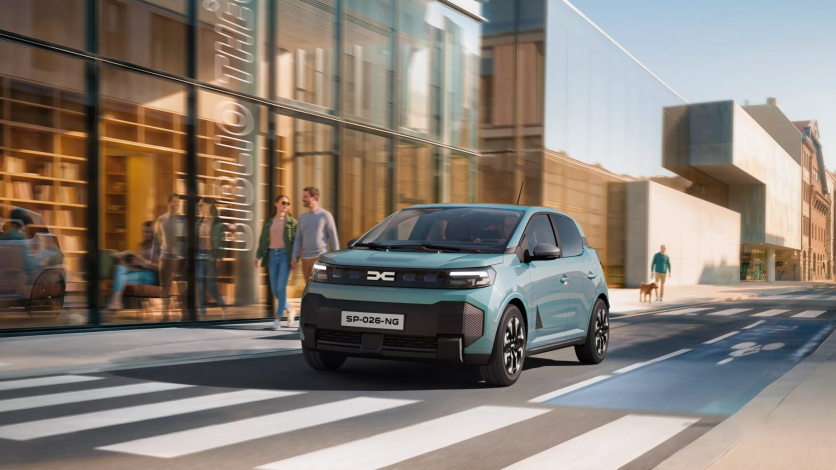
Dacia unveiled the second-generation Spring on September 8 in France, opening orders on the same day and setting a starting price of €17,900 (approximately $20,800) — but the headline figure undersells the real story. Because the new car is manufactured in Slovenia rather than China, it now qualifies for purchase incentives worth €3,620 to €6,180 (approximately $4,200 to $7,200) that the first generation was denied. After the maximum French subsidy, the effective purchase price falls to approximately €11,720 after maximum subsidy (~$13,600) — making it meaningfully cheaper, in real-money terms, than its €16,990 (~$19,700) China-built predecessor ever managed to be. The first-generation Spring sold 210,000 European units between 2021 and 2026 without a single euro of that subsidy.
What Subsidy Exclusion Cost Dacia — and Why Slovenia Fixes It
France's eco-score system, introduced to evaluate the environmental impact of vehicle production and shipping, is the mechanism that cut the first-generation Spring off from the French bonus écologique entirely. The old model was assembled by Dongfeng Renault in China, a manufacturing arrangement that had delivered rock-bottom costs for five years but ultimately became the car's biggest commercial liability. On top of losing subsidy eligibility, the China-built Spring faced European countervailing duties on Chinese-manufactured EVs from 2024 onward — a double penalty on what had been its chief competitive weapon.
The Novo Mesto plant in Slovenia, where Renault already produces the new Twingo E-Tech, solves both problems at once. Manufacturing inside the EU qualifies the Spring 2 for the "coup de pouce" incentive program, with subsidies ranging from €3,620 to €6,180 depending on household income. Air conditioning is now standard on every trim; a comparable outgoing Spring required €18,900 (~$21,900) before incentives for equivalent equipment. The new model at €14,280 (~$16,600) with the minimum subsidy is already better equipped and €4,620 cheaper in out-of-pocket terms.
Rivals including the Citroën ë-C3, the Renault 5 E-Tech, the Hyundai Inster, and the Leapmotor T03 now compete in the same sub-€20,000 segment. The Leapmotor T03 starts at €16,900 (~$19,600) but lacks eco-score qualification. BYD's Dolphin Surf starts at €19,990 (~$23,200) with similar subsidy ineligibility as of this writing. Dacia's advantage is not solely the sticker price — it is the combination of sticker price and incentive access.
How Dacia Built It So Fast
The Spring 2 was greenlit in early 2025 and reached the market in 16 months — a timeline that would be considered aggressive for a minor model update, let alone an almost entirely new vehicle. The speed was possible because Dacia is essentially a stripped-down derivative of a car Renault had already engineered: the 2026 Renault Twingo E-Tech. Structurally, the two vehicles share window glass and body architecture; everything else — exterior panels, interior surfaces, lighting, color choices, and rear-seat configuration — was redesigned specifically for the Spring nameplate.
That redesign work was done through Renault's Shanghai design bureau, allowing Renault to apply what then-Renault Group CEO Luca de Meo called "China speed" to a product staying within EU manufacturing. The original Twingo partnership with Volkswagen collapsed before the project reached this stage; Renault proceeded with Ampere, its in-house EV software and hardware division, and then immediately commissioned a Dacia derivative. The result is a proof of concept for something European automakers have been attempting to theorize for years: matching Chinese development velocity without locating production in China.
Dacia retained the Spring name deliberately. With more than 210,000 European customers, the brand equity of "Spring" was calculated to be worth more than the marketing spend required to establish a new nameplate — an unsentimental calculation typical of Dacia's engineering-at-a-price philosophy.
Bigger Car, Shared Bones, Specific Tradeoffs
Dimensionally the Spring 2 is a meaningfully larger car. Length rises by 15 centimeters to 3.85 meters overall length (12.6 feet), while width grows by 18 centimeters (7.1 inches) to 1.74 meters (5.7 feet) — proportions that give it more visual substance than its predecessor without moving it out of city-car territory. The design takes a deliberately angular direction — squared-off shoulders and slab sides — that distinguishes it visually from the rounder, more playful Twingo. Exterior body colors are limited to four options: Agave Blue, Slate Gray, Starry Black, and Glacier White. Wheel sizes are 15 or 16 inches.
The front and rear lighting uses a cost-efficient optical trick Dacia has now deployed across its range: only the upper element is actually illuminated; the lower section is angled at 45 degrees to create depth through mirror reflection. This is a deliberate engineering economy — one fewer set of LEDs per corner — that produces a distinctive visual signature at reduced manufacturing cost.
Inside, the Spring's relationship with the Twingo is visible but the two cars are not equivalent in equipment. The base Expression trim uses Dacia's Media Control system, where the driver mounts their smartphone to the dashboard and operates supported apps via steering-wheel controls; a new feature allows the phone to be used in portrait orientation, better suited to navigation applications. The Journey trim upgrades to a 10.1-inch touchscreen with navigation.
The most consequential departure from the Twingo concerns the rear seat arrangement. Dacia dropped the Twingo's independently sliding rear seats in favor of a conventional fixed two-person bench. It is a simpler, cheaper approach, though legroom is acceptable so long as front-seat occupants are not particularly tall.
Boot capacity stands at 337 liters (11.9 cubic feet), with a split floor for flexible load management. A front storage compartment under the hood accommodates a second charging cable, available as a €150 (~$174) option.
Powertrain: Where Twingo DNA Ends and Spring Economy Begins
The Spring 2 uses the same 60 kW (82 hp) motor as the Twingo, producing 175 Nm (129 lb-ft) of torque, paired with a 27.5 kWh lithium iron phosphate battery. The WLTP mixed-cycle range is rated at 250 km (155 miles) — slightly below the Twingo's 263 km (163 miles), a difference attributed to the Spring's flatter hood profile generating marginally more aerodynamic drag. Against the outgoing car, however, it is an improvement: the final version of the first-generation Spring used a 24.3 kWh LFP pack rated for 225 km (140 miles), giving the new model an additional 25 km (16 miles) of claimed range. Dacia reports that existing Spring customers average just 34 km (21 miles) per day, suggesting the range figure is more than adequate for the car's intended use pattern.
The LFP chemistry is central to the Spring 2's cost story. Unlike the nickel-manganese-cobalt cells used in higher-end EVs, LFP eliminates cobalt and nickel from the chemistry — both expensive and geopolitically fraught supply chains. LFP cells also tolerate higher operating temperatures than NMC cells without accelerating degradation, which is what makes passive air cooling viable here: Dacia omits the liquid thermal management system found in most competitors, along with a heat pump, both of which would add cost, weight, and maintenance complexity. The tradeoff is reduced efficiency in cold weather, but for a car whose primary use case is urban commuting in temperate European climates, LFP's thermal tolerance makes passive cooling a rational design choice rather than a compromise.
What the $580 Fast-Charge Option Really Means
Standard charging is via a 6.6 kW onboard AC charger. From a reinforced domestic outlet, recharging from 15 to 80 percent takes approximately 5 hours 40 minutes; on a 7 kW home wallbox, that drops to around 2 hours 55 minutes.
Buyers who want faster charging must opt into a €500 (~$580) fast-charge pack — available exclusively on the Journey trim — that adds bidirectional AC charging at 11 kW and DC rapid charging at up to 50 kW. With the fast-charge pack, a 15-to-80 percent top-up takes 28 minutes on a DC rapid charger, or around 1 hour 55 minutes on a three-phase 11/22 kW AC wallbox. The optional pack also unlocks vehicle-to-load capability via a separate adapter.
The structure of this option creates an important pricing dynamic. A fully optioned Journey — €19,400 (~$22,500) plus the €500 charging pack — reaches €19,900 (~$23,100), which is only €90 (~$104) below the Renault Twingo Évolution with an equivalent charging package and with better range. A budget-conscious buyer who chooses the Journey for charging capability is essentially splitting the cost difference between a fully functional EV and an entry-level one with a meaningful capability limitation. For most daily drivers the 6.6 kW base charger is entirely sufficient given the 34 km average daily use figure — but buyers who cannot guarantee overnight home charging need to understand that DC fast-charging capability is not included in any trim by default.
The Spring 2 also omits a heat pump, one-pedal driving mode (though an energy-recovery B mode is present), and liquid battery cooling. European-branded tires — Continental for 15-inch fitments, Goodyear for 16-inch — replace Chinese-sourced prior rubber from the previous generation.
Full Specifications and Pricing
| Specification | Detail |
|---|---|
Length | 3.85 m (12.6 ft) |
Width (excluding mirrors) | 1.74 m (5.7 ft) |
Motor output | 60 kW / 82 hp |
Torque | 175 Nm (129 lb-ft) |
Battery | 27.5 kWh LFP (usable) |
WLTP mixed range | 250 km (155 miles) |
WLTP consumption | 12.7 kWh/100 km (4.9 miles/kWh) |
Standard AC charging | 6.6 kW |
Optional fast charging | AC 11 kW (bidirectional) + DC 50 kW |
Boot volume | 337 liters (11.9 cu ft) |
Wheels | 15" or 16" |
Trim pricing (before subsidies):
| Trim | EUR Price | USD Approx |
|---|---|---|
Expression | €17,900 | ~$20,800 |
Journey | €19,400 | ~$22,500 |
Fast-charge pack (Journey only) | +€500 | +~$580 |
Effective pricing after French subsidy (Expression trim):
| Subsidy level | Price paid | USD Approx |
|---|---|---|
Minimum (€3,620) | €14,280 | ~$16,600 |
Maximum (€6,180) | €11,720 | ~$13,600 |
Does the New Spring Change the Competitive Picture?
The Spring 2 arrives into a segment that now has real competition — a stark contrast to 2021, when the original Spring had essentially no sub-€20,000 EV rivals. The Citroën ë-C3, Renault 5 E-Tech, Hyundai Inster, and forthcoming Volkswagen ID.1 are all pressing into the same sub-€20,000 price band. Chinese-manufactured entries from Leapmotor and BYD are present but — like the old Spring — ineligible for eco-score subsidies in France, leaving the fully subsidy-eligible field substantially thinner.
The Spring 2's structural advantage is the combination of Dacia's lowest-in-class sticker price and full subsidy eligibility — the product of its Slovenian manufacturing footprint. That competitive position holds unless rivals find ways to manufacture inside the EU at comparable cost, or unless European subsidy frameworks change. For now, Dacia has successfully used "China speed" — rapid design iteration via its Shanghai studio — to build a car that qualifies as European-made for all regulatory purposes, then priced it aggressively enough to absorb the cost of EU labor and still undercut every subsidized competitor on effective out-of-pocket price.
Orders were open in France as of September 8. First deliveries are expected before the end of 2026, ahead of a broader European market rollout anticipated in early 2027.
Currency conversions are approximate, based on exchange rates at time of publication and subject to change.
Frequently Asked Questions
How much does the Dacia Spring 2 actually cost after subsidies?
In France, the base Expression trim starts at €17,900 (approximately $20,800). After applying the French "coup de pouce" incentive — which ranges from €3,620 to €6,180 depending on household income — the effective purchase price falls to between €14,280 (~$16,600) and €11,720 (~$13,600). That makes the Spring 2 meaningfully cheaper in real-money terms than its predecessor ever was, because the first-generation Spring built in China was excluded from these subsidies entirely.
Does the new Spring qualify for the French bonus écologique?
Yes — and this is the most significant change from the first generation. Because the Spring 2 is manufactured in Renault's Novo Mesto plant in Slovenia, it earns a valid eco-score under French regulations, restoring access to purchase incentives that had been unavailable on the China-built original. The subsidy amount depends on the buyer's tax reference income.
What is the Renault Twingo connection, and does it matter for buyers?
The Spring 2 shares its underlying platform — developed by Renault's Ampere division — with the new Renault Twingo E-Tech, assembled on the same production line in Slovenia. This platform sharing is what enabled Dacia to develop the Spring 2 in just 16 months at a cost the brand could absorb. For buyers, it means the Spring 2 benefits from the Twingo's more modern architecture — better ride behavior, higher-quality tires, and improved noise insulation — compared to the first-generation Spring's China-market-derived City K-ZE base. The key difference between the two cars is equipment level: the Spring drops the Twingo's sliding rear seats, offers fewer color options, limits fast charging to a paid add-on, and uses passive rather than liquid battery cooling. Buyers who need full DC fast-charging capability and don't mind paying close to Twingo money should compare both carefully.
Is the base model's 6.6 kW charger fast enough for everyday use?
For most urban drivers, yes. Dacia's own data shows existing Spring owners average just 34 km (21 miles) per day, well within what a single overnight charge on a 6.6 kW home wallbox (0 to 80% in under three hours) can restore. The 6.6 kW charger becomes a real constraint only for drivers who rely on public AC charging, frequently take longer day trips, or cannot charge at home overnight. Those buyers should budget the €500 (~$580) optional pack on the Journey trim, which adds 50 kW DC rapid charging — bringing a 15-to-80% top-up to 28 minutes.

-
 C114 Communication Network
 -
 Communication Home
