
 Search

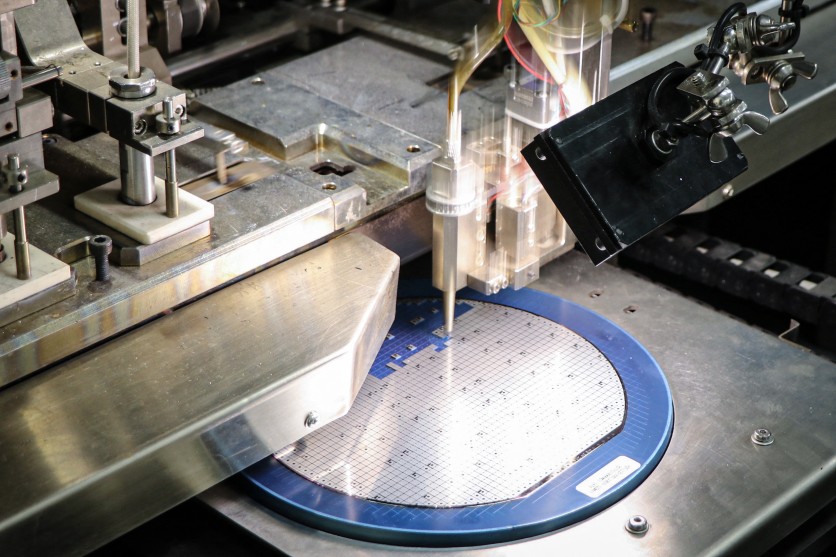
A semiconductor wafer is seen under process at a factory in Binzhou, in eastern China's Shandong province on January 15, 2025. / China OUT CN-STR/GettyImages.com
A Financial Times report published Tuesday reveals that China's two dominant memory chipmakers have quietly accumulated enough deep ultraviolet lithography machines from ASML to sustain three full years of planned capacity expansion — regardless of whether Western governments succeed in shutting the door on further equipment sales. The disclosure reframes the entire policy debate around the Multilateral Alignment of Technology Controls on Hardware Act: CXMT and YMTC have already pre-empted its new-sales ban, and the provision that now matters most is the one that targets ASML's ability to service machines already on Chinese factory floors.
That distinction — between banning new sales and banning maintenance — is not a technical footnote. Deep ultraviolet lithography scanners are not appliances. They require calibration, replacement optical components, firmware updates, and on-site engineering support from ASML specialists approximately every six months. Without that service relationship, production yields at Chinese fabs would degrade within 12 to 18 months, not years. A stockpile of machines that cannot be serviced is not an infinite runway; it is a countdown clock. How long that clock runs — and whether China's domestic alternative can become reliable before it expires — is now the decisive question in the semiconductor export-control competition.
What CXMT and YMTC Are Building With Three Years of Cover
ChangXin Memory Technologies, which claimed 10% of global DRAM revenue in the second quarter of 2026 — the first time the Samsung-SK Hynix-Micron oligopoly has fallen below 90% combined in over a decade — is now executing the largest capacity expansion in its history. The company holds approximately 11% of global DRAM manufacturing capacity, according to Yole Group, and is expanding its Shanghai facilities on a timeline that, according to Citrini Research's bottom-up modeling, would bring monthly wafer capacity from approximately 350,000 wafer starts per month at the end of 2026 to between 500,000 and 600,000 by late 2028. Equipment installation for key new phases at both companies is scheduled for the second half of 2026, with production slated to begin in 2027 — precisely the window the stockpile is designed to protect.
Yangtze Memory Technologies is simultaneously building its third Wuhan fab and has disclosed plans to dedicate half of that facility to DRAM production — a significant pivot beyond its traditional NAND stronghold. YMTC holds approximately 14% of global NAND flash bit shipments as of Q2 2026, according to Counterpoint Research, having edged past Japan's Kioxia into the third-largest position by volume for the first time. The company's NAND gross margin reached 76.8% in Q1 2026, according to its parent CCSH Corp.'s IPO prospectus filed with the Shanghai Stock Exchange, as Samsung, SK Hynix, and Micron redirected capacity toward high-bandwidth memory for AI data centers. UBS estimates China's combined memory capacity expansion could add between 120,000 and 140,000 additional wafer starts per month this year alone.
What a DUV Scanner Actually Is — and Why Servicing Changes Everything
To understand why the servicing distinction matters, it helps to understand what an ASML immersion deep ultraviolet machine actually does. Lithography is the process by which circuit patterns are printed onto silicon wafers using light. ASML's DUV immersion systems operate at a 193-nanometer wavelength, using a thin film of ultra-pure water between the lens and the wafer — water's higher refractive index (1.44, versus 1.0 for air) enables the system to resolve features finer than the wavelength of light alone would permit. Through a technique called multi-patterning — repeating the exposure with offset masks — fabs can achieve features at the 7-nanometer class in four passes, at the cost of compounding alignment errors and additional manufacturing steps.
ASML produces the lenses at the heart of these systems in partnership with Carl Zeiss SMT GmbH of Oberkochen, Germany. The ASML-Zeiss partnership, formalized in 1997, is unique in an economically significant way: as stated in ASML's FY2016 annual report filed with the US Securities and Exchange Commission, "Zeiss is our single supplier, and we are their single customer, of optical components for lithography systems." ASML's own website confirms that all its lithography systems have featured Zeiss optics since the late 1980s. The replacement optics that ASML's service engineers bring to Chinese fabs every six months come from Oberkochen.
This matters directly for China's domestic alternative. The Financial Times also reported Tuesday that Yuliangsheng Technology's flagship domestic DUV scanner — the machine that would eventually replace ASML tools in Chinese fabs — uses projection lenses manufactured by Zeiss, which publicly states it sells lithography optics only to ASML. China's "domestic" DUV alternative runs on German glass.
What the MATCH Act Can and Cannot Do Now
The Multilateral Alignment of Technology Controls on Hardware Act was introduced in the House on April 2, 2026, and passed the House Foreign Affairs Committee on April 22 by a 44-to-0 bipartisan vote — which members described as the most significant export control markup in congressional history. A Senate companion bill (S. 4281) was referred to the Senate Banking Committee on April 13; no markup has been scheduled as of September 9, 2026. The bill has two distinct operative provisions: a country-wide prohibition on the sale of DUV immersion lithography machines and other chokepoint equipment to any destination in China; and a requirement that ASML obtain a license to service equipment already installed in covered facilities — including CXMT, YMTC, and SMIC, all of which are explicitly named in the bill's text.
The stockpile disclosure reveals that the first provision — the new-sales ban — has been materially pre-empted. CXMT and YMTC have enough DUV inventory to cover planned expansion for three years from the date of any cutoff. What the stockpile cannot insulate them against is the second provision: the service and technical support ban. Analysis published by Model Diplomat citing AEI's Ryan Fedasiuk noted that the installed base of DUV tools in China requires specialized maintenance approximately every six months, maintenance that ASML itself often provides on-site. Bank of America has estimated that a full DUV-plus-servicing prohibition could translate to a 14 to 15 percent revenue impact on ASML and a 16 to 17 percent hit to operating profit — a figure that reflects the significance of installed base management, which generated €2.76 billion (approximately $3.21 billion) in the second quarter of 2026 alone.
ASML's own production planning is instructive. The company plans to ship approximately 130 immersion DUV systems globally in 2026, with a planned 30 percent capacity expansion for 2027 and investigations into a further 30 percent expansion for 2028. Against those numbers, Yuliangsheng's 2026 target of 12 domestic DUV machines — revised upward from an initial target of 5 — represents a fraction of what ASML ships in a single quarter. UBS analysis put Chinese domestic lithography technology at roughly the level ASML had reached in 2004.
Is the MATCH Act Still Worth Passing?
The political answer is yes, but the mechanism has changed. MATCH Act advocates, including Micron CEO Sanjay Mehrotra — who held closed-door briefings with key House Foreign Affairs Committee members in the months preceding the April vote — have argued consistently that restricting DUV access remains consequential even after the pre-emption. Their argument now turns on the servicing provision: an equipment ban that does not include a service cutoff is porous, because installed machines will continue operating. An equipment ban paired with a service cutoff imposes a degradation timeline on the entire Chinese installed base.
Whether the MATCH Act becomes law in this Congress is genuinely uncertain. Analysis by Model Diplomat, published July 9, 2026, assessed that the bill will likely pass the House but will not be enacted in the 119th Congress — Senate Banking Committee dynamics are hostile, and the Trump administration has preferred transaction-based leverage over statutory constraints. But the same analysis noted that the 44-to-0 committee vote has already done diplomatic work: it credibly threatens Dutch and Japanese firms with extraterritorial Foreign Direct Product Rule expansion, the mechanism by which Washington can assert jurisdiction over any equipment containing American-made components regardless of where it was manufactured. The Netherlands government has formally protested the bill's extraterritorial provisions, and Prime Minister Rob Jetten — who took office in February 2026 — raised ASML export controls in Washington discussions in the months following the committee vote, though no consensus was reached.
ASML guided investors toward approximately 20% of 2026 revenue from China — down from 33% in 2025 and 36% in Q4 2025 alone — but on a significantly higher revenue base, since the company raised its full-year 2026 guidance in July to between €43 billion and €45 billion (approximately $50.0 billion and $52.4 billion). CFO Roger Dassen confirmed that the decline in China's share reflects the ongoing tightening of Dutch export licensing, not a deterioration in the underlying demand.
YMTC Targets the Top, CXMT Eyes High-Bandwidth Memory
Against this backdrop, YMTC has reportedly set an internal ambition to overtake Samsung and SK Hynix to become the world's largest NAND flash manufacturer by 2027. That target — arriving via the CCSH Corp. IPO process, in which the Shanghai Stock Exchange issued its first formal regulatory inquiry on September 4, 2026 — reflects the confidence generated by YMTC's Xtacking 4.0 architecture, a hybrid-bonding design that separates the memory cell array from peripheral logic circuits onto two separate wafers, allowing the company to advance its layer count without requiring equipment subject to US export controls. CCSH Corp. is seeking to raise ¥33.3 billion (approximately $4.97 billion) in what analysts expect to be benchmarked against CXMT's own July debut, which raised ¥57.9 billion (approximately $8.63 billion) and saw shares surge 466% first day.
CXMT, for its part, delivered small-batch HBM3E chips to Alibaba Group's T-Head semiconductor division and to Cambricon Technologies for qualification testing as of September 1, 2026 — approximately 12 months ahead of the 2027 schedule most industry forecasters had assigned to China's first HBM3E production. Commercial HBM vendor qualification integrating with an existing AI chip platform typically requires six to eighteen months. SK Hynix entered HBM3E mass production in 2024; Samsung has already shipped HBM4E samples at speeds up to 16 gigabits per second per pin.
What the Legal Framework Means for Buyers
CXMT and YMTC are both headquartered in China and operate under three interlocking Chinese laws that create conditions no corporate privacy policy can override. China's National Intelligence Law (2017), Article 7, requires all Chinese organizations and citizens to support, assist, and cooperate with national intelligence work; there is no opt-out provision for private companies under Article 14. China's Data Security and Cybersecurity Laws (2021 and 2017, amended 2026) extend government access requirements to all data handled by Chinese companies, classified by sensitivity level. These are fixed legal conditions of operating under Chinese jurisdiction — not risks to be weighed against benchmark scores or market share figures.
Both companies also appear on the Pentagon's Section 1260H list of Chinese military companies, maintained under the National Defense Authorization Act: the June 8, 2026 update retained YMTC and CXMT alongside Alibaba, Baidu, BYD, and CATL. The Department of Defense's direct procurement ban on CXMT-listed entities took effect June 30, 2026. An indirect ban covering products with embedded CXMT components will take effect June 30, 2027. An all-federal-agency ban covering any semiconductor product from CXMT takes effect December 23, 2027. CXMT filed a federal lawsuit on August 28, 2026 challenging its 1260H designation, naming Defense Secretary Pete Hegseth as a co-defendant and alleging the designation was arbitrary and lacked due process. The lawsuit's outcome may eventually affect compliance timelines, but organizations cannot use pending litigation as a planning assumption in procurement calendars.
How Does This End?
The FT report lands at a moment when the memory market itself is providing cover for both Chinese companies' expansion. The AI infrastructure build-out has produced a severe supply crunch in conventional DRAM and NAND as Samsung, SK Hynix, and Micron redirect capacity toward high-bandwidth memory. Each wafer used for HBM produces roughly one-third the raw memory capacity of the same wafer devoted to standard DDR5. The elevated prices that resulted have allowed CXMT and YMTC to expand at positive margins despite the structural DUV cost penalty that CXMT's DUV-only multi-patterning process imposes — estimated at roughly 30% above Samsung, SK Hynix, and Micron on an equivalent process node.
For the policymakers who designed the export control architecture around EUV as the primary chokepoint and DUV as a secondary lever: the stockpile disclosure is a documented case of lead times between policy announcement and on-the-ground impact allowing determined counterparties to position themselves in the interim. The MATCH Act's advocates are arguing, in effect, that closing the DUV new-sales gap is still worth doing — because even if the near-term sales have been pre-empted, the servicing ban remains a credible degradation tool for the three-year window that follows. CXMT and YMTC appear to be betting that three years is enough time to make Yuliangsheng — or a supplier that does not depend on German glass — reliable enough to bridge the gap. The verdict on that bet will arrive well before ASML's next generation of equipment leaves Veldhoven.
Frequently Asked Questions
What happens to Chinese chip fabs if ASML stops servicing their existing DUV machines?
DUV immersion lithography scanners are high-maintenance precision instruments. They require calibration, spare optical components, firmware updates, and on-site engineering support from ASML specialists approximately every six months. Without that service relationship — which the MATCH Act's service-ban provision would cut off — production yields at Chinese fabs would degrade over a period of months to roughly a year and a half, not years. The three-year equipment stockpile gives CXMT and YMTC new machines to keep expanding, but it does not resolve the servicing requirement for the machines already on their production lines. That is why analysts who track the MATCH Act treat the servicing clause, not the new-sales ban, as the more operationally significant provision.
Can Yuliangsheng replace ASML for Chinese fabs?
Not yet, and possibly not without resolving a critical dependency. Yuliangsheng Technology has begun limited production of domestic DUV scanners — its 2026 target is 12 systems, revised upward from an initial target of 5. But UBS analysis puts Chinese domestic lithography technology at roughly the level ASML had reached in 2004. More specifically, the Financial Times reported Tuesday that Yuliangsheng's flagship machine uses projection lenses manufactured by Carl Zeiss SMT GmbH, the German optics company that publicly states it sells lithography optics to exactly one customer: ASML. That makes Yuliangsheng's machines dependent on the same German supply relationship that would be caught by any German export-control tightening aligned with US and Dutch rules. China's domestic DUV alternative currently runs on foreign glass.
How long does the stockpile actually protect CXMT and YMTC?
The Financial Times report characterizes the inventory as sufficient to cover "three years of planned expansion" — meaning three years of the specific capacity growth both companies have committed to in investor disclosures, not three years of unlimited operation. CXMT is targeting monthly wafer capacity of roughly 500,000 to 600,000 wafer starts per month by late 2028, up from approximately 350,000 at year-end 2026. YMTC is targeting similar expansion for its Wuhan fabs. Whether the stockpile is genuinely sufficient for that trajectory depends on how intensive the equipment buildout is and whether installation timelines hold. The strategic read is that both companies are betting the three-year window gives Yuliangsheng and other domestic suppliers time to mature — or gives diplomatic conditions time to shift — before the machines on Chinese floors start degrading without ASML's service engineers.
Does the National Intelligence Law make CXMT and YMTC memory unsafe for US enterprise use?
China's National Intelligence Law (2017) requires all Chinese organizations to support, assist, and cooperate with government intelligence requests. This obligation applies to CXMT and YMTC regardless of where their products are used, regardless of the company's own privacy policies, and regardless of any non-disclosure agreements signed with foreign customers. For US government agencies, the answer is already statutory: the Department of Defense's direct procurement ban on CXMT-designated entities took effect June 30, 2026, with an indirect ban on products containing CXMT components scheduled for June 30, 2027, and an all-federal-agency ban on December 23, 2027. For private-sector enterprise buyers — whose procurement decisions are not legally constrained — the question is whether the Chinese government's legal access to any company operating under its jurisdiction is a fixed condition they are willing to accept as part of their supply chain.

-
 C114 Communication Network
 -
 Communication Home
