
 Search

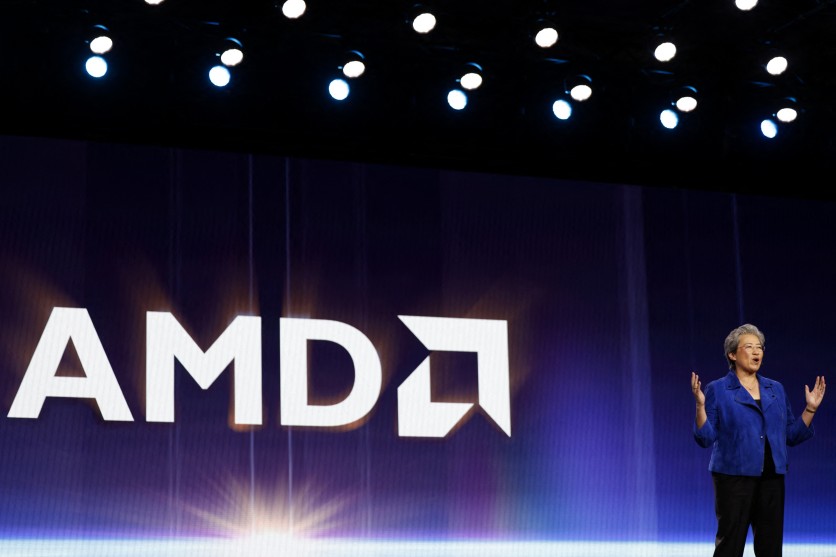
Lisa Su, chair and chief executive officer of Advanced Micro Devices Inc. (AMD), speaks during an AMD news conference ahead of the annual Consumer Electronics Show in Las Vegas, Nevada, on January 5, 2026. Caroline Brehman/AFP via Getty Images
Advanced Micro Devices crossed the $900 billion market cap threshold again this week, and with the commercial launch of its first 2-nanometer server processor now nine days away, the chip-maker's path to becoming the semiconductor industry's newest trillion-dollar company has never been more clearly defined — or more dependent on a single product delivering what its benchmarks promise.
AMD shares traded near $539 on Monday, July 13, reflecting a stock that has already surged more than 150% year to date, while Micron Technology's ascent to a $1 trillion valuation in May demonstrated that AMD's own milestone is not hypothetical. Closing the gap requires roughly 25% additional appreciation from current levels — a move that Goldman Sachs, Stifel, and Cantor Fitzgerald all believe the company's product cycle justifies, with price targets ranging from $635 to $700. One well-credentialed dissenter, William Blair analyst Sebastien Naji, launched coverage with a Market Perform rating and a $565 fair-value estimate on July 9, arguing that AMD's AI upside may already be priced in.
The catalyst that will likely resolve that disagreement arrives on July 22, when AMD opens its Advancing AI 2026 conference at Moscone Center in San Francisco. CTO Mark Papermaster confirmed the schedule at the RAISE Summit in Paris, and the company's own event page lists the two-day show. July 22 is when 6th Generation EPYC "Venice," the first chip to carry AMD's Zen 6 architecture and the first high-performance computing processor built on TSMC's 2-nanometer process, will move from production ramp to public commercial debut.
Read more: AMD Helios Faces Nvidia Vera Rubin at July 23 Keynote: Memory Leads, Training Trails
Demand That Finance Missed: How Agentic AI Became AMD's CPU Thesis
The most important number in AMD's investment case is not the $909.7 billion market cap as of July 10 or the $11.2 billion in revenue the company guided for the second quarter. It is the word "agentic" — and why it matters more for CPUs than GPUs.
The shift from AI training (where tens of thousands of GPUs run in synchronized parallel) to AI inference (where trained models answer queries) was already well understood by 2025. What Goldman Sachs analyst James Schneider articulated in his July 5 upgrade note — raising AMD's price target from $450 to $640 — is the next layer: as enterprise deployments evolve from simple query-response inference to full agentic workflows, where AI systems autonomously orchestrate multi-step tasks, the compute architecture changes meaningfully.
An agentic system is not just a GPU running a model. It is a software environment in which the AI agent continuously queries databases, routes requests through middleware, writes to key-value stores, calls APIs, and manages stateful context across an entire workflow. Every one of those background tasks runs on a CPU, not a GPU. AMD's own technical blog, published June 10, estimated that this infrastructure layer — web serving, relational databases, in-memory caching, transactional middleware — could require roughly as much compute per AI factory as the GPU layer itself. The company's EPYC Turin platform already outsells Intel Xeon at major U.S. cloud providers, and AMD has converted all 10 of the largest social media platforms and all 10 of the largest SaaS organizations to EPYC within the last two years.
The contested part of that thesis — and a risk investors should weigh seriously — is whether Agentic AI has actually arrived at enterprise scale. A Carnegie Mellon University study found that AI agents could not complete a majority of assigned tasks in a simulated company environment. Gartner characterized many "agentic AI" launches as rebrandings of existing automation products, a phenomenon the firm labeled "agent washing" in June 2025. The Wall Street Journal reported in November 2025 that few companies deploying AI agents had achieved a return on investment. The agentic AI infrastructure argument is a forward bet on a deployment timeline that is still actively debated.
That is the assumption embedded in AMD's valuation at more than 170 times trailing earnings and approximately 33 times its projected 2027 earnings per share. William Blair's Naji, ranked 157th out of 12,372 analysts on TipRanks with an 81% accuracy rate, made exactly this observation in his July 9 initiation: AMD's fundamentals are strong, but the recent rally may have already captured the value of the agentic CPU story.
How Venice Works: What 2nm Means at Rack Scale
For the technical reader deciding whether the hardware justifies the valuation, the architectural specifics of Venice matter as much as the analyst targets.
Venice is built on eight compute chiplets, each carrying 32 Zen 6c cores, for a maximum of 256 cores per socket — a 33% jump over EPYC Turin's 192-core flagship. The platform moves to AMD's SP7 socket and adds 16-channel DDR5 memory support at up to 12,800 megatransfers per second, pushing per-socket memory bandwidth to 1.6 terabytes per second, as confirmed in AMD's official Venice production announcement. That is 2.6 times the 614 gigabytes per second Turin delivers — a material gain for the database, caching, and orchestration workloads that CPU-based agentic infrastructure requires.
The CPU-to-GPU interconnect also upgrades to PCIe Generation 6, doubling the per-lane bandwidth over PCIe 5 to 128 gigabytes per second per direction. When Venice is paired with AMD's Instinct MI455X accelerators inside the Helios rack-scale platform, the wider bus means the CPU can feed the GPUs without becoming a data-movement bottleneck at rack scale — a genuine engineering constraint that PCIe 5 struggled with in large agentic deployments.
One critical caveat must accompany every Venice benchmark claim: as of July 13, all published performance figures are AMD's own estimates or modeled projections. The company's rack-level benchmark showing Venice at 3.3 times the throughput of Nvidia's 88-core Vera CPU — published June 10 — was calculated by applying a 1.7 times scaling factor over Turin results and modeling Vera's performance from a separate Phoronix benchmark set, not from head-to-head silicon comparison. AMD's own methodology note described the exercise as "intended to provide directional comparison rather than direct measured rack benchmarks." Tom's Hardware called this distinction significant. Independent benchmark results will not exist until systems are in reviewers' hands after the July 22-23 commercial launch.
The 2-nanometer process node itself is less contested. AMD has stated that TSMC's N2 process is in production for Venice in Taiwan, with additional manufacturing planned at TSMC's Arizona facility. Venice is the first high-performance computing product to reach production on N2, giving AMD a process node lead over Intel, whose Clearwater Forest and Diamond Rapids server platforms are targeting TSMC 18A-P and 2027, respectively.
MI455X and the Memory Capacity Argument
Alongside Venice, AMD's Helios rack-scale platform integrates 72 Instinct MI455X GPU accelerators carrying a combined 31 terabytes of HBM4 memory. Each MI455X holds 432 gigabytes of HBM4, compared with 192 gigabytes of HBM3e in Nvidia's B200 — a 2.25-to-1 capacity advantage per card, as detailed in the Helios platform technical breakdown at CES.
The architecture difference matters beyond the headline number. HBM4 doubles the memory interface from 1,024 bits per stack (HBM3e) to 2,048 bits, allowing AMD to achieve aggregate bandwidth in the vicinity of 19 terabytes per second per MI455X without depending solely on raising per-pin clock speeds. For large language model inference — where the attention mechanism requires reading the full key-value cache for every token generated — that memory capacity and bandwidth directly translates into how many users a single accelerator can serve simultaneously, and at what context length.
The supply constraint matters as much as the specification. All 2026 HBM4 production is reportedly allocated to hyperscalers, with volume beyond engineering samples not expected to reach general availability until 2027. Customers adopting Helios are entering a committed supply chain. HBM4 also requires a complete silicon interposer redesign from HBM3e platforms — a 2,048-bit routing layout replacing the 1,024-bit architecture — meaning that enterprises cannot swap MI455X cards into Nvidia server infrastructure or vice versa without a full platform transition. The customer signing a Helios contract is making a platform commitment, not a component purchase.
OpenAI and Meta have each announced large-scale AMD Instinct GPU deployments, with commitments measured in gigawatts of compute. Oracle has also confirmed MI450-series partnerships, and the U.S. Department of Energy selected EPYC Venice processors alongside AMD Instinct MI430X GPUs for its next-generation supercomputer program.
Read more: CES 2026: AMD Details Helios AI Rack and Next-Gen Instinct MI400 GPUs
Where the Software Gap Still Lives
AMD's hardware narrative would be more straightforward if the software ecosystem matched it. It does not yet.
ROCm, AMD's open-source alternative to Nvidia's CUDA, reached stable version 7.2.4 in May 2026 and now carries official first-class support in PyTorch — not "experimental," but a fully maintained backend alongside CUDA. Inference frameworks vLLM and SGLang both have working ROCm integrations. For teams running PyTorch-based training and inference workloads on Linux, ROCm in 2026 is a meaningfully different product than it was two years ago.
The gap that remains is in the specialized optimization layer. TensorRT-LLM, Nvidia's production inference runtime, does not have a full ROCm equivalent. FlashAttention 3, the kernel optimization that defines modern transformer inference efficiency, lacks a mature AMD port. A developer building from a research paper that dropped this week — writing CUDA-specific kernels, targeting TensorRT for deployment — finds AMD hardware usable but not frictionless. According to AI GPU market share analysis for 2026, Nvidia controls an estimated 80% or more of the AI accelerator market — a dominance that reflects a software ecosystem accumulated over nearly two decades, not a hardware specification gap.
AMD is investing in closing this gap: ROCm development staff has grown, the company has sponsored open-source compiler tooling through MLIR and IREE, and hyperscaler partnerships with OpenAI and Meta implicitly commit AMD to keeping those customers' workloads running. But the ROCm ecosystem will not match CUDA's breadth on July 22. It is a trajectory, not a completed transition.
What the Analysts Are Actually Disagreeing About
The spread between Cantor Fitzgerald's $700 target and William Blair's $565 fair-value estimate — a range of $135 — is wide enough to reflect genuine disagreement about the same facts, not just different confidence levels.
The bulls (Goldman $640, Stifel $635, Bernstein $600, Cantor $700) share a thesis: AMD's server CPU total addressable market will expand to at least $120 billion by 2030 as Agentic AI deployments scale; Venice and EPYC "Verano" in 2027 are positioned to capture more than half of that; and the GPU pipeline through MI450 and Helios gives AMD a second, independent revenue stream compounding on top of the CPU business. Goldman's James Schneider framed the upgrade specifically around the CPU story being "underpriced" relative to the GPU narrative. Stifel raised its target 41% and expects AMD to beat its Q2 2026 guidance and raise forward estimates when results are released after market close on August 4.
William Blair's Sebastien Naji, initiated with a Market Perform rating on July 9 at a $565 fair-value estimate, does not dispute AMD's execution. His concern is arithmetic: at more than 170 times trailing earnings and approximately 33 times 2027 earnings estimates, the stock has already priced in a substantial portion of the agentic CPU upside. The era of easy server CPU share gains, he argued, is ending — Arm-based competitors including Nvidia's own Vera CPU, AWS Graviton, Qualcomm's server platform, and custom silicon from major hyperscalers are all competing for the same workloads that EPYC owns today. Cathie Wood's ARK trimmed AMD positions on July 8 and July 9, though analysts characterized those moves as tactical rather than a change in long-term conviction.
Morgan Stanley's July 9 analysis confirmed that advanced packaging allocations for AMD — specifically the CoWoS packaging that integrates HBM4 with compute dies on a silicon interposer — are on track to rise significantly through 2027, giving supply-chain visibility that supports the bullish case. The Q2 earnings report on August 4 will be the first real look at revenue from the Venice production ramp, and analysts across the coverage spectrum named it the next primary catalyst.
From $4 Billion to $900 Billion: AMD's Structural Rerating
AMD's rise to near-trillion-dollar status is unusual even by semiconductor standards. The company's market capitalization was approximately $4 billion in December 1998. By January 2025, it had grown to roughly $196 billion. The subsequent 18-month run to $909.7 billion — an increase of more than 360% — coincides precisely with AMD's transformation from a components supplier competing for gaming GPU share into a datacenter infrastructure company competing for the same hyperscaler contracts that sustain Nvidia.
AMD's all-time stock high of $584.73 was set on June 30. From that level, reaching $1 trillion requires the same 25% gain it would from current levels of approximately $539 — the pullback from the high tracks exactly the valuation debate described above. Micron's path offers a useful comparison: the memory maker reached $1 trillion in May 2026 on the strength of HBM demand, a concentrated supply-demand imbalance, and a product cycle that had not yet fully played out in earnings. AMD's situation is structurally similar, with the added complexity that AMD's upside depends on two separate demand drivers — CPU and GPU — both maturing at once.
The risks that Lisa Su's team identified in its own guidance are real: CoWoS advanced packaging capacity remains constrained across the industry; Intel's Diamond Rapids in 2027 will compete for enterprise CPU sockets even as AMD extends its current lead; and custom ASIC programs at Google, Amazon, and Microsoft continue to displace merchant GPU purchases at the margin. AMD's internal CAGR targets — more than 35% overall, more than 60% for the data center business — are ambitious by any semiconductor industry standard.
What makes the July 22 event significant is not that it will answer the trillion-dollar question. It will not. What it will do is replace modeled Venice benchmarks with measured ones, give hyperscaler customers visibility into production shipment timelines, and provide Lisa Su a platform to update guidance on Helios deployments and MI450 customer wins. Every one of those disclosures will either validate or complicate the valuation case that Goldman Sachs and its peers have built over the past three months.
AMD enters that event at $900 billion. What it says on the morning of July 23 will determine whether the final 25% comes before or after Q2 earnings in August.
Frequently Asked Questions
How close is AMD to a $1 trillion market cap, and what would need to happen?
AMD's market cap stood at approximately $909.7 billion as of July 10, 2026, with shares trading near $539 on July 13. Reaching $1 trillion requires an additional gain of roughly 25% from that level. The most likely catalysts, according to Wall Street analysts, are a strong performance showing at the Advancing AI 2026 conference on July 22-23 — where Venice benchmarks will move from modeled estimates to measured results — and a second-quarter earnings report on August 4 that confirms AMD's guided revenue of approximately $11.2 billion and indicates a raise in forward estimates.
What is Agentic AI, and why does it create CPU demand rather than GPU demand?
Agentic AI refers to systems in which AI models operate autonomously over multiple steps to complete complex tasks — orchestrating database queries, API calls, in-memory state management, and middleware routing — rather than simply responding to a single prompt. GPU clusters handle the model inference step, but all the surrounding orchestration infrastructure runs on general-purpose CPUs. AMD's Agentic AI thesis holds that as enterprises scale multi-agent deployments, CPU demand grows proportionally alongside GPU demand, expanding the addressable market for EPYC processors. The contest in this argument is timing: independent research suggests enterprise agentic AI deployments are still maturing, and the magnitude and speed of CPU demand growth depends on deployment timelines that analysts actively disagree about.
What is the main engineering risk that could prevent AMD's MI455X from meeting expectations?
Two risks deserve attention. First, all HBM4 supply for 2026 is reportedly allocated to hyperscalers, which limits how broadly Helios systems can ship beyond large enterprise customers who secured early supply commitments. Second, AMD's ROCm software ecosystem — while significantly improved in 2026, with first-class PyTorch support — still lacks full equivalents to Nvidia's TensorRT-LLM inference runtime and FlashAttention 3 kernel optimization. Teams writing production inference infrastructure on AMD hardware encounter more friction than on Nvidia's CUDA platform. Neither issue is fatal to AMD's competitive position, but both represent real constraints that independent customers weigh against the memory capacity advantage MI455X delivers.
Why did William Blair initiate AMD with a neutral rating when most analysts are bullish?
William Blair analyst Sebastien Naji, a five-star TipRanks analyst with an 81% accuracy rate, launched coverage on July 9 with a Market Perform rating and a $565 fair-value estimate — near AMD's current trading range. His argument is not that AMD's business is weak, but that its valuation already reflects the agentic AI CPU upside the bulls are forecasting. At more than 170 times trailing earnings, AMD requires continued execution on Venice adoption, Helios ramp, and Agentic AI enterprise penetration to justify further appreciation. Any slowdown in hyperscaler AI spending, broader multiple compression in the semiconductor sector, or evidence that ROCm adoption is lagging could reprice the stock toward fair value without a fundamental change in AMD's competitive position.

-
 C114 Communication Network
 -
 Communication Home
