
 Search

Furiosa.ai
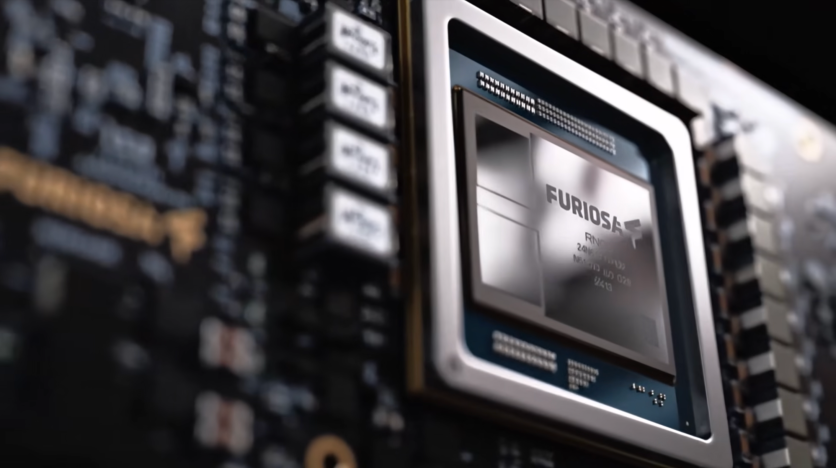
South Korean AI chip startup FuriosaAI activated its RNGD inference accelerator servers at Equinix's LS2 colocation facility in Lisbon, Portugal this week, marking the company's first confirmed commercial production deployment on European soil. The move arrived as the European Union's Technological Sovereignty Package — announced by the Commission in June 2026 — created formal policy incentives for EU enterprises to diversify their AI compute supply chains beyond US hyperscalers and Chinese alternatives.
That timing matters beyond coincidence. European enterprises looking to run AI inference inside EU jurisdiction face a narrow set of options: pay US cloud prices, accept Chinese supply-chain risk, or find something else. FuriosaAI's RNGD server — a 3 kW, eight-accelerator system that fits in a standard air-cooled rack — lands at Equinix Lisbon as exactly that third option, timed to a moment when EU policy finally gives procurement officers a political framework for choosing it.
The Lisbon deployment was timed to coincide with the RAISE Summit 2026, a major AI event held in Paris on July 8–9 where FuriosaAI co-founder and CEO June Paik joined other infrastructure leaders to discuss power and scaling challenges facing global AI compute. The announcement landed as European enterprises and sovereign AI projects are actively hunting for inference alternatives to NVIDIA's GPU clusters, which remain power-intensive, supply-constrained, and tied to proprietary software ecosystems.
Inside the RNGD: What the Tensor Contraction Processor Actually Does Differently
RNGD — pronounced "renegade" — is built on a 5-nanometer Tensor Contraction Processor (TCP) architecture developed by FuriosaAI and published at the ACM/IEEE ISCA 2024 conference. Understanding why that architecture matters requires a brief look at what makes GPU inference inefficient for LLM workloads.
Modern GPUs were designed around matrix multiplication as a fixed-size primitive instruction. Each forward pass in a large language model reads the model's weight parameters from high-bandwidth memory, routes them across interconnects, and runs a matrix multiply. This works well at the peak compute levels GPUs were optimized for — but it generates continuous, high-volume data movement between memory and compute that drives power consumption upward.
The TCP architecture takes a different approach: it executes tensor contractions directly in hardware as native operations, rather than decomposing them into fixed-size matrix multiplies. Tensor contraction is the mathematically generalized form of matrix multiplication, covering all the irregular memory patterns and attention head computations that transformer-based LLMs require. By making tensor contraction the lowest-level hardware primitive, RNGD keeps weight data resident longer in the chip's high-bandwidth memory instead of repeatedly shuffling it to and from DRAM. FuriosaAI calls this reduction in data movement the architectural source of its efficiency gains.
The resulting specifications: 512 teraflops of FP8 compute per card, 48 GB of HBM3 memory at 1.5 terabytes per second of bandwidth, and a strict 180-watt thermal design profile — versus 350 watts for the PCIe version of NVIDIA's H100, or up to 700 watts for the H100 SXM variant. FuriosaAI claims its RNGD delivers three times better performance than the H100 per watt when running LLM workloads. That figure is a company claim, not an independently published benchmark. The most specific third-party validation to date came from LG AI Research, which reported RNGD delivered better inference performance per watt than the GPU systems it replaced — a finding it confirmed after running LG's Exaone family of models in production and leading the company to offer RNGD-powered servers to its enterprise customers.
Each NXT RNGD Server integrates eight accelerators into a 3 kW system, yielding 4 petaflops of FP8 compute, 384 GB of total HBM3 memory, and 12 terabytes per second of aggregate memory bandwidth in a configuration that operates from standard PCIe interconnects without proprietary fabrics or specialized liquid cooling. Because five such servers fit in a standard 15 kW data center rack — compared with a single NVIDIA DGX H100 server — the RNGD offers operators a fundamentally different density equation for inference-only deployments. The same physical rack space runs more concurrent inference users on less power.
Read more: Custom AI Chips Outpace Nvidia GPU Growth in 2026: ASIC Shipments Set to Triple GPU Rate
FuriosaAI Fills a Structural Gap in EU Sovereign AI Compute
The Equinix LS2 facility opened in June 2025, offering 2,050 square meters of colocation space across three floors with capacity for 625 racks. By choosing a newly opened, commercially active EU-based facility rather than a data center it owns or operates, FuriosaAI gains European distribution without the capital expense of independent infrastructure — and its customers gain access to inference capacity that legally sits within EU jurisdiction and is supplied by a company headquartered in a US-allied nation that is not subject to Chinese state data-sharing obligations.
This distinction has grown materially more significant since the EU Commission's June 2026 Technological Sovereignty Package, which proposed new legislative frameworks — including a Cloud and AI Development Act — specifically designed to help European enterprises assess cloud and AI sovereignty and reduce structural dependencies on foreign providers. FuriosaAI's RNGD is not a European chip. But it is built by a South Korean company whose government holds US Tier 1 partner status under AI chip export controls, manufactured by TSMC on a 5-nanometer node, and now deployed inside the EU inside a facility governed by EU law.
"We are pleased to be establishing an important new distribution channel in Europe with Equinix," Paik said when announcing the partnership. "By pairing Equinix's infrastructure footprint designed for efficiency and sustainability with our high-performance, energy-efficient RNGD architecture, we unlock the ability for enterprises to run inference sustainably and reliably."
Why Air-Cooled Matters More Than It Sounds
One phrase in FuriosaAI's pitch recurs in every deployment context: "standard air-cooled data centers." It is worth explaining why infrastructure buyers in Europe find that phrase significant.
AI data center power requirements reached a structural inflection point in 2026. Inference workloads — running trained AI models in production, as opposed to training them from scratch — have grown to represent the majority of total compute demand across global AI data centers, according to industry analysts. Inference is continuous, latency-sensitive, and geographically distributed: it requires sustained high-wattage draw rather than the burst-and-pause patterns of training runs. The highest-density GPU clusters — those running NVIDIA H100s or the newer B200s, with power envelopes of 700 watts to 1 kilowatt per chip — have driven data center operators toward liquid cooling, custom rack hardware, and power density designs that most European colocation facilities simply were not built to support.
Europe's data center market faces grid capacity constraints, high electricity costs, and strict regulatory ceilings. Germany's new builds must now clear a Power Usage Effectiveness ceiling of 1.2 under its Energy Efficiency Act. Frankfurt's interconnects are fully allocated for years ahead. Data center operators in the EU are rationing power-dense workloads, not welcoming them.
The RNGD's 180-watt-per-card design profile allows operators to run eight accelerators in a 3 kW server in standard rack environments without liquid cooling retrofits or grid renegotiations. That is not a feature for operators who have unlimited power and water. It is a feature specifically suited to the European market's actual constraints.
Broadcom and the Road to Hyperscale
The Lisbon deployment comes weeks after FuriosaAI announced its most significant hardware partnership to date: a collaboration with Broadcom, announced May 27, 2026, to develop its third-generation AI accelerator using Broadcom's advanced packaging technology.
The third-generation chip moves FuriosaAI from the PCIe-card inference segment into hyperscale territory. It will feature a 2-nanometer compute die — up from the RNGD's 5nm — a dedicated I/O die for scale-up networking, and HBM4 or HBM4E memory, integrated into a multi-die chiplet package using Broadcom's Extreme Dimension System in Package technology. The system will also incorporate Broadcom's Ethernet and PCIe switching to enable high-bandwidth, rack-scale networking across hundreds of chips. Sampling is expected to begin in the first half of 2028.
Broadcom's participation is not incidental. Custom AI silicon design has become the semiconductor giant's largest revenue segment, accounting for roughly 65% of its total revenue in the first quarter of 2026. Broadcom supplies packaging and networking expertise to Meta's MTIA accelerators and other hyperscaler custom chips; FuriosaAI's third-generation partnership places it in the same tier.
Charlie Kawwas, president of Broadcom's Semiconductor Solutions Group, said that inference performance is now defined not just by raw compute but increasingly by data reuse and communication efficiency across servers and racks.
For context: the RNGD's 512 teraflops of FP8 compute is modest relative to the current generation of high-end NVIDIA and AMD data center chips. NVIDIA's B200 delivers roughly nine times the FP8 FLOPS, four times the memory capacity, and more than five times the memory bandwidth. The RNGD is not competing for the same workloads as a B200 cluster — and FuriosaAI does not claim otherwise. Its bet is that the majority of enterprise AI inference does not require peak compute, and that the workloads that do fit inside its current efficiency envelope can be served at dramatically lower power cost. The Broadcom partnership is the signal that the company intends to eventually compete in peak-compute territory as well.
Read more: OpenAI Cerebras Bet Spawns Jalapeño Chip as GPT-5.6 Faces Government Gate
A Company That Turned Down $800 Million Is Now Seeking $500 Million More
FuriosaAI was founded in 2017 by June Paik and Hanjoon Kim, veterans of AMD, Qualcomm, and Samsung. The company shipped a first-generation vision NPU called Warboy in 2021 — manufactured on Samsung's 14-nanometer process and validated on the MLPerf benchmark within three weeks of receiving initial silicon samples — before pivoting to the LLM inference market with RNGD.
The RNGD was unveiled at Hot Chips 2024 at Stanford and entered mass production in January 2026, manufactured by TSMC on its 5-nanometer node with SK hynix supplying the HBM3 memory. Production customers include Samsung SDS, which is rolling out a subscription-based NPU service through the Samsung Cloud Platform using RNGD, and LG AI Research. The company has raised $250 million to date, including a $125 million Series C bridge round closed in July 2025.
Early in 2025, Meta reportedly offered approximately $800 million to acquire FuriosaAI. Negotiations broke down over disagreements about post-acquisition business strategy — not price — and the offer was declined. The decision proved prescient in valuation terms: FuriosaAI subsequently raised its Series C bridge at a $735 million valuation, and the company is currently seeking to raise as much as $500 million in a new pre-IPO round with Morgan Stanley and Mirae Asset Securities serving as co-advisers. An initial public offering is targeted for the 2027–2028 timeframe.
The company plans to deliver approximately 20,000 RNGD units to global clients in 2026, according to company statements, marking its first large-scale revenue cycle.
The Software Problem That Beats the Hardware One
No analysis of RNGD's competitive prospects is complete without addressing the constraint FuriosaAI's own CEO acknowledged in a 2025 HPCwire interview: the CUDA ecosystem.
NVIDIA's Compute Unified Device Architecture is not a chip specification — it is a complete software platform that has accumulated more than fifteen years of optimized libraries, GPU kernels, developer tooling, and integration with every major AI framework. When enterprise engineering teams evaluate an alternative inference accelerator, they are not just comparing silicon specs. They are estimating how many months of porting work it takes to get their production models running on the new hardware, whether that hardware will have stable drivers across software releases, and whether they can hire engineers who already know the stack.
FuriosaAI's answer to this problem is a compiler-first software architecture built in its Lisbon R&D lab. The Furiosa SDK maps PyTorch models to the TCP hardware through a compiler that handles model optimization without requiring teams to write hand-tuned kernels for each workload. FuriosaAI also supports ONNX imports, vLLM integration, an OpenAI-compatible API layer, and a Tensor Contraction Language for developers who need low-level hardware control. The models already validated in production — OpenAI's gpt-oss 120B, LG's Exaone 236B, Qwen 3-30B-A3B at large context sizes — demonstrate that the SDK is mature enough to handle frontier-scale inference workloads, not just benchmarks.
But deployment observers at KoreaTechDesk and TechTarget's Moor Insights noted in early 2026 that the decisive commercial variable for RNGD would be whether its software maturity could translate across arbitrary enterprise workloads, not just validated reference models. Every design win in the near term requires dedicated porting effort. That barrier is falling — but it has not disappeared.
What This Means for European Enterprise Infrastructure Teams
For procurement and engineering teams evaluating AI inference options in 2026, the RNGD's European arrival shifts the practical decision framework. Before the Lisbon deployment, the options for on-premises or colocation inference in the EU were essentially NVIDIA GPU clusters (high power, high cost, strong ecosystem), or hyperscaler cloud (uncertain EU jurisdiction, US-law exposure under the Cloud Act). FuriosaAI's Equinix deployment adds a third column to that table.
The chips claim demonstrated production performance — LG's 2026 EXAONE production deployment is a publicly cited reference. The server form factor fits standard racks. The EU jurisdiction question is resolved at the Equinix LS2 level. The software stack is evolving but has cleared enough reference deployments to begin enterprise qualification cycles.
The counterweight is equally concrete: RNGD is roughly nine times less compute-dense than a B200, requires porting effort for non-validated workloads, and is produced by a company still building its global commercial scale. Teams whose inference workloads require the highest absolute throughput, or whose engineering resources cannot absorb a new SDK, should remain on NVIDIA for now. Teams running specific LLM inference workloads at production scale who are constrained by power density, rack space, or EU jurisdiction requirements now have a credible alternative to evaluate in person at Equinix Lisbon.
Frequently Asked Questions
Is FuriosaAI's RNGD a real competitor to NVIDIA's H100?
It is a competitor in specific use cases — LLM inference workloads where power efficiency and rack density matter more than absolute peak throughput. On raw compute, the RNGD's 512 teraflops of FP8 performance is roughly half of an H100's peak, and around one-ninth of NVIDIA's B200. But the RNGD draws 180 watts versus 350 to 700 watts for an H100, and a standard 15 kW data center rack can hold five eight-chip RNGD servers where it can hold one NVIDIA DGX H100 server. The tradeoff is real in both directions: efficiency for workloads that fit the form factor, raw compute gap for workloads that do not.
What is a Tensor Contraction Processor, and why is it different from a GPU?
A GPU executes AI computations by decomposing them into fixed-size matrix multiply operations — an approach inherited from graphics rendering that works at scale but creates repetitive, high-volume data movement between memory and compute. A Tensor Contraction Processor treats tensor contraction — the mathematical operation underlying all transformer attention and LLM inference — as a native hardware primitive, without first decomposing it into matrix multiplies. The practical benefit is that RNGD can keep the active model weights resident in high-bandwidth memory for longer, reducing data shuttle trips and the energy they consume. FuriosaAI published the architecture in a peer-reviewed paper at ISCA 2024.
What does "EU sovereign AI compute" mean, and why does FuriosaAI matter to it?
EU sovereign AI compute refers to AI inference infrastructure that operates under EU legal jurisdiction — where data processing stays subject to European law rather than US cloud law or Chinese intelligence obligations. The EU Commission's June 2026 Technological Sovereignty Package formally framed this as a policy priority, proposing new frameworks to help European enterprises reduce dependence on foreign AI compute providers. FuriosaAI's RNGD is not a European chip, but it is manufactured by a South Korean company whose government is a US Tier 1 ally, deployed inside an EU-regulated facility, and not subject to Chinese state data-sharing laws. For EU enterprises and sovereign AI projects that need to run inference outside US cloud infrastructure, the Lisbon deployment is one of the few commercially available options that meets that combination of criteria.
Does the RNGD run standard AI models, or do teams have to rewrite their software?
FuriosaAI's SDK maps PyTorch models to the RNGD hardware through a compiler, so teams do not need to rewrite model code from scratch. The company also supports ONNX imports and an OpenAI-compatible API layer, and has validated production inference on several large models including OpenAI's gpt-oss 120B, LG's Exaone 236B, and Qwen 3-30B-A3B. That said, migrating from an NVIDIA GPU deployment to RNGD still requires a qualification process — validating that your specific model and workload run correctly and efficiently on the new hardware. The Equinix Lisbon deployment is specifically designed to give enterprise teams a physical environment in which to run that evaluation before committing to a procurement. Full SDK documentation and developer resources are available through FuriosaAI's developer portal.

-
 C114 Communication Network
 -
 Communication Home
