
 Search

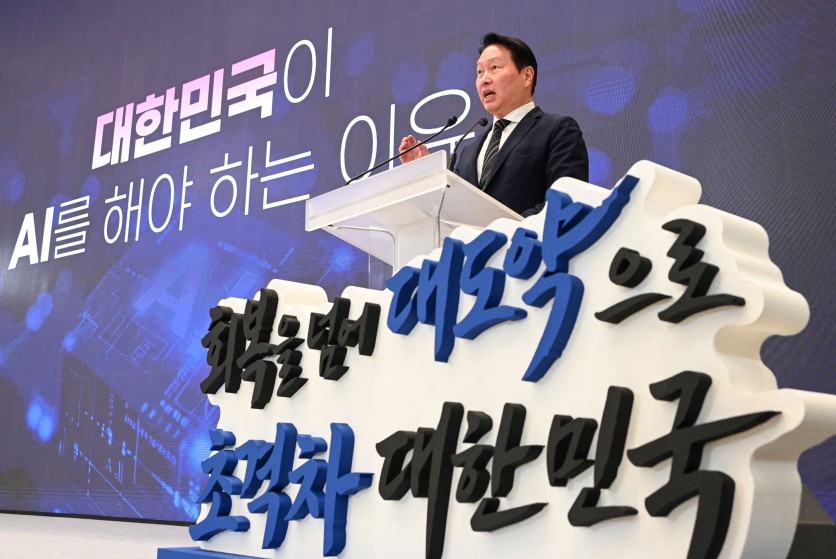
SK Group Chairman Chey Tae-won attends the briefing announcement of public-private collaboration projects at the presidential Blue House in Seoul on June 29, 2026. South Korea will invest nearly $1.2 trillion -- equivalent to more than two-thirds of its GDP -- in a new chip-building hub and AI data centres over several years, as it seeks to profit from soaring demand while developing previously neglected regions. KIM Min-Hee/AFP via Getty Images
SK Group Chairman Chey Tae-won laid out one of the boldest pieces of South Korea's June 29 mega-project announcement: roughly 1,000 trillion won (about $654 billion) for AI data centers and some 1,100 trillion won ($719 billion) to expand semiconductor supply — including about 400 trillion won ($261 billion) for a new chip cluster in the southwest.
What makes the plan more than a string of very large numbers is the idea holding it together. Chey's pitch reframes what an AI data center even is — and that reframing is the logic that drives both halves of SK's roughly 2,100-trillion-won commitment.
The Data Center as "Intelligence Factory"
Speaking at the national briefing at the former Blue House, Chey framed the plan around turning Korea "from a country that consumes AI into one that exports intelligence." An AI data center, he argued, is no longer a mere storage warehouse but an "intelligence factory" — a plant whose product is intelligence itself, generated by running AI models. In that framing, if Korea wants to export intelligence rather than import it, it needs to build the factories and the memory that feeds them at the same time.
The factories come first. SK plans to build a total of 15 gigawatts of AI data centers, led by SK Telecom — starting with 5 GW in regions where power and land are already secured (including Ulsan, the southwest, Gangwon, and the central region), built in 0.5-to-1-GW blocks for speed, then expanding by a further 10 GW in a second phase as demand, electricity, water, and memory supply allow. By 2035, Chey said, about $654 billion would be invested in the data-center push through various participants — strategic-partner investment, customer occupancy contracts, and project financing — infrastructure he called Korea's potential "AI national backbone" and "the heart that drives robots and physical AI." (Fifteen gigawatts is an enormous amount of electricity, on the order of many large power plants, which is why the rollout is explicitly gated on the grid.)
Read more: SK Telecom to Commit $483 Million to SK hynix's U.S. AI Hub
Feeding the Factories: An Accelerated Memory Build
Because every AI data center is a voracious consumer of memory, the second half of the plan is about supply. Chey said SK hynix would sharply increase output, pulling forward completion of its Yongin cluster — originally slated for 2045 — by 12 years, to 2033, with about 600 trillion won ($392 billion) going into Yongin for DRAM and roughly 100 trillion won ($65 billion) into Cheongju for NAND.
Even so, he said, shortages are likely to persist, which is why SK is adding the roughly 400-trillion-won southwestern cluster on top — because site selection and infrastructure have to begin now, and the Yongin cluster alone took nine years to establish. (The 400-trillion-won southwest figure is part of the 1,100-trillion-won semiconductor total, not additional to it.) Chey said SK would execute the investments while watching demand, with an average of more than 100 trillion won ($65 billion) a year in domestic investment planned over the next decade, backed by what he called a feasible, risk-aware financing plan.
Read more: SK hynix DRAM Capacity Roadmap Revealed: Yongin Alone Adds 360K Wafers Monthly
Why Even the Shortage Has Two Edges
The most striking part of Chey's argument is its restraint. He runs the company with the largest share of the high-bandwidth memory market, and he is racing to build because shortage is dangerous — but he warned that excessive shortage is dangerous too. If scarcity drives prices to spike too sharply, he cautioned, it could ultimately shrink both the memory and the AI markets, making sustainable supply expansion necessary rather than optional. It is an unusually candid acknowledgment from the supplier with the most pricing power that the goal is a market healthy enough to keep growing, not maximal scarcity.
All of these are announced plans stretching over roughly a decade to 2035, and Chey was explicit that execution depends on demand, power, water, and financing unfolding as projected — so the figures describe intent and direction rather than money already committed to the ground. But taken together, they sketch a coherent wager: that the country which builds both the intelligence factories and the memory to run them, and paces the build so the market survives the boom, is the one that gets to export the result.
Frequently Asked Questions
How much is SK investing in AI?
At South Korea's June 29 mega-project briefing, SK Group Chairman Chey Tae-won announced a plan totaling roughly 2,100 trillion won (about $1.37 trillion) over about a decade to 2035. That breaks down into approximately 1,000 trillion won (around $654 billion) for AI data centers, led by SK Telecom, and approximately 1,100 trillion won (around $719 billion) to expand semiconductor supply through SK hynix — which includes about 400 trillion won for a new chip cluster in the southwest. These are announced plans whose execution Chey said depends on demand, power, water, and financing developing as projected.
What is an AI data center "intelligence factory"?
It is the framing Chey used to describe how the role of a data center is changing. Traditionally a data center is essentially a warehouse that stores and serves data. Chey argued that in the AI era, a data center instead actively produces something — running AI models to generate intelligence, in the form of answers, predictions, and decisions. Calling it an "intelligence factory" reframes the facility as a production plant whose output, intelligence, can be treated as a national export, which is the logic underpinning SK's plan to build 15 gigawatts of such centers.
When will SK hynix's Yongin cluster be completed?
Chey said SK hynix is pulling forward completion of its Yongin semiconductor cluster by 12 years, from an original target of 2045 to 2033 for the fourth fab. The company plans to invest about 600 trillion won in Yongin for DRAM production and roughly 100 trillion won in Cheongju for NAND flash. The acceleration is meant to bring more memory capacity online sooner to meet surging AI demand, though SK has said the timeline depends on market and infrastructure conditions.
Why is SK building a new chip cluster in the southwest?
Chey said that even after accelerating the Yongin and Cheongju expansions, memory shortages are likely to persist, so SK plans to invest about 400 trillion won in an additional cluster in South Korea's southwest region. Because building a large semiconductor base requires extensive land, power, water, and workforce — and because the Yongin cluster alone took nine years to establish — Chey argued that site selection and infrastructure work need to begin now to meet future demand. The southwest figure is part of SK's roughly 1,100-trillion-won semiconductor investment, not separate from it.

-
 C114 Communication Network
 -
 Communication Home
