
 Search

(Image credit: Tom's Hardware)
-
Facebook -
X -
-
-
Pinterest -
Flipboard -
Email
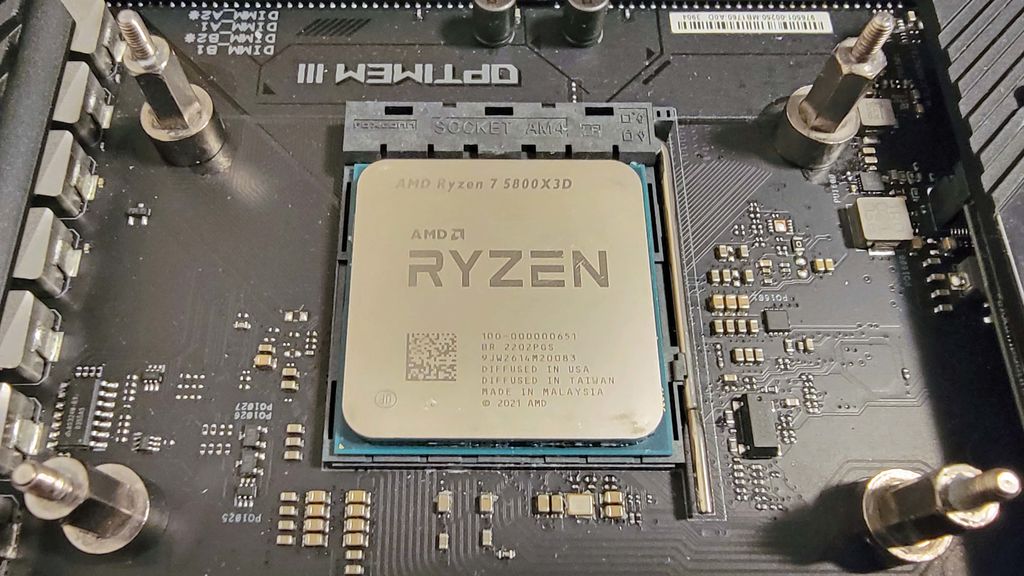
AMD finally reintroduced the Ryzen 7 5800X3D at Computex 2026, more than four years after it originally launched in a bid to combat rising DDR5 prices. Despite the re-release looking like a simple product spin-up, AMD’s David McAfee, VP and general manager of Radeon and Ryzen, says that “a whole body of engineering work” went into the re-release, as the original bonding process TSMC used for the Ryzen 7 5800X3D was no longer available.
(Image credit: Tom's Hardware)
- CPU scaling with DLSS
- Ryzen to the top: How AMD innovated in the gaming CPU market
- How ARM is working its way into PCs
- AMD CES 2026 gaming trends press Q&A roundtable transcript
“It's not as simple as just bringing back the 5800X3D,” McAfee said. “The original stacking process that was used at TSMC changed when we went from first-gen to second-gen cache, so we had to re-engineer that product, and there actually was a fair amount of development that went into bringing back the 5800X3D.”
The Ryzen 7 5800X3D used TSMC’s SoIC or System-on-Integrated-Chips hybrid bonding technology. It uses a combination of “hot” and “cold” bonding to marry two pieces of silicon together, which then share power with through-silicon vias (TSV). Fundamentally, this connection hasn’t changed over the course of 3D V-Cache’s existence, but it has evolved. With the move to Ryzen 7000, AMD had to make some changes to the 3D V-Cache design, which it then carried forward with Ryzen 9000.

To avoid any confusion, when we talk about second-gen 3D V-Cache here, we’re not talking about AMD’s new packaging available on Zen 5 CPUs, where SRAM is placed under the CCD rather than on top, as is the case with Zen 4 and 3 X3D chips. We’re talking about the bonding process that AMD used at TSMC, which changed from first-gen X3D chips to second-gen X3D chips.
“It completely changed the characteristics of how those two pieces of silicon are bonded together and how they were stacked together, and so when that first-gen facility really kind of went offline, then it meant there was a whole, you know, body of engineering work that had to be done to understand if we could even migrate the 5800X3D to the new, second-generation stacking process,” McAfee said.
It’s possible that AMD intended to bring back the Ryzen 7 5800X3D sooner, though McAfee stopped short of saying that outright. The shift in packaging helps explain the Ryzen 7 5800X3D’s (and eventually the 5700X3D’s) absence from the market. The chip has seen spotty availability over the past two years, and it’s been completely sold out over the past year, with resellers demanding as much as $800 on the secondhand market.
“That's been a lot of the work that's kind of been going on in the background to get us to where we are today, is redoing the qualification of that stacking process, building samples, testing to make sure that the reliability is top notch for consumers who might want to buy this product, and then, you know, kind of rolling it out and ramping it into production again in a new process of stacking those dies together,” McAfee told Tom’s Hardware.
You can read more about second-gen SoIC in our SoIC roadmap on Tom’s Hardware Premium, though it has far more implications for the data center (at least currently) than for consumer chips. Regardless, AMD couldn’t simply reintroduce the Ryzen 7 5800X3D; instead reworking the chip to work with TSMC’s second-generation stacking process. McAfee says it ended up being “a labor of love” for the engineers to work on this part again, as the company went through testing and validation for a re-release.

Follow Tom's Hardware on Google News, or add us as a preferred source, to get our latest news, analysis, & reviews in your feeds.

-
 C114 Communication Network
 -
 Communication Home
