
 Search

jeep.com
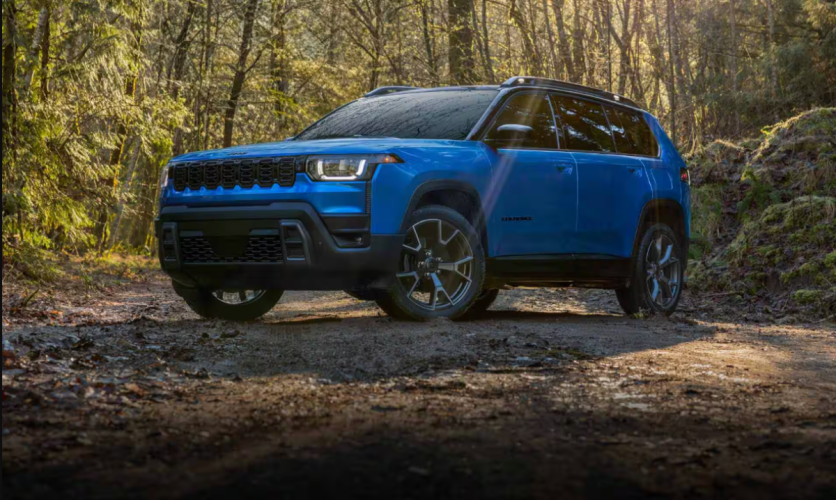
Jeep released the first teaser image of the 2027 Cherokee Trailhawk on June 22, 2026, signaling the return of Trail Rated off-road capability to the brand's compact hybrid SUV. The teaser comes one week after the 2027 Grand Cherokee Trailhawk was officially revealed with a full specification sheet, and it answers the loudest complaint from off-road enthusiasts who found the base 2027 Cherokee redesign too crossover-soft. For buyers already tracking the Cherokee's first-generation hybrid platform, the Trailhawk variant is where the technology story gets meaningfully more interesting.
The teaser itself is deliberately sparse — a single image showing a grey front fascia, a beefier bumper with red tow hooks, and body-color accents that break the base model's more urban look. Jeep confirmed Trail Rated certification is coming and stated that "more information will come at a later date." Full specifications, pricing, and an on-sale date have not been announced.
What Trail Rated Certification Means for the Cherokee's Off-Road Credentials
Trail Rated is Jeep's internal certification standard, validated by real-world testing across five performance categories: traction, water fording, maneuverability, articulation, and ground clearance. It is not a marketing claim but a hardware and calibration specification that requires measurable performance thresholds in each category. The designation has historically separated Jeep's genuinely capable off-road trims — Wrangler Rubicon, Grand Cherokee Trailhawk, Cherokee Trailhawk — from softer crossover-oriented trims.
For the 2027 Cherokee to earn Trail Rated status, it will need, at minimum, a proper low-range transfer case on top of the standard four-wheel-drive system that already comes on every Cherokee trim. The Grand Cherokee Trailhawk's specification sheet — which includes Quadra-Trac II with a two-speed transfer case, Selec-Terrain traction management with Rock mode, steel skid plates, and 30.5-inch all-terrain tires — establishes what the Trailhawk standard currently means in the Jeep lineup.
What Off-Road Driver Assistance Systems the Cherokee Trailhawk Is Expected to Carry
Jeep has not confirmed the Cherokee Trailhawk's driver assistance suite as of the teaser. Based on the Grand Cherokee Trailhawk's confirmed spec sheet and the previous-generation Cherokee Trailhawk's feature list, the following systems are expected.
TrailCam: The Grand Cherokee Trailhawk comes with an integrated TrailCam system that feeds a forward-facing camera view of the terrain immediately ahead of the front wheels to the infotainment display, acting as a virtual spotter on rock gardens and blind drop-offs. The Cherokee Trailhawk is expected to carry a version of the same system.
Selec-Speed Control: The previous-generation Cherokee Trailhawk offered Selec-Speed Control, Jeep's off-road crawl-speed management system. The system uses hill-ascent and hill-descent control to maintain a driver-set crawl speed — as low as 0.6 miles per hour — without requiring throttle or brake input, freeing the driver to focus entirely on steering through technical terrain. Selec-Speed is expected to return on the 2027 Cherokee Trailhawk, though its implementation on the current hybrid powertrain represents a meaningful engineering adaptation (see below).
Selec-Terrain: The Grand Cherokee Trailhawk's Selec-Terrain system provides discrete terrain modes — including a Rock mode calibrated for low-speed, high-articulation obstacles — by adjusting throttle response, transmission shift points, and the torque split between axles. A terrain management interface of this type is expected on the Cherokee Trailhawk as well.
How Off-Road Crawl Control Works Differently on a Hybrid eCVT
This is where the Cherokee Trailhawk's technology story diverges from prior Trailhawk generations — and from the Grand Cherokee Trailhawk sibling revealed the same week — and where it becomes genuinely interesting for anyone tracking the evolution of off-road driver assistance systems.
Traditional Selec-Speed Control is designed around a conventional automatic transmission. In that configuration, the driver selects a gear using paddle shifters or manual gear-select mode, and the transmission holds that gear. Because each gear in a fixed-ratio automatic corresponds to a specific maximum wheel speed, the gear choice effectively sets the crawl speed ceiling. The system then manages engine torque and individual-wheel brake pulses to hold the vehicle at or below that ceiling, regardless of terrain grade.
The 2027 Cherokee does not use a conventional automatic. Its powertrain pairs a turbocharged 1.6-liter four-cylinder engine with two electric motors, a 1.08 kilowatt-hour lithium-ion battery pack, and an eCVT — an electrically controlled continuously variable transmission — to produce a combined 210 horsepower and 230 pound-feet of torque. There are no fixed gear ratios to select. That means any implementation of Selec-Speed on this platform cannot use gear-position logic to set a speed ceiling. Instead, the system would need to manage crawl speed primarily through electric motor torque modulation — using the electric motors' ability to apply and release torque with millisecond precision as a substitute for the gear-step control available in a traditional automatic.
The practical consequence is potentially smoother crawl-speed control on technical terrain, because electric motor torque delivery is more linear than the torque steps between gear positions. The engineering challenge is that the eCVT's continuously variable ratio range and the battery's state-of-charge management must both be accounted for in the crawl-control calibration — a more complex control problem than the fixed-gear equivalent. Whether Stellantis has adapted Selec-Speed specifically for this platform, or whether the Cherokee Trailhawk will use a simplified crawl-control implementation, is not yet confirmed.
The base Cherokee comes standard with 140 safety and driver-assistance features including Active Driving Assist, according to Jeep. The Trailhawk will build on that foundation with the off-road-specific layer.
Powertrain and Hardware Expectations for the 2027 Cherokee Trailhawk
The 2027 Cherokee Trailhawk is expected to retain the standard Cherokee's hybrid setup throughout. The turbocharged 1.6-liter four-cylinder paired with two electric motors and the 1.08 kWh lithium-ion battery pack delivers 210 horsepower and 230 pound-feet of combined torque. In standard form, the Cherokee achieves 39 miles per gallon city, 35 highway, and 37 combined. The Trailhawk will likely sacrifice some of those efficiency figures in exchange for all-terrain tires and a more aggressive final drive setup, though Jeep has not confirmed revised fuel economy estimates.
Four-wheel drive is standard across all Cherokee trims, but the Trailhawk is expected to add a dedicated low-range ratio — the mechanical component that separates the Cherokee's standard AWD capability from something suitable for low-speed technical terrain. Steel skid plates protecting the powertrain and transfer case, and 18-inch wheels wrapped in all-terrain tires, are anticipated based on the Grand Cherokee Trailhawk's spec sheet and Carscoops' report on the Cherokee teaser.
Interior details have not been confirmed. Based on the standard trim differentiation between the two nameplates, Jeep will likely equip the Cherokee Trailhawk with Capri leatherette upholstery and red contrast stitching rather than the Nappa leather used in the Grand Cherokee Trailhawk.
How Stellantis Uses Software to Differentiate Trim Capability
The Cherokee Trailhawk fits within a broader Stellantis strategy for this generation: using software calibration and sensor integration to differentiate capability between trim levels, rather than relying solely on mechanical upgrades. The off-road driver assistance systems — terrain management, crawl control, TrailCam — share underlying sensor hardware and processing architecture with the Cherokee's highway driver-assistance suite. What changes between a base Cherokee Limited and a Trailhawk is not entirely the hardware; it is the calibration, the intervention thresholds, and the mode logic applied to sensors that are already present in the vehicle.
This matters for understanding what the Trailhawk adds to the Cherokee's technology story. It is not simply a suspension and tire upgrade with a Trail Rated sticker. It is a recalibration of the same sensor-fusion system across a new operational design domain — one where the terrain is unstructured, the consequence of a misjudged torque intervention is more severe than on a highway, and the sensor inputs are fundamentally different in character from the lane markings and preceding vehicles that define highway driver-assistance calibration. Off-road systems operate without the structured environment cues that highway systems rely on, placing the full burden of hazard classification on terrain cameras, pitch and roll sensors, and wheel-speed differential data.
Deploying that at a mid-market vehicle priced under $40,000 — not only on the Wrangler Rubicon or the Grand Cherokee Trailhawk — reflects both a maturing of the technology and a deliberate Stellantis decision to bring off-road software capability to a broader slice of the market.
When Will Jeep Reveal the Full Cherokee Trailhawk Specification?
Jeep has confirmed only that "more information will come at a later date." No reveal date, on-sale date, or pricing announcement has been scheduled. Based on the Grand Cherokee Trailhawk's production timeline — it enters production this fall at Stellantis' Detroit Assembly Complex — the Cherokee Trailhawk is expected to reach dealers before the end of 2026, but Jeep has not provided a firm window.
Frequently Asked Questions
What is the Jeep Trail Rated certification?
Trail Rated is Jeep's internal performance standard, requiring a vehicle to meet measurable thresholds across five off-road capability categories: traction, water fording, maneuverability, articulation, and ground clearance. It is validated through real-world testing on demanding terrain including the Rubicon Trail in California. A Trail Rated badge indicates the vehicle has the mechanical hardware — including a low-range transfer case and qualifying ground clearance — to handle serious off-road terrain in each of those five categories.
What is Selec-Speed Control and how does it differ from regular cruise control?
Selec-Speed Control is Jeep's off-road crawl-speed management system, designed exclusively for low-speed off-pavement conditions. Unlike highway cruise control, which operates at road speed and manages only engine throttle, Selec-Speed activates only when the drivetrain is in four-wheel-drive low range and manages both throttle and individual-wheel brake pulses to maintain a set crawl speed as low as 0.6 miles per hour. The driver selects the target speed and focuses entirely on steering. On the hybrid Cherokee, this system would rely on electric motor torque control rather than gear-position logic, because the eCVT does not have the fixed gear ratios that traditional Selec-Speed implementations use to set their speed ceiling.
How does off-road driver assistance differ from highway driver assistance systems?
Highway driver assistance systems — lane-keep assist, adaptive cruise control, forward collision warning — operate in a highly structured environment where lane markings, preceding vehicles, and predictable road geometry provide the sensor inputs the system uses to make decisions. Off-road systems like Selec-Speed and TrailCam operate in an unstructured environment where those cues do not exist. The system must instead use terrain cameras, pitch and roll sensors, and wheel-speed differential data to assess conditions and regulate vehicle behavior. The stakes for a misjudged intervention are also higher: a false lane-departure alert on a highway is an inconvenience, while a misjudged torque intervention on a 35-degree slope is a recovery situation. Calibrating off-road driver assistance requires tuning for dramatically different sensor inputs, intervention thresholds, and failure modes than highway-oriented systems.
When will the 2027 Jeep Cherokee Trailhawk go on sale?
Jeep has not announced a specific on-sale date or pricing for the 2027 Cherokee Trailhawk. The official teaser released June 22, 2026, states only that more details will follow. Based on the Grand Cherokee Trailhawk's confirmed production timeline — it enters production this fall at the Detroit Assembly Complex — the Cherokee Trailhawk is expected to reach dealers before the end of 2026, but Jeep has not set a firm date.

-
 C114 Communication Network
 -
 Communication Home
