
 Search

Ibm.com
Two independent research teams published peer-reviewed papers this week confirming that IBM's Nighthawk quantum processor can handle real problem classes at the frontier of two unrelated fields: simulating the strong nuclear force that binds quarks inside protons, and optimizing the detection of network traffic attacks. The results, coordinated through the RPI–IBM Future of Computing Research Collaboration and announced June 20 by the Quantum Computing Report, were obtained without direct engineering involvement from IBM — making them the strongest independent signal yet that Nighthawk can support meaningful quantum workloads as the company's end-of-2026 quantum advantage deadline approaches.
What makes the QCD result particularly significant is not that Nighthawk was faster than a classical computer — it was not tested on that basis — but that it successfully represented and measured a class of problem that classical hardware cannot accurately encode at all in full generality. Quantum chromodynamics calculations at low energies involve quark confinement, a regime where classical approximation methods break down entirely. A quantum processor that produces physically correct results in this domain, even in a controlled two-dimensional model, has entered territory classical hardware never fully occupies.
Mapping the Strong Force to a Quantum Chip
The particle physics study, a collaboration among Rensselaer Polytechnic Institute, Stony Brook University, the University of Washington, and Brookhaven National Laboratory, targeted a solvable two-dimensional version of quantum chromodynamics — the branch of physics that describes how quarks are bound together by gluons into protons, neutrons, and other hadrons.
In the large-N limit of two-dimensional QCD, baryons emerge as topological solitons — stable, localized disturbances in a mesonic field — rather than as composite quark assemblies. The research team exploited this structure to reformulate the nucleon-antinucleon interaction as an XXZ spin-chain model, a class of problem that Nighthawk's architecture can natively represent qubit-for-qubit using Jordan-Wigner encoding. This mapping is not an approximation in the ordinary sense: it is an exact reformulation of the mesonic Hamiltonian into the language of interacting quantum spins, and the Nighthawk processor physically realizes those spin interactions in superconducting qubits.
The team then faced the core challenge of noisy quantum hardware: extracting a clean signal from a system with ambient decoherence and gate errors. Their solution was a "difference of differences" energy estimator — a structured error cancellation technique that compares related quantum circuit outputs to isolate the genuine physical signal while the noise terms cancel. The approach required no full quantum error correction; instead it used ancilla qubits to implement postselected nonunitary disorder operators that sharpen the nucleon-antinucleon interaction profile.
The outputs matched classical verification methods including exact diagonalization and ideal simulation. The interaction potential between the simulated particles showed the expected attractive behavior at close range, a signature of nucleon-antinucleon binding that QCD predicts. Producing that result on hardware — rather than in theory — matters: it demonstrates that the error compensation architecture is sufficient to recover meaningful physics from a noisy superconducting chip.
Read more: IBM Stock Surges on Trump Video, $10B Quantum Bet: Analysts Flag Overvaluation Risk
QAOA and the Network Traffic Partitioning Problem
The second study, from Cameron V. Cogburn at Rensselaer Polytechnic Institute and collaborators at Marist University, approached a practical cybersecurity problem: how to separate malicious denial-of-service and distributed denial-of-service traffic from legitimate user connections without cutting off benign users in the process.
The team converted real honeypot traffic logs into a weighted MaxCut graph — a mathematical structure where each network event becomes one node, each node maps to one qubit, and the optimization objective is to find the partition that most cleanly separates attack traffic from benign traffic. The Quantum Approximate Optimization Algorithm then searches for the best cut by encoding the objective as an Ising Hamiltonian and alternating quantum evolution operators to concentrate probability on high-quality partitions.
Four benchmark graphs were tested: 16, 32, 66, and 110 event nodes. The largest — 110 nodes with 181 edges — was run on three IBM backends in the IBM Quantum Network for an architectural comparison. Nighthawk's square lattice topology gave it a specific advantage here: each qubit connects to four neighbors, enabling the algorithm's routing instructions to map directly to the physical hardware without costly SWAP operations. That compilation overhead advantage meant Nighthawk required the fewest total two-qubit operations of any tested processor.
A Heron-based processor edged Nighthawk on the primary objective cost metric, because raw gate calibration fidelity — Heron's physical error rates are among the lowest IBM has achieved — competes directly with routing overhead as a determinant of output quality. The finding reveals a real design tradeoff: topological routing efficiency and physical gate fidelity pull in different directions depending on the problem structure, and neither architecture dominates the other universally.
The paper makes no quantum advantage claim. The authors explicitly note that simple classical heuristics can solve the current labeled benchmark graphs, and that the purpose of the study is to demonstrate feasibility and establish a reproducible benchmarking framework at utility scale — not to prove quantum speedup. That is the honest framing: a 110-qubit QAOA run on real network traffic is meaningful infrastructure work, not a finished solution.
What These Results Do and Do Not Show
Neither team demonstrated quantum advantage — the formal threshold at which a quantum computer outperforms all known classical approaches on a given problem. The authors are explicit about this. What the studies do demonstrate is that Nighthawk can execute structured, domain-specific algorithms on real data at utility scale, recover accurate physics from noisy hardware without full error correction, and compare meaningfully against alternative architectures on the same workload.
IBM's own framing is precise: quantum advantage will arrive first in hybrid workflows where quantum hardware accelerates specific subroutines within classical computing pipelines, not in standalone contests against supercomputers. At its first-quarter 2026 earnings call, IBM CEO Arvind Krishna said the company's partners would demonstrate "the first examples of quantum advantage this year, leveraging IBM hardware" — a claim that depends on this kind of independent academic validation establishing that the hardware works on real problems before the formal benchmark comparisons begin.
The dual-domain nature of the validation week's results is itself informative. A single processor that passes independent stress tests in particle physics and network security optimization is demonstrating something closer to generality than purpose-built classical accelerators typically achieve. Classical GPUs are exceptional at certain classes of parallelizable computation; classical CPUs are general but increasingly slow on combinatorial search problems. A quantum processor that can handle both a spin-chain physics simulation and a graph-partitioning cybersecurity workload without architectural changes is a different kind of machine.
Read more: Quantum Computer Goes Live at Oak Ridge: IQM Pathfinder Joins Frontier's HPC World
Where Nighthawk Fits on the Road to Quantum Advantage
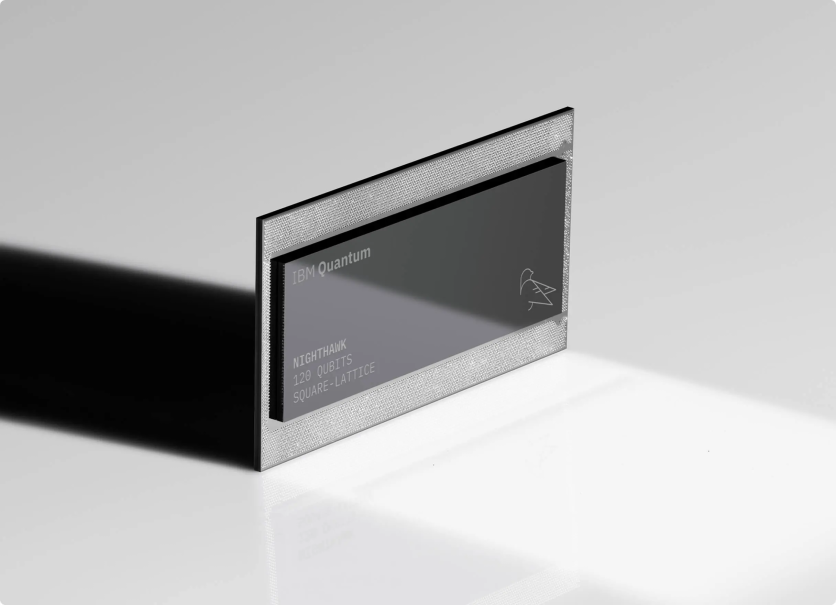
IBM unveiled Nighthawk at its annual Quantum Developer Conference in November 2025. The 120-qubit chip uses 218 next-generation tunable couplers arranged in a square lattice — a departure from the hexagonal heavy-hex layout of its predecessor, the Heron processor. The square lattice gives each qubit four neighbors instead of Heron's three, increasing coupler density by more than 20 percent and allowing circuits with up to 30 percent greater complexity.
IBM's roadmap calls for Nighthawk-based systems to support 7,500 two-qubit gates by the end of 2026, scaling to 10,000 gates in 2027 and 15,000 gates with 1,000 or more connected qubits by 2028. The company targets community confirmation of the first verified quantum advantage cases before the end of 2026, an initiative it is tracking through an open Quantum Advantage Tracker with partners including Algorithmiq, the Flatiron Institute, and BlueQubit.
The validation results published this week are building blocks for that timeline, not the headline event itself. What independent academic groups confirming that Nighthawk can handle real physics and real cybersecurity workloads tells IBM — and the broader quantum community — is that the hardware is ready for the next layer of stress tests, the ones designed explicitly to push for verified advantage.
Why Quantum Simulation of QCD Matters Beyond This Paper
Quantum chromodynamics calculations represent one of the clearest theoretical cases for quantum advantage. The low-energy regime of QCD — where quarks are confined inside hadrons and the coupling is too strong for perturbative methods — is where even the world's most powerful classical supercomputers can only approximate solutions using lattice QCD methods that are computationally intensive and limited in scope. Problems in this regime include modeling the conditions inside colliders, understanding neutron star interiors, and predicting how heavy elements form in supernovae.
The QCD simulation on Nighthawk was a two-dimensional simplification with a solvable structure, not the full four-dimensional theory. But the methodology — mapping a gauge theory Hamiltonian to a spin-chain representation via bosonization and implementing it with Jordan-Wigner encoding — is a template that scales. Demonstrating that the technique produces physically correct results on current hardware keeps the longer-term goal visible: using quantum processors to compute QCD dynamics that classical hardware cannot reach at all.
Frequently Asked Questions
What is quantum advantage, and did IBM's Nighthawk achieve it?
Quantum advantage is the point at which a quantum computer outperforms all known classical methods on a given problem. IBM's Nighthawk did not achieve quantum advantage in either of this week's studies — the researchers explicitly made no such claim. What the studies confirmed is that Nighthawk can execute real-world quantum workloads accurately and reproducibly, a prerequisite for the quantum advantage demonstrations IBM is targeting before the end of 2026.
Why can quantum computers simulate the strong nuclear force better than classical computers?
Quantum chromodynamics — the theory describing how quarks and gluons interact — is a quantum field theory at its core, which means its state space grows exponentially with the number of particles. Classical computers must approximate or discretize the theory to make calculations tractable, and those approximations break down entirely in the low-energy regime where quarks are confined. A quantum processor can natively represent the quantum states of the interacting system, allowing it to occupy representational territory that classical hardware cannot fully access — not merely reach the answer more quickly.
How does QAOA detect network attacks, and what did the Nighthawk test show?
QAOA, the Quantum Approximate Optimization Algorithm, reformulates the problem of separating malicious network traffic from legitimate traffic as a graph-cutting problem. Each network event becomes a node on a graph; the algorithm searches for the partition that most cleanly divides attack events from benign ones. On the largest tested graph — 110 nodes representing real honeypot traffic — Nighthawk required the fewest two-qubit operations of any tested architecture, demonstrating compilation efficiency. However, simple classical algorithms can still solve the current benchmark graphs. This was a feasibility demonstration, not a deployment-ready security tool.
What does IBM's 2026 quantum advantage deadline mean for enterprise technology planning?
IBM's CEO stated in April 2026 that partners using IBM quantum hardware would demonstrate the first verified quantum advantage cases this year. If confirmed, this would mark the beginning of a transition from research-scale demonstrations to computationally useful quantum systems for specific problem classes. Enterprise planners in fields that involve combinatorial optimization, chemistry simulation, or materials modeling should track these results as early signals — but current quantum systems remain specialized tools for narrow problem classes, not general-purpose replacements for classical computing infrastructure.

-
 C114 Communication Network
 -
 Communication Home
