
 Search

Employees work during an organized press visit at the AESC gigafactory of Verkor's electric vehicle battery plant in Bourbourg, northern France, on December 10, 2025. Francois LO PRESTI/Getty Images)
Pharmicell, a Korean company spanning bio, pharmaceuticals, and advanced materials, has emerged as the sole supplier of a critical ingredient in the circuit boards that go into Nvidia's AI servers — feeding its materials to Doosan, whose end customer is Nvidia. Demand has sent Pharmicell's sales climbing, and its capacity is set to roughly double once a third plant in Ulsan comes online.
The AI hardware story is usually told at the top of the stack, where the GPUs and high-bandwidth memory are. This one sits three tiers down — and it is a small reminder that the AI buildout has minted quiet beneficiaries deep in the supply chain, some of them holding positions more defensible than the marquee names above them.
Three Tiers Below the GPU
According to industry sources, Pharmicell exclusively supplies the low-dielectric electronic materials — resin and curing agents — that serve as core raw materials for the AI-server copper-clad laminate (CCL) made by Doosan's Electronics Business Group. Doosan is a key supplier of AI-server CCL to Nvidia and other big-tech firms, and that has lifted Pharmicell with it. By the company's own account, first-quarter revenue from low-dielectric materials rose more than 1.5 times from a year earlier, to about 26 billion won — roughly 71% of its 36.7 billion won in total first-quarter sales — and roughly 7.6 times from the first quarter of 2024, when supply to Doosan began. Pharmicell expects annual sales of these materials to roughly double this year.
Why the Position Is Hard to Dislodge
The genuinely interesting part is not the growth but its durability. Resin and curing agents behave differently depending on formulation and process, requiring lengthy customer-specific optimization, and even an identical recipe needs re-certification if production equipment changes. On top of that, a would-be supplier in this chain has to pass consecutive evaluations — from the CCL maker, then the board maker, then the end customer — before it can ship anything. That sequential, slow, expensive gate is a high barrier that makes it hard for newcomers to break in quickly, and it is what converts Pharmicell's single-customer reliance into a position that is, for now, difficult to take away.
To keep up, Pharmicell announced last March a 30 billion won investment in a third Ulsan plant, about 1.7 times the combined footprint of its first two. After completion in September it will go through licensing and customer re-certification, with operations starting in early 2027 and roughly doubling capacity. The existing plants, the company says, are running flat out.
What CCL Is, and Where Pharmicell Sits
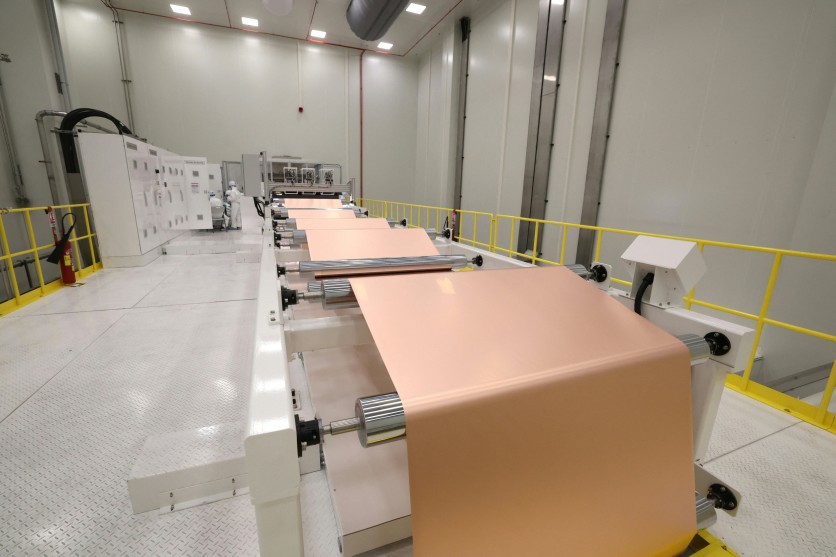
CCL sits at the base of the AI hardware stack. Resin and curing agents are combined with glass-fiber yarn to make prepreg, the insulating layer; CCL is then formed by laminating copper foil onto both sides, and used in the high-value substrates and motherboards for AI accelerators and networking gear, where low signal loss is critical. The reason the resin has to be "low-dielectric" is signal integrity: as AI servers push data across the board at hundreds of gigabits per second, a lossy insulating layer degrades the signal, so the chemistry Pharmicell supplies is part of what determines whether the board can keep up. Pharmicell and Doosan co-developed the materials over about a decade before supply began in 2024, and Pharmicell ships to Doosan's main hub in Jeungpyeong and its plant in Changshu, China. Doosan, in turn, sources glass fiber from Japan's Nitto Boseki and copper foil from Lotte Energy Materials, among others.
Read more: Lotte Energy Materials Bets Big on AI Substrate Circuit Foil: A High-Value Strategic Pivot
The Opening That Created the Tailwind
The whole chain got its tailwind from a competitive stumble. Taiwan's Elite Material, the world's largest CCL maker, reportedly failed Nvidia's quality verification for the CCL used in the compute trays of its Blackwell GB300 systems — a test Doosan passed. Industry reporting frames that as putting Doosan in position to supply Nvidia through its next-generation Rubin chips and pushing its Nvidia-driven materials sales toward a projected 1 trillion won; some analysts describe the same dynamic more cautiously, as Elite Material facing "supply difficulties" that opened a door for Doosan's quality-competitive product. Either way, the opening is the reason the Korean side of this chain is scaling so fast.
Doosan is expanding to match. In April it announced a 180 billion won plant — roughly $118 million to $130 million depending on the exchange rate — in Thailand's Araya Industrial Estate, its third overseas CCL base after China and Vietnam, dedicated to high-performance AI CCL, with mass production targeted for the second half of 2028. For now, Pharmicell, while courting new customers, plans to focus on meeting Doosan's demand.
That focus is both its strength and its risk. A near-total reliance on one customer is exactly what makes a supplier vulnerable if that customer's own fortunes turn — but as long as Doosan holds its place in Nvidia's supply chain, the certification moat that locks Pharmicell in also locks competitors out.
Read more: NVIDIA and Doosan Expand Physical AI Across Robots, Reactors, and Circuit Board Materials
Frequently Asked Questions
What is copper-clad laminate (CCL)?
Copper-clad laminate is the foundational material of a printed circuit board. It is made by combining resin and curing agents with glass-fiber yarn to form an insulating layer called prepreg, then laminating copper foil onto both sides. Board makers drill and etch this base to create the circuitry. For AI servers, high-performance CCL with very low signal loss is essential to carry high-speed data across accelerator and networking boards.
What does Pharmicell supply, and to whom?
According to industry reporting, Pharmicell exclusively supplies the low-dielectric resin and curing agents that Doosan's Electronics Business Group uses as core raw materials for its AI-server CCL. Doosan in turn supplies that CCL to Nvidia and other big-tech firms, which makes Pharmicell a deep-tier, behind-the-scenes beneficiary of AI-server demand. Pharmicell co-developed the materials with Doosan over roughly a decade before supply began in 2024.
Why is Pharmicell's exclusive position considered durable?
Resin and curing agents behave differently depending on formulation and manufacturing process, so qualifying a grade requires lengthy, customer-specific optimization — and even an unchanged recipe must be re-certified if the production equipment changes. New suppliers must also pass sequential evaluations from the CCL maker, the board maker, and the end customer. These barriers make it slow and difficult for competitors to enter, protecting an incumbent that is already qualified.
How did Doosan and its suppliers gain ground against Taiwan's Elite Material?
Industry reports say Elite Material, the world's largest CCL maker, failed Nvidia's quality verification for CCL used in the compute trays of its Blackwell GB300 systems, a test Doosan passed; some analysts frame it more cautiously as Elite Material facing supply difficulties. That opening positioned Doosan to supply Nvidia through its next-generation Rubin chips, lifting demand throughout its Korean supplier base, including Pharmicell. These are industry-sourced claims rather than figures confirmed by the companies involved.

-
 C114 Communication Network
 -
 Communication Home
