
 Search

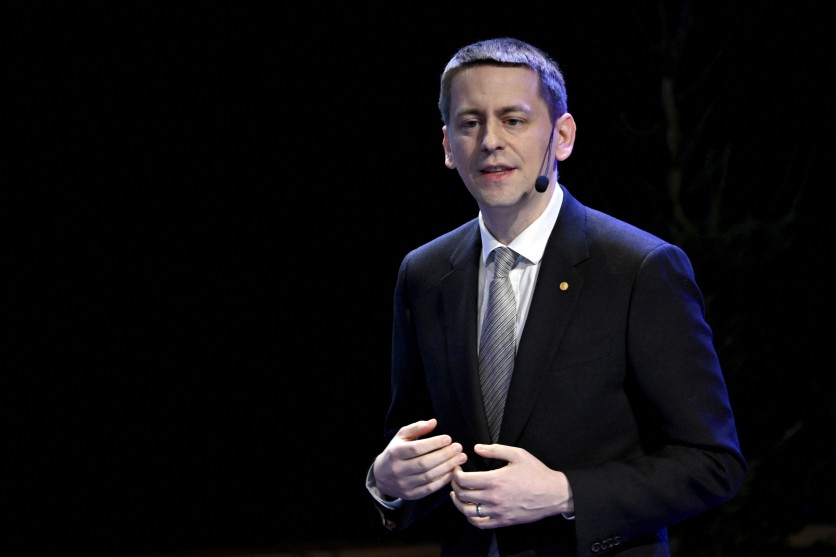
Nobel Prize in Chemistry 2024 co-laureate US chemist and computer scientist John Jumper gives his Nobel Prize lecture in Aula Magna, Stockholm University, Sweden, on December 8, 2024. Pontus LUNDAHL/Getty Images
John Jumper — the computational chemist who led the development of AlphaFold, shared the 2024 Nobel Prize in Chemistry for it, and spent nearly nine years turning Google DeepMind into the world's most credible AI-for-science lab — announced on Friday that he is leaving the company to join Anthropic. The announcement, posted to X on June 19, 2026, makes Jumper the most decorated individual scientist ever to change employers mid-career in the AI industry. It also makes this the most consequential week for Google's talent base since the company first assembled that talent.
One day earlier, Noam Shazeer — Google's vice president of engineering, co-lead of its flagship Gemini AI models, and co-author of the 2017 "Attention Is All You Need" paper that introduced the transformer architecture underpinning every major large language model today — announced he was leaving for OpenAI. Shazeer had returned to Google less than two years earlier as part of a roughly $2.7 billion deal involving his startup Character.AI. That investment walked out the door on Thursday.
What happened in those 48 hours was not a coincidence and not a personnel problem. It was a structural event: in less than two days, the two scientists most responsible for the transformer era's most consequential outputs — one applied to language, one applied to biology — both left Google for its two most significant competitors. The transformer architecture that Shazeer co-invented is the same attention-based mechanism that Jumper's team adapted to build AlphaFold. Google built the era; its rivals just recruited the people who defined it.
What AlphaFold Did and Why It Still Matters
To understand why Jumper's move matters, it helps to understand what AlphaFold actually solved and how it worked.
Predicting the three-dimensional structure of a protein from its amino acid sequence had been one of biology's open grand challenges since Christian Anfinsen proposed in 1961 that a protein's shape is fully determined by its sequence. The CASP competition, launched in 1994, tracked progress on this problem every two years. For decades, computational methods improved but never reached the accuracy of experimental approaches — techniques like X-ray crystallography and cryo-electron microscopy that could take years of lab work per protein. The gap between the pace of protein sequence discovery and the pace of structural resolution became one of biology's defining bottlenecks.
AlphaFold2 closed that gap almost entirely. At the CASP14 competition in 2020, the system achieved accuracy comparable to experimental methods — a result the judges described as a solution to the problem. Jumper and his collaborators published the full architecture in Nature in July 2021. DeepMind subsequently released predictions for more than 200 million proteins, covering most of the known protein universe. That database is now used by more than 2 million researchers across 190 countries and has accelerated drug discovery, vaccine development, and the understanding of disease at a scale no prior tool in life sciences ever achieved.
The technical mechanism behind AlphaFold2 is worth understanding, because it explains both the achievement and why Jumper's expertise is so coveted. The system is built around a custom transformer architecture called the Evoformer — 48 stacked attention blocks that process two kinds of input simultaneously: multiple sequence alignments (MSAs), which encode evolutionary conservation patterns across related proteins, and pairwise residue representations, which track interactions between amino acids. Crucially, the Evoformer's attention mechanism is not constrained to neighboring positions the way earlier convolutional neural networks were. It can capture long-range dependencies across the full protein sequence, which matters enormously in three-dimensional folding where residues distant in the chain can be adjacent in space. After the Evoformer processes these representations, a Structure Module translates them into predicted atomic coordinates, with the entire process recycled iteratively to refine accuracy.
The 2024 Nobel Prize in Chemistry recognized this work specifically — awarding Jumper and Demis Hassabis, the CEO of Google DeepMind, one half of the prize for protein structure prediction. David Baker of the University of Washington received the other half for computational protein design. It was the Nobel committee's explicit recognition that AI had not merely automated a laboratory task but had solved a fundamental scientific problem.
Read more: Google DeepMind Maps the Road From AGI to Superintelligence: Four Paths and Hard Limits
Where Jumper Is Going and Why Anthropic Built the Runway First
Jumper has not disclosed the specifics of his role at Anthropic, and the company has not commented. But Anthropic did not recruit him into an organization that had no idea what to do with him. Throughout 2026, Anthropic has been methodically constructing the infrastructure required to do serious AI-for-science work: opening wet labs, publishing research on AI agents designed for biological workflows, and in February 2026 announcing flagship partnerships with the Allen Institute and the Howard Hughes Medical Institute, which runs Janelia Research Campus. Those partnerships deploy Claude-powered AI agents directly into scientific data analysis pipelines — targeting the months-long bottlenecks in single-cell genomics, connectomics, and imaging that currently separate raw experimental data from validated biological insight.
Anthropic CEO Dario Amodei described the underlying ambition in a 2024 essay arguing that AI-enabled biology could compress the scientific progress of 50 to 100 years into five to ten years. Jumper is, by any reasonable measure, the person who has most concretely demonstrated that this kind of compression is possible. AlphaFold collapsed decades of expected progress in protein science into a database that anyone with a browser can access.
Jumper is not the first major scientist to choose Anthropic over a larger lab. In May 2026, Andrej Karpathy — an OpenAI founding member and one of the most influential AI researchers of the last decade — joined Anthropic's pre-training team. The broader talent flow has been documented: according to SignalFire's 2025 State of Talent Report, engineers at DeepMind were nearly 11 times more likely to leave for Anthropic than the reverse. Anthropic's two-year retention rate of 80 percent leads every frontier AI lab, ahead of DeepMind at 78 percent and OpenAI at 67 percent.
Read more: Karpathy, Who Called Today's AI Agents 'Slop,' Joins Anthropic to Use Claude to Build the Next Claude
What the Dual Departure Means for Google
For Google, the challenge is harder to quantify than a headcount problem. AlphaFold remains a landmark achievement and the database it produced is not going anywhere. DeepMind retains enormous research depth and continues to publish work at the frontier of AI. But the narrative implication of losing Shazeer and Jumper in the same week — to two different competitors — is significant. When the organizations that most directly compete with you recruit the scientists most identified with your greatest achievements, the question is no longer about resources. It is about whether the most exceptional people believe the most important work happens inside your walls.
Google's attempts to retain talent have not been passive. DeepMind has enforced noncompete clauses of six to twelve months for UK-based researchers, in some cases placing staff on full-pay garden leave rather than allow immediate transitions to competitors. Demis Hassabis publicly praised Jumper's work on X following the announcement, writing that AlphaFold had changed the world and demonstrated what AI could do for science and medicine. That is a gracious farewell — and also a fair description of the problem Google now faces: the proof of concept for AI-for-science that DeepMind generated is now the primary credential its most important hires bring to a competitor.
What Anthropic Is Now Building
Jumper's arrival gives Anthropic something that no amount of language-model benchmark performance could supply: scientific legitimacy at the level of the Nobel Prize. The company has spent 2026 rapidly expanding its commercial position — filing confidential IPO paperwork on June 1 at a $965 billion valuation, growing annualized revenue from roughly $9 billion at the end of 2025 to more than $47 billion by May 2026, and overtaking OpenAI in U.S. business AI payments for the first time as of April. But its self-described identity as an AI safety and science lab has, until now, rested primarily on language model work.
Jumper's hire signals that the AI-for-science division Anthropic has been quietly constructing is intended to produce something structurally new — not a chatbot interface on top of biology databases, but an organization capable of generating the kind of foundational scientific output that wins Nobel Prizes. Anthropic is hosting a science-focused event on June 30, and Jumper's timing positions him to shape whatever that next chapter looks like.
The prize in the AI talent competition has never been market share. It is the small number of researchers who have the rare combination of scientific depth, engineering ability, and track record to push an entire field in a new direction. John Jumper has done that once. Where he points next will likely matter more to the future of AI than any product announcement either lab makes this year.
Frequently Asked Questions
What is John Jumper known for?
John Jumper is the computational chemist who led the development of AlphaFold at Google DeepMind, solving one of biology's central challenges: predicting the three-dimensional structure of a protein from its amino acid sequence. He shared the 2024 Nobel Prize in Chemistry with DeepMind CEO Demis Hassabis for that work and is the youngest chemistry laureate in more than 70 years. AlphaFold's predictions now cover more than 200 million proteins and are used by more than 2 million researchers in 190 countries.
What is AlphaFold and how does it work?
AlphaFold2 is an AI system built on a custom transformer architecture called the Evoformer — 48 stacked attention blocks that process evolutionary sequence data (multiple sequence alignments) and pairwise residue interactions simultaneously. Unlike earlier computational approaches that could only examine local sequence neighborhoods, AlphaFold's attention mechanism captures long-range dependencies across the full protein chain, allowing it to predict how distant amino acids interact in three-dimensional space. The result is atomic-level protein structure predictions that match experimental accuracy in most cases — a benchmark researchers had been trying to reach for over 50 years.
Why did John Jumper leave Google DeepMind for Anthropic?
Jumper has not stated his reasons in detail beyond expressing warmth for his time at DeepMind. But Anthropic has been actively building AI-for-science infrastructure throughout 2026 — including wet labs, biological agent research, and partnerships with the Allen Institute and Howard Hughes Medical Institute — that aligns directly with Jumper's expertise. Anthropic also leads all frontier AI labs in talent retention, with an 80 percent two-year retention rate, and engineers are nearly 11 times more likely to leave DeepMind for Anthropic than the reverse, according to SignalFire's 2025 State of Talent Report.
What does Jumper's move signal about the AI talent war?
Jumper's departure — coming one day after Noam Shazeer, co-lead of Gemini and co-author of the "Attention Is All You Need" transformer paper, announced he was joining OpenAI — marks a structural shift in AI talent competition. Both scientists were central architects of the same foundational attention mechanism applied to different domains: Shazeer to language, Jumper to biology. Their simultaneous departures suggest the competitive advantage in AI has shifted from who has the most compute to who can attract the scientists most capable of generating the next foundational breakthrough.

-
 C114 Communication Network
 -
 Communication Home
