
 Search


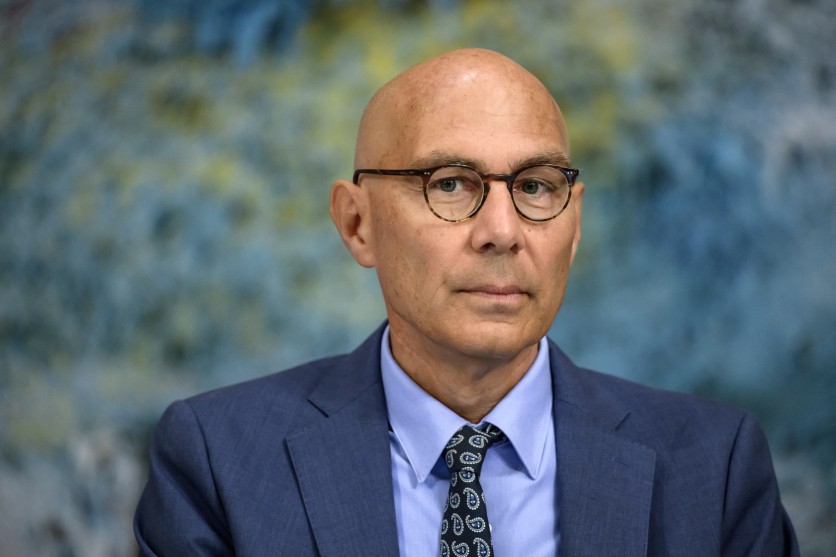
Fabrice COFFRINI / AFP via Getty Images
UN High Commissioner for Human Rights Volker Türk said Thursday, Nov. 19, at the RightsX summit in Geneva that five technology companies own more than 70% of global AI computing capacity and that AI is governed in a way he called almost medieval, according to an AFP report carried by Euronews. Neither Türk nor the AFP report named the companies or cited a source for the figure.
The closest published match is Epoch AI's estimate that Amazon, Google, Meta, Microsoft and Oracle owned 71% of cumulative AI compute at the end of 2025. That match is an inference, because Türk did not confirm it. The distinction matters for the rules he wants: Epoch's data counts chips owned, while OpenAI and Anthropic rent most of the compute they run, mainly from cloud providers.
For a reader tracking AI regulation, the practical question is which layer a rule reaches. Türk's September letter went to States and AI developers, according to the UN human rights office, while the owners of the chips are cloud and platform companies that competition regulators have examined, in Brussels through preliminary Digital Markets Act findings and in Washington through an FTC staff report on AI partnerships. A reader who relies on one cloud provider for AI services also gets a concrete step from Cloud Security Alliance researchers: test a second provider before an outage forces the choice.
Which Five Companies Own Over 70% of AI Computing Power?
Epoch AI, a research group that tracks AI chips, estimates the five owned 63% of the world's cumulative AI compute in the first quarter of 2024 and 71% by the fourth quarter of 2025. Epoch measures compute in H100-equivalents, a count that converts different chips into the computing power of one Nvidia H100 graphics processor. Google leads with about 5 million H100-equivalents, roughly 25% of the world's total.
Apart from Meta, all five are major cloud companies that rent out part of their compute. Epoch estimates that Chinese companies collectively own just over 5% of the cumulative computing power of recently sold leading AI chips, less than any single top US hyperscaler. That China figure leaves out smuggled chips and compute that Chinese companies rent from offshore clouds.
Epoch Counts Chips Owned, Not Chips Used, and Frontier Labs Used 20% to 30%
Epoch builds its ownership estimates from vendor data-center revenue. It assumes a company's share of Nvidia's data-center revenue roughly equals its share of flagship AI chip sales, converts that share into chip counts, and runs Monte Carlo simulations to put ranges around the result. Newer chips are scaled to the H100: Epoch's example treats about 100,000 Blackwell chips at Stargate Abilene as roughly 250,000 H100-equivalents.
The attribution rule is the part that changes the headline number. When a lab rents cloud compute, Epoch credits chips to the cloud provider, not the lab. Epoch says OpenAI relies mainly on Microsoft, Oracle and CoreWeave, and Anthropic mainly on Amazon and Google. Hyperscaler-owned compute also serves renters, internal AI labs and products such as recommendation systems, and Epoch says the ranking of those uses is unclear.
Epoch's separate usage research puts numbers on the gap. A May 20 newsletter estimated that OpenAI, Anthropic and xAI together made up about 20% to 30% of operational AI compute at the end of 2025, and that the five most resource-rich developers, which add Google DeepMind and Meta Superintelligence Labs, probably had access to less than half. The author describes the estimates as more tentative than Epoch's standard data work. Epoch's AI Chip Users explorer puts December 2025 median use at about 1.74 million H100-equivalents for OpenAI and about 1.19 million for Anthropic, with wide error ranges. For a reader, the takeaway is specific: the 70% describes how much hardware five firms own, and how much of it frontier labs use is a separate, smaller number.
Read more: Top500 Supercomputer List: Average Core Count Jumps 46 Percent but Speed Rises About 5 Percent
Türk's September Letter Went to States and AI Developers; Regulators Examine Cloud Owners
On Sept. 7, Türk told the Human Rights Council that "a handful of men has almost unlimited power over AI" and said he would write to AI companies. On Sept. 14, the UN human rights office said his letter was addressed to States and AI developers. UN News reported that it asked countries hosting frontier AI companies to require serious-incident reporting, capability verification and human rights due diligence, and that it reported no direct company response. The AFP report of Nov. 19 does not say which companies received his letter or whether any replied.
UN News's account of the letter lists incident reporting, capability verification and due diligence, and does not mention a limit on how much compute any one firm may own. A CADE Project summary of the UN rights office's June report says it extends due diligence recommendations to infrastructure providers.
Competition regulators are working on the cloud layer. On June 25, the European Commission issued preliminary findings on AWS and Azure indicating both should be designated gatekeepers under the Digital Markets Act. According to a trade report, Amazon argued the European market is competitive. Microsoft argued that regulators overlook Google Cloud and Gemini. A final decision is expected in the coming months, without a set date. In the United States, an FTC staff report from January 2025 found that partnerships among Alphabet, Amazon, Microsoft, Anthropic and OpenAI may affect access to computing resources and may increase switching costs.
Laws that use compute as a trigger work differently. The EU AI Act presumes high-impact capabilities in general-purpose models trained above 10 to the 25th power floating-point operations, a threshold that attaches to a training run, not to who owns the chips.
Epoch Itself Has Published Both Two-Thirds and 71% for Year-End 2025 Compute Ownership
The headline figure is softer than a single percentage suggests. Epoch's April 14 newsletter said the five own about two-thirds of the world's compute, up from about 60% at the start of 2024. Its data insight lists 71%, and an April 6 launch post said "over 70%."
Epoch attributes ownership informally and says the figures should not be used for financial analysis. Headline values are Monte Carlo medians with 5th-to-95th-percentile ranges, and uncertainty is widest for Oracle's holdings before 2025. The series ends in the fourth quarter of 2025. Türk spoke in the present tense, so the best available match is a snapshot nearly a year old.
Türk's Background Is Law; His Office Signed Microsoft Partnership in 2017
Türk holds a law degree from Johannes Kepler University Linz and a doctorate in international law from the University of Vienna. His public AI record is policy work: the Sept. 7 Human Rights Council speech, the Sept. 14 letter and, in February, a remark to UN News about a handful of companies in North America holding AI power.
The UN Human Rights Office signed a five-year partnership with Microsoft on May 16, 2017, including a $5 million grant, under Türk's predecessor, Zeid Ra'ad Al Hussein. Microsoft's announcement does not address any renewal.
Microsoft appeared twice in the RightsX afternoon program in Geneva on Nov. 19. Steven Gemmel of Microsoft sat on Panel C from 9:05 a.m. to 10:05 a.m. ET, and Jenny Lay-Flurrie of Microsoft spoke in the lightning-talk block that began at 10:05 a.m. ET, according to the UN Web TV program listing. The program listing does not show how Microsoft responded to Türk's remarks.
EU Cloud Gatekeeper Ruling and Geneva AI Summit 2027 Will Test Compute Concentration Claims
The first test is the European Commission's final decision on AWS and Azure, which would put two of the five under gatekeeper rules. The second is the Geneva AI Summit planned for 2027. A UN event listing for a Nov. 3 roundtable says its recommendations are meant to inform RightsX Summit 2026 and the Road to Geneva discussions ahead of that summit.
The takeaway for readers is narrow and checkable. When a headline says a few firms control a share of AI compute, ask whether the number counts chips owned or compute used, because Epoch's data shows the answers differ by a wide margin. Rules aimed at AI developers do not by themselves reach the firms that own most of the hardware, and the regulatory scrutiny of those owners described here comes from competition authorities.
Read more: Türk Brings AI Existential Risk to Human Rights Law; Cites Hack, Drone Deaths as Proof
Frequently Asked Questions
Which companies own most of the world's AI computing power?
Türk did not name them. Epoch AI's data points to Amazon, Google, Meta, Microsoft and Oracle, which it estimates held 71% of cumulative AI compute at the end of 2025, with Google alone near 25%.
Does owning 70% of AI compute mean five companies control frontier AI?
Not by itself. Ownership is not use: OpenAI and Anthropic rent most of their compute, and Epoch estimates OpenAI, Anthropic and xAI used about 20% to 30% of the world's operational AI compute. Renters still depend on owners for access, which is why the FTC studied whether cloud-and-AI-developer partnerships affect compute access.
What has Türk asked AI companies and governments to do?
His Sept. 14 letter asked countries hosting frontier AI companies to require serious-incident reporting, capability verification and human rights due diligence, according to UN News reporting. On Nov. 19, AFP reported that he suggested giving the Universal Declaration of Human Rights to AI as its task, a standard that is not legally binding.
What is an H100-equivalent?
Epoch AI measures compute in H100-equivalents, a unit scaled to the computing power of one Nvidia H100. In Epoch's example, about 100,000 Blackwell chips at Stargate Abilene count as roughly 250,000 H100-equivalents.

-
 C114 Communication Network
-
 Communication Home
