
 Search


Microsoft will use Intel Foundry’s Embedded Multi-die Interconnect Bridge (EMIB) packaging for Azure-designed silicon under a long-term agreement that also secures multi-year Intel Xeon supply capacity. The agreement covers planned Azure instances based on Diamond Rapids, Intel’s next-generation server CPU. Microsoft and Intel announced the expansion on November 18.
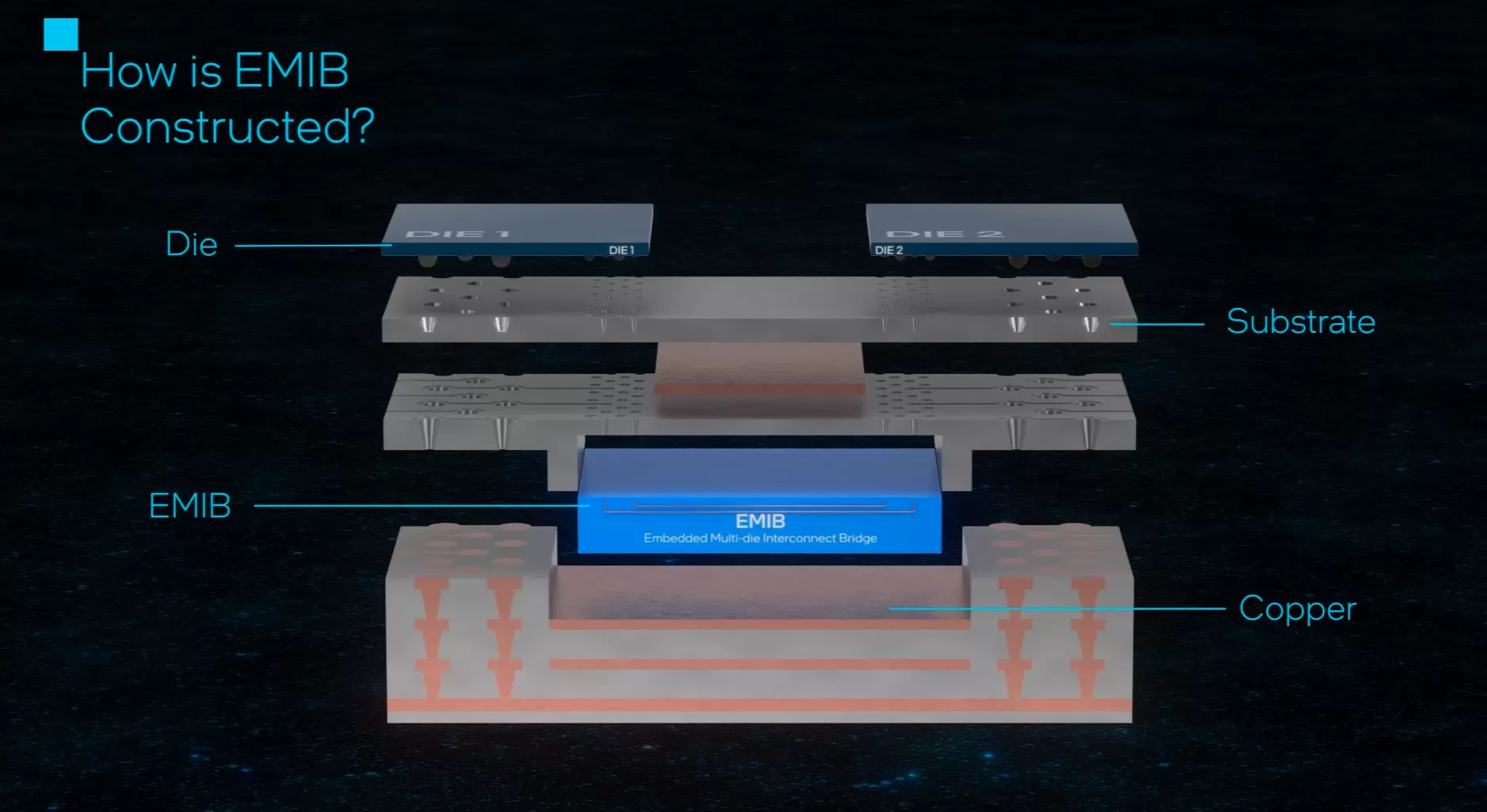
EMIB uses small silicon bridges embedded in a package substrate to connect adjacent dies. Microsoft is the first company to announce plans to use the technology for Azure first-party silicon. The companies did not identify the Azure chip that will use EMIB or disclose the package configuration, production volumes, or deployment schedule.
The collaboration also covers Compute Express Link (CXL) memory expansion, Intel QuickAssist Technology (QAT) for offload, and confidential computing. The companies reported up to 2.3× the performance in a sandbox workload on an Azure M-series v4 VM using Xeon 6 and CXL memory, and up to 2.5× faster SQL backups in a separate test involving QAT. Intel Trust Domain Extensions (TDX) protect VM memory and CPU register state during migration between hosts.
“Our customers need infrastructure built around the workloads that matter to them,” said Saurabh Dighe, corporate vice president for Azure System & Architecture at Microsoft.
| Microsoft–Intel Azure Agreement |
| • Advanced packaging Azure first-party silicon will use Intel Foundry EMIB to connect dies inside a package. |
| • Xeon capacity The agreement secures multi-year supply capacity and covers planned Azure instances using Diamond Rapids. |
| • CXL memory The companies report up to 2.3× the performance in a sandbox test on Azure M-series v4 using Xeon 6 Flat Memory Mode. The compared VMs differed in vCPU count and memory capacity. |
| • SQL backup offload The companies report up to 2.5× faster SQL backups in a comparison involving a QAT-enabled Azure VM. The tested systems differed in processor generation and configuration. |
| • Confidential VM migration Intel TDX encrypts VM memory and CPU register state as confidential VMs move between hosts. |
| Intel EMIB Packaging and Its Variants | |
|---|---|
| EMIB 2.5D | Embedded Multi-die Interconnect Bridge Intel embeds a small, multilayer silicon bridge in a cavity in the organic package substrate. Fine-pitch microbumps connect the edges of neighboring dies to the bridge, whose metal layers carry short, dense lateral links. Coarser bumps elsewhere on the dies connect to the package substrate. Use cases include logic-to-logic links and links from a processor or accelerator to high-bandwidth memory (HBM). |
| EMIB-M | Local power decoupling Metal–insulator–metal (MIM) capacitors are built into the bridge. The capacitors supply charge locally during fast changes in current demand, helping suppress short-term voltage droop and high-frequency supply noise. The bridge still carries lateral die-to-die signals. |
| EMIB-T | Vertical power delivery Conductive through-silicon vias (TSVs) pass through the bridge silicon to provide a vertical path for power from the package substrate to the dies above. This can shorten the power path in dense logic-to-HBM layouts while the bridge’s metal layers carry lateral data. The TSVs here are in the bridge itself. |
| EMIB 3.5D | Lateral links plus vertical stacks A package architecture that combines EMIB bridges with Foveros die stacking. Foveros connects chiplets vertically within a stack, while EMIB routes between adjacent tiles or stacks. Foveros Direct 3D uses copper-to-copper hybrid bonding for the vertical interface. Intel’s Data Center GPU Max Series is a production example. |
| Bump pitch | Spacing at the bridge interface Intel documents a generational reduction from 55 µm to 45 µm between microbumps. Tighter spacing lets designers fit more connections along a given die edge. Link bandwidth also depends on the lane count and signaling rate. |
| Package scaling | Local bridges and reticle limits Each bridge covers a die-to-die seam, so the package can integrate multiple separately fabricated dies across an area larger than a single lithography exposure field. Bridge placement and dense I/O still require designers to line up compatible interfaces at adjoining die edges. |
| Azure agreement | What Microsoft disclosed Microsoft will use Intel Foundry EMIB for Azure first-party silicon. The announcement leaves the chip, bridge variant, bump pitch, and package layout undisclosed. The same agreement also covers planned Xeon Diamond Rapids instances. |
| Intel Foundry packaging documentation · Azure announcement | |
Analysis
The agreement gives Intel Foundry an announced Azure packaging customer and extends Intel’s role as a server CPU supplier as Microsoft expands its own silicon portfolio. Microsoft has already detailed its Cobalt CPUs and Maia AI accelerators. The EMIB announcement leaves the target chip and the wafer fabrication process open. The first product disclosure will show where Microsoft plans to use Intel’s packaging in its Azure silicon roadmap.
The CXL comparison shows how Azure can use a larger memory tier for a specific workload. The CXL-enabled VM had 76 vCPUs and 1,764 GB of usable memory, while the DRAM-only VM had 64 vCPUs and 1,007 GB. The SQL backup comparison likewise used different Xeon generations and memory configurations. Both results describe the tested systems. A comparison at matched CPU and memory capacity would help isolate the contribution of CXL or QAT.
| Company Profile | Intel | |
| Headquarters | Santa Clara, California, United States |
| CEO | Lip-Bu Tan |
| Founded | 1968 |
| Listing | Nasdaq: INTC |
| Business | Intel designs and manufactures semiconductors, including Xeon server processors. Intel Foundry offers semiconductor manufacturing and advanced packaging, including EMIB for connecting dies in a package. |
| Azure relationship | Intel supplies Xeon processors. Microsoft plans to use Intel Foundry EMIB for Azure first-party silicon. |

-
 C114 Communication Network
-
 Communication Home
