
 Search

Cascoldatom.com
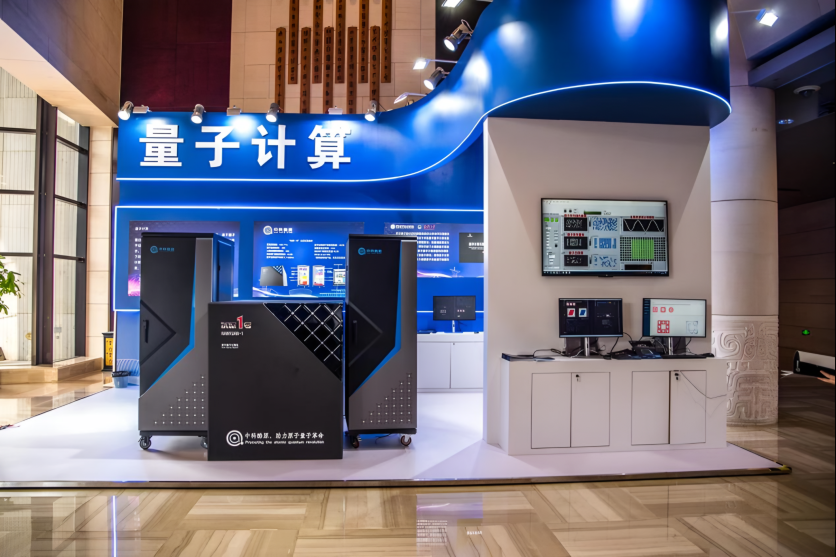
On Saturday morning in Shanghai, a startup that did not exist a year ago walked onto the floor of the World Artificial Intelligence Conference and showed a quantum computer built to slide into an ordinary server rack — no dilution refrigerator, no vibration isolation table, no dedicated quantum facility required. Zhongqi Wuliang (众擎无量), a spinoff from the Chinese Academy of Sciences' Shanghai Institute of Optics and Fine Mechanics, unveiled the Qinghe No. 1 (清河一号) at WAIC 2026, pitching it as the first neutral atom quantum computer engineered specifically for direct data-center deployment in a Pandaily report on the WAIC debut.
Whether or not that specific "first" claim stands up — and at least one predecessor system, the Hanyuan-1, came close — the direction the claim points to is real. A pattern has emerged in China's neutral atom quantum computing sector: successive generations of hardware are getting closer to ordinary infrastructure with each release. Three generations in nine months, each physically smaller and thermally simpler than the last, is a cadence that no other national quantum program has matched.
The announcement came on day two of WAIC 2026, a conference running July 17–20 at the Shanghai World Expo Exhibition and Convention Center under the theme "AI Partnership for a Brighter Future." The conference has become China's primary showcase for frontier technology announcements, and this year's edition drew over 1,100 exhibitors — more than 300 of them making global product debuts.
Read more: Quantum Computing Stocks Drop 35% as Federal Mandate Reshapes Investment Case
Why Removing the Refrigerator Changes Everything
The engineering barrier that has kept quantum hardware in laboratories for three decades is not primarily about qubits. It is about what surrounds them. Superconducting quantum computers — the dominant commercial architecture used by IBM, Google, and most Western players — require dilution refrigerators to cool their circuits to roughly 15 millikelvin, colder than interstellar space. That cooling equipment is bulky, expensive, vibration-sensitive, energy-intensive, and demands specialized facilities that most enterprise data centers cannot accommodate. The hardware itself might fit in a room; the cryogenic support system fills the rest of it.
Neutral atom quantum computers sidestep this constraint at the architectural level. In a neutral atom system, individual atoms — each chemically identical, making them inherently uniform qubits — are suspended in a vacuum using tightly focused laser beams called optical tweezers, then manipulated by additional laser pulses to perform quantum operations. The atoms are cooled to micro-kelvin temperatures inside the vacuum chamber using laser cooling techniques, but the cooling is self-contained and does not require external cryogenic infrastructure. A researcher can carry the laser system across a room. A data center can rack the unit alongside conventional servers.
The specific quantum gate mechanism is the Rydberg blockade. When one atom is excited to a high-energy "Rydberg" state — a state with a very large principal quantum number that amplifies electromagnetic couplings by roughly twelve orders of magnitude — it prevents a nearby atom from being simultaneously excited, because the energy shift induced by the dipole-dipole interaction detunes the second atom from the laser pulse. This blockade effect is the control mechanism for two-qubit entangling gates: the state of the control atom conditionally determines what the target atom does. The gate speed is slower than superconducting alternatives — two-qubit Rydberg gates run in microseconds, compared to nanoseconds for superconducting gates — but the room-temperature operating requirement and the uniform, manufacturable nature of atomic qubits provide structural advantages in commercial deployability that gate speed alone does not capture.
What Zhongqi Wuliang Built, and What Remains Unverified
Zhongqi Wuliang was founded by Lu Xudong of CAS SIOM, which brings more than 60 years of precision optics and photon science expertise to the venture. The company reports completing its full integrated hardware stack within months of founding — a pace that the Quantum Computing Report characterized as a new implementation velocity benchmark for the field.
Qinghe No. 1 is described as a second-generation server form factor unit, designed for insertion into a standard data-center server rack. The company reports "internationally competitive performance" and frames the system as targeting near-term quantum advantage applications in financial optimization, logistics, and materials simulation.
What has not been published: an independent qubit count, two-qubit gate fidelity figures, coherence time measurements, or any peer-reviewed benchmark. The claim of "internationally competitive performance" is asserted, not verified. Any enterprise buyer evaluating this system should treat it as an announcement, not an established technical result — and demand the same independent validation standard applied to any quantum hardware purchase. The gap between a trade-show demonstration and a publishable benchmark is not cosmetic; it is where most announced quantum systems have historically stalled.
Zhongqi Wuliang's supply chain partner, Xuanxiang Technology, has separately commercialized what it describes as the world's first million-level tweezers array chip, which the company says addresses optical alignment bottlenecks that had previously constrained neutral atom scaling.
How Qinghe No. 1 Fits China's Three-Generation Pattern
Qinghe No. 1 did not emerge in isolation. It is the third commercially positioned neutral atom quantum system to come out of China in nine months, and each generation has pushed the form factor further into ordinary infrastructure.
In October 2025, Zhongke Kuyuan (a separate company with CAS ties) delivered Hanyuan-1 to a China Mobile subsidiary — the first commercial neutral atom deployment in China. The Hanyuan-1 is a 100-qubit system that operates at room temperature and fits within three standard equipment racks, with single-qubit gate fidelity of 0.999 and two-qubit gate fidelity of 0.98. It secured 40 million yuan (approximately $5.6 million) in orders, including an international sale to Pakistan for the establishment of that country's first national quantum computing center. By December 2025, Zhongke Kuyuan had received strategic financing from the China Mobile Chain Leader Fund.
In May 2026, the same research lineage produced Hanyuan-2: a dual-core cabinet design neutral atom system unveiled May 7 under a standard cabinet-style integrated design requiring no ultra-low temperature cooling environment, with total power consumption below 7 kilowatts. The dual-core architecture lets the two processor units operate in parallel for throughput or in a main-core-plus-auxiliary-core configuration for more stable logical qubit encoding.
Qinghe No. 1 is positioned as the next step: not three racks (Hanyuan-1), not a cabinet (Hanyuan-2), but a single standard server rack unit. Whether that form factor actually delivers the qubit count and fidelity figures needed for commercially useful computation — that is the open question every technical buyer should be asking.
Shanghai's Quantum Industrial Policy Behind the Announcement
Zhongqi Wuliang's debut is not coincidental to WAIC 2026. It is a product of the same industrial policy that has been systematically building Shanghai's neutral atom quantum sector since at least late 2025. The city has designated neutral atom computing as its primary quantum technical roadmap and established two coordinating hubs: the Xuhui Cultivation Zone and Zhangjiang Quantum Bay. State-backed investment, the Yangtze River Delta supply chain, and proximity to CAS institutes have attracted a cluster of hardware, software, and application companies.
USTC Academician Lu Chaoyang at WAIC 2026 reiterated that fault-tolerant computing and logical qubit validation remain the essential milestones for genuine commercial deployment — a framing that Zhongqi Wuliang's own roadmap aligns with. The company is pursuing near-term quantum advantage applications while keeping the longer-horizon goal of fault-tolerant general-purpose quantum computing as its stated end point.
Read more: Neutral-Atom Quantum Computer: 2,000 Laser Tweezers in One Square Meter
Qinghe No. 1 Enters a Field Google Just Validated
The global neutral atom sector has received an unusually strong institutional endorsement in the past few months, which is the competitive context that makes Zhongqi Wuliang's announcement legible rather than marginal.
On March 24, 2026, Google's neutral atom Boulder program launched when Google Quantum AI announced a dedicated neutral atom research team at a new laboratory in Boulder, Colorado, led by physicist Adam Kaufman from JILA. The decision is significant because Google is not abandoning its flagship superconducting quantum program — it is adding neutral atoms as a second parallel modality, specifically because the two architectures have complementary strengths. Superconducting qubits excel at circuit depth; neutral atoms offer reconfigurable any-to-any connectivity and more efficient scaling in qubit count. Google also confirmed it would continue its collaboration with QuEra, following QuEra's $230 million funding round in 2025.
QuEra's Gemini system — the current Western benchmark for commercial neutral atom hardware — operates at 260 physical qubits with more than 99% single-qubit fidelity and greater than 99.2% two-qubit gate fidelity. In January 2026, QuEra published a landmark Nature paper in collaboration with Harvard and MIT demonstrating a universal fault-tolerant quantum processing architecture using reconfigurable arrays of up to 448 neutral atoms, achieving below-threshold error suppression — the first time this milestone had been reached at that scale on any platform.
Pasqal, Atom Computing, and Infleqtion are also advancing commercial neutral atom systems. The modality that was considered a research curiosity as recently as 2023 is now the architecture that Google, the world's most technically sophisticated quantum investor, chose to run in parallel with the approach it has spent two decades refining.
What State Affiliation Means for International Buyers
Zhongqi Wuliang is a Chinese Academy of Sciences spinoff. CAS is a state institution. The company has received investment through Shanghai's state-designated quantum industrial policy. Under China's National Intelligence Law (2017), Article 7, all Chinese organizations are required to "support, assist, and cooperate with national intelligence efforts in accordance with law." Article 14 of the same law grants intelligence agencies authority to demand that assistance. This legal obligation applies regardless of the company's stated policies or the physical location of its operations.
The practical implication for an enterprise buyer considering Qinghe No. 1 is not primarily a consumer data privacy risk — this system does not passively collect personal data in the way a smartphone or router might. The risk is more specific to enterprise intellectual property: optimization problems, simulation workloads, or financial models run on a Chinese state-affiliated quantum system could theoretically be accessible to Chinese intelligence as a legal matter, not merely as a hypothetical. This is the same structural exposure that has prompted U.S. export controls on quantum hardware to Chinese entities — controls that have been in effect since late 2024 and were extended by the current administration.
The debate about Article 7's precise scope is genuine. China Law Translate's analysis by legal analyst Jeremy Daum noted that the provision lacks independent enforcement mechanisms and that the obligation to cooperate must be invoked by intelligence agencies through lawful procedures. But even in the narrower reading, no company operating under Chinese law can contractually immunize its quantum computing services from that legal framework. Western enterprise buyers deploying sensitive workloads should factor this into procurement decisions.
What Qinghe No. 1 Actually Needs to Prove
The correct frame for Qinghe No. 1 is not whether it is impressive — the engineering concept is sound and the direction is industrially significant — but whether it has been validated at the level the form-factor claim implies.
The system needs to publish qubit count, gate fidelity across multiple rounds, coherence time, and system-level error rate. It needs those figures to appear in a venue where independent researchers can scrutinize the methodology. And it needs to demonstrate that the single-rack form factor has not been achieved by sacrificing the qubit count or performance that makes a neutral atom system useful.
The Hanyuan-1 precedent is instructive. That system shipped to a paying customer, published its performance figures, and secured international orders — all within months of its debut. If Zhongqi Wuliang follows the same pattern, Qinghe No. 1 will have a much stronger claim to "world's first" than it does today. WAIC 2026 closes July 20; the company has said additional technical details will follow.
What the announcement demonstrates right now is something more modest and more honest: that China's neutral atom cluster is iterating faster than most outside observers realized, that the data-center form factor for quantum hardware is within reach of current engineering rather than a decade away, and that the barrier keeping quantum out of the enterprise is lower than the cryogenic cooling story implied.
Frequently Asked Questions
What makes a neutral atom quantum computer different from the superconducting machines IBM and Google build?
Superconducting quantum computers cool their circuits to roughly 15 millikelvin in a dilution refrigerator — hardware that is large, expensive, vibration-sensitive, and unsuitable for most data centers. Neutral atom systems trap individual atoms in vacuum using laser beams called optical tweezers and perform quantum operations via laser pulses and the Rydberg blockade mechanism. The atoms are cooled with laser techniques inside the vacuum chamber, but no external cryogenic infrastructure is required. The tradeoff is gate speed: two-qubit Rydberg operations run in microseconds, about 100 times slower than superconducting gates. But neutral atom qubits are structurally identical (every atom of a given element is the same), reconfigurable in any connectivity pattern, and deployable in hardware that fits in a server rack alongside conventional computing equipment.
Can I trust Qinghe No. 1's performance claims?
Not yet. Zhongqi Wuliang reported "internationally competitive performance" at WAIC 2026, but has not published qubit count, two-qubit gate fidelity, coherence time, or error rates in any peer-reviewed or independently verified source. The announcement is a trade-show debut, not a validated benchmark. Before any procurement decision, an enterprise buyer should demand the same independent technical validation applied to any quantum hardware — published performance data, methodology documentation, and third-party replication. The predecessor Hanyuan-1 published its figures and shipped to paying customers; the same standard applies here.
What does China's National Intelligence Law mean for enterprise buyers of Chinese quantum hardware?
China's National Intelligence Law (2017), Article 7, requires all Chinese organizations to support and cooperate with national intelligence requests. This applies to Zhongqi Wuliang as a CAS spinoff operating under Chinese law, regardless of any stated privacy commitments. For an enterprise customer, the relevant risk is not personal data collection — Qinghe No. 1 is a computation instrument, not a consumer device — but rather potential access to the computational workloads, algorithms, or problem inputs run on the system. Organizations running sensitive optimization, financial modeling, or materials simulation workloads should evaluate this legal framework before committing to Chinese-origin quantum hardware. U.S. export controls on quantum hardware to Chinese entities reflect the same concern from the other direction.
Is the neutral atom approach actually winning the quantum computing race?
"Winning" is premature, but the modality has received exceptional recent validation. In January 2026, a Harvard, MIT, and QuEra team published a Nature paper demonstrating below-threshold error suppression using 448 neutral atoms — a landmark fault-tolerance milestone. In March 2026, Google launched a parallel neutral atom research program alongside its superconducting work, calling the two approaches complementary rather than competitive. QuEra's Gemini system achieves greater than 99.2% two-qubit gate fidelity commercially. The logical qubit leaderboard in 2026 has been dominated by neutral atom results. That does not mean the race is over or that superconducting systems cannot close the error-correction gap — but it does mean neutral atoms are no longer a dark horse. They are one of two or three serious contenders for a fault-tolerant quantum computer, and Zhongqi Wuliang's announcement arrives in a field that has never been more active.

-
 C114 Communication Network
 -
 Communication Home
