
 Search

Jlr.com
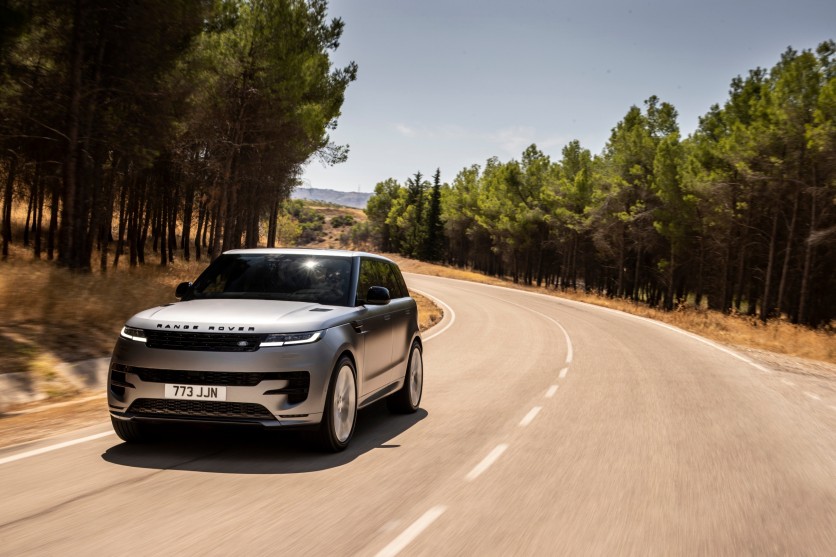
Jaguar Land Rover gave the first public look at its Range Rover Sport Electric at a private preview during the Goodwood Festival of Speed on July 16, 2026, confirming the model as its second all-electric vehicle and setting expectations for a September 2026 on-sale date — though JLR has not officially confirmed that timeline, and the full specification package will not be disclosed until a formal reveal later this year. The prototype was driven through a series of challenges on the Goodwood Motor Circuit, with ride impressions from journalists on hand suggesting the electric powertrain may actually improve on the dynamics of the combustion-engined Sport — but the headline charging speed that makes the vehicle technically impressive in brochure terms is one most buyers will not be able to use at the locations where they actually stop to charge.
JLR had already used Goodwood to debut the full-size Range Rover Electric in production specification on July 9, and the Sport Electric preview one week later followed the same logic: this is real, this is coming. Range Rover's choice of venue carried deliberate weight — a car driven on the Goodwood Motor Circuit, in front of media and public alike, is understood by the automotive industry to be a production-bound vehicle, not a design study.
The preview paid deliberate homage to the Sport's heritage of high-profile performance stunts — including a 999-step staircase ascent at China's Heaven's Gate and the climb of an Icelandic spillway — by running the prototype through driven challenges on the Goodwood circuit.
Read more: Range Rover Electric Debuts at Goodwood: 800V Charging, One Key Trade-Off
Goodwood Preview Puts Prototype on Track
Martin Limpert, Range Rover's Managing Director, said the electric powertrain brings a new edge to Range Rover Sport, describing the Goodwood appearance as "only a glimpse of how this model will redefine performance SUVs again later this year."
What Limpert did not bring to Goodwood was a complete specification sheet. JLR's official press release confirmed the vehicle's existence and forthcoming arrival and nothing more, stating that "further details of Range Rover Sport Electric will be announced later this year."
Same Platform, Estimated Specs — Not Yet Official
The technical picture comes primarily from third-party automotive reporting rather than from JLR directly, and it should be read that way. Based on what Range Rover has confirmed — that the Sport Electric shares the same platform, twin-motor setup, and battery pack as the full-size Range Rover Electric — automotive outlets including Zecar and Autocar India have assembled the following estimated specification profile.
The Sport Electric is expected to use the same 118.5 kWh double-stacked prismatic nickel-manganese-cobalt battery pack as the full-size model, an 800V electrical architecture capable of up to 350 kW DC fast charging, two in-house developed permanently excited synchronous motors producing a combined estimated 404 kW (542 hp) and 850 Nm of torque at all four wheels, and a range in the region of 530 km (approximately 330 miles) under the WLTP test cycle. None of these figures has been officially confirmed by JLR for the Sport Electric variant. Autocar India reported the output figure as "550hp" — a rounded version of 542 bhp.
JLR has confirmed only that the Sport Electric will use "the same platform and powertrain" as the full-size Range Rover Electric, and that "exact outputs for the Sport Electric have not been released."
The battery's double-stack configuration is a direct consequence of platform geometry: the Range Rover's elevated ride height provides vertical packaging space unavailable in lower-slung vehicles, allowing twice the number of prismatic cells to be stacked vertically into a floor-mounted pack without compromising ground clearance to a degree that undermines off-road capability. The Sport Electric weighs an estimated 2,700 kg per Autocar India — slightly less than the full-size model, reflecting its shorter body and smaller interior volume.
On the exterior, the Sport Electric is visually close to its combustion siblings. The front grille is narrowed rather than eliminated, wheel designs are optimized for aerodynamic efficiency, and subtle EV badging on the wheel hubcaps signals the powertrain change. Inside, the cabin carries over from existing Range Rover Sport models, including the 13.1-inch central touchscreen and 13.7-inch driver display, with EV-specific screens added. Notably, there are no regen paddles on the steering wheel; the drive selector's "S" position — formerly Sport mode — now activates single-pedal drive.
What the 800V Architecture Actually Means in Practice
The 800V electrical architecture is the engineering centerpiece of JLR's electric Range Rover program, and it is worth understanding what it does — and where its limits are.
An 800V system charges faster than a 400V system because electrical power equals voltage multiplied by current. At twice the voltage, the same charging rate can be achieved at half the current, which halves resistive heating losses in the cables and cells and allows faster peak charging without requiring heavier wiring or more aggressive battery cooling. JLR designed its 800V system entirely in-house, attaching 67 patents to the Range Rover Electric's development, rather than sourcing an available Tier 1 system — a decision that added approximately one year to the development timeline but produced a proprietary architecture competitors cannot replicate from existing supply chains.
The practical ceiling for that architecture, on the current estimate of shared specs, is 350 kW DC fast charging — enabling a 10-to-80% charge in approximately 20 minutes at a compatible ultra-rapid charger. The caveat is structural: ultra-rapid chargers capable of delivering 350 kW represent a minority of total public charging points in the UK, European Union, and United States as of mid-2026. A buyer who parks near a standard 50 kW fast charger — the most common type at UK motorway services as of this writing — will wait considerably longer than 20 minutes. JLR's 800V design does include a solution for 400V charger compatibility: it splits the battery pack into two 400V banks that charge in parallel, so the car is not left stranded at non-ultra-rapid infrastructure, but the speed advantage disappears.
The Sport Electric is also expected to support 22 kW AC charging, which covers home charging and most destination chargers, with charging ports on both sides of the vehicle — a practical convenience for forecourt layouts.
How Is the MLA Platform Different From JLR's Newer Architecture?
JLR's electrification strategy runs on two distinct platform philosophies. The Modular Longitudinal Architecture (MLA) that underpins both Range Rover Electric models was originally designed to support combustion, mild-hybrid, plug-in hybrid, and fully electric powertrains from the outset, making it a transitional architecture — purpose-built to allow JLR to electrify its flagship nameplate without replacing the entire production line. The payoff is manufacturing flexibility and cost efficiency; the tradeoff is drivetrain efficiency: the MLA-based BEV achieves approximately 85% drivetrain efficiency, versus 92% for vehicles on JLR's newer Electrified Modular Architecture (EMA), which was designed from scratch for battery-electric use and uses a native 800V system with no legacy combustion provisions per prior TechTimes reporting.
EMA will underpin JLR's next wave of electrified models, including a Range Rover Velar-style coupe-SUV and vehicles in the Defender family. JLR has since expanded EMA to support full hybrid (HEV) powertrains as well as pure BEV — a strategic move that widens the platform's commercial flexibility while signaling that JLR is not committing fully to a BEV-only path, as Electrive reported in June 2026.
Five Powertrains, One Nameplate
The Sport Electric's arrival completes a five-powertrain lineup for the Range Rover Sport nameplate: diesel, six-cylinder petrol, mild-hybrid V8 petrol, plug-in hybrid, and fully electric — a breadth of options that few luxury SUVs match and one that gives JLR significant regulatory flexibility across markets with different electrification timelines, as confirmed in the official Goodwood press release.
The move follows the full-size Range Rover Electric, which had accumulated more than 78,000 interest registrations as of JLR's Investor Day on June 17, with over 16,000 of those described as having progressed to a more formal waiting list position. JLR CEO PB Balaji described the Sport Electric as one of five EV launches planned for the next 18 months, alongside two EMA-platform models and the Jaguar Type 01 grand tourer, which is expected to enter production in August 2026, per TechTimes coverage of the Investor Day.
The broader context for that pipeline is sobering: JLR's retail sales fell 15.3% year-on-year in Q1 FY27, and the company is still in the financial recovery phase from the August 2025 cyberattack that the Cyber Monitoring Centre estimated cost the UK economy approximately £1.9 billion, halting JLR's production across Solihull, Halewood, and Wolverhampton for several weeks. The five-launch pipeline is a growth bet placed by a company that has not yet recovered to its pre-attack volume, which makes execution on the Sport Electric's reported September timeline a meaningful test of JLR's operational recovery.
Read more: Range Rover Electric Confirmed for Late 2026 Launch With 76,976 on Waitlist
Pricing, Timing, and What Remains Unconfirmed
Autocar India, citing sources, reported that the Range Rover Sport Electric will go on sale globally in September 2026. JLR's official press release did not confirm this date. First customer deliveries may follow in early 2027 depending on production ramp-up pace.
UK pricing is similarly reported rather than official: Autocar put the expected starting price at approximately £100,000 — roughly £50,000 below the full-size Range Rover Electric's estimated opening price of £150,000, and roughly £30,000 above the current Range Rover Sport PHEV. In the US market, a starting price near $100,000 has been cited by analysts covering the JLR product pipeline.
The vehicle will compete primarily against the Porsche Cayenne Electric and the upcoming BMW iX5 in the large luxury electric SUV segment — a comparison that will be difficult to draw precisely until JLR releases official performance figures, WLTP range, and towing capacity for the Sport Electric specifically. The towing figure is one of the more decision-relevant unknowns: the full-size Range Rover Electric's towing capacity is confirmed at 2.5 tonnes, down from 3.5 tonnes for combustion and plug-in hybrid variants, due to the physical constraints of the battery pack occupying packaging space that the combustion drivetrain's layout used for heavy tow-point engineering. Whether the Sport Electric carries the same 2.5-tonne figure, or a different one given its shorter body and different packaging geometry, has not been stated.
A confirmed ride impression from a journalist who sampled the prototype at Goodwood described the Sport Electric's ride quality as potentially superior to the ICE-powered Sport, with smooth, brisk performance, though a hint of torque steer was noted under hard acceleration — an expected characteristic given the twin-motor AWD system's front-axle torque delivery. Single-pedal drive proved effective in off-road scenarios, where the precision of electric motor torque response — reacting in approximately one millisecond versus the 100-millisecond response window of ABS-based combustion traction systems — gives a meaningful capability advantage on loose surfaces.
Full specifications, confirmed pricing, and order book opening are expected when JLR formally reveals the production Range Rover Sport Electric later in 2026.
Frequently Asked Questions
When will the Range Rover Sport Electric go on sale?
Autocar India reported an expected global on-sale date of September 2026, with the India market following by March 2027. JLR's official Goodwood press release did not confirm this date, stating only that "further details will be announced later this year." First customer deliveries may follow in early 2027 depending on production scheduling. Order books are expected to open alongside the full formal reveal.
How long does it take to charge the Range Rover Sport Electric, and does it matter where you charge?
Based on estimated specifications carried over from the full-size Range Rover Electric, the Sport Electric is expected to support up to 350 kW DC fast charging, enabling a 10-to-80% charge in approximately 20 minutes at a compatible ultra-rapid charger. The critical caveat is infrastructure: ultra-rapid chargers capable of 350 kW remain a minority of total public charging installations in the UK, EU, and US as of mid-2026. At a standard 50 kW fast charger — the most common type at UK motorway services — the same charge would take substantially longer. The 800V system includes 400V charger compatibility by splitting the battery into two parallel banks, so the car is usable at conventional fast chargers, but the speed advantage is only realized where 800V infrastructure is actually present.
How does the Range Rover Sport Electric compare to the Porsche Cayenne Electric and BMW iX5?
A precise comparison will not be possible until JLR releases official figures. Based on estimated specs, the Sport Electric would enter the large luxury electric SUV segment at approximately £100,000 in the UK — broadly similar to the Cayenne Electric's entry point — with twin-motor AWD, 118.5 kWh of estimated battery capacity, and a target range around 330 miles WLTP. The BMW iX5 is a newer entrant expected in the UK by mid-2027, and is expected to weigh approximately 2,500 kg versus the Sport Electric's estimated 2,700 kg. The defining differentiator is JLR's 800V charging architecture, designed in-house, versus Porsche's own 800V system (shared across the Cayenne Electric and Taycan) and BMW's 400V architecture on earlier iX models. Both the Cayenne Electric and the Sport Electric compete in a segment where real-world capability, off-road credentialing, and charging network access matter as much as peak output figures.
What is the Sport Electric's towing capacity?
JLR has not confirmed the towing capacity for the Sport Electric. On the full-size Range Rover Electric, the battery pack's physical envelope reduces maximum towing from 3.5 to 2.5 tonnes compared with combustion and PHEV variants — a structural constraint that cannot be resolved through software. Whether the Sport Electric carries the same limit, or a different one given its shorter wheelbase and different packaging geometry, has not been stated and will be confirmed at the formal reveal later in 2026.

-
 C114 Communication Network
 -
 Communication Home
