
 Search

Normalcomputing.com
Artificial intelligence has a power problem. Data centers worldwide are projected to consume 565 terawatt-hours of electricity in 2026 — up 26 percent from the prior year — and AI workloads now account for roughly 31 percent of that total, a share that will surpass conventional server consumption within two years, according to Gartner. Every generative model that produces text, an image, or a video runs on silicon chips that spend enormous energy doing one specific thing: fighting thermal noise, the random jitter of electrons that any standard transistor must suppress to function reliably.
Two new peer-reviewed studies published this year propose inverting that logic entirely. Instead of suppressing thermal noise, use it to do the computing.
The approach, called thermodynamic computing, crossed a significant credibility threshold this week when Quanta Magazine published a field-wide survey by science writer Philip Ball, covering peer-reviewed hardware results from startup Extropic, independent theoretical validation from Lawrence Berkeley National Laboratory, and silicon-chip progress from New York startup Normal Computing. The Quanta article drew on a paper published in early July 2026 in npj Unconventional Computing by researchers at Extropic and MIT, and a Physical Review Letters study published in January 2026 by Berkeley's Stephen Whitelam. The efficiency figures in both papers are projections from simulations, not measurements from finished hardware — a distinction the researchers state clearly and the article returns to repeatedly.
But the convergence of peer-reviewed results from national lab physicists, MIT collaborators, and venture-backed engineering teams represents something the broader computing industry has not seen before from this field: evidence organized enough to be judged.
Why Generative AI and Thermodynamic Physics Share the Same Math
Here is the connection the press releases do not highlight: the mathematics underlying modern AI image generation and the mathematics underlying thermodynamic computing are not merely compatible — they are, in deep structure, identical.
Modern diffusion models — the technology behind AI image generators — work by learning to reverse a process of progressive noising. A training image is corrupted step by step into random static, and the model learns to reconstruct the original by tracing that corruption backward. This framework, formalized as reverse Langevin dynamics, is named for the early-20th-century French physicist Paul Langevin, whose equations describe how physical systems move under a combination of systematic force and random thermal jitter.
Thermodynamic computers operate under exactly those equations. They are physical systems that move under systematic coupling forces and random thermal noise — which means that running a diffusion-like generative model on thermodynamic hardware is not an adaptation of the technology to a foreign task. It is the hardware doing what it physically is.
Whitelam's Physical Review Letters paper makes this explicit: his thermodynamic computer was trained by maximizing the probability that the circuit would generate the reverse of a noising trajectory. The result was a circuit that could reconstruct Paul Langevin's face from static — the physicist whose equations described the fluctuations the circuit was running on. If realized in analog hardware, Whitelam writes, such a system would generate structured outputs from noise without externally injected randomness or active control.
What the Whitelam Paper Actually Claims
The efficiency figure that has circulated most widely — that a thermodynamic computer dissipates roughly 100 billion times less heat than an equivalent digital neural network performing the same task — comes from Whitelam's Physical Review Letters paper, described by the American Physical Society as demonstrating "eleven orders of magnitude better efficiency." That number deserves careful reading.
Whitelam trained a network of connected nodes, with adjustable coupling strengths, on a video of Paul Langevin's face being progressively corrupted into static. He then showed that the trained network could start from the static and recover Langevin's face. The 100-billion figure represents a theoretical calculation of how much heat a physical implementation of that network would dissipate, compared to how much a digital neural network doing the same task would dissipate — not a measurement of any running hardware. The thermodynamic computer in Whitelam's experiment was a simulation running on a conventional computer.
What the paper does demonstrate — concretely and with peer review — is that the training framework works, that the physics predicts massive efficiency advantages, and that the algorithm is generative in both directions: it reconstructs known images from noise, and it generates new images it has not seen. "My algorithm is generative in two ways," Whitelam told Quanta Magazine. "First, it turns noise into structure, thereby generating order from disorder. Second, if you train it on a set of images, then it can generate additional images that it hasn't seen before."
His honest assessment of where the field stands: "The computer designs we've come up with so far [for thermodynamic computing] are only as capable as the small digital neural networks of around 1990. The history of AI suggests that it should be possible to do better with larger circuits and more training — but that remains to be seen."
How the Hardware Actually Works: RLC Resonators and the Matrix Inversion Trick
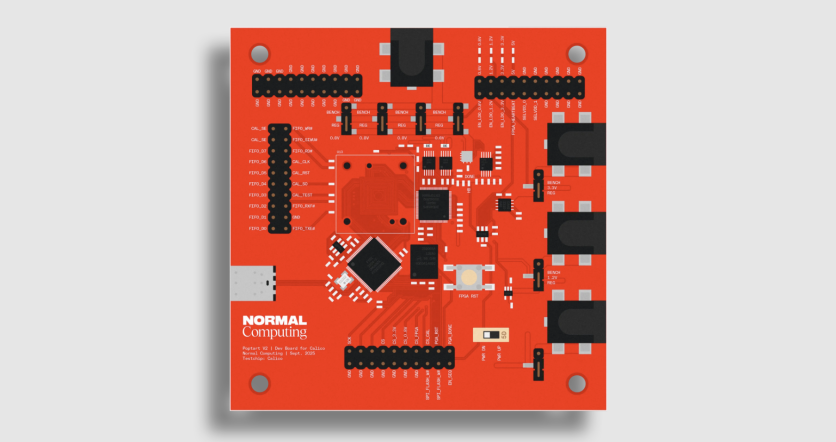
Normal Computing's 2025 Nature Communications paper provides the clearest explanation of how the core hardware mechanism functions. The company — founded in 2022 by Faris Sbahi, Antonio Martinez, and Matthias Tan, former members of Google X and Google Brain — built a custom circuit board containing eight clusters of RLC resonators: components made from a resistor, a capacitor, and an inductor.
An RLC resonator oscillates at a characteristic frequency. Couple several together in a network, and the coupling strength between each pair can be tuned to represent a number — specifically, an entry in a mathematical matrix. Now drive the network with noise. What happens?
The equilibrium fluctuations of the driven network correspond to the mathematical inverse of the coupling matrix. "So you can build your device and come back sometime later and measure its fluctuations, and you've done matrix inversion," Whitelam explained to Quanta Magazine. No algorithm. No matrix multiplication. Physics produces the answer.
Matrix inversion is foundational to machine learning, computer graphics, engineering simulation, and financial modeling. A chip that performs it through physical fluctuation rather than digital computation — if it could do so at speed and at scale — would be useful across a wide range of technical fields.
The immediate caveat: ambient thermal noise at room temperature is too small to drive Normal's prototype circuits. The researchers had to inject synthetic noise using a random-number generator, which itself consumes energy. The Quanta article notes that this overhead diminishes as systems scale — and that the energy advantage of thermodynamic computation becomes decisive at sufficient scale. Whether "sufficient scale" arrives before the overhead outweighs it remains the field's central engineering question.
Extropic's Architecture: Sampling Without Matrix Multiplication
Where Normal's initial prototype was an analog circuit board, Boston startup Extropic — founded in 2022 by engineers from Google, IBM, Apple, and Microsoft — has been building what it calls thermodynamic sampling units (TSUs): semiconductor components designed to produce samples from a programmable probability distribution, rather than to execute deterministic Boolean logic.
The architectural distinction is specific. A conventional AI inference pipeline on a GPU computes a vector of probabilities, then draws a sample from that vector — two separate operations, both energy-intensive. Extropic's TSU hardware bypasses the computation step entirely. It takes parameters specifying an energy function — a mathematical description of the shape of a probability distribution — and directly samples from the corresponding distribution. High-energy states are unlikely outcomes; low-energy states are likely ones. The physics of the circuit does the sampling.
In early July 2026, Extropic and MIT quantum information scientist Isaac Chuang published a paper in npj Unconventional Computing describing what they call a Denoising Thermodynamic Computer Architecture (DTCA). Because a complete thermodynamic computer does not yet exist, the researchers evaluated the design using GPU simulations informed by measurements from an experimental hardware random-number generator. The benchmark: Fashion-MNIST, a standard image-generation dataset widely used in machine learning research. The simulated architecture produced results comparable in image quality to GPU-based approaches while requiring an estimated 10,000 times less energy per generated sample. The researchers are explicit that this figure represents projections from a physical energy model, not measurements from a finished system.
Extropic's XTR-0, its first hardware research platform, was announced in October 2025 for early beta testing with partners. The DTCA paper represents the company's first peer-reviewed architecture result.
Normal Computing's Silicon Chip and What It Can and Cannot Do
In August 2025, Normal Computing announced the tape-out of CN101, described as the first thermodynamic computing chip on silicon. The chip implements what Normal calls its Carnot architecture, targeting AI inference, linear algebra, and diffusion model sampling workloads. Normal projects up to 1,000 times better energy efficiency on targeted tasks compared to conventional approaches, along a roadmap that runs through CN201 and CN301 by 2027 to 2028.
The Quanta Magazine article is careful to note that the CN101 "has yet to be assessed by other experts." Unlike the RLC circuit board of the earlier prototype, CN101 uses digital processing on silicon — meaning it processes thermodynamic computations in a digital representation, rather than being literally driven by thermal fluctuations. Zachary Belateche, Normal's silicon engineering lead, has described the target algorithm space broadly in an interview with IEEE Spectrum: "everything from scientific computing to AI to linear algebra." Normal's own roadmap blog post characterizes CN101 as a test chip with relatively low-speed I/O interfaces, designed to de-risk key engineering challenges and characterize how random processes behave on real silicon.
Patrick Coles, Normal's chief scientist, has outlined the commercial ambition directly: "Our vision to scale diffusion models with our stochastic hardware starts with demonstrating key applications on CN101 this year, then achieving state-of-the-art performance on medium-scale GenAI tasks next year with CN201, and finally achieving multiple orders-of-magnitude performance improvements for large-scale GenAI with CN301 two years from now," according to the company's press release.
Can Thermodynamics Compete With GPUs?
The benchmark that thermodynamic computing must clear is not the one the field has been running. Demonstrating that thermal fluctuations can solve matrix inversion in an eight-node circuit, or that a simulation of thermodynamic hardware matches GPU quality on Fashion-MNIST, is not the same as demonstrating that thermodynamic hardware can compete with a modern GPU on a production inference workload — in speed, in generality, in programmability, and in cost.
The quantum computing comparison is instructive and carries a warning. Normal's 2025 Nature Communications paper draws the analogy explicitly: "The field of thermodynamic computing is in its early days, 'analogous to when small-scale quantum computers were built in the 1990s.'" Quantum computing is now a global industry estimated at around $12 billion — but the path from 1990s proof-of-concept to commercial relevance took three decades and tens of billions of dollars of investment, and practical general-purpose quantum advantage over classical hardware remains elusive for most workloads. Thermodynamic computing proponents argue, with some justification, that the lower engineering barriers — no cryogenic cooling, no quantum coherence to maintain, standard CMOS fabrication — make a faster path plausible.
Kunihiko Kaneko, a complex-systems theorist at the Niels Bohr Institute in Copenhagen, offered a more measured assessment to Quanta: the central idea of harnessing thermodynamic fluctuations instead of suppressing them "is indeed thought-provoking," but "whether this effectively translates to computing in a biological context remains an open question."
The field's most honest scorecard today: the physics is credible and peer-reviewed; the hardware is early and largely uncharacterized; the efficiency advantages are theoretically enormous and practically undemonstrated at scale; and the target application — generative AI inference — is, uniquely among computing workloads, mathematically matched to the substrate.
Does Thermodynamic Computing Have a Real Shot Against GPUs?
The question the field will answer over the next three to five years is whether thermodynamic computing can clear three thresholds simultaneously: raw performance on real inference workloads, programmability across problem types, and fabrication cost that competes with established GPU supply chains.
None of those thresholds has been cleared. Normal Computing's CN101 is being characterized now, with performance results pending. Extropic's DTCA exists as a peer-reviewed architecture but not as a finished chip. Whitelam's theoretical framework is confirmed as elegant and the efficiency calculation is peer-reviewed — but the hardware that would realize it has not been built.
What has changed, as of this week, is the evidential basis for taking the field seriously. A researcher at Lawrence Berkeley National Laboratory has published in Physical Review Letters that the training framework works and the physics predicts massive efficiency gains. A team at Extropic and MIT has published in npj Unconventional Computing that a specific architecture — evaluated by GPU simulation informed by hardware measurements — projects 10,000 times lower energy per generated sample. And Quanta Magazine, which does not cover fringe work, has surveyed the field as a genuine scientific development.
The next milestone is straightforward to identify and hard to achieve: a thermodynamic chip running a production AI workload on real hardware, with efficiency measured rather than projected. That result, whenever it comes, will tell the industry whether the decades-long war on thermal noise was, in fact, a failure of imagination — or the correct engineering instinct all along.
Frequently Asked Questions
What is thermodynamic computing and how is it different from quantum computing?
Thermodynamic computing uses the random thermal fluctuations that naturally occur in any electrical circuit — the same noise that conventional computer engineers spend enormous effort suppressing — as the actual substrate of computation. Instead of switching bits at energies thousands of times above the thermal noise floor, thermodynamic circuits operate at energy scales comparable to thermal fluctuations and let the resulting dynamics explore solution spaces. The key practical difference from quantum computing: thermodynamic computing requires no cryogenic cooling, no delicate quantum coherence, and can be implemented on standard semiconductor fabrication equipment. It operates at room temperature (or near it) and uses classical physics rather than quantum effects. Quantum computing's advantage lies in specific mathematical problems where quantum superposition provides exponential speedup; thermodynamic computing's advantage is targeted at probabilistic AI inference — generative models, sampling, Bayesian reasoning — where its physical dynamics are structurally matched to the computation.
Why are the efficiency claims so large, and should readers trust them?
The 10,000x and 100-billion-times figures represent theoretical projections from physical energy models and digital simulations, not measurements from running hardware. Both research teams — Extropic/MIT in npj Unconventional Computing and Whitelam in Physical Review Letters — are explicit about this distinction in their papers. The physics underlying the projections is peer-reviewed and credible; the projections themselves assume that circuits can be built that operate at or near the thermodynamic limit of energy efficiency, with minimal overhead from injected noise, cooling, or control hardware. Whether real fabricated chips achieve anywhere near those figures at useful scales is the central open question. The honest summary: the theoretical case is strong; the engineering case has not yet been made on production hardware.
What does this mean for data centers and AI energy costs right now?
Nothing — in the near term. Thermodynamic computing chips are not commercially available, and the most advanced hardware (Normal Computing's CN101) is still in the characterization phase, with results pending independent expert review. The Gartner forecast of 565 terawatt-hours of data center electricity consumption in 2026 — driven by AI-optimized servers that will account for 31 percent of that total — will not be affected by thermodynamic computing on any near-term timeline. What the new peer-reviewed results do is establish a credible scientific foundation for the efficiency claims, raising the probability that the field produces commercially useful hardware before the end of the decade. For decision-makers at hyperscalers and AI hardware companies, the implication is that thermodynamic computing deserves tracking as a candidate inference-acceleration technology in the 2028-2030 planning horizon.
Does thermodynamic computing only work for AI, or is it more general?
The physics is general — thermodynamic circuits performing matrix inversion, for example, would be useful in engineering simulation, financial modeling, and computer graphics, not just AI. Normal Computing's CN101 targets linear algebra and sampling workloads as well as diffusion model inference. The reason AI — specifically generative AI — is the primary commercial focus is that the mathematics of diffusion models and the mathematics of thermodynamic computation are structurally identical: both are formalizations of Langevin dynamics. This means thermodynamic hardware is not merely useful for diffusion model inference; it is, in a precise physical sense, the natural hardware for it. For deterministic workloads — sorting, classification, database operations — thermodynamic computing provides no advantage over conventional digital chips and is unlikely to be competitive.

-
 C114 Communication Network
 -
 Communication Home
