
 Search

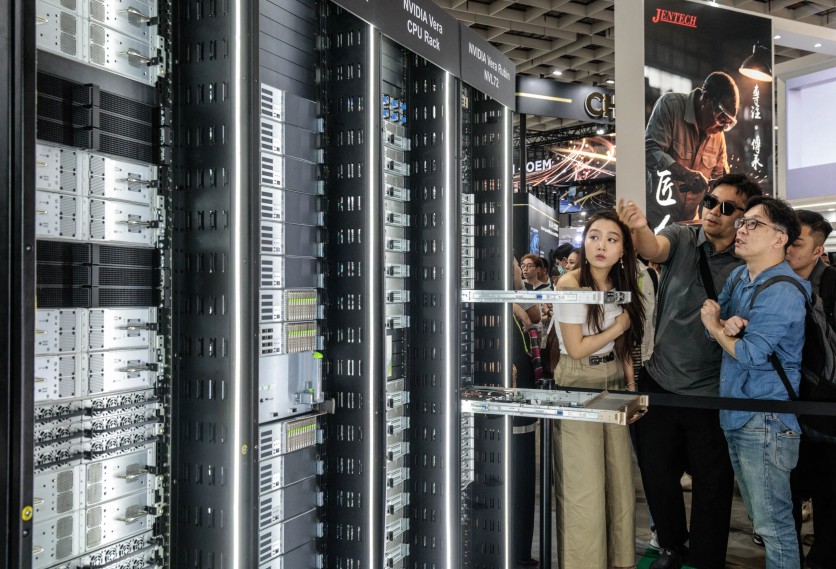
Visitors look at Wiwynn's AI data centre reference architecture display during Computex in Taipei on June 2, 2026. CHENG Yu-chen/AFP via Getty Images
Computex 2026 closed in Taipei on June 5, setting a record in the show's 45-year history as organizers confirmed 111,312 buyers and visitors from 152 countries attended across four days — the largest turnout since the show's founding in 1981. The final figures land at a moment when the event has structurally outgrown its origins as a PC hardware trade fair: every major silicon announcement at the 2026 edition was framed around agentic AI infrastructure, physical robotics deployment, and the compute platforms needed to sustain them both.
The show drew exhibitors from 1,500 companies across 33 nations, spread across 6,000 booths at Taipei Nangang Exhibition Center Halls 1 and 2 and Taipei World Trade Center Hall 1. Taipei Computer Association Chairman Jason Chen told attendees at the opening ceremony that "AI is rapidly moving from an innovation showcase to real-world deployment" — a framing the product lineup backed up across four days of announcements.
Nvidia Enters PC Market With RTX Spark SoC, Targeting Apple Silicon
The single most structurally consequential announcement of the week was Nvidia's entry into the Windows PC processor market. CEO Jensen Huang unveiled the RTX Spark Superchip at his June 1 keynote at the Taipei Music Center — the first time Nvidia has designed a processor for consumer Windows devices.
The RTX Spark is a two-chiplet system-on-chip fabricated on TSMC's 3-nanometer process: a Blackwell GPU die carrying 6,144 CUDA cores (equivalent to a discrete RTX 5070) paired with a MediaTek-designed CPU and I/O die housing 20 Arm cores (10 high-performance Cortex-X925 cores and 10 efficiency-class Cortex-A725 cores). The two dies connect via NVLink C2C, a chip-to-chip interconnect that sustains 600 GB/s of bandwidth — higher than the latest PCIe standards — enabling the GPU and CPU to share up to 128 GB of unified LPDDR5X memory at 300 GB/s. That memory pool is large enough to run 120-billion-parameter large language models locally. AI inference throughput reaches one petaflop of FP4 performance.
The architecture's central design decision is unified memory. Unlike a discrete GPU configuration, where the CPU and GPU maintain separate memory spaces requiring explicit data transfers, the RTX Spark treats all 128 GB as a single coherent pool accessible at full bandwidth by both processors. That removes a major bottleneck for agentic workloads, where an AI agent alternates rapidly between language model inference, tool calls, and code execution — tasks that, on a discrete GPU system, would require copying data across a PCIe bus.
A genuine constraint exists: Windows on Arm cannot emulate kernel-mode drivers, which means games that rely on anti-cheat software operating at the kernel level may not run correctly on RTX Spark hardware. Competitive multiplayer titles represent a meaningful share of the premium PC gaming market; buyers in that segment should verify compatibility before committing to an RTX Spark device. Systems from ASUS, Dell, HP, Lenovo, Microsoft, and MSI are scheduled to ship in fall 2026.
Intel 18A Arrives in Production: RibbonFET and PowerVia in the Data Center
Intel used Computex to formally complete a milestone it had been working toward for three years: placing a shipping data center processor on its 18A process node. The Xeon 6+ "Clearwater Forest" family — officially launched June 2 — is the first data center CPU with compute tiles manufactured on Intel 18A, putting the node into production hardware available through Dell, HPE, Lenovo, and Supermicro.
Intel 18A combines two manufacturing innovations that distinguish it from the FinFET architecture that dominated chip production since 2011. The first is RibbonFET — Intel's implementation of gate-all-around transistor technology, in which the gate electrode wraps around all four sides of the silicon channel rather than three sides as in FinFET. The four-sided enclosure provides better electrostatic control over current flow, reducing leakage and enabling the transistors to run at lower supply voltages. Intel reports a 15% improvement in performance per watt compared to its prior Intel 3 node.
The second is PowerVia — the industry's first production implementation of backside power delivery. In conventional chip designs, power delivery wires and signal routing lines share the same side of the silicon wafer, competing for space and generating resistive voltage drops (IR drop) that reduce efficiency. PowerVia moves the entire power network to the wafer's back face, leaving the front face exclusively for signal routing. Intel measures a 5–10% improvement in cell utilization and a 4% ISO-power performance gain from the separation.
Clearwater Forest itself is a chiplet design: the compute tiles containing 288 Darkmont E-cores (576 MB of last-level cache, PCIe Gen 5, Intel SGX and TDX confidential-compute support) are built on 18A, while other components use a different process node in a disaggregated packaging arrangement. A supply caveat applies: Intel has targeted customer sampling for the second half of 2026, and broader availability is expected to follow. Looking further ahead, Intel confirmed at the show that its next-generation Xeon 7 "Diamond Rapids" — planned for 2027 — will run on a refined 18A-P node that adds high-NA EUV lithography and a second-generation RibbonFET, projecting a roughly 50% increase in core count and double the memory bandwidth of the current generation.
AMD Locks AM5 Support Through 2029, Betting Longevity Against Intel
AMD arrived at Computex with a platform message rather than a flagship processor launch. The company announced that its AM5 desktop socket — introduced in 2022 alongside the first Zen 4 processors — will receive new Ryzen CPUs through at least 2029, extending a prior "2027 and beyond" commitment by dropping the hedging qualifier for the first time. The commitment implies at least one additional CPU microarchitecture, expected to be Zen 6, will launch on the same socket without requiring a motherboard replacement.
The longevity pledge matters because AMD's platform advantage is structural: AM5 currently supports three Ryzen generations (Zen 4, Zen 5, and forthcoming products), and a buyer who purchased an AM5 motherboard in 2022 can upgrade their processor through the end of the decade. Intel, which has historically cycled to new sockets after one or two processor generations, has indicated it intends to extend platform support windows — but has not committed to comparable timelines. AMD also introduced EXPO Ultra Low Latency, a new memory certification standard for tighter DDR5 timing profiles, with certified kits from G.Skill, Kingston, TeamGroup, and XPG expected in mid-June 2026.
On the product side, AMD launched the Ryzen 7 7700X3D — an 8-core processor with 3D V-Cache stacking — for AM5 at $329, scheduled to become available July 16, 2026. To mark the tenth anniversary of the AM4 platform, the company also brought back a fresh production run of the Ryzen 7 5800X3D for AM4 at $349, releasing June 25, 2026.
Physical AI Robotics Zone Debuts as €430 Billion Market Takes Shape
The most substantive programming change at Computex 2026 relative to prior editions was the dedication of Taipei World Trade Center Hall 1 entirely to an inaugural AI Robotics Zone — aggregating supply-chain players across embodied AI, robotics hardware, and systems integration in a single location for the first time in the show's history. The timing corresponds with a commercial inflection that market analysts are beginning to quantify: a March 2026 study from Strategy& (part of PwC) projects the global Physical AI systems market will reach approximately €430 billion by 2030, with automotive applications accounting for roughly €171 billion of that total, followed by industrial automation and warehousing. The firm defines Physical AI as systems capable of autonomously controlling real-world devices and machines — vehicles, industrial robots, and infrastructure components — rather than generating purely digital outputs.
The COMPUTEX Forum ran six thematic tracks across the four days — covering AI computing, robotics, data governance, edge infrastructure, enterprise adoption, and commercialization strategy — drawing more than 13,200 session visits from the assembled buyers and exhibitors. The keynote stage convened four chief executives: Qualcomm's Cristiano Amon, Marvell's Matt Murphy, Intel's Lip-Bu Tan, and NXP's Rafael Sotomayor, collectively representing silicon platforms that span mobile, data center, automotive, and industrial compute.
InnoVEX Reaches 500 Startups as Robotics Foundation Model Takes Prize
The InnoVEX startup platform ran concurrently with the main show and reached its own milestone: more than 500 startup participants from 23 nations, an increase of more than 11% from the 2025 edition. Taiwan, Japan, and South Korea led participation by country. First-time partnerships with Plug and Play Taiwan — one of the world's largest open-innovation accelerators — and Japanese organizer Everidge added structure to the international pipeline, and nine national pavilions were present, including France, South Korea, Japan, Israel, Australia, Canada, Italy, and the Czech Republic.
The InnoVEX Pitch Contest — which packages access to capital, cloud computing resources, and enterprise validation as a single competitive format — awarded its grand prize from a $60,000 pool to RLWRLD, a startup developing what it describes as a Robotics Foundation Model — an attempt to build the equivalent of a general-purpose large language model for physical robotic systems. The award outcome signals where the innovation investment community believes Physical AI's most valuable infrastructure layer will be built.
What Computex 2026 Numbers Mean for Technology Procurement
The final figures — 111,312 attendees, 1,500 exhibitors across 33 nations, six forum tracks — carry a meaning beyond event statistics. Computex was founded in 1981 as a buyer-facing showcase for Taiwan's PC components industry. Taiwan's current position in the global technology stack — TSMC's role in manufacturing the most advanced silicon for AI training and inference, the island's dominant position in server ODM supply chains, and its dense ecosystem of memory, power management, and thermal management suppliers — has transformed the show's character from component fair to AI infrastructure forum.
For technology buyers, the show produced three concrete inputs for near-term procurement decisions: AMD AM5 motherboards are safe investments through 2029; RTX Spark laptops will appear on shelves in fall 2026, with a kernel-mode driver limitation that affects competitive multiplayer games and should be confirmed before purchase; and Intel's 18A Clearwater Forest systems are available now for inference and agentic workloads through major server vendors but remain in limited sampling for the balance of 2026. Computex 2027 is scheduled for June 1–4 at Nangang Exhibition Halls 1 and 2 and TWTC Hall 1.
Frequently Asked Questions
What was announced at Computex 2026?
The four most significant hardware platform announcements were Nvidia's RTX Spark Superchip — the company's first Windows PC processor, combining a Blackwell GPU and an Arm CPU on TSMC's 3-nanometer process — Intel's Xeon 6+ Clearwater Forest, the first data center CPU with compute tiles on Intel's 18A process node, AMD's confirmation of AM5 socket support through 2029, and Qualcomm's Snapdragon C platform targeting $300 Windows laptops. The show also debuted an inaugural AI Robotics Zone and saw InnoVEX's startup platform surpass 500 participants from 23 nations for the first time.
What is the Nvidia RTX Spark chip, and when will devices ship?
The RTX Spark is a two-chiplet system-on-chip co-developed with MediaTek and Microsoft, combining a 6,144-core Blackwell GPU with a 20-core Arm CPU on TSMC's 3-nanometer node, delivering one petaflop of FP4 AI performance and up to 128 GB of unified memory. Devices from ASUS, Dell, HP, Lenovo, Microsoft, and MSI are scheduled to ship in fall 2026, with broader availability extending into early 2027.
When is Computex 2027?
Computex 2027 is scheduled to run June 1–4, 2027, across Taipei Nangang Exhibition Halls 1 and 2 and Taipei World Trade Center Hall 1 — the same venue configuration used in 2026.
Is AMD AM5 worth buying in 2026?
AMD confirmed at Computex 2026 that the AM5 socket will receive new Ryzen processors through at least 2029, extending a prior "2027 and beyond" commitment. The platform currently supports Zen 4 and Zen 5 processors, and the 2029 commitment implies at least one additional microarchitecture — expected to be Zen 6 — will remain on the same socket. Buyers who purchase AM5 hardware now will be able to upgrade their processor without replacing their motherboard for the remainder of the decade.

-
 C114 Communication Network
 -
 Communication Home
