
 Search

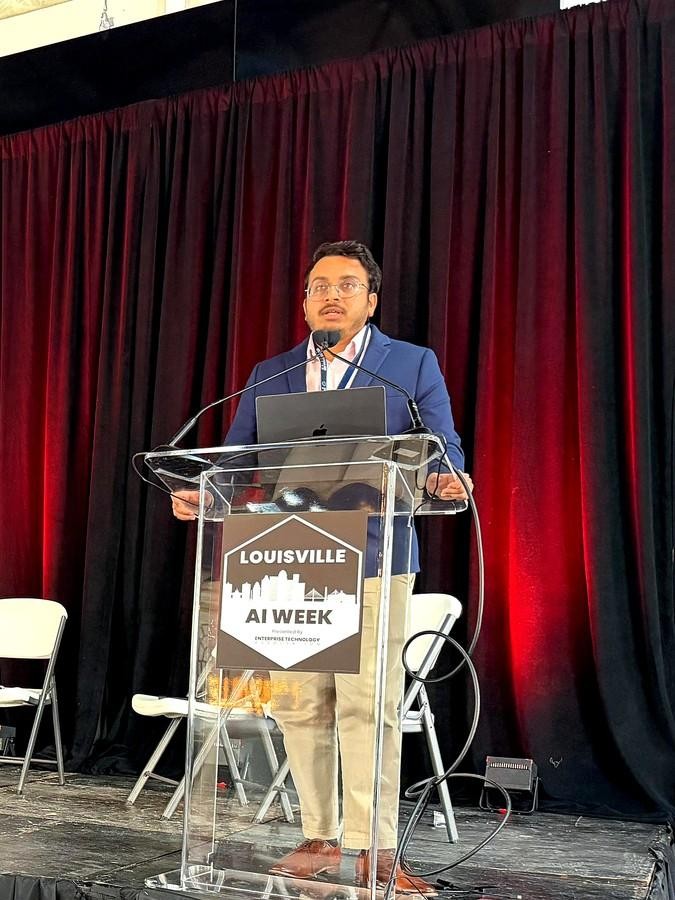
Tejas Pravinbhai Patel addresses the Main Stage at Louisville AI Week 2026, Kentucky International Convention Center, February 10–12, 2026
LOUISVILLE, Ky. — Inside the Kentucky International Convention Center on a cold February morning, the executives, engineers, and researchers gathered for Louisville AI Week 2026 kept circling back to one uncomfortable question: why do so many enterprise AI deployments that look impressive in the lab quietly fail in production?
The three-day event, held February 10 through 12, was produced by the Enterprise Technology Association under founder Zack Huhn. Its Main Stage was a curated handful of speakers selected to address the operational realities of AI deployment rather than the better-circulated narratives around foundation models or generative output. Organizers framed the selection process as an attempt to surface practitioners with verifiable production experience, a contrast to the open-submission model that has come to define much of the AI conference circuit.
Among the speakers on that stage was Tejas Pravinbhai Patel, a Senior Software Development Engineer at Amazon specializing in distributed systems and large-scale AI, who chairs the Irving Chapter of the Association for Computing Machinery (ACM). The Enterprise Technology Association's invitation cited three areas of expertise behind his selection: distributed systems, large-scale AI applications, and multi-agent systems architecture, the foundational engineering disciplines that determine whether a model running cleanly in development can survive an unpredictable production load.
Patel's selection reflected a broader shift visible across the program. Where AI conferences for the past three years have emphasized capability and benchmark performance, Louisville AI Week 2026 leaned into the operational layer, the pipelines, observability tools, coordination protocols, and architectural decisions that increasingly separate AI initiatives that scale from those that stall.
A Widening Gap Between Capability and Reliability
From the lectern, Patel argued that enterprise organizations continue to invest disproportionately in model development while neglecting the surrounding infrastructure. The result, he said, is a kind of operational debt that does not surface during pilot programs but becomes visible months after deployment, when telemetry gaps and coordination failures emerge under sustained load.
He described this dynamic, which he labeled the "harvest now, deploy later" pattern of AI procurements, as the central engineering challenge facing enterprise AI today, particularly as workloads transition from batch inference toward continuous, real-time decisioning. The economics of AI investment, he observed, have outpaced the discipline required to operate it.
Multi-agent systems, increasingly common in enterprise architectures, raise the stakes further. Patel addressed coordination failures, partial-outage cascades, and state-drift problems that appear in multi-agent environments under production pressure. These are not theoretical risks, he argued, but the active engineering frontier territory familiar to those who have actually built such systems and unfamiliar to many who write about them. He pointed to event-driven architectures, consensus protocols, and continuous observability as the practical instruments through which multi-agent systems can be made to evolve safely under changing conditions.
Trust as a System Property
A second thread running through Patel's remarks was the concept of trust at scale. Model accuracy, he said, is necessary but insufficient. Explainability, data lineage, operational resilience, and the capacity for graceful degradation together determine whether an AI system can be deployed in environments where automated decisions carry consequences. He framed metadata governance, system observability, and architectural discipline as the structural prerequisites for trustworthy intelligent systems, the means by which organizations track source data, monitor distributional shifts, and continually reassess fitness.
The argument matched the broader mood of the room. Attendees, many of whom hold infrastructure or platform engineering responsibilities at large enterprises, signaled in conversation between sessions that the past year has seen growing pressure from leadership to deliver AI outcomes without a corresponding investment in the underlying systems. Patel's framing that distributed infrastructure must be treated as a first-class engineering discipline for AI, not an afterthought registered as both a critique and a working agenda.
A Credentialed Voice, Presented without Elaboration
Patel's standing in the field was not a focus of his address, but it informed the weight given to his remarks. He has published more than thirty peer-reviewed papers indexed in IEEE Xplore on topics including LLM inference optimization, speculative decoding, GPU memory scheduling, multi-agent coordination, and fault-resilient distributed AI infrastructure. He has served as session chair at IEEE SoutheastCon 2026, peer-reviewed manuscripts for PLOS ONE and publications of the Association for Computing Machinery, and holds the rank of Distinguished Fellow of the Soft Computing Research Society. His chair position with ACM's Irving Chapter places him among the leadership of one of the world's largest scientific and educational computing societies.
These credentials inform the question of selection. The Enterprise Technology Association's invitation language that Main Stage participation was reserved for speakers capable of delivering "insightful, forward-looking, and practical content" to technology leadership audiences suggests a curatorial standard built around demonstrated production experience rather than visibility alone.
The Conference Circuit Moves Toward Operations
Louisville AI Week's emphasis on the operational substrate of AI is not isolated. Across recent industry conferences, the topics drawing the largest sessions have shifted from model architecture toward inference cost optimization, data platform design, and the engineering of agentic systems. Patel is scheduled to speak at The Data Science Conference in Chicago in May 2026, part of a schedule of IEEE conferences and industry events that itself reflects how the discipline is consolidating around a smaller group of practitioners who can speak with authority on both research and operations.
For the audience that traveled to Louisville, most of them representing the decision-making layer of enterprise AI investment, the practical question is no longer whether AI will be deployed but which architectural patterns hold up under real load, and which practitioners have the credibility to make the call. On both questions, the program's structure suggested an answer in progress.
About this report: Louisville AI Week 2026 was produced by the Enterprise Technology Association and held February 10–12, 2026, at the Kentucky International Convention Center in Louisville, Kentucky. Program details are available at joinaiweek.com.

-
 C114 Communication Network
 -
 Communication Home
