
 Search

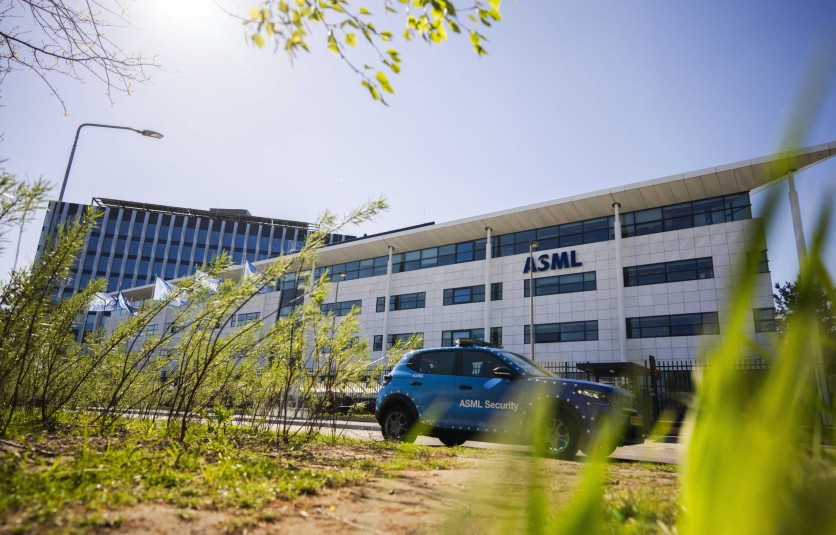
A private security vehicle drives outside Dutch tech giant ASML's corporate headquarters in Veldhoven during its general shareholders' meeting on April 22, 2026. Freek VAN DEN BERGH/ANP / AFP via Getty Images
China has commercially produced an immersion deep ultraviolet (DUV) lithography machine for the first time — but what changed on Monday was not what chips China can make. It was where China will buy the equipment to keep making them.
A state-backed Shanghai company, incorporating development teams from several Chinese firms including startup Shanghai Yuliangsheng Technology, has begun manufacturing immersion DUV lithography machines — the tightly controlled presses used to stamp circuit patterns onto silicon wafers. First reported by The Information, the development sent ASML shares tumbling as much as eight percent on Monday, their sharpest single-day drop since early June. Applied Materials, Lam Research, and KLA fell between five and seven percent in sympathy.
Here is the fact investors need before pricing this milestone: SMIC, the Chinese chipmaker lined up as first customer for the new machine, already produces seven-nanometer class chips — using ASML's older deep ultraviolet tools, as documented by the American Enterprise Institute's April 2026 Lithography Loophole report. What Yuliangsheng's machine adds is not new process capability. It adds a domestic supply path for capability China already has, one that cannot be cut off by a policy decision in Washington or The Hague. That is strategically significant. It is also a categorically different thing from what the market sell-off implied.
China's Immersion DUV Machine: What It Is and What It Does
Immersion DUV lithography machines use a 193-nanometer argon fluoride laser beam that passes through a water medium — the "immersion" element — before hitting a photoresist-coated silicon wafer. The water's refractive index (1.44) increases the effective numerical aperture of the lens system beyond what air allows, enabling finer features. ASML's current immersion tools achieve a 1.35 numerical aperture, resolving circuit features down to 38 nanometers in a single exposure. Below 36 nanometers — the node range where cutting-edge AI chips live — the physics of the water medium hit a hard ceiling, and a technique called multi-patterning takes over.
Multi-patterning runs the wafer through multiple exposure cycles, each with a slightly offset mask, to achieve feature density finer than a single pass can print. It is the method SMIC has used since at least 2023 to produce seven-nanometer class chips with existing ASML equipment — the same method that produced the Kirin 9000S processor inside Huawei's Mate 60 Pro, whose existence prompted a US Commerce Department investigation into possible sanctions violations. Each additional patterning pass accumulates overlay errors — tiny misalignments between mask layers that directly limit yield. The American Enterprise Institute's April 2026 "Lithography Loophole" report found SMIC's five-nanometer process operating at approximately twenty percent yield, compared to near-perfect yields at TSMC using single-exposure extreme ultraviolet tools.
Yuliangsheng's machine, per technical analysis, is equivalent in capability to ASML's TWINSCAN NXT:1950i — a system first shipped around 2008, originally designed for 32-nanometer class processes in single exposure. ASML's current flagship immersion tools are the NXT:2100i and NXT:2050i. The gap between 2008-era specifications and today's represents roughly fifteen years of continuous iteration in throughput, overlay control, and yield — not a single numerical aperture difference.
The machine targets 28-nanometer manufacturing in single exposure. Through multi-patterning, engineers believe it can reach seven-nanometer class production, and potentially five-nanometer chips, though at lower yields. That puts it at precisely the same ceiling SMIC is already operating at with ASML tools — not above it.
How China Got Here: Yuliangsheng, SiCarrier, and Huawei
The company identified in industry reports as central to the production program is Shanghai Yuliangsheng Technology, a startup founded in 2022 with registered capital of CNY 1 billion (approximately $148 million USD). Shenzhen-based semiconductor equipment maker SiCarrier — which has reported ties to Huawei — is among its shareholders, according to TrendForce.
The broader production program appears to involve consolidated development teams drawn from multiple Chinese companies, not Yuliangsheng alone. Reuters, reporting from its own sources, named a separate entity — Shanghai Aishengna — as the company behind the mass-production ramp, adding a layer of ambiguity to a program being run with deliberate operational secrecy.
Most components in the new systems are domestically sourced. However, some critical parts still arrive from Japan, and delays at local suppliers have constrained output this year. The machine has been undergoing evaluation at SMIC since September 2025. Expected initial customers are SMIC, Hua Hong Semiconductor, and ChangXin Memory Technologies (CXMT) — which went public this week.
All three named customers appear on the list of covered facilities in the MATCH Act — the Multilateral Alignment of Technology Controls on Hardware — legislation introduced in Congress in April 2026 and subsequently reported out of the House Foreign Affairs Committee. That bill would ban sales and servicing of ASML DUV tools to those entities by statute. Yuliangsheng's machine is precisely the insurance policy those chipmakers have been building toward.
What Investors Priced In — and What They Should Have
ASML's stock fell as much as eight percent Monday, its worst session since early June. Applied Materials, Lam Research, and KLA dropped five to seven percent each. The iShares Semiconductor ETF (SOXX) fell sharply. One secondary analysis estimated the aggregate market-cap loss across the semiconductor equipment sector at approximately $44 billion — though that figure is a single-source estimate and should be treated as directional.
The sell-off reflects a specific fear: that a competitive moat once considered structurally permanent has at least one crack in it. That fear is real, but the crack is narrower than Monday's move implied.
"Tool performance, scaling production of the machine itself, fleet performance, surrounding ecosystem and poor economics against fully depreciated ASML machines all stack up against China DUV," analysts at SemiAnalysis told CNBC. "Scaling production of the machine itself is the most underestimated part." They further noted that the Chinese machines "displace revenue ASML already lost to export controls" and that "a tool ASML cannot legally or physically supply being built locally does not subtract from a sold-out order book."
Stephane Houri, head of equity research at ODDO BHF, told CNBC he would "take this with a pinch of salt" given the likely limitations of the machine to the low end of DUV production. Paul Triolo, a partner at DGA Albright Stonebridge Group, framed the global-fleet question bluntly: "Providing a small number of even minimally capable DUV machines domestically is one thing, supporting a global fleet that would provide real competition is another."
ASML's actual China exposure adds context. China accounted for approximately twenty percent of ASML's net sales in 2026, down from thirty-three percent in 2025, and China contributed around fourteen percent of ASML's net system revenue of approximately €6.6 billion (about $7.5 billion) in the second quarter — roughly €924 million (approximately $1.05 billion). In its July earnings call, CFO Roger Dassen confirmed ASML plans to ship approximately 130 immersion DUV systems in 2026, with plans to expand immersion capacity by thirty percent in 2027 and investigating a further thirty-percent expansion in 2028. Five machines from Yuliangsheng represents 3.8 percent of that planned output. Twenty machines in 2027 would be roughly twelve percent of ASML's anticipated capacity for that year.
Why Export Controls Created the Problem They Were Meant to Prevent
The timing puts this milestone directly in the middle of a fraught policy moment. The MATCH Act would extend the existing EUV ban to cover DUV immersion tools and their servicing — a significant escalation, since some of its provisions would affect tools already installed and operating inside Chinese fabs. The Centre for European Policy Analysis noted in a May 2026 review that the MATCH Act faces major structural obstacles to multilateral agreement and that its 150-day deadline for coordinating allied export controls is unrealistic given that the Wassenaar Arrangement itself took approximately three years to negotiate.
There is also a harder question underneath the policy debate: whether the controls worked as intended. The AI Futures Project, in a June 2026 forecast, put commercial-scale Chinese immersion DUV production in the mid-2030s. Actual events arrived at least a decade ahead of that estimate, as Dutch semiconductor analysts noted. The American Enterprise Institute's April 2026 report documented a more fundamental problem: China was already printing near-frontier AI chips using hundreds of stockpiled ASML DUV machines acquired before the controls tightened, making the DUV restrictions a partial measure applied too late to prevent the capability they were intended to deny.
Whether domestic Chinese production accelerates that trajectory — or simply secures supply-chain independence for what China already does — is the operative question for policymakers. The answer matters for the MATCH Act's calculus: if China can now produce its own machines, banning ASML from servicing already-installed tools imposes real costs on ASML without necessarily slowing Chinese chip production.
What ASML's Lead Actually Consists Of
ASML's dominance in DUV rests on far more than the machines themselves. The company built a global supply chain of approximately 5,000 specialized component suppliers over four decades. Each EUV machine typically comes with an embedded on-site ASML technician who remains at the customer's fab across the tool's thirty-year operational life. In DUV, the same accumulated expertise applies: throughput optimization, process recipe libraries, metrology integration, overlay control software, and yield engineering are all assets that exist in ASML's institutional knowledge and its customers' process flows — not in the machine specification alone.
ASML ships roughly 130 immersion DUV systems per year. Its current flagship tools — the NXT:2100i and NXT:2050i — represent the output of fifteen-plus years of iteration beyond the 2008-era technology Yuliangsheng's machine is now matching. ASML CEO Christophe Fouquet noted on the July earnings call that rising memory lithography intensity partly reflects customers already "replacing multipatterning with cheaper single-exposure EUV" — a statement that captures the economic reality precisely: multi-patterning DUV at seven nanometers is expensive, slow, and increasingly economically irrational where EUV access exists. That irrational path is the one China must walk.
What China has now is not parity. It is the ability to walk that path using domestically sourced equipment, rather than imported equipment that can be cut off.
What Comes Next
The immediate question is not whether China can match ASML — it cannot, not for years and possibly not for a decade or more in throughput, yield, and ecosystem depth. The questions are whether five machines becomes fifty, whether the remaining imported Japanese components get fully domesticated, and whether performance and yields improve fast enough to matter to the competitive timeline.
Scaling production is the challenge SemiAnalysis flagged as most underestimated. Even if Yuliangsheng doubles or triples output from its current base, the gap with ASML in units per year will remain vast for the foreseeable future. The machines also require further validation before reaching the kind of stable, high-volume production that would let Chinese fabs retire their reliance on ASML tools entirely.
For ASML, the strategic position remains intact but the trajectory has shifted. China was already not a growth market given export controls; China was already pursuing domestic alternatives; China was already using multi-patterning DUV to produce chips at the ceiling of what these machines allow. What changed Monday is that the alternative has arrived ahead of nearly every public forecast — and arrived in production, not in prototype.
ASML noted that replicating its technology "is no small feat." On that, ASML and every independent analyst agree. China's DUV machine is a real milestone in an industry where milestones are measured against physical limits rather than business plans. The ceiling it bumps against is not a competitive failure. It is the ceiling every DUV machine in the world shares.
Frequently Asked Questions
Can China's new DUV machine produce chips that weren't previously possible in China?
No — that is the key clarification the market sell-off obscured. SMIC already produces seven-nanometer class chips using multi-patterning techniques on older ASML DUV tools. The Yuliangsheng machine matches roughly the specifications of ASML equipment first shipped around 2008. What it provides is a domestic supply path for manufacturing capability China already demonstrated — one that cannot be cut off by future export-control expansions. That is strategically significant, but it is a supply-chain independence story, not a capability-expansion story.
Why did ASML's stock fall so sharply if the Chinese machine is so limited?
Investors are not pricing the five machines Yuliangsheng expects to ship in 2026. They are pricing the trajectory — the evidence that China's domestic lithography effort has moved from prototype to production faster than nearly every expert projected. The AI Futures Project put commercial Chinese immersion DUV in the mid-2030s as recently as June 2026. That estimate is now obsolete. A development arriving a decade ahead of the consensus forecast changes how investors model ASML's long-term market position in China, even if ASML's near-term order book — sold out globally — is unaffected by machines it was already prohibited from selling.
What is multi-patterning, and why does it limit what China's new machine can actually do?
Multi-patterning is a technique that runs a silicon wafer through multiple exposures with slightly different masks, achieving finer circuit features than a single exposure allows. It is how any DUV machine — Chinese or ASML — reaches below 28-nanometer class production. The problem is that each pass accumulates overlay errors, tiny misalignments that reduce yield. At five nanometers via DUV multi-patterning, SMIC's reported yield runs at approximately twenty percent — high enough for Huawei's AI accelerator production targets, but economically inefficient compared to single-exposure EUV. China's new machine inherits that same constraint. The DUV physics ceiling is not a competitive gap that can be closed by building a better DUV machine; it is the physical limit of the technology category itself.
What is the MATCH Act, and does China's domestic DUV production make it more or less relevant?
The MATCH Act — the Multilateral Alignment of Technology Controls on Hardware — is legislation moving through the US Congress that would ban sales and servicing of ASML DUV tools to Chinese chipmakers including SMIC, Hua Hong, and CXMT, the three named first customers for Yuliangsheng's machine. If passed, it would represent a significant escalation because it covers servicing of already-installed equipment, not just new exports. China's domestic production makes the MATCH Act's calculus more complicated in both directions: it makes the ban more urgent as a signal of Western resolve, while simultaneously reducing how much practical constraint the ban imposes on China's ability to keep manufacturing chips at the nodes it already runs.

-
 C114 Communication Network
 -
 Communication Home
