
 Search

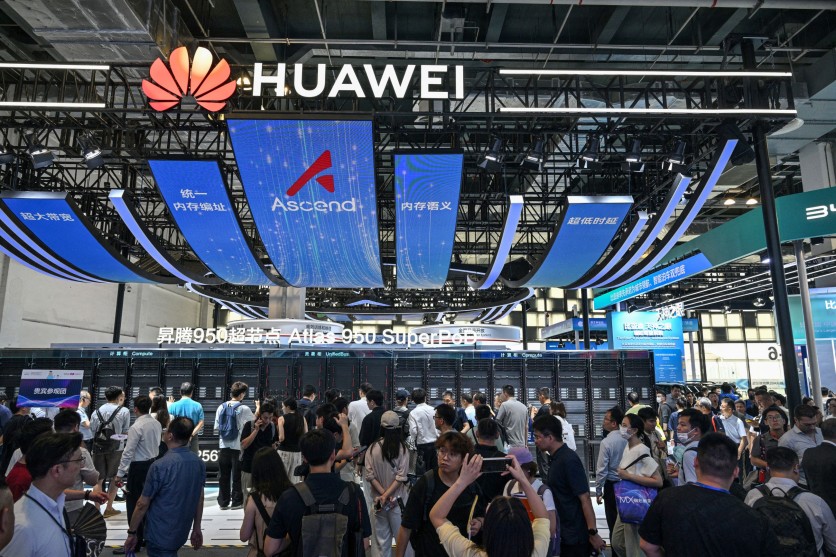
Hector RETAMAL/GettyImages.com
Huawei officially gave names and roles to its next two PC processors on Wednesday at a HarmonyOS Computer New Product Technology Communication Event — the first time the company has publicly announced its laptop chip roadmap from a stage — and the reveal came with a built-in caveat: full specifications will not arrive until August 5, when the Kirin X90 Plus and Kirin XE90 are expected to debut inside two new MateBook models. (Exchange rate as of July 29, 2026; conversions are approximate.)
The chips matter because they are the latest iteration of the only domestic computing stack China has put in front of consumers at scale. They also illustrate, with some clarity, the constraint that defines every Huawei PC: the Semiconductor Manufacturing International Corporation's 7nm process node, which is the ceiling under which HiSilicon must design every chip it ships, now sits approximately three to four process generations behind TSMC's N2 node currently in volume production. That gap translates to a roughly four to six times difference in transistor density and proportional performance-per-watt deficits compared to the silicon powering a MacBook Air M4 or a Qualcomm X Elite laptop. Huawei is iterating quickly within that constraint. Whether the constraint itself can be lifted before TSMC reaches 1.4nm is a different question, and the answer to date is no — a finding confirmed by SemiAnalysis's first teardown of a SMIC N+3 chip in June 2026.
Huawei's First On-Stage PC Chip Announcement
Zhu Dongdong, President of Huawei's Consumer Business Tablet and PC Product Line, used the event to review what he described as momentum for HarmonyOS PCs before announcing what comes next. According to Zhu, HarmonyOS PC sales have exceeded expectations — he reported that HarmonyOS PCs captured a 12% market share in China's thin-and-light segment priced above ¥8,000 (approximately $1,182 USD), and that the MateBook Fold held a 70% share of China's ultra-high-end foldable PC market, per the official event reporting by Huawei Central. Those figures are company-stated and have not been independently audited.
The event marked the first time Huawei has taken its PC processors on stage publicly. Last year, the company brought its mobile Kirin chips to a live event during the launch of the Mate XT triple-foldable; today's announcement extends that posture to the PC silicon roadmap, as Huawei Central reported.
Read more: Huawei LogicFolding Chip Claims 54% Density Gain: No Independent Audit Yet
Two Chips, Two Performance Profiles
Huawei positioned the Kirin X90 Plus as a high-performance chipset aimed at flagship MateBook models — likely the Pro-tier variants — and the Kirin XE90 as a highly energy-efficient alternative targeting weight-sensitive designs, according to the Huawei Central announcement. The division mirrors the strategy Apple used in differentiating its M-series performance and efficiency lines.
No official specifications for either chip were disclosed at the event. What is publicly available comes from pre-release leaks. Bilibili account AAA魅魔荧師傅 posted details on the Kirin XE90's core cluster prior to today's announcement: a 10-core layout with four performance cores running at 2.45 GHz with 1 MB of L2 cache, four large cores at 2.1 GHz with 1 MB of L2 cache, and two medium cores at 2.15 GHz with 512 KB of L2 cache, as reported by Huawei Central. NotebookCheck and AndroidHeadlines, citing those same Bilibili and Weibo sources, both characterized the XE90 as an overclocked, refined version of the existing Kirin X90 rather than a new microarchitecture — a pattern consistent with how HiSilicon has iterated on its mobile Kirin line since regaining domestic fab access, per NotebookCheck's MateBook Pro S coverage and AndroidHeadlines' reporting on the XE90 specs.
What SMIC's 7nm Ceiling Actually Means for Performance
The Kirin X90 — the predecessor both new chips refine — is manufactured on SMIC's N+2 process, a 7nm-class node confirmed by chip analysis firm TechInsights. It uses a 10-core, 20-thread configuration in a 4+4+2 tri-cluster arrangement, with a maximum clock speed of 4.2 GHz, a 128-bit dual-channel LPDDR5-6400 memory bus, an 8 MB system-level cache, Huawei's proprietary Maleoon 916 GPU, and a dual Da Vinci architecture NPU rated at 40 TOPS of AI inference, per Baidu Baike's Kirin X90 specifications.
SMIC achieved 7nm-class production without EUV lithography — which remains export-controlled and unavailable to Chinese foundries — by using deep ultraviolet multi-patterning, including a technique called self-aligned quadruple patterning on its tightest metal layers. In June 2026, SemiAnalysis published the first analysis from its new teardown lab using a Kirin 9030 chip built on SMIC's N+3 (third-generation 7nm-class) node. The findings: SMIC's N+3 achieves a minimum metal pitch of 32.5 nanometers (nm), which is nominally tighter than Intel's 18A on some metrics. However, transistor density clocked in at approximately 113.4 million transistors per square millimeter — higher than TSMC's N6 node, but 38% below Intel 18A's high-density cell density, according to Tom's Hardware's coverage of the SemiAnalysis STEEL lab teardown.
TSMC, meanwhile, entered volume production of its N2 (2nm-class) process node in late 2025, offering up to 15% performance improvement and 25–30% power reduction versus its own N3E. Apple's M4 Pro runs on TSMC's 3nm process. The Qualcomm X Elite, which powers globally available Windows-on-Arm laptops, runs on TSMC's 4nm. A chip at SMIC 7nm operating in 2026 competes in a market where its closest Western rivals enjoy a three-to-four-generation process advantage — and that advantage compounds into real-world battery life and sustained performance differences that no amount of clock-speed tuning can fully close.
This is not a criticism of HiSilicon's engineering. The SMIC ceiling is a geopolitical and legal constraint, not an engineering failure. Following U.S. sanctions that began in 2019 and were significantly expanded in August 2020 — when the Commerce Department's expanded Foreign Direct Product Rule blocked any chip manufacturer using U.S.-origin equipment or software from supplying Huawei — the company lost access to TSMC, Samsung, and every other leading foundry, per the Bureau of Industry and Security's FDPR expansion on Huawei. SMIC's 7nm without EUV is the result of building a complex chip under a supply embargo.
Whether and when SMIC advances beyond 7nm at scale remains the central unanswered question in Chinese chip manufacturing. TSMC will enter volume production of 1.4nm-class chips in approximately 2028. SMIC has no publicly confirmed path to EUV lithography.
MateBook Pro S: Sub-800 Grams, Five Colors, and a Future Launch Date
The MateBook Pro S is expected to be the primary vehicle for the Kirin XE90's efficiency credentials. A leaked image — shared by Weibo tipster UncleKanshan (看山叔) — showed a laptop lid sitting on a kitchen scale reading 798.0 g (1.76 lbs), which NotebookCheck reported would undercut the current MateBook X Pro's approximately 980 g (2.16 lbs) by nearly 200 g (0.44 lbs). The same leak listed memory options of 16 GB, 24 GB, and 32 GB, storage of 512 GB and 1 TB, and five color choices: yellow, white, gray, purple, and black. The device is reportedly designed with an anti-peeping PaperMatte display. None of these specifications are officially confirmed; all remain subject to change before the August 5 announcement.
The MateBook Fold PC 2026 will also debut at the August 5 event, per a giant poster Huawei posted to its Chinese social media channels on Wednesday. Huawei confirmed three color options for the Fold: Flowing Gold, Phantom Black, and Skyline White, per Huawei Central's color announcement. The original MateBook Fold Ultimate Design weighed 1.16 kg (2.6 lbs) and featured an 18-inch foldable dual-layer OLED at 3.3K resolution.
Read more: Huawei Launches New Harmony OS, AI Model to Rival OpenAI, Google
HarmonyOS Is Certified — But Only by China
The Kirin X90 carries a Security and Reliability Grade II certification from China's Information Technology Security Evaluation Center, the highest such rating available from that body, covering core technology autonomy, supply chain security, and intellectual property compliance with national security standards, per Huawei Central's report on the certification. HarmonyOS PC version 1.0 received an equivalent Grade II certification in early 2026, meaning both the silicon and operating system have cleared China's highest domestic security bar, as Huawei Central reported.
What neither certification establishes is an independent Western security assessment of the platform's data transmission behavior. No published independent cybersecurity audit of the HarmonyOS PC software stack has been confirmed as of this writing. The most recent MateBook security incident on record is from 2019, when Microsoft researchers discovered a privilege-escalation vulnerability (CVE-2019-5241 and CVE-2019-5242) in Huawei's PCManager driver for its then-Windows laptops — a design defect, not a confirmed backdoor, which Huawei patched in January 2019.
The absence of a Western audit is not evidence of wrongdoing. It is, however, a gap that enterprise buyers in regulated industries and any user concerned about data sovereignty should factor into their decision.
Before You Buy: What China's Law Requires Huawei to Share
If you are considering a HarmonyOS MateBook — and they are, at the moment, available only in China — there is a fixed legal framework you should understand before purchase. It does not change based on where Huawei's servers are located, what its privacy policy says, or what the company's executives state publicly.
China's National Intelligence Law (2017), Article 7, requires all organizations and citizens to support, assist, and cooperate with national intelligence work in accordance with the law. Article 14 grants intelligence agencies authority to demand that support from any organization or citizen. A 2019 independent legal analysis by Swedish law firm Mannheimer Swartling concluded that the law applies to all Chinese citizens and to overseas subsidiaries of Chinese companies — a conclusion directly contrary to the legal opinion Huawei commissioned from Zhong Lun law firm in 2018. Legal scholars remain divided on the precise scope of the obligation, but not on whether the obligation exists.
Supplementing the Intelligence Law, China's Data Security Law (2021) and Cybersecurity Law (2017) mandate cooperation with law enforcement and government data access requests and contain data localization provisions.
Categories of data that a HarmonyOS MateBook could collect and that would be subject to these legal demands include: location data, device usage patterns and OS telemetry, account credentials and app data, documents and files processed on the device, and network activity.
Practical mitigations for readers who use or plan to use such a device include keeping the laptop on an isolated network segment with no access to sensitive enterprise data, minimizing Huawei ID account creation and cloud sync, and treating all data processed on the device as potentially accessible to Chinese state intelligence. No VPN or software mitigation fully addresses the structural legal risk, because the operating system itself can collect and transmit data prior to any VPN connection being established.
Ecosystem Maturity and the China-Only Constraint
HarmonyOS PCs are currently sold exclusively in China. The platform operates independently of Linux and Android and runs no Google services, as CNX Software noted in its first-look coverage of the HarmonyOS laptop. The app ecosystem is built around Huawei's AppGallery and the Chinese domestic software market; Western enterprise software, including most enterprise security and endpoint protection tools, is not natively available.
For Chinese enterprise buyers and government procurement officers — the primary addressable market — HarmonyOS's Grade II certifications and domestic supply-chain independence are competitive advantages. For international users, the platform's China-only availability, limited app ecosystem, absence of independent Western security validation, and the legal framework described above collectively define what adopting the technology actually means.
Huawei's pace of iteration is real and worth acknowledging on its own terms. Moving from the standard Kirin X90 to the X90A, and now to the X90 Plus and XE90, within a single product generation shows HiSilicon extracting meaningful refinements from SMIC's current manufacturing constraints. How the new chips perform in absolute terms — specifically whether the Kirin X90 Plus can close the single-core gap with Qualcomm X Elite or Apple M4 in sustained workloads — will only be answerable when full benchmarks emerge after August 5.
Frequently Asked Questions
What are the Kirin X90 Plus and Kirin XE90?
They are Huawei's next-generation PC processors, both built on the same HiSilicon Kirin X90 microarchitecture that powers current MateBook laptops. The X90 Plus is positioned as a high-performance chip for flagship MateBook Pro variants; the XE90 is an energy-efficiency-optimized version, expected to debut in the MateBook Pro S. Both are manufactured on SMIC's 7nm-class process node using deep ultraviolet lithography — no official specifications have been released yet; leaked pre-announcement figures put the XE90 at 2.45 GHz for its primary cluster. Full specs are scheduled for August 5.
What is SMIC's 7nm process, and how does it compare to what Apple and Qualcomm use?
SMIC's N+2 node is a genuine 7nm-class process — confirmed by TechInsights teardown — achieved using deep ultraviolet multi-patterning rather than EUV lithography, which is export-controlled and unavailable to Chinese foundries. In practice, SMIC's 7nm in 2026 is comparable to where TSMC's 7nm was in approximately 2018. TSMC is currently shipping Apple's M4 chips on 3nm and entering volume production of 2nm (N2) — a three-to-four-generation advantage that translates to substantially better performance per watt. A SemiAnalysis teardown of a SMIC N+3 chip in June 2026 found transistor density 38% lower than Intel's 18A high-density cells. Huawei's chips run; they just run less efficiently per watt and at lower peak throughput than their nearest Western counterparts.
Can a MateBook Pro S running the Kirin XE90 compete with a MacBook Air M4?
For typical productivity workloads — document editing, video calls, light coding — current MateBook Pro reviews suggest the Kirin X90 delivers satisfactory performance. In sustained workloads, thermal efficiency, and battery life per gram of device weight, the process node gap creates a structural disadvantage that iterating on the same microarchitecture cannot overcome. Apple's M4 (TSMC 3nm) achieves meaningfully better performance per watt than any chip on SMIC 7nm. The Kirin XE90's energy-efficiency positioning suggests Huawei is prioritizing thinness and battery life for the MateBook Pro S — which, at a rumored 798 g (1.76 lbs), will be among the lightest HarmonyOS laptops shipped. Whether the XE90's clock tuning delivers competitive sustained performance remains to be seen after August 5 benchmarks.
Is a Huawei HarmonyOS MateBook safe to use for sensitive work?
For enterprise users outside China, the relevant consideration is not whether Huawei has malicious intent, but what Chinese law requires of Huawei regardless of intent. China's National Intelligence Law (2017) Article 7 requires all Chinese organizations to cooperate with intelligence work on demand; Article 14 allows intelligence agencies to compel that cooperation. These obligations travel with the company regardless of where its servers are physically located. No independent Western cybersecurity audit of the HarmonyOS PC platform has been published. For sensitive enterprise work, regulated-industry data, or users who need assurance of data sovereignty, the absence of independent auditing combined with the legal framework described above constitutes a risk that cannot currently be independently evaluated.

-
 C114 Communication Network
 -
 Communication Home
