
 Search

Nvidia.com
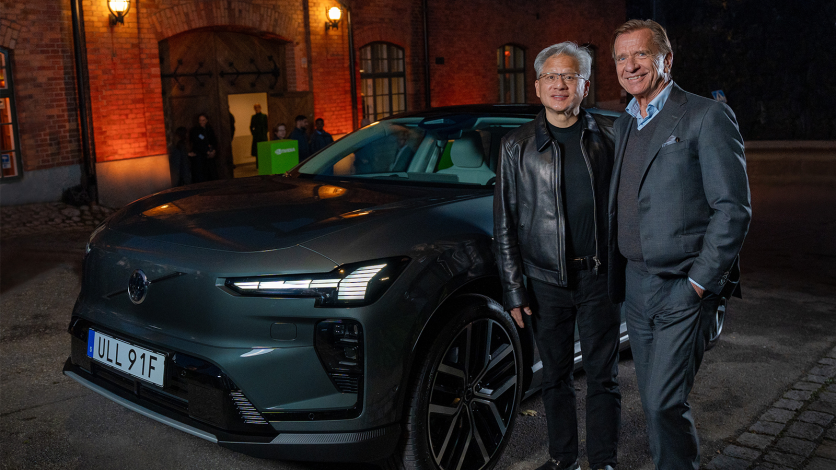
On October 15, 2026, Volvo Cars announced it is adopting Nvidia's complete autonomous-driving platform — Hyperion sensor hardware, Nvidia Halos safety software, and Alpamayo reasoning AI — for its next generation of production vehicles, betting that an independently certified, shared-investment stack can deliver legal eyes-off and mind-off driving to mainstream buyers after Mercedes-Benz, BMW, and Stellantis each abandoned their proprietary Level 3 programs within the past 14 months. On the same day — a coincidence that underscores how quickly the industry consensus has shifted — Mercedes-Benz also announced an expanded Nvidia partnership for its own future autonomous vehicles, with Mercedes CTO Jörg Burzer declaring that "Nvidia is our most important strategic partner in automated driving."
What "Eyes-Off" and "Mind-Off" Actually Mean for Drivers
The terms carry more legal weight than they appear to. Level 3 conditional automation — what the automotive industry calls "eyes-off" driving — allows a driver to legally divert their visual attention from the road while the system is engaged, whether to read a message, watch a video, or close their eyes briefly. The critical legal obligation remains: a Level 3 system must be able to issue a "takeover request" when it reaches the edge of its competence, and the driver must respond within a defined window, as the SAE J3016 Level 3 standard specifies. The system still needs a human fallback.
Level 4 automation — "mind-off" driving — removes that obligation entirely within the vehicle's defined operational design domain (ODD). Within an L4 ODD, the car handles all driving tasks and cannot legally require driver intervention, regardless of what the human occupant is doing. Robotaxis like those Waymo operates in Phoenix are L4 systems; they run without a human in the driver's seat at all.
Volvo's announcement targets both levels. The Nvidia Hyperion platform architecture scales from current Level 2++ driver assistance through L3 conditional automation and into L4 via over-the-air software updates, all on the same physical sensor architecture.
Read more: Volvo's ES90 Is Packing Insane AI Power: Nvidia Chips Make It a Supercomputer on Wheels
Three Layers, One Certified Platform: Hyperion, Halos, and Alpamayo
The stack that Volvo has committed to has three distinct components, each doing a different job.
Nvidia Hyperion is the hardware and sensor reference architecture. A production Hyperion configuration includes 14 cameras, 9 radars, 1 LiDAR, and 12 ultrasonic sensors — all feeding into two Nvidia Drive AGX Thor system-on-chip units, each rated at 1,000 INT8 TOPS (tera-operations per second) for a combined 2,000 TOPS of onboard compute running on Blackwell GPU architecture. That redundant, dual-SoC design — two separate compute channels processing the same sensor inputs independently — is one of the architectural requirements for meeting ISO 26262 ASIL D, the highest automotive functional safety standard, which applies to hazards in the same risk class as complete braking-system failure.
Nvidia Halos is the safety envelope that sits above the hardware and around the AI. Halos' foundational layer is DriveOS, certified to ASIL D under ISO 26262. TÜV Rheinland performed a Halos UNECE WP.29 safety assessment for the United Nations framework governing Level 3 type approval in more than 50 countries, including all European Union member states. TÜV SÜD separately granted ISO/SAE 21434 cybersecurity process certification. Nvidia says the Halos system represents more than 15,000 engineering years of autonomous-vehicle safety investment, encompassing more than 1,000 AV-safety patents and more than 30 safety and cybersecurity certificates.
"Built into the system is a runtime behavioral envelope that enforces safety constraints around AI neural network outputs," wrote Nvidia's Head of Industry Safety Riccardo Mariani in a March 2025 blog post. "This approach could help accelerate standardization and regulatory compliance." The significance of that architecture is what distinguishes Halos from conventional automotive safety design: because traditional compositional safety methods cannot fully certify open-ended neural networks — they assume known, enumerable failure modes — Halos enforces a separate runtime layer that overrides AI decisions that violate defined safety parameters, allowing the AI to do its job without the entire system's safety case depending on the AI being certifiably correct in every possible scenario.
Nvidia Alpamayo is the AI reasoning layer. Alpamayo 1, the industry's first open-source VLA model for autonomous driving, launched at CES in January 2026. Its 10-billion-parameter architecture uses chain-of-causation reasoning — the system generates a written trace of its decision logic before outputting a driving trajectory, making its decisions auditable in a way that end-to-end neural networks are not. Alpamayo 1.5, released at Nvidia's GTC conference in March 2026, added multimodal inputs, enabling the model to process video, navigation context, and natural-language instructions simultaneously; Alpamayo 1.5 weights are available on Nvidia's NGC catalog and on Hugging Face. As of October 2026, more than 650,000 automotive developers have downloaded the Alpamayo models.
"Accelerated computing has transformed the car into an intelligent machine that can understand the world around it. Volvo has spent nearly a century protecting people on the road," Nvidia CEO Jensen Huang said in a statement.
Why Volvo Is Betting on a Shared Platform While Three Rivals Retreated
Three Level 3 programs from major automakers have been discontinued in the past 14 months, all for structural reasons that Nvidia's platform architecture is specifically designed to address.
Mercedes-Benz paused and effectively cancelled its Drive Pilot system in January 2026. Drive Pilot had been the only Level 3 system approved for American consumers — in California and Nevada, on freeways, at speeds up to 40 mph (64 km/h), in good weather — and cost $2,500 per year as a subscription. The cancellation's proximate cause was the Luminar Technologies bankruptcy liquidation, Drive Pilot's sole LiDAR supplier, which left Mercedes without a qualified sensor source at a viable price. The structural problem underneath: Mercedes had built a proprietary stack using a single vendor for its most critical and expensive sensor. Nvidia's Hyperion specifies LiDAR as one of multiple sensor modalities but does not mandate a single supplier, allowing OEMs to source from qualified vendors including Hesai and Innoviz.
Stellantis shelved its AutoDrive Level 3 program in August 2025, citing insufficient consumer demand to justify continued certification expenditure. BMW dropped Level 3 from its 7 Series facelift scheduled for April 2026, replacing it with a Level 2++ Motorway Assistant — a hands-off but eyes-on highway system — at a price of approximately €1,450 (approximately $1,627), down from the roughly €6,000 (approximately $6,733) that the L3 option had commanded.
The pattern those three failures share is one that Nvidia's platform architecture directly targets: bespoke, single-vendor-dependent, in-house safety stacks whose certification costs could not be amortized across a large enough customer base to produce consumer-acceptable prices. The Nvidia platform, by contrast, distributes certification costs across every OEM partner that deploys it.
"We have completely changed and migrated into being a full-tech stack company," said Volvo's head of software development, Alwin Bakkenes, speaking to TechCrunch. "By working with NVIDIA, we bring together two distinct strengths: industry-leading safety knowledge and world-class AI technology. That combination gives us a unique opportunity to create safer and more attractive cars for our customers," added Volvo CEO Hakan Samuelsson.
What Does Alpamayo's Chain-of-Causation Reasoning Actually Do?
A conventional end-to-end neural network processes sensor inputs and outputs a steering and acceleration command without an intermediate reasoning step that a human engineer can inspect. Alpamayo's VLA architecture inserts a chain-of-causation trace between perception and action: the model first reasons in natural language about what it is seeing — a pedestrian at the curb, a brake light ahead, a yield sign partially obscured by shadow — then outputs a trajectory based on that reasoning.
That intermediate trace serves two functions. For safety engineering, it provides an auditable record of why the system made a specific decision — important for post-incident analysis and regulatory compliance. For model improvement, the reasoning traces generated by a large teacher model can be used to fine-tune smaller, faster models that run efficiently on in-vehicle hardware without requiring data-center-class compute at the edge.
The open-model approach means that improvements contributed by any OEM partner benefit every vehicle on the platform. At GTC 2026 in March, BYD, Geely, Isuzu, and Nissan adopted Nvidia Hyperion for Level 4 vehicles; Volvo's commitment came separately on October 15, 2026. "We run these two stacks at the same time," Ali Kani told TechCrunch, referring to the redundant compute architecture. "Multimodal sensors and multiple processing approaches make for a safer product."
Read more: Volvo EX90 Goes 800V in Malaysia: 350 kW Charging, 680 PS, CKD Pricing
Geely Ownership and What Chinese Data Laws Mean for Volvo Drivers
Volvo Cars is majority-owned by Zhejiang Geely Holding Group, a Chinese company headquartered in Hangzhou. That ownership structure creates a specific legal exposure that drivers considering a Volvo autonomous vehicle should understand before purchase.
China's National Intelligence Law (2017), Article 7, requires that all organizations and citizens "support, assist, and cooperate with national intelligence work." The Data Security Law of 2021 and the Cybersecurity Law (2017) impose additional data-localization and government-access obligations. These obligations apply to any company subject to Chinese jurisdiction — including Geely's subsidiaries — regardless of where a company's servers are physically located, what its privacy policy states, or that its operational headquarters is in Gothenburg, Sweden.
The Nvidia Hyperion stack deployed in future Volvo vehicles will collect 14 camera streams, 9 radar streams, one LiDAR point cloud, and 12 ultrasonic sensor streams — constituting a high-resolution, continuous record of the vehicle's environment and the driver's location. Whether or how that sensor data flows to Geely's systems is not fully disclosed in publicly available documentation. No independent security audit of Volvo's data-transmission architecture specific to Geely data flows has been published as of October 2026. That gap is a material unknown for privacy-conscious buyers.
The US government has addressed part of this exposure. The Department of Commerce finalized a connected-vehicles Chinese-software ban in January 2025 covering software from Chinese or Russian companies effective 2027, and restricting autonomous-driving-system connectivity hardware from Chinese-controlled companies effective 2030. In May 2026, the Commerce Department and Volvo signed an agreement allowing Volvo US import continuation, though as FDD's Commerce agreement analysis notes, the specific terms of that agreement have not been made public.
Practical steps for buyers concerned about data exposure include: monitoring Commerce Department compliance updates for Volvo's post-2027 regulatory status; requesting specific written data-architecture disclosure from Volvo before committing to a vehicle on the SPA3 platform; and noting that the May 2026 data agreement's undisclosed terms mean the specific restrictions on Geely data access to autonomous-driving sensor streams remain unverifiable from public sources.
When Will Eyes-Off Driving Reach Volvo Production Cars?
Volvo has not announced a specific vehicle or model-year target for the full eyes-off capability. Alwin Bakkenes told TechCrunch that Level 3 capability will arrive within the decade — a deliberately imprecise signal that places it beyond the immediate product cycle. The platform it will run on is SPA3, Volvo's next-generation electric-vehicle architecture; the first SPA3 vehicle is the EX60 midsize SUV.
For comparison: Ford has announced Level 3 for its 2028 pickup at a price point around $30,000. General Motors has announced eyes-off driving for 2028 on the Cadillac Escalade IQ, a vehicle expected to cost approximately $130,000. Honda offers Level 3 approval in Japan on the Honda Legend in extremely limited production volumes, but has not extended L3 approval to the United States.
For consumers unwilling to wait for L3 production approval, Nvidia's autonomous-driving platform will also power commercial robotaxi deployments. Nvidia and Uber announced at GTC 2026 that the Uber 28-city Nvidia network will deploy across four continents by 2028, starting with Los Angeles and the San Francisco Bay Area in the first half of 2027.
Frequently Asked Questions
What is the difference between eyes-off and mind-off driving?
Eyes-off driving refers to Level 3 conditional automation under SAE J3016: a driver can legally divert their visual attention from the road — reading, watching a screen, or looking away — while the system is engaged. However, a Level 3 system must be able to issue a takeover request when it reaches the boundary of its capability, and the driver must respond within a defined time window. Mind-off driving refers to Level 4 high automation: within the vehicle's defined operational design domain, the car manages all driving tasks and cannot legally require the driver to intervene at all. Robotaxis like Waymo's Phoenix fleet operate at Level 4; the driver's seat can be empty.
Why did Mercedes Drive Pilot fail, and why does Volvo's approach differ?
Mercedes Drive Pilot — the first Level 3 system approved for American consumers in California and Nevada — was cancelled in January 2026 after Luminar Technologies, its sole LiDAR supplier, went bankrupt. That single-vendor dependency exposed the structural weakness of proprietary, bespoke AV stacks: if any critical component supplier fails, the entire certified system fails. Volvo's adoption of Nvidia Hyperion addresses this differently: Hyperion's multi-modal sensor architecture supports multiple qualified LiDAR vendors, and the platform's ASIL D safety certification is held at the stack level — distributed across Hyperion hardware, Nvidia Halos safety system, and Alpamayo AI — rather than locked to a single sensor chain. Certification costs are also shared across all OEM partners including BYD, Geely, Nissan, and Isuzu, making amortization feasible at consumer-accessible price points.
What does Geely's Chinese ownership mean for data privacy in a Volvo autonomous vehicle?
It means that Chinese law applies to Geely's obligations as a corporate entity. China's National Intelligence Law (2017), Article 7 requires all organizations to support and cooperate with national intelligence requests. This obligation applies regardless of where Volvo's servers are physically located or what Volvo's privacy policy states. A Volvo equipped with the Nvidia Hyperion stack will continuously collect 14 camera streams, 9 radar streams, one LiDAR point cloud, and 12 ultrasonic sensor streams. Whether or how that data flows to Geely's systems is not publicly documented, no independent security audit of Volvo's Geely-facing data architecture has been published, and the terms of the May 2026 Commerce Department data-restriction agreement with Volvo are not public. Buyers should request specific data-architecture disclosure from Volvo and monitor US Commerce Department compliance updates for Volvo's post-2027 regulatory status.
Can Alpamayo be used by automakers other than Volvo?
Yes — that is the deliberate design. Nvidia's Alpamayo models are open-source, with weights available on Hugging Face and simulation tools on GitHub. Any automaker can download, fine-tune, and deploy Alpamayo on Hyperion-equipped vehicles. As of October 2026, more than 650,000 automotive developers have done so. The OEM partners currently committed to the Hyperion platform include BYD, Geely, Nissan, and Isuzu, in addition to Volvo. Mercedes-Benz's expanded Nvidia partnership, also announced October 15, 2026, is expected to bring Mercedes vehicles onto the same platform for future L4 applications. Improvements made by any partner — additional training data, refined reasoning traces, edge-case handling — become available to every other vehicle on the platform through model updates, compounding over time in a way that no single automaker building a proprietary stack can match at comparable cost.

-
 C114 Communication Network
 -
 Communication Home
