
 Search

Nvidia.com
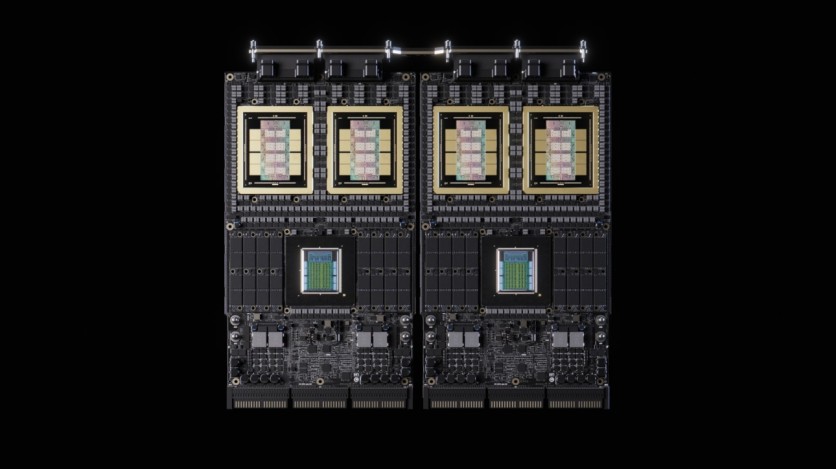
On Day 3 of the OCP Global Summit 2026 in San Jose, Giga Computing — the AI infrastructure subsidiary of GIGABYTE — is displaying a fully configured NVIDIA Vera Rubin NVL72 rack at booth #A39, a platform that compresses what previously required multi-rack configurations into a single, self-contained system. The rack integrates 72 Rubin GPUs and 36 Vera CPUs sharing a 20.7 TB unified HBM4 memory pool — enough headroom to run trillion-parameter language models and million-token context windows from a single rack without cross-rack network traffic.
Each Rubin GPU carries 288 GB of HBM4, enabling the memory pool. At the rack level, sixth-generation NVLink interconnects bind the 72 GPUs into a single coherent memory domain, delivering aggregate memory bandwidth of approximately 1.4 petabytes per second across all 72 GPUs. Individual GPUs deliver up to 19.2 TB/s of bandwidth — a per-chip figure, not the rack aggregate. For inference workloads, NVIDIA rates the platform at 3.6 exaFLOPS in NVFP4 precision, with up to 5x inference performance per GPU compared to the prior-generation GB200 and up to 10x lower cost per token for mixture-of-experts (MoE) model architectures.
Thermal management is handled entirely through liquid cooling. The rack operates at a 45°C coolant inlet temperature (113°F) and is 100% liquid-cooled, including a liquid-cooled busbar that NVIDIA says provides 20 times more energy storage than prior-generation busbar designs. The platform supports NVIDIA Confidential Computing across the full rack-scale system — a feature of growing significance as AI workloads move into regulated industries and enterprises deploying on shared infrastructure.
The Vera Rubin NVL72 made its world debut at NVIDIA GTC 2026 in March and has since entered volume production, with deployments underway at hyperscalers, neoclouds, and frontier AI research laboratories. Giga Computing's display at the OCP Summit is among the first public showcases of a fully configured production rack outside of NVIDIA's own venues.
Read more: Nvidia Circular Financing: $24.9B CoreWeave Debt Puts Pension Funds at Risk
How Does Groq 3 LPX Solve the Latency Bottleneck in AI Inference?
Serving a large language model at scale involves two computationally distinct phases with incompatible hardware requirements. The prefill phase — processing an entire input prompt in parallel — is a dense matrix operation that benefits from the Rubin GPU's massive FLOP count. The decode phase — generating one output token at a time, sequentially — is memory-bandwidth-bound and is penalized by the high-latency characteristics inherent to large GPU clusters serving many simultaneous users.
The Groq 3 LPX rack directly addresses the decode bottleneck. Built around Groq's Language Processing Units, the system delivers 315 petaFLOPS of compute, 256 LPUs, and 128 GB of on-chip SRAM with 40 petabytes per second of on-chip memory bandwidth. That on-chip bandwidth figure—measured in petabytes per second, not terabytes—is what lets the LPUs fetch model weights fast enough to generate tokens at near-instant speeds. NVIDIA rates the combined Vera Rubin NVL72 and Groq 3 LPX configuration at up to 35x higher throughput per megawatt compared to a Grace Blackwell NVL72 system.
Giga Computing's booth framing positions the Groq 3 LPX and Vera Rubin NVL72 as complementary systems. In a disaggregated inference architecture, Rubin GPUs handle attention computation during the decode phase while the Groq LPUs take on the feed-forward and MoE layers—the weight-heavy portion where on-chip bandwidth, not raw FLOP count, limits throughput. The result is a stack that maximizes tokens per second per user while keeping expensive GPU capacity occupied with the work only GPUs can do efficiently.
NVIDIA Vera CPU Rack: 22,500+ Environments for Agentic AI
A third rack in Giga Computing's OCP Summit display targets a different layer of the AI infrastructure stack. The NVIDIA Vera CPU rack is built around NVIDIA's Arm-based Vera data center processor — a chip designed specifically for data center workloads rather than derived from a consumer or workstation architecture — and addresses the orchestration and sandboxing demands that agentic AI pipelines generate above the GPU tier.
Giga Computing quotes a capacity of 22,500 concurrent execution environments per rack — a figure relevant to reinforcement learning from human feedback, multi-agent orchestration, and any AI workflow that requires spinning up and tearing down lightweight compute contexts rapidly, where the bottleneck is parallelism across many lightweight processes rather than peak FLOP density.
The rack is built on the NVIDIA MGX open architecture and integrates NVIDIA Spectrum-X Ethernet networking. Spectrum-X is NVIDIA's Ethernet fabric optimized for AI traffic patterns, targeting the congestion and jitter characteristics that standard data center Ethernet introduces at the request volumes transformer inference generates. The Vera CPU rack is designed to operate alongside the Vera Rubin NVL72 and Groq 3 LPX racks as part of a coordinated AI factory — not as a standalone compute node.
Read more: NVIDIA Invests $40B to Equity AI Deals This Year; OpenAI Becomes Top Recipient
OCP ORV3: Open Infrastructure With Direct Liquid Cooling and 800V Power
Not all of Giga Computing's OCP Summit footprint is occupied by proprietary NVIDIA platforms. The company is also showcasing a fully configured OCP Open Rack Version 3 rack — a standards-based platform that supports both AMD EPYC and Intel Xeon CPU configurations and spans compute nodes, high-density flash storage, and management hardware. Every server in the ORV3 portfolio incorporates direct liquid cooling, a requirement given the core counts and thermal design powers of current-generation server CPUs.
Among the display configurations is the GIGABYTE TO46 series, a platform designed for eight-GPU baseboards including configurations based on the NVIDIA HGX B300 system. Giga Computing's ORV3 presence reflects a portfolio that has evolved considerably since the company's early work on OCP ORV1, offering customers flexibility to build open, interoperable data center infrastructure without committing to proprietary rack designs or fabric.
On the power distribution side, the booth features an 800V CDU from TaiSol Electronics. The shift to 800V DC power distribution — a transition the broader data center industry is actively adopting — reduces resistive losses over long rack-to-rack and rack-to-CDU cable runs. At the power densities AI racks now require, delivering watts efficiently from the facility switchgear to individual compute nodes is a first-order system design constraint. A conventional lower-voltage distribution path loses a measurable percentage of delivered power to cable resistance; 800V distribution reduces that loss for a given current, translating directly to lower facility operating costs at scale.
From Server Maker to Full-Stack AI Infrastructure Partner
Giga Computing's OCP Summit display arrives as the company continues a systematic repositioning from GPU server manufacturer to full-stack AI infrastructure partner.
On September 22, 2026, Giga Computing unveiled GAIFA, an AI computing center and validation test bed in New Taipei City, Taiwan, housing 700 kilowatts of compute capacity across six racks, all equipped with direct liquid cooling. The facility is not a commercial data center; it functions as a validation and proving ground where the company can demonstrate production-configuration rack-scale systems to prospective customers before they commit to full deployments.
Earlier in 2026, in July, Giga Computing expanded its GigaPOD AI infrastructure platform family to accelerate enterprise AI factory deployments. The previous month, at Computex 2026 in Taipei, the company had signed a memorandum of understanding with South Korean chip startup Rebellions to jointly develop rack-scale AI server solutions, with a stated focus on sovereign AI deployments in markets that require regionally controlled infrastructure.
The OCP Global Summit — running October 12–15 at the San Jose Convention Center — is one of the data center industry's primary venues for open infrastructure standards development, with contributors from hyperscalers, chip companies, original design manufacturers, and cooling technology providers. Giga Computing's Day 3 presence across the Vera Rubin NVL72, Groq 3 LPX, Vera CPU, and ORV3 portfolios represents a system-level answer to each layer of a modern AI factory: training and inference compute in unified memory, decode acceleration, agent orchestration, and open-standard infrastructure for workloads that do not require proprietary interconnect. Visitors to Giga Computing booth #A39 can see each of these rack systems operating in production configurations through October 15.
Frequently Asked Questions
What makes the Vera Rubin NVL72 architecturally different from prior-generation GPU racks?
Prior GPU racks — including Blackwell-generation systems — required models larger than their per-rack memory to be partitioned across multiple racks, introducing cross-rack NVLink or InfiniBand traffic that adds latency and reduces effective bandwidth. The Vera Rubin NVL72's 20.7 TB unified HBM4 pool, bound by sixth-generation NVLink with approximately 1.4 PB/s of aggregate memory bandwidth, is large enough to hold a trillion-parameter model entirely within one rack. A query to a frontier-scale model can be processed without any cross-rack traffic — the rack itself becomes the unit of memory as well as the unit of compute.
Why deploy Groq 3 LPX alongside a Vera Rubin rack rather than simply using a second Vera Rubin rack for decode?
A Vera Rubin GPU is optimized for the attention computation at the core of transformer decoding — but every decode step also requires loading large feed-forward and MoE layer weights from memory. Those weight loads are bandwidth-bound, not compute-bound, and the LPU architecture Groq uses is designed to sustain 40 PB/s of on-chip bandwidth at the granularity of per-token generation. Running the weight-heavy MoE layers on Groq LPUs and the attention layers on Rubin GPUs in a disaggregated configuration avoids underutilizing the GPU's FLOP capacity on work that doesn't require it—improving tokens-per-second-per-user economics without the cost of a second full GPU rack.
What is the practical significance of the 800V power distribution unit Giga Computing is showcasing at OCP?
At the power densities modern AI racks require, conventional lower-voltage DC distribution loses a measurable percentage of delivered power to resistive heating in the cable runs between facility power supplies and individual racks. Raising the distribution voltage to 800V reduces resistive losses for a given current — the same principle that makes high-voltage transmission lines more efficient than low-voltage ones. For an AI factory deploying a large number of Vera Rubin NVL72 racks, the efficiency gain at 800V adds up to a real reduction in facility power overhead and operating cost, not just a marginal engineering improvement.
How does the Vera CPU rack fit into an AI factory alongside GPU and LPU infrastructure?
Large-scale AI deployments—particularly those using reinforcement learning or running multi-agent pipelines—need to spin up thousands of concurrent lightweight execution environments for policy rollouts, agent sandboxing, and task orchestration. A GPU rack handles this inefficiently: each isolated environment uses only a small fraction of a GPU's available compute, and the GPU's memory is consumed holding OS state for work a CPU core can handle at far lower cost. The Vera CPU rack's 22,500-plus concurrent environment capacity makes it the right layer for process-intensive orchestration, keeping GPU and LPU resources free for the dense matrix work they are built to perform.
Read more: NVIDIA Open-Sources FlashREINFORCE: Half Rollout Cost, Better Accuracy

-
 C114 Communication Network
 -
 Communication Home
