
 Search

Nvidia.com
Production review embargoes for NVIDIA's RTX Spark N1X lifted this morning, and the first production review roundup from ComputerBase, HotHardware, Tom's Guide, Trusted Reviews, Windows Central, and KitGuru lands in two distinct halves: the GPU is genuinely the most capable integrated graphics package ever placed inside a Windows laptop, and the CPU uses ARM cores that MediaTek — the very company NVIDIA co-developed them with — has already surpassed in its own current smartphone lineup. Retail availability begins Thursday, October 16.
For buyers ready to spend between $2,599 and roughly $6,700 on a first-wave RTX Spark laptop, the production benchmark data now answers the questions that months of prototype leaks and pre-launch software demos could not: the GPU performance and AI memory architecture are real; the CPU story carries a caveat that matters more the less your workflow is GPU-bound; and the memory bandwidth architecture imposes a ceiling on AI inference token speed that Apple's M4 Max still exceeds, for models small enough to fit on either platform.
What RTX Spark N1X Actually Is: Two Dies, One Package, One Memory Pool
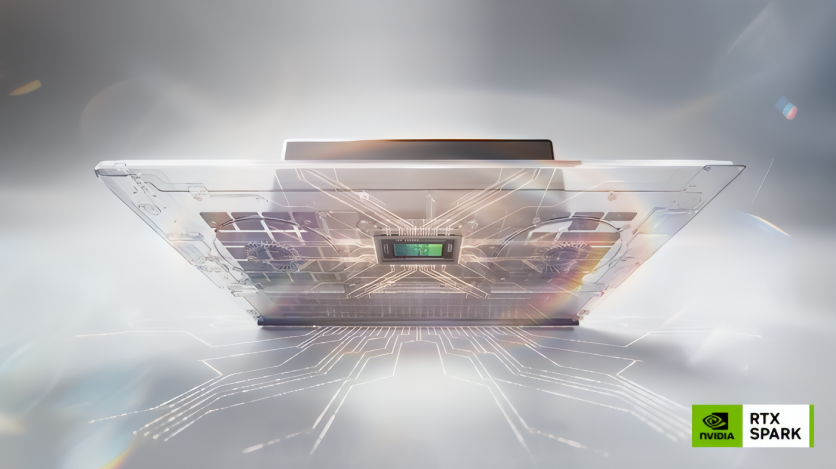
RTX Spark N1X is not a traditional laptop chip. It is a two-chiplet 2.5D package — a MediaTek-designed ARM CPU die and an NVIDIA Blackwell GPU die, manufactured separately on TSMC's 3nm process and integrated into a single unit connected by NVIDIA's NVLink C2C interconnect. The NVLink C2C delivers 600 GB/s of bidirectional bandwidth between the two dies, which is why NVIDIA's marketing materials quote that figure prominently.
But 600 GB/s is the inter-die speed — how fast data moves between the CPU and GPU inside the package. The figure that governs AI inference performance and GPU memory throughput is the peak bandwidth to the shared physical LPDDR5X-9400 memory pool: 300 GB/s memory bandwidth over a 256-bit interface. Both chiplets draw from this pool. Up to 128 GB is available on flagship configurations, and up to 96 GB can be allocated to the GPU — more than any previous laptop GPU by a factor of four.
The unified memory architecture is what makes RTX Spark categorically different from every previous Windows laptop. A 70-billion-parameter AI model quantized to 4 bits requires roughly 41 GB to load into memory. On any conventional laptop — regardless of how fast the discrete GPU is — that model cannot fit, because discrete GPUs ship with a maximum of 24 GB of VRAM, and the system DRAM and GPU VRAM are separate pools. On an RTX Spark laptop with 64 GB or more, that model loads and runs entirely on-device.
Two hardware configurations go on sale beginning October 16:
| Variant | CPU Cores | GPU Shaders | Memory Options |
|---|---|---|---|
RTX Spark N1X (large) | 20 (10× Cortex-X925 + 10× Cortex-A725) | 6,144 | 32–128 GB LPDDR5X |
RTX Spark N1X (small) | 18 (9× Cortex-X925 + 9× Cortex-A725) | 5,120 | 24–96 GB LPDDR5X |
Performance cores peak at 4.0–4.1 GHz on the large variant, 3.9 GHz on the smaller. The design traces its lineage to the GB10 "Grace Blackwell" Superchip inside NVIDIA's DGX Spark developer workstation, which launched in 2025 for $4,699. The N1X is the consumer-portable adaptation: ConnectX-7 networking interfaces removed, TDP capped at 80W in laptop form (versus 140W for the desktop version), and memory configurations starting at 24 GB.
Read more: NVIDIA RTX Spark Launches Friday: 74-Billion-Parameter AI Fits in 24GB Laptop
GPU Benchmarks: Leads Every Mobile Competitor Without Qualification
The 6,144-shader configuration matches the CUDA core count of NVIDIA's desktop GeForce RTX 5070 and exceeds both the RTX 5070 Laptop GPU and the RTX 5070 Ti Laptop GPU in raw shader count. Dedicated GDDR7 memory in those discrete chips gives them higher bandwidth — up to 672 GB/s versus 300 GB/s on the N1X — but in 3DMark synthetic tests, the N1X's larger compute block and unified memory architecture produce clear advantages.
In 3DMark Time Spy Extreme, the N1X scored 6,060 — against 4,689 for AMD's Ryzen AI Max+ 395 (Strix Halo) and 3,226 for Intel's top mobile chip. Steel Nomad: 2,912 (N1X) versus 1,895 (AMD) and 1,483 (Intel). Solar Bay ray tracing: 10,594 (N1X) against 6,047 (AMD) and 4,015 (Intel).
In real-game testing, Trusted Reviews reported Cyberpunk 2077 at 1080p Ultra settings averaging nearly 70 frames per second — playable, and genuinely impressive for a 60–80W TDP envelope. Frame rates fell to around 47 fps at QHD. Heavy ray tracing at Ultra presets pushed closer to 30 fps at 1080p — the bandwidth constraint becoming visible.
ComputerBase found the platform delivers more than double the efficiency of a discrete GeForce RTX 5070 Laptop GPU paired with an x86 CPU at roughly 60W TDP, because the discrete GPU alone typically requires at least 50W, leaving almost no power budget for the CPU. That efficiency advantage translates to the battery performance HotHardware's Marco Chiappetta measured on the Surface Laptop Ultra review: 14 hours and 35 minutes of video playback, with the system producing full performance on battery and not just while plugged in. NVIDIA claimed this at Computex; the production data confirms it.
Chiappetta's verdict: "In its most potent form, the RTX Spark N1X is a powerful SoC that offers competitive multi-threaded CPU performance versus today's top mobile platforms, with class-leading GPU performance."
CPU Benchmarks: Where the Platform's Age Becomes Visible
Why Does the RTX Spark CPU Already Trail MediaTek's Own Lineup?
The Cortex-X925 and Cortex-A725 cores inside the N1X are ARM's 2024-generation designs. ComputerBase noted — pointedly — that MediaTek, NVIDIA's CPU partner on this chip, has already shipped ARM's newer C2 architecture in its own Dimensity 9600 Pro. Engineering samples of the N1X reportedly date back to 2024, suggesting a development timeline that slipped significantly from original targets.
That age shows in single-threaded benchmarks. In Geekbench 7, the 20-core N1X scored approximately 2,604–2,710 single-core — competitive with Snapdragon X Elite territory but trailing Apple's M5 Pro. In Cinebench 2026 single-core, scores cluster around 555–558 across reviewers' units, landing roughly between Apple's M3 and M4.
Multi-core tells a more favorable story. HotHardware found multi-core CPU throughput competitive with the Apple M4 Pro and Intel's Core Ultra 9 285K desktop chip. Windows Central benchmarked Geekbench 7 multi-core at 23,571; Tom's Guide reported 26,310 on the same test. The spread reflects different test systems and configurations across the first-wave OEM lineup.
PassMark's publicly submitted PerformanceTest CPU database gives the 20-core N1X a CPU Mark of approximately 42,224 in multi-threaded workloads and a single-thread rating of 4,452 — placing it 350th overall and 98th in single-thread performance among the 6,050 processors tracked in the database.
The practical summary: for workloads that scale across many threads — code compilation, video encoding, multi-threaded scientific computing — the CPU is genuinely competitive with today's best mobile platforms. For single-threaded tasks like gaming engine logic, web browser performance, and interactive applications, it trails Apple's current M5 generation by a meaningful margin.
AI Performance: 128 GB Changes What a Laptop Can Do — With One Architectural Caveat
RTX Spark's AI case rests on two distinct advantages: memory capacity and software ecosystem. On capacity, 128 GB unified memory enables loading and running models that no previous laptop could handle at all. At 4-bit quantization, a 70-billion-parameter model requires roughly 41 GB — comfortably within the 64 GB and 128 GB configurations. NVIDIA claims support for models up to 120 billion parameters with context lengths up to one million tokens. Nemotron 3.5 Bolt 74B — available for download today — uses sparse mixture-of-experts architecture to activate only 9 billion of its 74 billion parameters per inference, fitting into 24 GB while retaining frontier-class reasoning capability.
On software ecosystem, CUDA is confirmed working on production RTX Spark units — the pre-production CUDA failures documented in July 2026 on prototype hardware were driver-related and have been resolved. TensorRT, TensorRT-LLM, PyTorch's CUDA backend, llama.cpp-for-CUDA, and the broader NVIDIA AI platform now run natively on the N1X. This ecosystem is RTX Spark's deepest structural advantage over AMD Ryzen AI Max hardware, which relies on ROCm — a GPU compute platform that supports the major frameworks but lacks CUDA's fifteen-year depth of community tooling.
The caveat buyers need: LPDDR5X memory at 300 GB/s is the binding constraint for token-generation speed. AI inference in large language models is memory-bandwidth-bound, not compute-bound — the GPU's processing units must continuously stream model weight data from DRAM during token generation, and the rate of that stream sets the tokens-per-second ceiling. Apple's M4 Max delivers approximately 540 GB/s bandwidth from its monolithic SoC design, nearly double RTX Spark's figure. For models that fit within both platforms' memory — which includes everything up to roughly 70B parameters at 4-bit quantization — Apple's platform generates tokens faster.
RTX Spark wins on capacity (models too large for Apple's current configs fit here) and on CUDA ecosystem depth. Apple wins on tokens-per-second for models below the ~96 GB ceiling. Buyers choosing between them for AI inference work need to know which constraint matters more to their specific workflow.
The 55 TOPS neural processing unit included in the N1X is, for now, reserved exclusively for Microsoft Copilot+ features and is inaccessible to third-party software — a significant constraint NVIDIA confirmed to ComputerBase.
DLSS 5's New Model Is the GPU's Best Friend
NVIDIA confirmed today, alongside the review embargo lift, the arrival of an updated DLSS 5 model deploying first in NBA 2K27 Season 2 on October 16. The updated model reduces its parameter count to approximately 118 million — roughly 24% smaller than its predecessor — and cuts 4K VRAM usage by 20%, according to NVIDIA.
HotHardware separately reported figures of up to 35% faster on an RTX 5060 compared to the previous DLSS 5 version, with the improvement coming from a lighter algorithm for the optical flow model that Frame Generation relies on. For RTX Spark specifically, this matters beyond the headline frame-rate number: Multi Frame Generation at up to 6x generates multiple display frames from a single rendered frame, directly reducing the effective bandwidth demand per displayed output. That is the software-layer mitigation for the hardware 300 GB/s bandwidth ceiling.
NVIDIA characterized the new model as roughly ten times more efficient than the original March demonstration that required dual RTX 5090 GPUs, and twice as fast as the September version. The update applies simultaneously to GeForce RTX 50-series GPUs, GeForce NOW, and RTX Spark laptops. Hogwarts Legacy will receive DLSS 5 on November 5; RTX Remix will gain DLSS 5 support for modders on October 23.
Windows on Arm: Mature Enough for Most Users, Not Yet Complete
All first-wave RTX Spark laptops ship with Windows 11 on Arm. ComputerBase's compatibility assessment described the experience as "not a catastrophe" — language that accurately captures both the genuine progress made since Qualcomm's Snapdragon X Elite restarted the Windows-on-Arm platform in 2024 and the gaps that remain.
NVIDIA confirmed day-one native ARM anti-cheat support for Counter-Strike 2, Dota 2, Fortnite, Marvel Rivals, Rocket League, The Finals, and several other titles. Games with kernel-level anti-cheat that have not yet shipped native ARM builds remain incompatible through the Prism emulation layer. The most notable gap for a large portion of the gaming audience: Call of Duty arrives in 2027 for RTX Spark.
Microsoft is deepening Windows integration around the platform for launch: general availability of Microsoft Execution Containers (MXC) for agent sandboxing, expanded Copilot local-model support, and a new Get Started experience that auto-configures popular AI agent platforms on first boot.
Read more: Surface Laptop Ultra Prototype Leak Reveals RTX Spark CUDA Failures Before Fall Launch
Power, Thermals, and What "80W TDP" Actually Means at the Wall
Peak system power consumption on the Surface Laptop Ultra reached 138W transiently during intensive workloads, suggesting the N1X boosts beyond its official 80W envelope when thermal and power headroom permits. The 80W TDP is a sustained rating, not a ceiling, and first-wave OEMs have clearly designed their thermal systems with burst capacity in mind.
On battery, a Speedometer browser benchmark showed an 18% performance reduction versus plugged-in on the Surface Laptop Ultra — better than most competing systems at similar price points, and consistent with NVIDIA's Computex claim that RTX Spark machines deliver full performance regardless of power source. That claim holds for the GPU under real-world workloads; the 18% CPU headroom reduction on battery is the qualifier.
OEM Lineup and Pricing
First-wave RTX Spark laptops go on sale October 16 from HP, ASUS, MSI, Dell, Lenovo (Yoga 9n 2-in-1), and Microsoft (Surface Laptop Ultra). ComputerBase's review tested the ASUS ProArt P16 (H7607) configured with the 20-core N1X, 64 GB of memory, and a 1 TB SSD at €4,299 (approximately $4,819 USD). A smaller ASUS ProArt P14 with 32 GB starts at €3,299 (approximately $3,698 USD). The US entry point across the lineup — a 24 GB N1X configuration — begins at $2,599, according to HotHardware.
Mini-PC form factors from Acer and others are expected to follow, using the higher-TDP 140W configuration of the same N1X chip at desktop power limits.
NVIDIA's published roadmap indicates that lower-power N1 variants — with 10- or 12-core CPUs and 2,048–2,560 GPU shaders — are in development for more affordable configurations below the $2,599 floor. The successor platform — RTX Spark with Vera and Rubin successor architecture — is currently targeted for 2028.
Who Should Buy an RTX Spark Laptop on Friday
For AI developers, data scientists, and researchers who need to run models in the 30B–120B parameter range locally on a portable Windows device, RTX Spark N1X is the only option that exists at any price. No other laptop delivers more than 24 GB of usable GPU memory. The CUDA ecosystem is now confirmed working on production hardware, and the entry price of $2,599 is substantially below what comparable model-capacity workstations have historically cost.
For content creators working in NVIDIA-optimized applications — Premiere Pro, Photoshop, Blender, ComfyUI — the combination of confirmed CUDA stack, GPU efficiency advantage, and up to 128 GB for large project assets makes RTX Spark a credible professional platform. The CPU age caveat matters less when the GPU bottleneck dominates the workflow.
For mainstream gaming buyers, the picture is less straightforward. The GPU delivers playable performance in modern titles within its thermal envelope, and DLSS 5's updated model substantially extends frame-rate reach for supported games. But Call of Duty's absence until 2027, the WoA anti-cheat patchwork for other titles, and a starting price of $2,599 make this a harder sell than the GPU benchmark numbers alone suggest.
For buyers comparing directly to Apple's MacBook Pro M4 Pro or M4 Max: RTX Spark wins on GPU compute, CUDA ecosystem depth, and memory capacity ceiling; Apple's M-series wins on single-core CPU performance, tokens-per-second AI inference speed for models below 96 GB, and a more mature software ecosystem for the mainstream Mac application library. The right choice depends on which constraint matters more to the work you actually do.
(Exchange rate as of October 15, 2026; conversions are approximate.)
Frequently Asked Questions
Is the RTX Spark CPU competitive with Apple's M4 Pro?
In multi-threaded workloads — video encoding, code compilation, scientific computing — production benchmarks place the 20-core N1X close to Apple's M4 Pro. In single-threaded performance, which governs gaming engine responsiveness, browser speed, and interactive application latency, the RTX Spark trails Apple's M5 generation by a meaningful margin. ComputerBase's finding is the key context: the Cortex-X925 cores inside the N1X are already two generations behind MediaTek's own current smartphone lineup, which has moved to ARM's newer C2 architecture.
Can a 128 GB RTX Spark laptop run 70B AI models locally, and is it faster than a MacBook Pro for AI?
Yes on capacity: 70-billion-parameter models at 4-bit quantization require roughly 41 GB, well within a 64 GB or 128 GB RTX Spark configuration. But "faster" depends on which constraint matters. Apple's M4 Max delivers approximately 540 GB/s bandwidth versus RTX Spark's 300 GB/s, meaning it generates tokens faster per second for any model that fits within Apple's memory ceiling. RTX Spark's advantage is (a) models too large for Apple's base configurations — anything requiring more than 48–96 GB — and (b) CUDA-specific software workflows (TensorRT, PyTorch CUDA backend, llama.cpp-for-CUDA) that Apple Silicon does not support.
What games cannot be played on RTX Spark at launch?
Call of Duty will not be available on RTX Spark until 2027. Other games with kernel-level anti-cheat that have not yet shipped native ARM builds remain incompatible through Windows on Arm's Prism emulation layer. Day-one native ARM support is confirmed for Counter-Strike 2, Dota 2, Fortnite, Marvel Rivals, Rocket League, The Finals, and other titles whose publishers have integrated ARM-native anti-cheat support.
What is DLSS 5's new model and why does it specifically matter for RTX Spark?
The updated DLSS 5 model reduces its parameter count by approximately 24% and cuts 4K VRAM usage by 20%. For RTX Spark, the significance extends beyond raw frame-rate improvement: Multi Frame Generation at up to 6x generates multiple display frames from a single rendered frame, reducing effective per-frame bandwidth demand. Since RTX Spark's GPU is constrained to 300 GB/s of LPDDR5X bandwidth — compared to 672 GB/s for discrete GDDR7 laptop GPUs — DLSS 5 acts as a software-layer mitigation for a hardware architectural ceiling. The updated model deploys first in NBA 2K27 Season 2 on October 16.

-
 C114 Communication Network
 -
 Communication Home
