
 Search

Kakaomobility.com
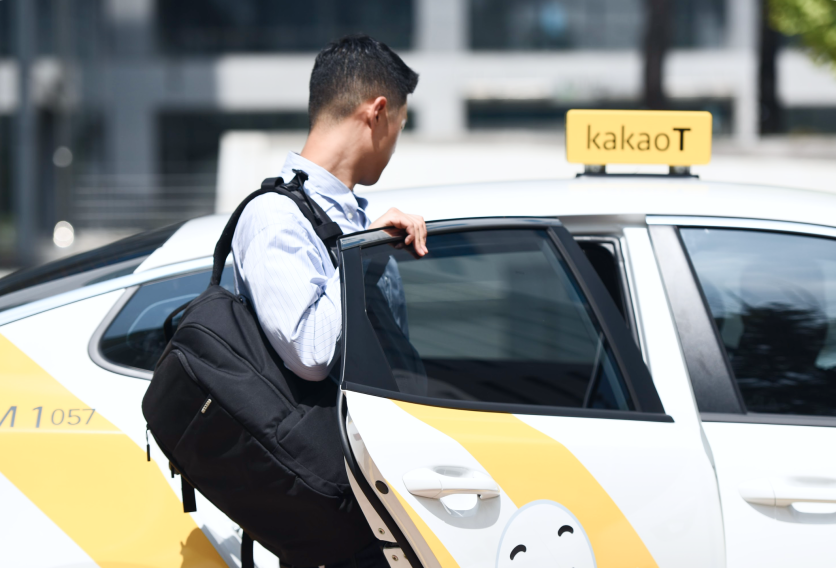
Korea's largest ride-hailing company disclosed Monday that the autonomous taxi it operates in Seoul's Gangnam district achieved an 82.5% vehicle utilization rate — a figure that dramatically outpaces the 44 to 56 percent range that a peer-reviewed study found for Waymo's California fleet — and the edge came not from better sensors or more city infrastructure, but from routing every ride through the Kakao T app that 31 million Koreans already use.
Kakao Mobility CEO Ryu Geung-sun delivered the utilization figure in a keynote address at the 2026 Global Mobility Conference in Seoul on September 7, an annual event co-hosted by South Korea's Ministry of Land, Infrastructure and Transport, the Korea Transportation Safety Authority, and the International Transport Forum under the Organisation for Economic Co-operation and Development — a body with 64 member nations. Ryu argued that the autonomous driving industry had been asking the wrong question. "Autonomous vehicles drive alone," he said, "but autonomous driving services must be built together." The emphasis was not on car intelligence but on what surrounds the car: the fleet management systems, city-level infrastructure, and — above all — the demand-routing layer that determines how many minutes a driverless vehicle spends carrying a paying rider versus circling a block waiting for one.
The economics of any autonomous fleet depend on a single number more than any other: utilization, or the share of vehicle time spent carrying passengers rather than deadheading — driving empty while waiting for a trip. A vehicle that sits idle still consumes depreciation, electricity, maintenance, and cleaning costs. When utilization is low, those costs stack up against a thin revenue base.
Read more: Seoul Triples Gangnam Robotaxi Fleet, Unlocks School Zones for Driverless Operation
Why 82.5% Matters: Solving the Cold-Start Problem
The most detailed picture of this problem in a live robotaxi service comes from a May 2026 study published in MIT's Transport Findings, which analyzed more than 86 million total vehicle miles across approximately 14 million Waymo robotaxi trips in California from August 2023 through December 2025. The study found that 54% of miles were driven empty, with a passenger onboard the remainder, with empty miles ranging between 36% and 56% month-to-month. A separate analysis by Matthew Raifman at UC Berkeley, using California Public Utilities Commission data through September 2025, found that 44% of Waymo's miles were driven empty — and that two-thirds of those empty miles were vehicles waiting to be assigned a rider at all.
The Kakao Mobility figure of 82.5% is not a miles-traveled metric — it measures productive deployment time relative to total available time — but the directional comparison is stark. Waymo has been building demand in mature markets city by city; it has deliberately kept fleets small to concentrate them where demand is densest. Kakao Mobility's solution was architecturally different: it had already won the demand problem years before its first autonomous vehicle turned a wheel.
Ryu disclosed that 97% of users of the late-night Gangnam autonomous taxi service accessed it through the existing Kakao T app, without installing a separate application. That figure is the mechanism. The demand-density cold-start problem that costs Waymo utilization and forced it into a partnership with Uber's existing rider network was, for Kakao Mobility, already solved: it operated Korea's dominant taxi-hailing platform with roughly 98% market share before it deployed a single autonomous vehicle. When Seoul added the autonomous option to Kakao T, existing users — tens of millions of them — were offered the vehicle type as a standard menu option, not a new service requiring new habits. Autonomous vehicles became, in effect, a new taxi category within a platform people already unlocked every night.
How the Technology Works
Kakao Mobility has spent more than eight years building the underlying technical stack for this result. Beginning in 2018, the company deployed a proprietary modular sensor unit it calls the AV-Kit across vehicles collecting real-time urban driving data from Seoul's Gangnam and Pangyo districts. That data fed an AI Data Pipeline that trains and continuously validates the company's autonomous driving models against actual urban conditions — not simulated environments. The "brain" of Kakao's autonomous vehicles, which it calls the AI Planner, is an end-to-end architecture trained on this data: it ingests raw sensor input from the five LiDAR sensors and seven cameras mounted on each vehicle and outputs driving decisions directly, without the intermediate rule-based layers that earlier AV systems relied on.
The vehicles themselves are built on Kia EV6 electric vehicle platforms. Each unit mounts five LiDAR sensors and seven cameras, enabling real-time recognition of other vehicles, pedestrians, and road infrastructure. Kakao has described the AI Planner as specifically tuned for Gangnam's complex urban geometry — dense intersections, irregular lane configurations, high pedestrian traffic — rather than optimized for open-road performance.
This last point is important for understanding the utilization result. Kakao's technology is not designed to operate everywhere; it is designed to operate extremely well in a specific, well-mapped zone where Kakao T demand is already concentrated. That is a deliberate tradeoff: zone-optimized performance at high utilization versus generalist performance across geographies at lower utilization. Wayve, the British AI startup whose vehicles launched in London this month, takes the opposite bet — a "mapless" approach that trains its AI Driver on video data to navigate new environments without pre-built high-definition maps, which it argues should allow faster expansion to new cities. Both approaches have merits and costs, and neither has produced a result as commercially efficient as Kakao's Seoul zone, at least not yet.
What Seoul's Expansion Plans Reveal
Seoul's government announced on August 19, 2026 that it would nearly triple the Gangnam autonomous taxi fleet from seven vehicles to 19 — with SWM operating 13 vehicles and Kakao Mobility operating six — after the service recorded more than 15,000 rides since its September 2024 launch and 6,176 paid rides following a transition to paid fares in April 2026.
The city simultaneously announced that autonomous driving would be extended to all roads within the Gangnam operating zone, including school zones and other areas that had previously required manual takeover — a regulatory change that became possible after a January 2026 revision to the rules governing autonomous vehicles on restricted roads. Seoul also confirmed a further expansion: a Level 4 fully driverless taxi service, without any safety operator present, is planned to begin in the Sangam-dong district of western Seoul in November 2026, which will mark a material regulatory and technical threshold if it proceeds as announced.
At a Level 4 designation under the Society of Automotive Engineers' J3016 classification, the vehicle must manage all aspects of the driving task within its defined operational zone, including handling failure scenarios on its own, without expecting a human fallback. This is meaningfully different from the supervised autonomous rides that Uber and Wayve launched in London on September 3, 2026, where a trained, Transport for London-licensed private-hire driver occupies the vehicle and can take the wheel if needed.
Read more: South Korea Doubles Dedicated Bus Lanes as the Foundation for Autonomous Transit
London's Model Versus Seoul's Model
London became the second European city after Zagreb where Uber offers autonomous rides through its app. Passengers requesting UberX, Uber Comfort, or Uber Electric in London may be matched with one of a small initial fleet — fewer than 20 — of all-electric Ford Mustang Mach-E vehicles equipped with Wayve's AI Driver and surrounding sensors. The ride arrives, unlocks, and operates through the standard Uber app; an interactive screen inside the vehicle shows the planned path.
The parallels with Seoul are real: in both cases, an incumbent ride-hailing app — Uber in London, Kakao T in Seoul — is serving as the consumer interface, eliminating the need for users to adopt a new platform. Uber's global head of autonomous mobility described the London launch as building credibility with consumers and regulators simultaneously.
The differences are also substantial. London's launch is supervised, its fleet is tiny, its vehicles operate under a government trial framework pending full regulatory authorization, and Wayve's AI Driver is a first-generation product in live consumer service. Uber targets facilitating autonomous trips in as many as 15 cities globally by year-end 2026. Kakao Mobility, by contrast, is operating a maturing paid commercial service with a nearly two-year operational record, zero reported accidents, and utilization numbers that suggest the economics are working — not because the technology is superior, but because the demand-routing was solved before deployment began.
Ryu put the point explicitly at the Seoul conference. "Even with the same technology," he said, "changing the city introduces a different 10 percent of challenges." The evaluation metric he proposed was fleet-level rather than vehicle-level: not how well a single car drives, but how hundreds of them are operated within a city. That frame, applied consistently, would shift industry benchmarking from disengagement rates and miles per accident — the metrics Waymo and Tesla publish — toward fleet utilization, city deployment density, and integration depth with existing transportation networks. Those metrics favor operators who started with dominant consumer platforms. They are also the metrics that most directly predict whether a robotaxi service can sustain itself financially.
What This Means for Operators Without Kakao's Headstart
There is a structural caveat to the Seoul result that Ryu's keynote did not foreground, but that the data implies. The 82.5% utilization rate is achievable partly because of the technology, partly because of the city collaboration Ryu described, and substantially because Kakao T already commands approximately 98% of Korea's taxi-hailing market. That incumbent position is not replicable by most entrants, and it came with costs: South Korea's Fair Trade Commission fined Kakao Mobility in 2023 for manipulating its algorithm to favor franchise drivers who paid membership fees, and the company's Financial Supervisory Service issued a fine over accounting irregularities and recommended CEO Ryu step down from his position — a recommendation shareholders rejected.
For city planners and AV operators in markets without an equivalent incumbent, the Seoul model is instructive but not directly transferable. The useful lesson is that platform integration — not city redesign or vehicle technology — appears to be the primary commercial variable. Operators that can plug autonomous vehicles into existing high-volume demand flows will achieve utilization rates that make fleet economics viable; operators that must build demand networks from scratch will face exactly the idle-vehicle cost problem that Waymo's California numbers illustrate.
Ryu acknowledged that city collaboration remains essential even with platform advantages. Autonomous vehicles require infrastructure that did not exist when roads were designed for human-driven cars: communication protocols, traffic signal integration, loading zone designations, and safety rules written for vehicles with no human fallback. Seoul's willingness to redesign those rules — including removing the manual-control requirement for school zones in January 2026 — is part of what allowed the Gangnam service to expand to all roads within the operating zone. The technology and the city evolved together, as he argued they must. But the commercial precondition — demand density sufficient to fill vehicles — came from platform dominance, not from the city.
Frequently Asked Questions
What is a vehicle utilization rate, and why does 82.5% matter for robotaxis?
Utilization rate measures the share of time a vehicle spends actively carrying a paying passenger versus idling or traveling empty between trips. For autonomous vehicles, which incur full depreciation, electricity, and maintenance costs whether or not anyone is inside, high utilization is essential for financial viability. A 2026 study in MIT's Transport Findings found that Waymo's California fleet spent between 36% and 56% of its time driving empty — implying a utilization rate broadly below 60% even in mature markets. Kakao Mobility's 82.5% figure, disclosed at the 2026 Global Mobility Conference, is significantly higher, and the primary reason is that the company routed autonomous rides through Kakao T, an existing platform with approximately 98% of Korea's taxi-hailing market, rather than building demand for a standalone autonomous service.
Can other cities replicate Seoul's result without an incumbent platform like Kakao T?
Not easily, and not through city redesign alone. The Seoul result depends on three factors working together: a proprietary zone-optimized AI driving system tuned for years on Gangnam's urban data, active regulatory collaboration from the Seoul Metropolitan Government, and — crucially — the demand-routing advantage of an incumbent platform with tens of millions of existing users. The last factor is the hardest to replicate. Operators in markets where no single platform commands equivalent ride-hailing market share will need to solve the demand-density cold-start problem that Seoul effectively bypassed. Uber's partnership with Wayve in London, and Waymo's partnership with Uber in several US cities, both reflect the same recognition: autonomous vehicle operators without dominant consumer platforms need a demand aggregator to achieve competitive utilization.
Is London's new Uber-Wayve service the same as Seoul's Kakao autonomous taxi?
Superficially similar, but structurally different at several key points. Both route autonomous rides through an existing mainstream app. But the London service, launched September 3, 2026, is supervised — a trained, Transport for London-licensed private-hire driver remains inside each vehicle and can take over the controls. Seoul's Gangnam service currently also operates with a safety operator, but Seoul has announced it will introduce fully driverless Level 4 operations in the Sangam-dong district as early as November 2026, with no human fallback required. Wayve's AI Driver also takes a different technical approach than Kakao's system: Wayve trains its model to navigate without pre-built high-definition maps, which it argues allows faster expansion to new cities, while Kakao's system is deeply optimized for a specific zone using years of local data.
What happens to the Seoul fleet next?
Seoul tripled its Gangnam fleet to 19 vehicles in August 2026 and extended autonomous driving to all roads in the operating zone, including school zones and protected areas. The planned next step is a Level 4 fully driverless service — no human safety operator — in Seoul's Sangam-dong district, expected to begin in November 2026. That launch, if it proceeds as announced, will be the first service of its kind in Korea and one of the earliest in the world to remove the human safety operator from a live commercial service operating in dense urban traffic.

-
 C114 Communication Network
 -
 Communication Home
