
 Search

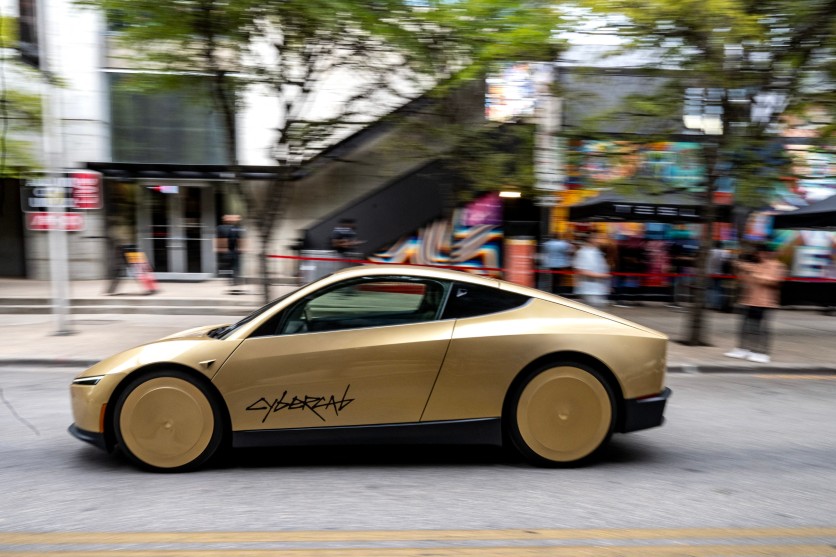
A Tesla's "Cybercab" rides in downtown Austin, Texas, on September 3, 2026. Tesla is launching the "Cybercab" which is a taxi with no steering wheel or pedals, designed purely for autonomy. RONALDO SCHEMIDT/AFP via Getty Images
Tesla has brought its Cybercab robotaxi to Japan for the first time, staging a multi-city public showcase across Tokyo, Nagoya, and Osaka just days after the vehicle began carrying paying passengers in Austin, Texas — and hours after the US federal auto safety agency opened a formal investigation into whether the car legally qualifies for American roads. The Cybercab Japan Tour, announced by Tesla Japan September 5, spans four venues across Japan's three largest metropolitan regions and follows a now-familiar Tesla playbook: get the most futuristic vehicle in front of audiences while commercial deployment remains years away.
The timing is deliberate. On September 3, Tesla launched its Cybercab in Austin — the first commercial driverless vehicle deployment by a major automaker in the US. That same afternoon, the National Highway Traffic Safety Administration filed Audit Query AQ26002, targeting approximately 1,000 Cybercab vehicles and asking a question that will shape the future of every autonomous vehicle company operating in America: when a car has no steering wheel, no pedals, and no mirrors, which Federal Motor Vehicle Safety Standards still apply?
Tesla's self-certification gamble is now under federal examination. Rather than applying for the formal Part 555 exemption that Amazon's Zoox spent four years navigating — ultimately receiving commercial clearance on July 30, 2026, with a 2,500-vehicle annual cap attached — Tesla certified the Cybercab directly under existing FMVSS, arguing that standards written for human-driver controls simply do not apply to a vehicle built without them. NHTSA's audit will determine whether that legal logic holds.
Built From Zero for Zero Drivers
The Cybercab is unlike anything Tesla has shipped before. Every previous Tesla — Model S, Model 3, Model Y, Model X, Cybertruck — was designed with a human driver in mind, its autonomy features layered on top of a conventional cockpit. The Cybercab reverses that logic entirely. Its two-passenger cabin has no steering wheel, pedals, or mirrors — hardware that Tesla says a vehicle never meant to have a human operator simply does not need.
Entry and exit happen through upward-swinging butterfly doors. The cabin's dominant feature is a 20.5-inch center touchscreen, the largest ever fitted to a Tesla, for passengers to watch content or track their route. The vehicle cannot be manually driven; there is no provision for it.
The technical underpinning is Tesla's camera-only Full Self-Driving architecture. Eight high-definition cameras feeding an end-to-end neural network — running on the same AI 4 computing hardware used in the current Model 3 and Model Y — handle perception, planning, and control entirely from visual input. There is no LiDAR. There is no radar. This is not a cost-cutting compromise for Tesla: it is the company's stated conviction that sufficiently large visual datasets, processed by a sufficiently capable neural network, replicate and eventually surpass the spatial awareness that active sensors like LiDAR provide.
The debate within the autonomous-vehicle industry over whether that conviction is correct remains live. Rivian, which is adding LiDAR to its vehicles in 2026, has put its position bluntly: cameras are passive light sensors that struggle in night conditions, fog, and rain in ways that active lidar sensors do not. Uber CEO Dara Khosrowshahi has publicly called camera-only systems "going to be very difficult" to build in the near term. Waymo, Tesla's most direct robotaxi competitor, uses a sensor fusion approach — LiDAR plus cameras plus radar — and as of September 2026 is operating in eleven US cities with all vehicles retaining traditional steering wheels and pedals.
Tesla's counter-evidence is its fleet data. The company says its global fleet has accumulated more than 22.5 billion kilometers of assisted-driving mileage, with the amount of training data added each day equivalent to roughly 500 years of continuous driving. Tesla's published FSD safety data shows 7x fewer major and minor collisions than human drivers. These figures come from Tesla and have not been independently verified by a third party.
What the EPA Numbers Actually Say
The technical specification the Cybercab launched with is confirmed by EPA certification documents filed in May 2026. The Cybercab is a front-wheel-drive electric vehicle — the first in Tesla's history — powered by a single 163-kilowatt (219-horsepower) AC permanent magnet motor. It runs on a 326-volt electrical architecture with a lithium-ion battery pack rated at approximately 47.6 kilowatt-hours, giving it a curb weight of 3,113 pounds (1,413 kilograms), roughly 750 pounds lighter than the Model 3 Standard Range.
In EPA laboratory testing, the Cybercab posted an unadjusted combined range of 418 miles (673 kilometers). Applying the EPA's standard real-world correction factor yields an estimated range of approximately 280 to 293 miles (450 to 472 kilometers) under normal driving conditions. Tesla's VP of Vehicle Engineering Lars Moravy confirmed 165 watt-hours per mile, a figure the company claims makes it the most efficient production EV ever built.
The engineering choices behind those efficiency numbers are deliberate. The Cybercab is said to contain roughly 50% fewer parts than the Model 3 — a simplification made possible by eliminating the entire driver-control system and designing for autonomous operation alone. It is engineered for wireless inductive charging, removing the need for a plug, and for automated interior cleaning, features essential for a fleet vehicle that needs to run close to around the clock without a human owner managing it.
Volume production began at Gigafactory Texas in April 2026, using Tesla's Unboxed manufacturing process, which builds large sub-assemblies simultaneously in parallel rather than sequentially on a traditional linear assembly line. Tesla says this radically simplifies assembly and is central to its long-term production cost ambitions. The first Cybercab came off the Gigafactory line on February 17, 2026.
What NHTSA Is Actually Asking
The Audit Query AQ26002 is not a defect investigation. NHTSA is not alleging the Cybercab has malfunctioned or hurt anyone. What the agency is examining is the legal logic Tesla used to self-certify the vehicle as compliant with Federal Motor Vehicle Safety Standards — the decades-old body of rules written by Congress and NHTSA to govern vehicle safety before any automaker deploys a car commercially in the US. The full AQ26002 filing is publicly available on NHTSA's website.
FMVSS rules were written for human-driven vehicles. Many of them — the steering-column crash-performance standard, the driver-airbag deployment requirements, the mirror-placement standard, the brake-pedal force standard — presuppose that a human being is sitting in a specific position at the front of the vehicle with hands on a wheel. The Cybercab has none of those things. Tesla notified NHTSA that it certified the Cybercab as compliant with all applicable FMVSS, and NHTSA's audit query will examine the process and data Tesla relied upon to determine which standards it considered "inapplicable" to a vehicle with no driver.
NHTSA Administrator Jonathan Morrison framed the agency's position carefully: "NHTSA fully supports the safe development and deployment of automated vehicles. But as the federal regulator, we need to ensure that all of our laws are followed," according to NHTSA's press release.
The significance extends far beyond Tesla. This audit is the first formal federal examination of whether the existing FMVSS framework is structurally compatible with a Level 4 autonomous vehicle deployed at commercial scale. Its resolution will set a legal precedent for every other AV company — Waymo, Zoox, Cruise, Motional — that intends to operate fully driverless vehicles in the US. Notably, Zoox (Amazon's AV subsidiary) obtained a formal Part 555 exemption from NHTSA in late July 2026; Tesla did not apply for an equivalent exemption, choosing instead to self-certify under the existing framework. That decision is now under a federal microscope.
Tesla has 420 autonomous vehicles registered in Texas, including 45 Cybercabs and a larger number of Model Y crossovers that carry safety monitors. Rival Waymo maintains 988 registered vehicles in the state, all of which retain steering wheels and pedals.
Read more: Tesla's 'Zero At-Fault' Robotaxi Record Rests on Unverified Self-Reports
Japan: Display, Not Deployment
Japan's public can see the Cybercab in September 2026. They cannot ride it, and there is no timeline for when they could.
The four tour venues span Tokyo, Nagoya, and Osaka, and Tesla Japan says the Cybercab will be displayed alongside its existing Model 3 and Model Y lineup. Specific venue dates and opening hours will be published on Tesla's Japanese website and official X account; the press release notes that schedules are subject to change due to weather or venue conditions.
That "display only" framing reflects Japan's actual regulatory position. Japan's 2022 Road Traffic Act amendment created a permit system for Level 4 autonomous operation — vehicles with no human driver — but only for remotely monitored transport services, and only with permits granted by local public safety commissions. Tesla has not applied for any such permit. There is no indication it plans to.
Beyond the legal framework, Japan presents operational challenges that go beyond paperwork. Japan's urban road environment — dense intersections, narrow streets, heavy pedestrian and bicycle traffic, complex signage — is among the most demanding in the world for autonomous systems. Japan also drives on the left, on roads engineered for right-hand-drive vehicles. The current Cybercab is designed for and deployed in a left-hand-drive, right-side-of-road country. Any commercial deployment in Japan would require a right-hand-drive variant. Tesla has confirmed Cybercab will appear in display-only events in Beijing, Shanghai, and other Chinese cities from mid-September 2026, suggesting the Japan tour is the opening of a coordinated global awareness campaign rather than a prelude to commercial operations in any of these markets.
The Japan automotive market is the world's third largest, and Tesla's market share there has historically been low. Elon Musk noted in a shareholder Q&A that Japan was an example of a market where brand awareness was "remarkably low." The Cybercab, like the Cybertruck before it — which toured Japan in early 2024 — is being used as a brand-building instrument in a market where the company has yet to establish the consumer relationships that would underpin a future commercial service.
Can You Ride a Cybercab Today?
As of September 7, 2026, the answer is yes — if you are in Austin, Texas. Paid public Cybercab rides began on September 4, 2026, through Tesla's Robotaxi app, operating in a limited zone within the city. Tesla has indicated the service will expand toward 24/7 operations within the "next month or so," though no formal announcement has confirmed a specific date.
Tesla says operating costs could fall to $0.20 per mile at scale — a figure supported, in theory, by the two-seat layout, the vehicle's exceptional energy efficiency, driverless operation eliminating labor costs, and the Unboxed manufacturing process lowering unit costs. Tesla has also said it is exploring selling Cybercabs to third-party fleet operators, which could dramatically accelerate deployment beyond its own ride-hailing network. The company has publicly targeted producing two million Cybercabs per year at full rate, roughly one vehicle every ten seconds.
Whether those ambitions survive regulatory contact — in the US or anywhere else — is the open question that the NHTSA audit will begin to answer.
Frequently Asked Questions
Will the Tesla Cybercab be available to ride in Japan?
Not yet, and not soon. The Cybercab Japan Tour is a public display event, not a commercial service. Japan's 2022 Road Traffic Act allows Level 4 autonomous vehicles to operate commercially only under permits from local public safety commissions, which Tesla has not applied for. Operational challenges — narrow urban roads, left-side traffic, and the engineering requirement for a right-hand-drive variant — add to the regulatory gap. Commercial Cybercab deployment in Japan is likely years away, dependent on successful US operations and regulatory evolution in Japan.
How does Tesla's camera-only self-driving system work, and why don't they use LiDAR?
Tesla's Full Self-Driving architecture uses eight high-definition cameras feeding an end-to-end neural network: raw camera images go in, and steering, acceleration, and braking commands come out, without the system constructing an explicit 3D map of the environment. Tesla removed radar from its vehicles in 2021 and ultrasonic sensors in 2022. The argument is that human beings navigate the world using vision alone, and that a sufficiently trained neural network processing enough real-world camera footage can replicate that capability more cheaply and at greater scale than sensor fusion approaches. LiDAR-based competitors like Waymo counter that cameras are passive sensors that struggle in darkness, fog, and rain in ways that active laser sensors do not — a debate that the Cybercab's Austin deployment will generate data to inform.
What is the NHTSA investigation into the Cybercab, and should Austin riders be concerned?
NHTSA's Audit Query AQ26002 is a formal paperwork examination, not a defect investigation triggered by an accident or injury. The agency is asking Tesla to demonstrate the legal reasoning and technical data it used to self-certify the Cybercab as compliant with Federal Motor Vehicle Safety Standards — many of which were written assuming a human driver and thus may not apply to a vehicle with no wheel, no pedals, and no mirrors. NHTSA is not ordering a halt to Cybercab operations. The audit's significance is structural: it is the first federal examination of whether FMVSS as written is compatible with commercial Level 4 autonomous vehicles, and its outcome will set a legal precedent affecting the entire AV industry.
How efficient is the Cybercab compared to other electric vehicles?
The Cybercab achieved 165 watt-hours per mile in EPA certification testing, which Tesla claims is the highest efficiency ever recorded for a production electric vehicle — better than the Lucid Air Pure, previously considered the efficiency benchmark. Its compact 47.6 kilowatt-hour battery and lightweight 3,113-pound (1,413-kilogram) curb weight contribute to that figure. For comparison, a standard Tesla Model 3 rear-wheel-drive carries a larger battery pack and weighs roughly 750 pounds more. The tradeoff is range under real-world conditions: estimated at approximately 280 to 293 miles (450 to 472 kilometers), meaningfully less than the unadjusted 418-mile (673-kilometer) figure from EPA lab testing.

-
 C114 Communication Network
 -
 Communication Home
